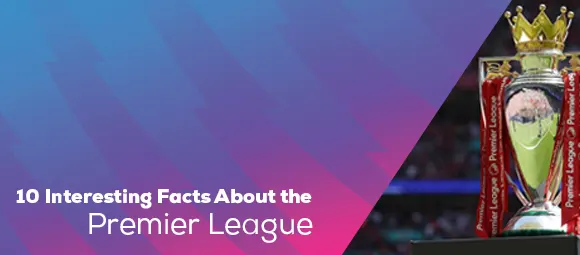

From muddy pitches and rattling terraces to the TV trends and TikTok edit reels of today, English Club football has gone through multiple wild transformations. For most of the 20th Century, the top tier was simply the Football League First Division that was run by the Football League. Then, in 1992, the most prominent clubs broke away to form the FA Premier League, which was funded on the backs of new satellite TV money and a new commercial model.
Over time, the League picked up its first big sponsor, first Carling, then Barclaycard, and finally Barclays, under which most of the world came to know it globally as the Barclays Premier League. From the 2016-17 season onward, the league dropped its title sponsorship altogether to build a clean global brand, renaming the league simply the Premier League.
Below are 10 of the most interesting and obscure facts from the four phases of this journey: the old First Division, the early Premier League years, the Barclays era and the modern ‘clean’ brand Premier League era. To attend fixtures like this, book your Premier League football tickets via 1BoxOffice for the best deals at reasonable prices.
Old Division Era - Before 1992
1. A Breakaway League… That Left its History Behind
When the 22 First Division clubs resigned en masse in protest in 1992 to form the Premier League, they did not technically ‘rebrand’ the old league; instead, they created a new competition with its own governance and commercial rights. The First Division continued under the Football League as the second tier, eventually becoming the Championship in 2004.
This means that many English top-flight records before 1992 officially belong to a different competition, or as the fans of Twitter would have you believe, ‘they do not exist or don’t matter’. So when broadcasters talk about Premier League records, they often start in 1992-93 and quietly ignore more than a century of First Division history. That’s why, for example, some legendary goal tallies or title streaks from the 1960s or the 70s don’t appear in official Premier League stats, a quirk that annoys the old-school fans who grew up before the Super Sunday and Sky Sports era.

2. Countries That Vanished Between the First Division and the Premier League
Here is a wonderful trivia nugget: there were players with nationals that played in the old First Division but never appeared in the Premier League, usually because the countries themselves no longer exist according to The Guardian.
For instance, the Soviet Union and Yugoslavia both produced players who went on to play in the First Division, such as Sergie Baltacha at Ipswich Town and Raddy Antic at Luton Town, long before 1992. After those states dissolved, their successors (Russia, Serbia, Croatia, etc.) did feature in the Premier League, but the original ‘USSR’ or ‘Yugoslavia’ nationality never appears in the Premier League stats.
There were curiosities like a Hong Kong international in 1961 with Cheung Chi-doy at Blackpool, or Jack Butler, born in Colombo (modern-day Sri Lanka), at Arsenal in the 30’s. These players are part of the top-flight English history.

3. Promotion to a League That Didn’t Exist Yet
Another oddity from the 1992 league change is that clubs were promoted to a league that technically didn’t exist yet at the start of the season. The 1991-92 First Division campaign began as usual, but behind the scenes, the big clubs were negotiating the breakaway. By the time Leeds United won the title in April 1992, the Premier League was already in motion.
From the start of 1992-93 as stated in the EPL official website, the First Division became the second tier, and promotion meant going up to the Premier League instead of the old top flight. There was a sense of discontinuity among the fans that is still being joked about with memes and videos more than three decades later.
Early Premier League/ The “Carling” Era - 1992-2001
4. First, There Were 22, Now There are 20
We are used to a 20-club Premier League now, but when the league began, there were 22 clubs. The slimming only happened in 1995-95, after the official body FIFA demanded that top European divisions play fewer fixtures.
To facilitate this, four teams had to be relegated, two from the Premier League to the First Division and two from the First Division to the Second Division, the then third tier. This is why, according to the Football History Website, there were many quirky one-season stories in the earlier years, when clubs like Oldham Athletic and Wimbledon appeared in the Premier League, though most newer fans, this writer included, have never even seen them at the top level.
5. The First TV Deal Considered Wild, Tiny in Hindsight
The Premier League’s origin story is inseparable from satellite TV money. The first broadcast deal with BSkyB (now Sky Sports) was worth 304 million pounds over five years, a staggering sum in the 1990s and the biggest in British sport at the time.
Traditionalists were horrified: live top-flight games moved almost entirely behind a paywall, breaking with decades of free-to-air culture. Yet that money funded better facilities, higher wages, new foreign signings and the beginning of the Premier League’s global expansion. What was once a controversial gamble has become the prototype engine for a sporting empire now worth billions with a capital ‘B’, and the original 304 million pounds seems like a small amount in comparison.

6. The First Premier League Champions Started the Season Awfully
Everyone remembers that Manchester United dominated the early years of the Premier League, but their title-winning campaign in 1992-93 actually began in surprisingly shaky fashion. United took just one point from their first three games, continuing a slight wobble from the end of the old First Division era.
Alex Ferguson was already under pressure after narrowly missing out on the 1991-92 title to Leeds United. It took a few years for the Red Devils to usher in a confident new dawn after signing Cantona from Leeds; from then on, as reported in The Analyst, Manchester United embarked on a rapid ascent, with multiple consecutive wins.
The Modern Era - Barclays (2001-2016) and the Rebranding (2016- Present)
7. Match Attax: The Kids’ Card Game that became a global phenomenon
One of the most influential products of the Barclays era wasn’t a boot, a ball or a TV show; it was a trading card game. In 2007, Topps launched Match Attax, officially licensed Premier League cards designed for kids to collect and play with. Within a few years, it had become the best-selling boys’ collectable in the UK and the world's biggest-selling sports trading card game.
For a generation of younger fans, knowledge of squad players, their numbers and even obscure transfers came not from Match of the Day but from schoolyard swaps and rare holographic cards. This became such a cultural phenomenon that it still exists in a form in the EA Sports PC game FIFA in the Ultimate Team multiplayer mode.

8. Dropping the Title Sponsor to Look Less Corporate.
In 2015, the Premier League announced it would drop title sponsors from 2016-17 onward, ending the Barclays era and moving to a US-style model with multiple official partners but no name in front of the competition. The goal, according to ESPN, was to make the EPL a brand in itself, like the NFL and the NBA.
The rebrand went beyond the logo, the lion’s head crest was simplified, the colours brightened, and the league’s marketing deliberately shifted towards fans, communities and global inclusivity rather than boardroom gloss. Ironically, by trying to be less corporate, they became more inclusive in the corporate world, with brands like Coca-Cola and Cadbury becoming category partners rather than title sponsors.
9. Off-Pitch Sponsorship Has Become a Story in Its Own Right
In the modern era, shirt sponsors and sleeve sponsors generate almost as many headlines as news signings. Take Chelsea: as of the 2025 season, they’ve had long spells without a front-of-shirt sponsor, which is an unusual situation for the global super club, according to The Sun.
This was not just an aesthetic quirk; with the Premier League phasing out front-of-shirt gambling sponsors after a government-backed review, clubs are scrambling to lock in long-term, non-gambling deals worth 60 to 65 million pounds per year. For fans, this was an odd kind of meta-drama; you might buy a shirt in August with a blank front, only for a new logo to appear in October, showing how commercial pressures now sit right on the surface of the match-day experience, literally printed across the chest of your favourite player.
10. The Global Reach Now Shapes Who Plays and Who Doesn’t
Today’s Premier League has players from over 120 countries, with new nations still making their debuts. Still, the same global gravity creates a strange side effect. Some countries are ‘locked out’ not because there is no talent, but because of work visa and permit rules, along with the fundamental economic problems of scout networks and transfers.
The league is both a destination and a filter shaping football culture, with trends visible to the world each weekend, from the parochial, mostly British First Division of the 1970s, to a reminder that the Premier League is as much a global entertainment product as it is a domestic competition.
Always Moving, Always Premier
From breakaway paperwork in 1992 to global card games, sponsorless branding and nationality trivia, the Premier League has an interesting story with hidden corners and obscure facts. Scratch beneath the covers and be part of the inside club, be part of the journey by booking your tickets for these matches via 1BoxOffice for genuine tickets with a 150% money-back guarantee.
لماذا تحجز معنا؟
- ضمان استرداد 150٪!
- موثوق به من قبل مشجعي كرة القدم منذ عام 2006
- تذاكر موثوقة من بائعين موثوقين
- خدمة العملاء على مدار 24 ساعة طوال أيام الأسبوع
مواقع التواصل الاجتماعي