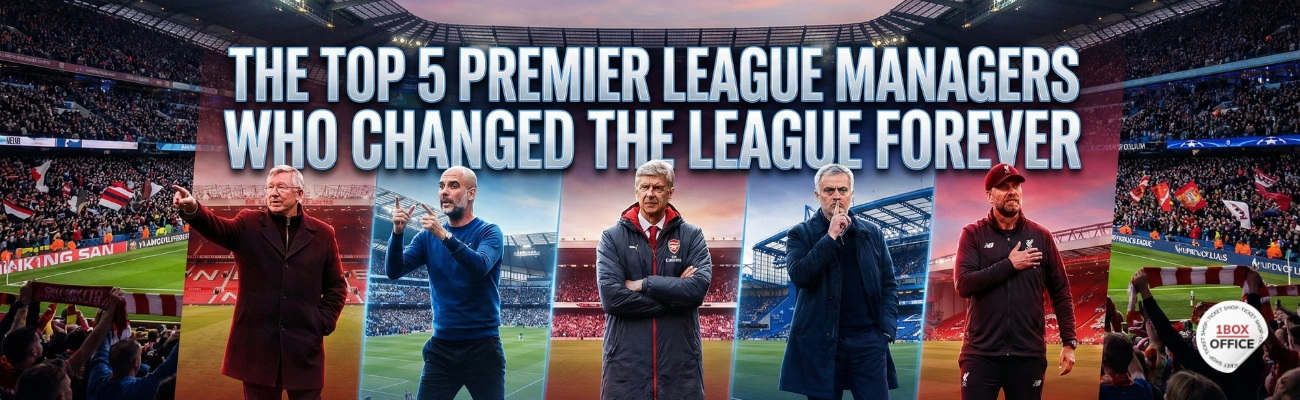

Since 1992, hundreds of managers have taken a seat in the Premier League dugout, with all of them being the cream of the crop. Among these managers, only a handful have had an impact that rewired how the game was played in the league, changing how English football is played, trained, scouted, watched and even talked about.
If you strip away any tribal pub talk bias and look at trophies, tactical evolution and long-term influence, there are only five names that tower over the rest, and what a legacy these five have left over English football and even the world. The five managers are:
In this article, we will go manager by manager and unpack how each of them changed the Premier League, not just who they beat or what they won
When the world hears EPL, the first thing that comes to mind is Manchester United and Alex Ferguson; that’s how synonymous Fergie is to the Devils. While this is the case now, what most newer fans don’t know is that when the Premier League was born in 1992, the local Scottish star manager from Aberdeen was already at United, and under a lot of pressure.
He used that pressure and turned the club into his personal empire-building project. He won the inaugural Premier League title in 1992-93, ending United’s 26-year wait for a championship and making them the first champions of the new competition. As per the United website, over the next 20 years, he added title after title, finishing with a record 13 Premier League championships for United between 1992-93 and 2012-13.
1. The idea of a “super-club dynasty” in the Premier League
Ferguson didn’t just win, he normalised 90+ point title races, repeated three-in-a-row runs (the only English manager to win three titles back to back) and the idea that one club could dominate a supposedly hyper-competitive league for decades.
United under Ferguson also set a benchmark in Europe: two Champions League wins (1999, 2008), plus repeated deep runs, created a template for a Premier League club that simultaneously contended domestically and in Europe every year. That bar is the one Guardiola, Klopp, and others have been measured against.
2. The modern English “big club” model
Ferguson’s United were among the first in England to fully blend:
He also imposed a clear internal culture - standards on time-keeping, fitness, professionalism and behaviour that players still talk about today. That culture has become the blueprint for any elite Premier League club trying to rebuild, and United's struggles since his retirement underline how unique that centralised authority was, The Guardian writes.
3. The tactical baseline everyone else had to beat
Ferguson wasn’t a “system coach” in the Guardiola sense, but he mastered the evolution of English tactics across three decades:
By constantly rebuilding squads and styles, he made “continuous evolution” the expectation at a big club. That idea, you never stand still, is now baked into Premier League thinking.
If Ferguson defined the first 20 years of the Premier League, Pep Guardiola has defined the last ten. When he arrived at Manchester City in 2016, there were doubts about whether his possession-heavy style would work in English conditions. According to the Premier League website, his first season ended trophyless and 15 points behind Chelsea.
The response was brutal. In 2017-18, City became the first team in English top-flight history to reach 100 points in a season, winning 32 games and scoring 106 goals, breaking records for most wins, goals and points. Guardiola followed that up with 98 points in 2018-19 and has now won six Premier League titles with City, plus a historic treble, including City’s first Champions League in 2022-23.
1. The tactical language of the Premier League
Pre-Guardiola, English punditry talked about “4-4-2 vs 4-3-3, playing two strikers, and putting it in the mixer.” After Guardiola, even casual viewers talk about:
Detailed tactical analysis of City’s 2017-18 side shows how Guardiola used strict spacing, overloads and quick circulation to create high-quality chances while retaining control. Within a few years, rival managers began copying elements: full-backs tucking in, centre-backs stepping into midfield, wingers staying wide to stretch the pitch. You can argue about who executes it best, but the whole league’s tactical baseline shifted closer to Pep’s model.
2. The “90-plus points or you lose” title race
Guardiola’s City have normalised the idea that to win the Premier League, you may need 95+ points, effectively turning a 38-game season into a sprint with almost no margin for error.
Jonathan Wilson pointed out in 2020 that Guardiola’s City and Klopp’s Liverpool have forced each other to sustain absurd standards just to stay in the race. As The Guardian stated, pressure has reshaped squad-building: deeper benches, more rotation, and micro-managed fitness cycles.
3. Training and detail are the main competitive edge
Accounts from City and from previous clubs consistently highlight Guardiola’s obsessive attention to small details, body shape, passing angles, distances between lines, as the source of his team’s consistency.
In the Premier League context, that’s pushed rivals towards data-rich, detail-obsessed coaching environments. Recruitment now targets players who can thrive under this level of tactical instruction; the old stereotype of “just letting talent play” at the top level is effectively dead.
When Arsène Wenger arrived at Arsenal in 1996, the English media’s reaction was basically:” Arsène who?” He left as a three-time Premier League winner, the architect of the Invincibles, and arguably the man who dragged the entire league into the modern era.
Wenger became the first foreign manager to win the Premier League + FA Cup double in 1997-98, repeated the feat in 2001-02, and then delivered the iconic unbeaten league title in 2003-04, going 38 games without defeat. Arsenal ultimately set an English record of 49 consecutive league games unbeaten.
1. Nutrition, conditioning and the end of “beer and burgers”
Multiple players from the 1990s Arsenal squad have spoken about the shock of Wenger’s methods:
The official Arsenal history notes that he transformed the club through innovations in nutrition, training methods and global scouting, as stated by the official Arsenal website. Within a few years, other Premier League clubs were forced to copy those practices just to keep up. Wenger didn’t invent sports science, but he made it non-negotiable in England.
2. The foreign manager and global squad model
Wenger’s success opened the door for other foreign coaches by proving that an outsider could understand and dominate English football. His recruitment of Vieira, Henry, Bergkamp, Ljunberg, and Pires also accelerated the globalisation of Premier League squads, blending French, Dutch, African and South American talent into a cohesive team.
The modern cosmopolitan Premier League, where a dressing room can include 10-15 different nationalities, owes a lot to Wenger’s early willingness to trust foreign stars and build around them.
3. Technical, possession-based football as an identity
Wenger’s Arsenal sides of the late 1990s and early 2000s played a quick, technical possession game in an era still dominated by 4-4-2, long diagonals and aerial battles.
The Invincibles combined that flair with toughness, an unbeaten season in a league that routinely allowed heavy challenges. According to The Sun, their style inspired a generation of players and fans who came to see the Premier League as a home for sophisticated attacking football, not just blood-and-thunder.
In many ways, Wenger laid the groundwork for Guardiola and Klopp: he proved that the English game could be reshaped by ideas from continental Europe rather than by local tradition.
When José Mourinho walked into his first Chelsea press conference in 2004, he announced himself as a “Special One”, and then spent two seasons proving it. After winning the Champions League with Porto, he took over a wealthy but underachieving Chelsea side in Roman Abramovich’s second year of ownership.
In 2004-05, his first season, Chelsea won their first league title in 50 years, collecting 95 points, winning 29 of 38 games, and conceding just 15 league goals with 25 clean sheets, defensive records that still stand. As the Premier League website states, he retained the title in 2005-06 and added another Premier League crown on his return in 2015-15.
1. Defence and structure as a prestige weapon
Mourinho’s first Chelsea side didn’t just defend well; they made defensive organisation glamorous. The 2004-05 team remains the benchmark for goals conceded and clean sheets in a Premier League season.
When Wenger was associated with attacking fluency, Mourinho normalised the idea that a big club could be admired and revered, for their defensive clock, compactness and ruthless counter-attacks. Tactical analyses of that Chelsea highlight their rigid two-banks-of-four, intelligent pressing triggers and deadly transitions, which many see as a tactical revolution in English football.
2. The psychological era: mind games and siege mentality
Mourinho also introduced a new level of media and psychological warfare. He routinely used press conferences to:
Former captain John Terry recently described how Mourinho’s family-friendly, tight-knit culture at Cobham, including letting players’ kids attend Sunday warm-downs, created extraordinary loyalty and togetherness. That combination of off-pitch charisma, on-pitch structure and internal siege mentality has been widely copied (with mixed success) by later coaches.
3. The modern “super-club” arms race
Mourinho’s instant success, title in his first Premier League season, is still a rare feat, plus Abramovich’s spending forced rivals like United, Arsenal, and later City to accelerate their own recruitment and infrastructure.
In many ways, Mourinho’s Chelsea were the first fully-formed oil-backed super-club in England: big fees, big wages, big personalities, big trophies, and a manager able to handle all of it. The current landscape of state-backed or billionaire-owned giants owes a lot to that early 2000s Chelsea template.
Jürgen Klopp arrived at Liverpool in October 2015, promising to turn “doubters into believers.” He left in 2024, having delivered the club’s first title in 30 years (2019-20), a Champions League (2018-19), and a playing style that forced the entire Premier League to rethink pressing.
Liverpool’s 2019-20 league win wasn’t just a feel-good story; they stormed to the title with 99 points, winning 26 of their first 27 games and effectively ending the race by February, as per The Guardian.
1. Gergenpressing as the league’s new default aggression level
Klopp popularised his version of heavy metal football gergenpressing in the Premier League. The tactic is the idea that the best playmaker is the ball you win back immediately after losing it. According to The Medium at Dortmund, he had already used this approach, and tactical writers were analysing his pressing variations years before he landed at Anfield.
At Liverpool, UEFA-licensed coaches and club analysts have broken down how his teams:
The net result: a style of play that suffocated teams. Opponents were either forced to copy elements of the approach or find new ways to play through it, making pressing intensity and transitional organisation central to every top team’s identity.
2. Emotional culture and the “big club as cult”
Klopp also re-framed what a big-club manager could be:
This wasn’t just theatre. Writers tracking his tenure note how he reconnected a fractured fanbase and squad, turning Anfield into a genuine home-field advantage again and making players feel part of something bigger than their contracts.
That emotional authenticity has influenced how supporters judge managers elsewhere: cool tactical competence is no longer enough; there’s an expectation of clear identity, connection and narrative.
3. Pushing Guardiola to his limits - and vice versa
The Klopp-Guardiola rivalry in England - 90+ point seasons, Champions League knockouts, title races decided by a single point- has been central to the Premier League’s recent global appeal.
Analysts like Jonathan Wilson have noted that Liverpool’s pressing and transitional control forced City to become even more precise with the ball, while City’s positional play forced Liverpool to refine its possession structure. In other words, Klopp didn’t just change Liverpool; he changed what Guardiola’s City had to be and raised the standard for any contender in the league.
There’s no single, mathematically correct answer, but each of them reshaped a different layer of the league. They traced the Premier League’s journey from high-tempo, occasionally chaotic 1990s football to the hyper-coached, tactically dense, globally watched product it is today. If you remove any of these five from the story, the Premier League looks completely different. Want to attend future EPl fixtures? Book your tickets via 1BoxOffice for genuine tickets with a 150% money-back guarantee.
مواقع التواصل الاجتماعي
ابق على اطلاع بآخر تحليلاتنا


The History of the FA Cup Told Through 10 Forgotten Players
Discover 10 forgotten heroes, from Victorian icons to modern underdogs, whose untold stories and iconic goals defined over 150 years of FA Cup history.


Champions League Knockout Play-offs Draw 2025/26 Explained: Tickets, TV Guides, Winners and Losers of the Draw
Eight two-legged ties will decide who joins the Round of 16, where the league-phase top eight are already waiting. The new Champions League format doesn’t just determine who qualifies, it also shapes the path (and limits the number of possible opponents) much earlier than before.


أعظم نادٍ في إنجلترا: مقارنة شاملة بين الأندية بناءً على عدد الألقاب التي فاز بها كل منها.
من هو حقاً أكبر نادٍ في إنجلترا؟ إذا سألت عشرة مشجعين، فستحصل على أحد عشر إجابة، وستكون الإجابات بصوت عالٍ، بل وقد ينتهي الأمر بشجار في الحانة في نهاية هذه المناقشة.
انضم الآن للوصول إلى عروض لا تُضاهى وتحديثات المباريات والعروض الحصرية.