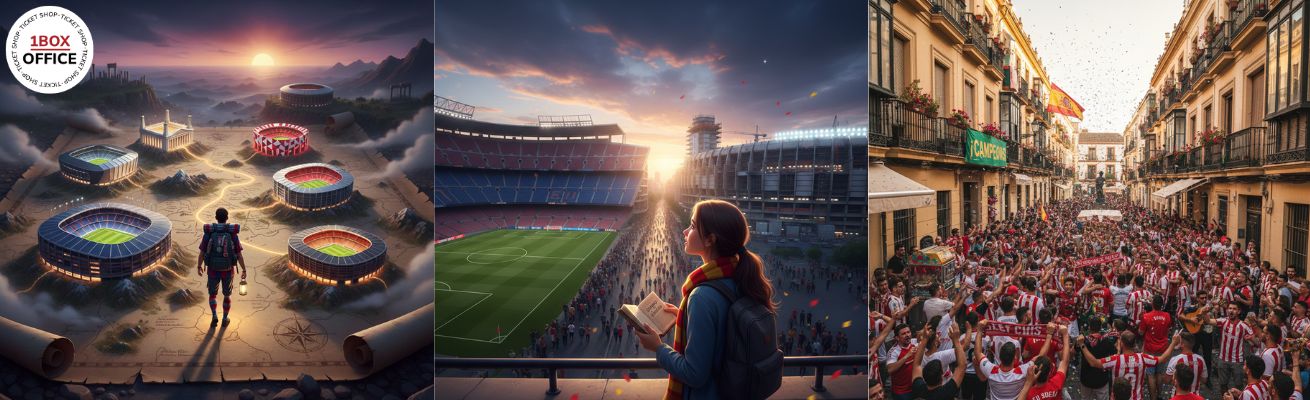
Football in Spain is not just a weekend getaway, it is woven into the national fabric of the country. From the grant opening whistle to the final one, matchday is an experience loaded with emotion where fans fill the streets with chants and scarves, then pack the stands to share a welcoming yet intense atmosphere.
For many supporters, visiting Spain’s legendary stadiums is like a pilgrimage. Whether you are an FC Barcelona supporter or a Madridista, it is impossible not to pay a visit to the iconic football ‘cathedrals’ in Spain. Here are seven must-visit Spanish Stadiums that are a living piece of football heritage, drama, and culture.
The colossal Camp Nou has been home to FC Barcelona since its inauguration on 24 September 1957. Conceived to accommodate the ever-growing Barca crowds, it is undergoing renovation to become the largest stadium in Spain, with 105,000 seats.
Over the decades, Camp Nou has hosted historic games such as the 1982 World Cup opener and two European finals in 1989 and 1999, etc. Legends like Johan Cruyff, Diego Maradona, Lionel Messi, Rivaldo, Ronaldo Nazario, Romario, Xavi Hernandez, Andres Iniesta, etc. have played in front of 90,000+ fans over the decades.
Fans here create a buzz unique to the Camp Nou by singing the iconic “Cant del Barca” in unison, and roar approval for each incredible play.
Tour the Camp Nou experience museum and trophy rooms to walk in the footsteps of Barca's greats. The stadium is easily reached by Barcelona Metro (Line L3 to Palau Reial/ Les Corts, or L5 to Collblanc/Badal options).
Nearby attractions mean you can easily combine your trip with sightseeing, for example, the wondrous Sagrada Familia and Park Guell, the Gothic Quarter, and vibrant La Rambla are all a short ride away in the heart of Barcelona.
Opened on 14 December 1947, the Santiago Bernabeu has long been the pride of Real Madrid. This concrete cathedral in the Chamartin district was built at the behest of legendary president Santiago Bernabeu, after whom it is named, and has been expanded repeatedly to seat 80,000+ fans.
The stadium’s long lines of concrete columns and Real (Royal) Madrid crest above the main entrance are iconic images.
Inside, the atmosphere on matchday is electric with white-clad home supporters, and famously rowdy Ultras Sur from the stands above generate deafening noise, especially in El Clasico matches against FC Barcelona.
The Bernabeu has seen history as it hosted Spain’s Euro 1964 triumph game and the dramatic 1982 World Cup semifinal, two European Cup finals (1957, 2010), and even the 2018 Copa Libertadores final, which was the first final outside South America.
Fans can tour the Bernabeu’s famous trophy room, changing rooms, and pitch edge as the club runs daily stadium tours and an on-site museum.
Getting there is straightforward, as fans can travel via Bus or Metro. Madrid Metro’s Line 10 has a stop at Santiago Bernabeu right at the ground, or take Cercanias trains to Nuevos Ministerios station, and a short walk. Several city buses, such as 14, 27, 43, 120, and 147, also stop nearby. In the surrounding Madrid neighbourhood, you will find bars and clubs buzzing before games.
After your visit, Madrid’s historic centres such as the Prado Museum, Plaza Mayor, and the Royal Palce is only a 10-15 minute metro ride away, making it easy to mix football with flamenco and tapas.
Known affectionately as La Catedral, San Mames is a monument where tradition and cutting-edge design meet. The current stadium opened on 16 September 2013 next to the old ground and the seats about 53,000.
It immediately won praise in the World Football Summit as the best stadium in 2017 for its sleek steel-and-glass architecture. Yet it carries forward a story of Athletic Bilbao’s legendary players, from Jose Angel Iribar to Iker Muniain, who have all played here.
Fans in red and white fill San Mames with a spine-tingling atmosphere on matchdays. Chants to the Basque club anthem and drums echo loudly in the compact bowl, and Bilbao’s supporters, who are famous for bringing their own sacred lion mascot, Rufo, roar approval for every goal.
The modern stadium is very accessible, as Bilbao Metro’s San Mames interchange station, which includes metro lines 1 and 2, tram, and commuter rail, is just outside the gates. Eateries around Plaza San Mames and the nearby San Mames Terminal bus station get lively on game days, serving pintxos and beer.
If you have time, Bilbao offers much beyond football as the striking Guggenheim Museum is within 20 minutes’ walk and the charming old quarter known as Casco Viejo is famed for its narrow streets and bars. Don’t miss the Basque cider houses or the Basque-style murals in the town center, which give visitors a real taste of local culture alongside football.
Opened on 20 May 1923, Estadio Mestalla is one of Spain’s oldest and most atmospheric grounds. Nestled in Valencia’s city centre, it has narrow, steep-tiered stands that once held over 70,000 fans.
Today, the seating capacity is about 49,000, and the legacy of Valencia CF is written here. From memorable nights under the lights, notably the 1980 and 2004 UEFA cup finals, to the yearly La Liga thrillers, Mestalla has seen it all.
The worn concrete and urgent pitch-side chants give Mestalla a thrilling intimacy. Club greats from Mario Kempes to Vincente Rodriguez have given memorable and iconic moments in this stadium.
Visitors can take the Mestalla tour to see the trophy room and players’ tunnel. The stadium is easy to reach via public transit by taking Metrovalencia Line 3, which stops at Amadeo de Saboya, and from there, a short walk to Mestalla.
Local buses, lines 25,31, and 93, run along the Avenida de Cataluna. You can tour the futuristic City of Arts and Sciences, which is famous for its oceanographic aquarium and hemispheric complex, and stroll through the old town. The City Hall Square, Plaza del Ayuntamiento, and the Turia River Gardens are only minutes away.
You can also dive into local cuisine, the seaside paella and horchata (a sweet tiger nut drink) are Valencian classics best enjoyed nearby after the game.
Atletico Madrid’s modern home, the Riyadh Air Metropolitano (formerly known as Wanda Metropolitano), is a state-of-the-art arena located in eastern Madrid. It was reopened on 16 September 2017 after rebuilding the old Peineta stadium.
It has a seating capacity of 70,692 spectators, and it replaced the Vicente Calderon and marked the beginning of a new era at Atleti. The sleek oval bowl, huge digital screens, and roof create a fresh, fan-focused atmosphere. Legends like Fernando Torres and Diego Godin lifted trophies on this pitch, and in 2019, it hosted the Champions League final.
Getting to Riyadh Air Metropolitano is simple thanks to Madrid’s metro as Line 7 ends at Estadio Metropolitano, a few minutes’ walk from the turnstiles. Metro Lines 2 (Las Rosas) and 5 (Canillejas) are also within about a 10-15 minute stroll.
A fleet of city buses (15 EMT lines and many suburban buses) serves the stadium area on matchdays. The stadium sits by the M-40 ring road near the airport/IFEMA complex, and away fans often combine a game with an easy airport transfer or an expo visit.
For sightseeing in Madrid itself, the downtown districts (Sol, Gran Via, Salamanca) are a 20-30 minute metro ride away, so plan accordingly.
Sporting Gijon’s El Molinon holds a special place in Spanish football as the oldest professional stadium in the country. The ground’s first recorded use was in 1908, and it has been in continuous use ever since. Its name, El Molinon, the mill, harks back to an earlier windmill on the site.
Today’s stands (renovated in 2009-2011) still reflect a century of history, with a current capacity of around 30,000. While Sporting may not have won La Liga, El Molinon has hosted World Cup matches (three games in 1982) and many Copa del Rey finals in the early 20th century.
Local legends like Enrique Castro and Aberlardo Fernandez always spoke of the humble pride of playing here. On Matchday, the rojiblancos supporters fill the air with booming chants, their sea-shanty style anthems, and creative banners make Gijon feel like one big family rally.
Travelers can reach El Molinon by local bus and other modes of transportation. EMT’s L6 stops right at the stadium. There is no metro, but the nearest RENFE train station is about 2km away. Gijon itself is a coastal city, so after the games, check out the harbor and beaches.
Nearby points of interest include the Campa Torres archaeological park and the charming Cimavilla quarter. You can also sample Asturia’s famous cider by visiting a nearby Ilagar (cider house) like Llagar de Cabuenes or enjoy fresh seafood at a portside taberna.
Sevilla FC’s Ramon Sanchez-Pizjuan Stadium is the crown jewel of Andalusia. Inaugurated on 7 September 1958, it replaced the old Nervion ground and was eventually filled by some of the club’s golden eras.
The current capacity is about 42,700, and its layered facade of concourses and iconic neon “SEVILLA FUTBOL CLUB” sign makes it stand out. Sanchez-Pizjuan has seen high drama, like the 1982 World Cup semifinal between West Germany and France, the 1986 European final, and the 2022 Europa League final, all of which were all held here.
Fans at “La Bombonera de Nervion” create a cauldron-like vibe, and Sevilla supporters are obsessive about their team, producing passionate choruses of “Yo te quiero, Sevillaaa” that reverberate on every attack.
The Spanish national team has never lost here, adding to the ground’s mystique.
Ramon Sanchez-Pizjuan is in Seville’s Nervion district, and the stadium sits just a short walk from Nervion Metro station on Line 1, which is less than 5 minutes on foot, and buses from the center stop nearby.
On off-days, visitors should explore Seville’s many sights, such as the Gothic cathedral, the Alcazar palace, and Plaza de España, which are just a few Metro stops away in the old town. Back in Nervion, the retail Streets and the Nearby Santa Justa train station provide convenience, with whole taverns around the stadium, the mood festive long after the final whistle.
مواقع التواصل الاجتماعي
مقالاتنا الأخيرة
ابق على اطلاع بآخر تحليلاتنا
7 Crazy Facts About Der Klassiker (Bayern Munich vs Borussia Dortmund)
Bayern and Dortmund have won 27 of the last 32 titles. Dive into the stats behind Der Klassiker, including Lewandowski’s scoring records and the 2025 title race.
اقرأ المزيد15 of the Best Teams to have Gone Unbeaten in a Single League Campaign
Explore 15 legendary unbeaten teams like 1995 Ajax, 2004 Arsenal, and 2024 Leverkusen. Discover the iconic stars and stats behind these historic seasons
اقرأ المزيد20 Surprising and Rare Facts about FC Barcelona
Uncover the hidden history of FC Barcelona with 20 rare and quirky stories most fans have never heard. From players being paid in soap and a one-eyed winger to secret trophy hideouts and Rottweiler security guards, explore the fascinating anecdotes that prove why Barça is truly "More Than a Club."
اقرأ المزيدانضم الآن للوصول إلى عروض لا تُضاهى وتحديثات المباريات والعروض الحصرية.