In this guide
Key TakeawaysFour Systems Hiding Behind One WordWhat Category 1 to 4 Actually Buys YouWhy the Same Seat Costs More Against LiverpoolThe Away End Runs on Different Rules EntirelyStanding Changes the ArithmeticTicket Types That Survive the Digital SwitchHow Your Ticket Opens the TurnstileReading a Listing Before You PayFAQsFrom the start of this season every Premier League club must issue tickets digitally, with paper stubs, print-at-home PDFs and plastic membership cards phased out under a league-wide mandate that only newly promoted clubs may delay. That change lands on top of a pricing structure most fans already misread, because football ticket categories describe two entirely different things depending on who is selling: where you sit, or who the opponent is.
Getting those two systems straight is the difference between a fair price and an expensive surprise. This guide sets out all four layers that determine what you pay across the competitions listed on the football tickets marketplace, with real 2026 figures rather than rounded estimates.
Key Takeaways
- Seat category (1 to 4) sets where you sit. Match category (A to C) sets who the opponent is. Both move the price.
- The scale is venue-specific: Category 1 cost €950 at the 2026 Champions League final and €240 at the Conference League final.
- Prime seats, tier one and P1 are marketing labels. They signal price, not position.
- Away tickets are regulated, not categorised: 3,000 or 10% of capacity, capped at £30 to 2027/28.
- German terraces are priced separately from seats and convert to seating for European fixtures.
- Paper is finished in the Premier League. Digital delivery is mandatory from 2026/27.
Four Systems Hiding Behind One Word
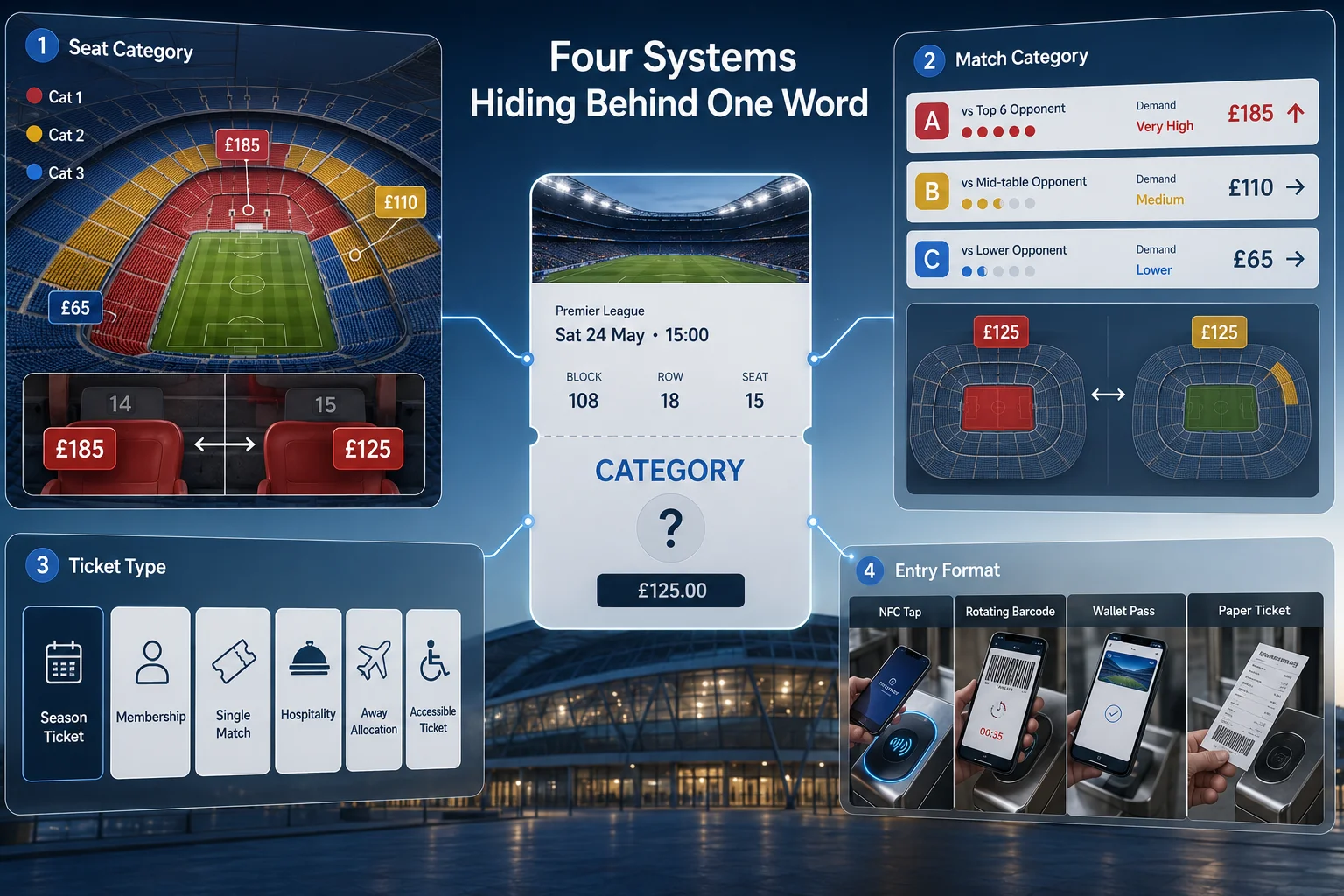
The word "category" gets applied to at least four separate layers of a ticket, and sellers rarely say which one they mean. Reading a listing correctly means identifying each in turn.
- Seat category: where in the ground the seat sits, numbered from Category 1 downwards. Set by the venue or the competition.
- Match category: how the club grades that particular fixture, usually lettered A to C. Set by the opponent and the demand it brings.
- Ticket type: the entitlement itself. Season ticket, membership, single match, hospitality, away allocation, accessible.
- Entry format: how you actually get through the turnstile. NFC pass, rotating barcode, wallet pass or, increasingly rarely, paper.
Two seats in the same block can carry different prices because of layer two. Two seats at the same price can sit at opposite ends of a stadium because of layer one. Most buying mistakes trace back to reading one layer and assuming it covers all four.
What Category 1 to 4 Actually Buys You
The numbered scale runs from best sightline down to lowest price. Category 1 covers the sides of the pitch between the penalty areas, Category 2 takes the wider side sections and corners, Category 3 sits behind the goals and Category 4, where it exists, occupies the upper tiers and furthest corners. Some European venues extend the scale to Category 5 for the highest rows, so the numbers are only meaningful within a single venue map.
UEFA finals show the scale at its most brutal. For the 2026 Champions League final at the Puskás Aréna in Budapest on 30 May, prices ran €70 for the Fans First band, €180 for Category 3, €650 for Category 2 and €950 for Category 1, according to UEFA's ticketing announcement of March 2026. That is a 13-fold spread inside one stadium for the same 90 minutes.
Two details in that structure matter more than the headline numbers. First, "Fans First" is not a public category: it replaced the old Category 4 and is reserved for supporters of the two finalist clubs through their club allocations, so a neutral applying through the public ballot cannot buy the lowest band at all. Second, the scale is competition-specific, not universal. The 2026 Conference League final in Leipzig on 27 May priced the identical four-band structure at €40, €65, €160 and €240. A Category 1 seat at one UEFA final cost nearly four times a Category 1 seat at another in the same week.
| Band | Champions League final 2026 | Conference League final 2026 | Typical location |
|---|---|---|---|
| Category 1 | €950 | €240 | Sides, between the penalty areas |
| Category 2 | €650 | €160 | Wider sides and corners |
| Category 3 | €180 | €65 | Behind the goals |
| Fans First | €70 | €40 | Reserved for finalists' supporters |
| Accessible | €70 | €40 | Wheelchair positions, companion included |
Prices as published by UEFA, March 2026. Accessibility tickets at both finals carried a complimentary companion ticket on request, a convention now standard across UEFA competitions and most domestic leagues.
Prime seats, tier one and P1 are the same idea
Above the numbered scale sit three labels that cause constant confusion because they mean roughly the same thing. Prime seats, tier one and P1 (short for Price Level 1) all describe the top price band on a venue map, typically central positions along the halfway line. None is a formal designation, and no governing body defines them, so the label tells you the seat is expensive without telling you where it is. Always check the block and row before paying a premium for a name.
Hospitality sits outside the scale entirely. It bundles a seat with lounge access, dining and a defined arrival window, which is why hospitality at a UEFA final has run from roughly €5,900 per person for shared lounge access upwards. You are buying hours in a building, not just a view.
WhatsApp channel
Sports news straight to your phone
Match updates, on-sale dates and ticket news from 1BoxOffice.
Why the Same Seat Costs More Against Liverpool
Clubs run a completely separate grading system for fixtures. English clubs typically split home league games into Category A, B and C by opponent, with derbies and title rivals in the top band and midweek games against newly promoted sides in the bottom one. West Ham use four grades at the London Stadium, running C, B, A and AA, so a single seat in the Billy Bonds Stand can carry four different prices across one season depending purely on the visitors.
The practice is not English. Werder Bremen grade fixtures A, B and C, and the interesting part is what they exempt: standing tickets cost a flat €17 whatever the grade, while seats move with it. Eintracht Frankfurt place a home game against Mainz in Category C and a visit from Bayern or Dortmund in Category A. Even Danish Superliga clubs vary prices by match grade.
Spain runs the same logic without the letters. Clubs in La Liga name their stands rather than number them: Tribuna for the main stand, Lateral for the opposite side, Fondo Norte and Fondo Sur behind the goals, with Corner sections between. Barcelona release seats in waves and raise prices as a fixture approaches, so the gap between a Tribuna seat and a Fondo seat at Camp Nou can run to several multiples for the same match. Marquee fixtures such as El Clásico and the Madrid derby sit in the top tier at every club that grades them.
This is why price comparison alone misleads. A Category B fixture in a Category 1 seat routinely costs less than a Category A fixture in a Category 3 seat. Establish the fixture grade first, then choose your seating band inside it.
The Away End Runs on Different Rules Entirely
Away tickets are not a category, they are a separate regulated allocation, and the rules are unusually specific. Under Section R of the Premier League handbook, a home club must provide the visiting club with 3,000 tickets where the ground holds 30,000 or more, or 10% of capacity where it holds less. That allocation must include at least 10% of the home club's disabled spectator accommodation, which is why away wheelchair positions exist even at grounds where they are scarce.
Price is capped too. In March 2026 Premier League clubs voted unanimously to extend the £30 away ticket cap for a further two seasons, taking it to a 12th consecutive campaign. The league credits the cap, introduced in 2016, with lifting away attendance from 82% to 91%. Domestic cup competitions such as the EFL Cup sit outside that cap and set their own terms round by round.
European competition works to a different floor. UEFA safety regulations set a minimum away allocation of 5% of capacity, which is why an away end at a Europa League tie can be smaller than the same club's domestic allocation at a larger ground. Spanish clubs commonly work to roughly that 5% figure domestically too, so away sections in La Liga sell out faster than the raw capacity suggests.
Three consequences follow for anyone buying:
- An away seat behind the goal at a top-six ground can cost less than a home seat in the same tier, because one is capped and the other is not.
- Away allocations are distributed by the visiting club through loyalty points, not sold openly by the host, so availability has nothing to do with how full the stadium is.
- Sitting in the away end while wearing home colours, or the reverse, is grounds for ejection at most grounds in Europe. Section matters as much as price.
Standing Changes the Arithmetic
Germany runs the clearest two-tier system in European football. Stehplatz (standing) tickets sit well below seated equivalents, commonly €12 to €25 across the Bundesliga, with Union Berlin among the lowest at €14 in the bottom of four bands during 2025/26 and Köln pricing standing day tickets at €18 against seats from €39 to €83. Sitzplatz (seated) tickets then run through the club's own numbered categories.
The detail that catches out travelling fans concerns European nights. UEFA requires all-seater configurations, so German terraces are converted to seats for continental fixtures and capacity drops accordingly. Borussia Dortmund hold 81,365 at Signal Iduna Park for domestic games and 65,829 for international ones, because the 24,454-capacity Südtribüne, the largest terrace in European football, becomes a seated block. A domestic stadium map is not a reliable guide to a European night at the same ground.
England now has its own version. As of 19 January 2026 the Sports Grounds Safety Authority listed 39 grounds with licensed safe standing sections, using seats with integrated or independent barriers rather than open terracing. Liverpool operate 13,300 standing places across the Kop and lower Anfield Road Stand, and Wembley Stadium added 10,000 rail seats on Level 5 ahead of 2026, first used at the Carabao Cup final in March. These are sold as ordinary seats with a rail, not as a separate lower-priced category, which is the key difference from Germany.
Ticket Types That Survive the Digital Switch
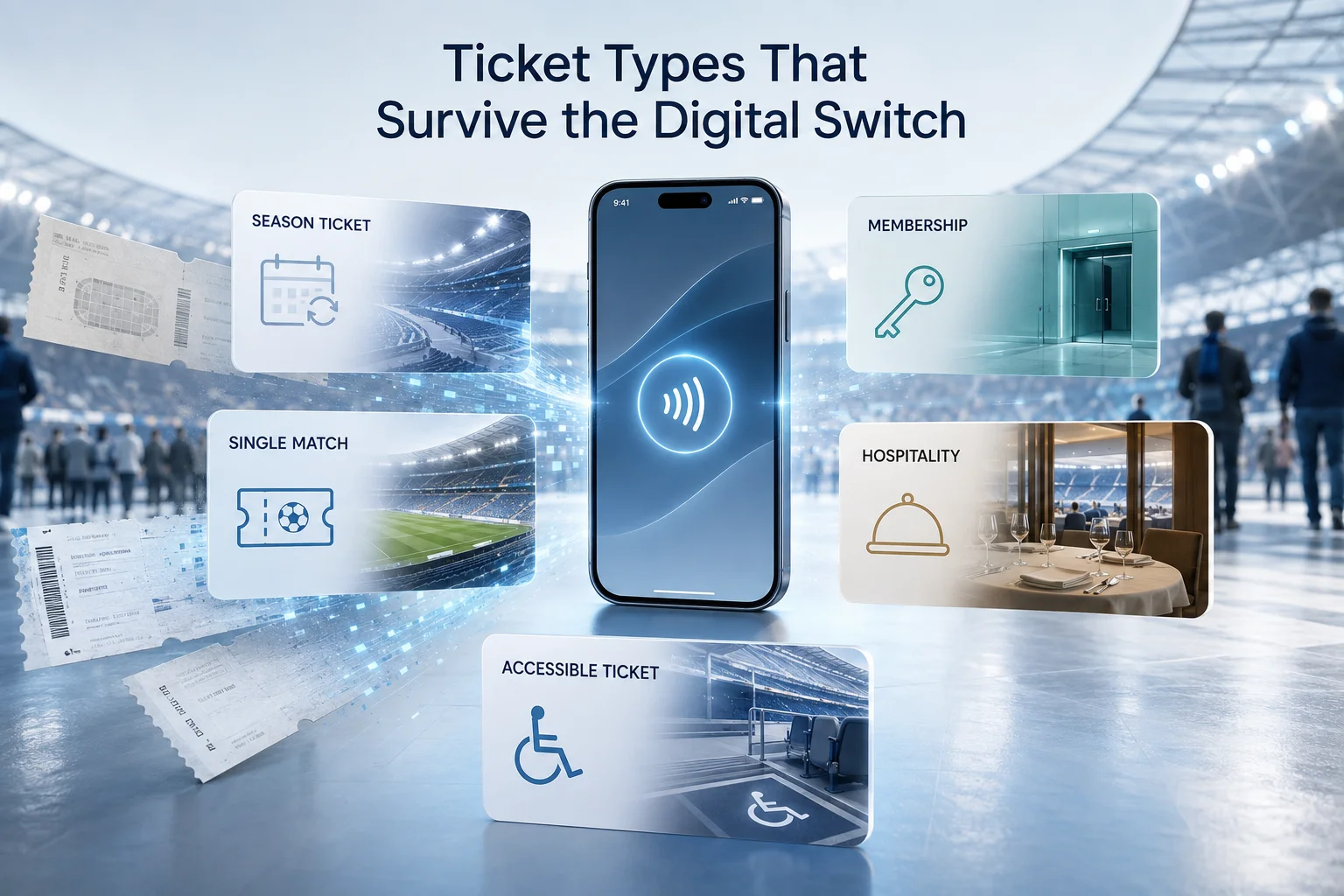
The Premier League mandate retires formats, not entitlements. What you can hold in 2026/27 breaks down as follows.
- Season tickets remain the lowest outlay per match for regulars and usually carry priority in cup and European sales. Coverage of cup football varies materially by club, so read what is bundled rather than assuming. Our guide to season tickets covers the renewal and forwarding mechanics.
- Memberships buy access to a ballot or a priority window, not a seat. A membership that guarantees entry does not exist at any high-demand English club.
- Single match tickets are released in staged windows, typically opening to season ticket holders, then members by loyalty tier, then general sale if anything remains.
- Hospitality is sold as a package with a defined lounge, dining offer and arrival time, and is the one route usually available without a purchase history.
- Accessible tickets cover wheelchair positions, ambulant seating and easy-access seats, priced at or near the lowest band with a companion ticket included at most competitions.
Italy adds a layer the rest of Europe does not. Under Italian nominal ticketing rules every ticket carries a named holder checked against identity documents at the gate, and buying into the visiting section of a Serie A ground requires a club fidelity card regardless of your nationality. Each club brands its own: Inter issue the Siamo Noi card at €15 for six years, AC Milan charge €5 for theirs, and clubs including Como and Genoa issue them free. Neutrals sitting in home areas need no card at all, which is the single most misunderstood point about buying football in Italy.
Two formats are effectively finished in the English top flight. Paper tickets and print-at-home PDFs are phased out under the mandate, and plastic membership cards go with them. Badge or card access now survives mainly as an accessibility provision: Liverpool, for instance, continue to issue photographic access cards to supporters who meet strict eligibility criteria and cannot use a digital pass.
How Your Ticket Opens the Turnstile
Entry format is now a genuine purchase consideration rather than an afterthought. Two technologies dominate, and they behave differently.
Rotating or hidden barcodes refresh on a short cycle inside the club app, which means a screenshot fails at the gate by design. NFC passes go a step further, storing an encrypted single-use token in Apple, Google or Samsung Wallet and opening the turnstile on a tap. Tottenham Hotspur have removed QR codes entirely and run NFC at every entry point, while Liverpool issued NFC passes for Anfield from 22 June 2026 and require them to be downloaded on the phone you carry to the ground, not a desktop.
Practical consequences worth planning around:
- Download the pass before travelling. Several clubs release tickets to the app roughly a week out, and some activate only inside a geofence near the ground.
- A photograph of a barcode is worthless. Anyone offering one outside a ground is not selling you entry.
- Transfer usually happens inside the club app under a forwarding function, and high-demand fixtures often restrict transfers to registered contacts.
- Battery matters. A dead phone at an NFC-only ground is a missed match, and a stadium queue is the worst place to find that out.
Reading a Listing Before You Pay
Whatever the competition, the same six checks separate a good purchase from a regretted one.
| Check | What to look for | Why it matters |
|---|---|---|
| Block and row | A specific identifier, not just a band name | "Prime" and "tier one" describe price, not position |
| Fixture grade | Category A, B, C or club equivalent | Sets the baseline before any seating premium |
| Restricted view | An explicit flag on the listing | Pillars, rails and camera gantries are discounted for a reason |
| Home or away section | Which end the block sits in | Colours in the wrong section risk ejection |
| Seated or standing | Stated on the listing, plus the competition | Terraces convert to seats for European fixtures |
| Delivery format | NFC, app barcode or wallet pass | Determines what you need on matchday |
On 1BoxOffice each listing shows the block and row before checkout, and creating a 1BoxOffice register account lets you follow delivery through track order once a purchase is confirmed.
FAQs
1. Which ticket sites offer the best seat locations?
-
Sellers that publish the exact block and row before checkout, as 1BoxOffice does, let you judge the location against a stadium map yourself rather than trusting a band label.
2. Do concession prices apply in every band?
-
No, many clubs restrict junior and senior discounts to their lower-priced bands, so the same concession can cost full adult price in a premium stand.
3. What happens to my ticket if a fixture is rescheduled for television?
-
Tickets almost always remain valid for the new date and time, which is why booking travel before broadcast selections are confirmed carries more risk than booking the ticket itself.
4. Can a group buy seats together in the same category?
-
A shared band guarantees a similar price rather than adjacent seats, so check that a listing states consecutive seats in one row if the group needs to sit together.
5. Why do tournament tickets not let me pick a seat?
-
Major tournaments sell a price band and assign positions within it afterwards, so two people paying the same Category 2 rate can end up in noticeably different parts of the ground.
Read the seat band and the fixture grade together and pricing across the 2026/27 season stops looking arbitrary. 1BoxOffice has listed tickets across Europe's major competitions since 2006, with every order covered by a 150% money-back guarantee.
Sources: UEFA, Premier League, Sports Grounds Safety Authority, Liverpool FC, Football Supporters' Association, Football Ground Guide.