In this guide
The 2026 Trionda in detailMade in Sialkot, the city behind every modern ballEvery World Cup ball, ranked1. The Telstar, 1970 and 1974: the ball that invented the look2. The Tango years, 1978 to 19823. 1986 Azteca: the first synthetic ball, and Maradona's two goals4. 1990 and 1994: the Etrusco and the Questra reach the United States5. 1998 Tricolore: colour arrives as France win at home6. 2002 Fevernova: the bold redesign that split opinion7. 2006 Teamgeist: seams cut, and Portugal step forward8. 2010 Jabulani: the ball everyone remembers for the wrong reasons9. 2014 Brazuca: redemption, and Goetze's winner10. 2018 Telstar 18: trust restored, and England's summer11. 2022 Al Rihla: when the ball learned to thinkThe sensor inside the ball, and where it goes nextSo which is the best World Cup ball?Can you still buy these balls?FAQsIn 2010, the best goalkeepers in the world could not read the ball. The Jabulani dipped and swerved in the air at the speed of an ordinary shot, and a physicist later measured why: it stayed in its wobble-prone zone up to about 82 kilometres an hour, while most match balls settle by around 58, so at normal playing speeds it kept moving in ways nobody could predict. Sixteen years on, the game has swung hard the other way. The ball that took the first kick of the 2026 tournament under the lights in Mexico City, the Trionda, has four panels and a sensor wired into its side: the fewest pieces and the most technology any World Cup ball has ever carried.
Every ball kicked at a men's World Cup since 1970 has worn the same three stripes, and since 2014, every one has been built in a single Pakistani city that has never qualified for the finals. This piece covers the 2026 ball in detail, the factory behind it, a ranking of all 15 editions, and a section on each one, with its defining moment and the science behind it. The Trionda comes first, because it is the ball in play right now.
The 2026 Trionda in detail
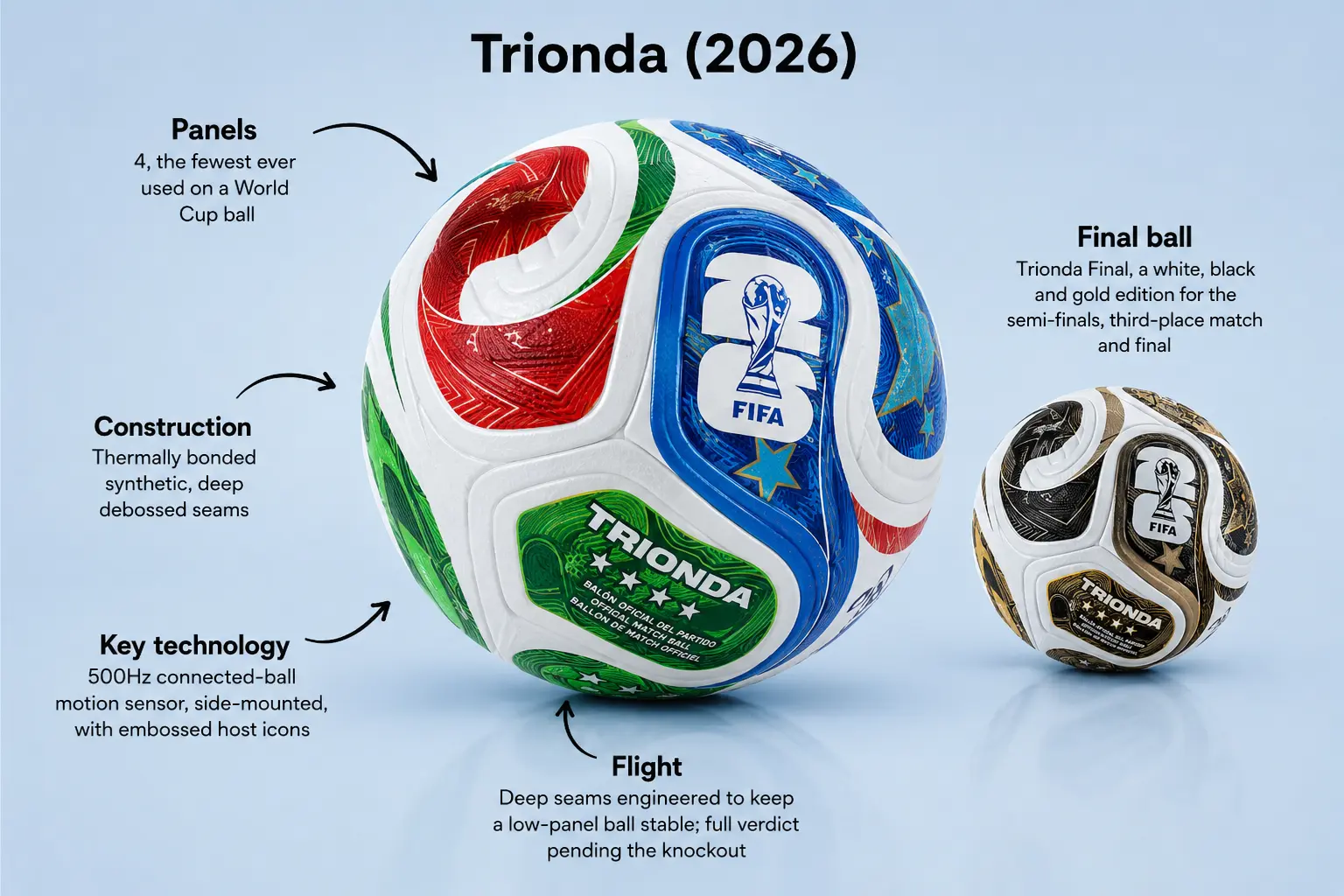
The Trionda, Spanish for "three waves", is built around the three host nations, and that idea runs through the whole design. It is the most stripped-back ball in World Cup history to look at, yet the most advanced to engineer. Where the 1970 Telstar had 32 panels and the well-liked 2014 Brazuca had six, the Trionda has four. Fewer panels mean fewer seams, and fewer seams are exactly what sent an earlier ball haywire in 2010, so this time Adidas cut deliberately deep grooves and debossed lines into the surface to keep the air moving predictably across it.
The headline features are these:
- A four-panel construction, the fewest ever used on a World Cup match ball, with deep seams and debossed texturing engineered to hold the flight steady.
- Embossed host symbols, a star for the United States, a maple leaf for Canada and an eagle for Mexico, which double as a grip in wet or humid air.
- A motion sensor running at 500 readings a second, mounted to the side of the ball this time rather than at its centre, feeding the same offside and touch data the game relied on in 2022.
| Specification | Detail |
|---|---|
| Panels | 4, the fewest ever used on a World Cup ball |
| Construction | Thermally bonded synthetic, deep debossed seams |
| Key technology | 500Hz connected-ball motion sensor, side-mounted, with embossed host icons |
| Flight | Deep seams engineered to keep a low-panel ball stable; full verdict pending the knockouts |
| Top scorer | Tournament in progress, still to be decided |
| Top-scoring team | Tournament in progress, still to be decided |
| Also used at | Made for the 2026 World Cup |
| Final ball | Trionda Final, a white, black and gold edition for the semi-finals, third-place match and final |
The sensor is the part that changes the results. It records the ball 500 times a second and sends the precise instant of every kick to the video referees, the system that in 2022 could prove whether a player had got a touch at all. Sitting it to the side rather than the centre is a packaging change, not a change of job. For players, the four-panel surface is the bigger talking point, because a ball this smooth lives or dies on whether those engineered grooves do what the wind tunnel promised.
The Trionda took its first competitive kick at the opening match in Mexico City on 12 June 2026 and is in use right through the group stage now underway. It is also on sale, the match-grade Pro alongside club and competition versions, through Adidas and the tournament's own store, plus major sports retailers.
The host symbolism is the whole point of the name, so it is fitting that two of the three icons sit on co-hosts staging World Cup football for the first time in this format. The maple leaf marks Canada and the eagle marks Mexico, while the star belongs to the United States, a country that last hosted in 1994 and whose own ball from that summer appears further down this list. If you are planning around the co-hosts, the team pages are the place to start.
One honest caveat on the Trionda: it is too early to rank it on merit. With only the group stage gone, the ball has not yet met knockout football or the full spread of North American conditions, from humid coastal stadiums to the thin air of high-altitude venues where a low-drag ball tends to fly further. The entry rules for visitors are not a straight copy of 2018 either, and our guide to whether a fan ID is needed for the 2026 World Cup walks through what changed. This section was last updated on 17 June 2026 and will be revisited as the tournament progresses.
Made in Sialkot, the city behind every modern ball
Like the three match balls before it, the Trionda came out of one place: Sialkot, in north-east Pakistan, a city often called the football factory of the world. The numbers earn the title. Sialkot produces close to 70% of every football made anywhere, with around 300,000 balls leaving its factories each day and roughly 40 million exported in a World Cup year. The quiet irony is that Pakistan has never qualified for a World Cup, yet the country has been on the pitch at every one for more than 44 years.
The company at the centre of it is Forward Sports, founded in Sialkot in 1991. It built the Brazuca for 2014, the Telstar 18 for 2018, the Al Rihla for 2022 and now the Trionda for 2026: four tournaments running. The work moved long ago from hand-stitching to thermal bonding, where panels are glued and pressed in heated moulds rather than sewn, which keeps water out and settles the flight.
One popular myth is worth correcting here, because it gets repeated constantly. The 2010 Jabulani is often said to have been made in Pakistan with latex from Kerala in India. It was not. The Jabulani was assembled in China, its latex bladders came from Enkay Rubber in India, and its polyurethane came from Taiwan. The Sialkot story belongs to the balls that came after it, not to the one footballers spent a whole summer complaining about.
Every World Cup ball, ranked
This ranking blends two things that do not always agree. The first is how the ball was received in play, above all by the goalkeepers who had to read its flight. The second is reach, meaning how far the design and its cultural weight travelled beyond the tournament. A handsome ball that keepers distrusted cannot sit above one that did both jobs. The Trionda is ranked provisionally at four, on specification and pedigree rather than a finished tournament, for the reason given in its own section above.
| Rank | Ball | World Cup | Verdict |
|---|---|---|---|
| 1 | Telstar | 1970 and 1974 | The template. Black-and-white panels built for television; the look that still means "football". Returned in 1974 with a water-resistant Durlast coating. |
| 2 | Tango / Tango Espana | 1978 to 1982 | The most copied design in the game; the triad pattern ran in some form for over a decade. |
| 3 | Azteca | 1986, Mexico | First fully synthetic World Cup ball and the one Maradona used for his two most famous goals. |
| 4 | Trionda | 2026, USA-Canada-Mexico | Provisional. The fewest panels ever and a side-mounted sensor, placed on specification until the knockouts test it. |
| 5 | Brazuca | 2014, Brazil | The redemption ball. Players trusted it after the 2010 backlash; six panels, true flight. |
| 6 | Al Rihla / Al Hilm | 2022, Qatar | The thinking ball. A motion sensor inside it helped settle offside calls as they happened. |
| 7 | Tricolore | 1998, France | The first World Cup ball printed in colour, for France's win on home soil. |
| 8 | Etrusco Unico | 1990, Italy | A clean, well-liked all-synthetic ball with an internal foam layer. |
| 9 | Teamgeist | 2006, Germany | A 14-panel bonded design that cut the seams and smoothed the surface. |
| 10 | Questra | 1994, USA | An early foam-layer ball, softer on the boot, for the first World Cup in the United States. |
| 11 | Telstar 18 | 2018, Russia | A return to predictable flight after 2010, with a chip for fans built in. |
| 12 | Fevernova | 2002, Korea-Japan | A striking look, but goalkeepers found it light and skittish in the air. |
| 13 | Jabulani | 2010, South Africa | The most criticised ball in the tournament's history. Few players had a good word for it. |
Every ball below meets the same regulation, 410 to 450 grams in weight and 68 to 70 centimetres around, so what separates them is panels, seams, materials, and now electronics, and that is what each section's data table sets out. The rest of this piece takes the editions in order, from the ball that started it all to the one that taught the game to read its own flight.
WhatsApp channel
Sports news straight to your phone
Match updates, on-sale dates and ticket news from 1BoxOffice.
1. The Telstar, 1970 and 1974: the ball that invented the look
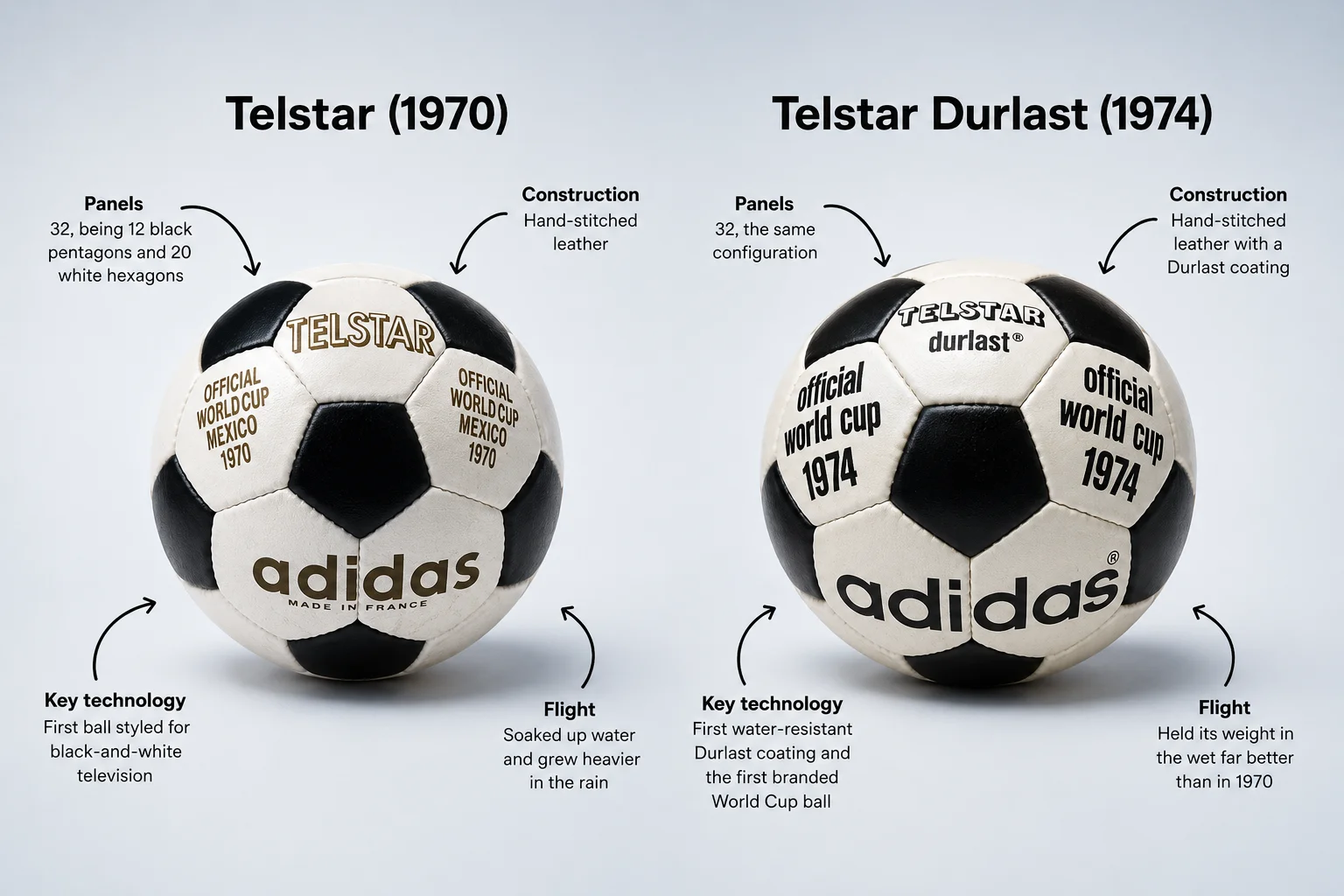
The Telstar is where modern football begins. Its 32 panels, 12 black pentagons and 20 white hexagons, were arranged so that viewers watching on black-and-white television sets could actually follow the ball, and that pattern became the default picture of a football for a generation of children who drew it without ever seeing the real thing. It was still made of leather, so it still soaked up rain, but it set the visual rulebook that everything else worked from. Its defining moment came in the final, when Carlos Alberto finished a flowing move to seal a 4-1 win over Italy, a goal still cited as the finest team strike the tournament has produced. The side that scored it was Pele's Brazil, a name that keeps Brazil near the front of every conversation about who can win in 2026.
Four years later, the same ball came back for West Germany 1974, lightly updated as the Telstar Durlast and joined by an all-white version called the Chile Durlast. The design was unchanged, but a Durlast coating now sealed the leather against water, so the ball held its weight in the rain far better than the 1970 version had. It was also the first World Cup ball to carry printed names and logos. The same Telstar shape turned up at the 1972 and 1976 European Championships. West Germany beat a Total Football Netherlands in the final to win it.
| Specification | Telstar (1970) | Telstar Durlast (1974) |
|---|---|---|
| Panels | 32, being 12 black pentagons and 20 white hexagons | 32, the same configuration |
| Construction | Hand-stitched leather | Hand-stitched leather with a Durlast coating |
| Key technology | First ball styled for black-and-white television | First water-resistant Durlast coating and the first branded World Cup ball |
| Flight | Soaked up water and grew heavier in the rain | Held its weight in the wet far better than 1970 |
| Top scorer | Gerd Muller (West Germany), 10 goals | Grzegorz Lato (Poland), 7 goals |
| Top-scoring team | Brazil, 19 goals | Netherlands, 15 goals |
| Also used at | Made for the 1970 World Cup | Also the 1972 and 1976 European Championships |
| Final ball | Same ball used in the final; separate final balls began in 2006 | Same ball used in the final |
2. The Tango years, 1978 to 1982
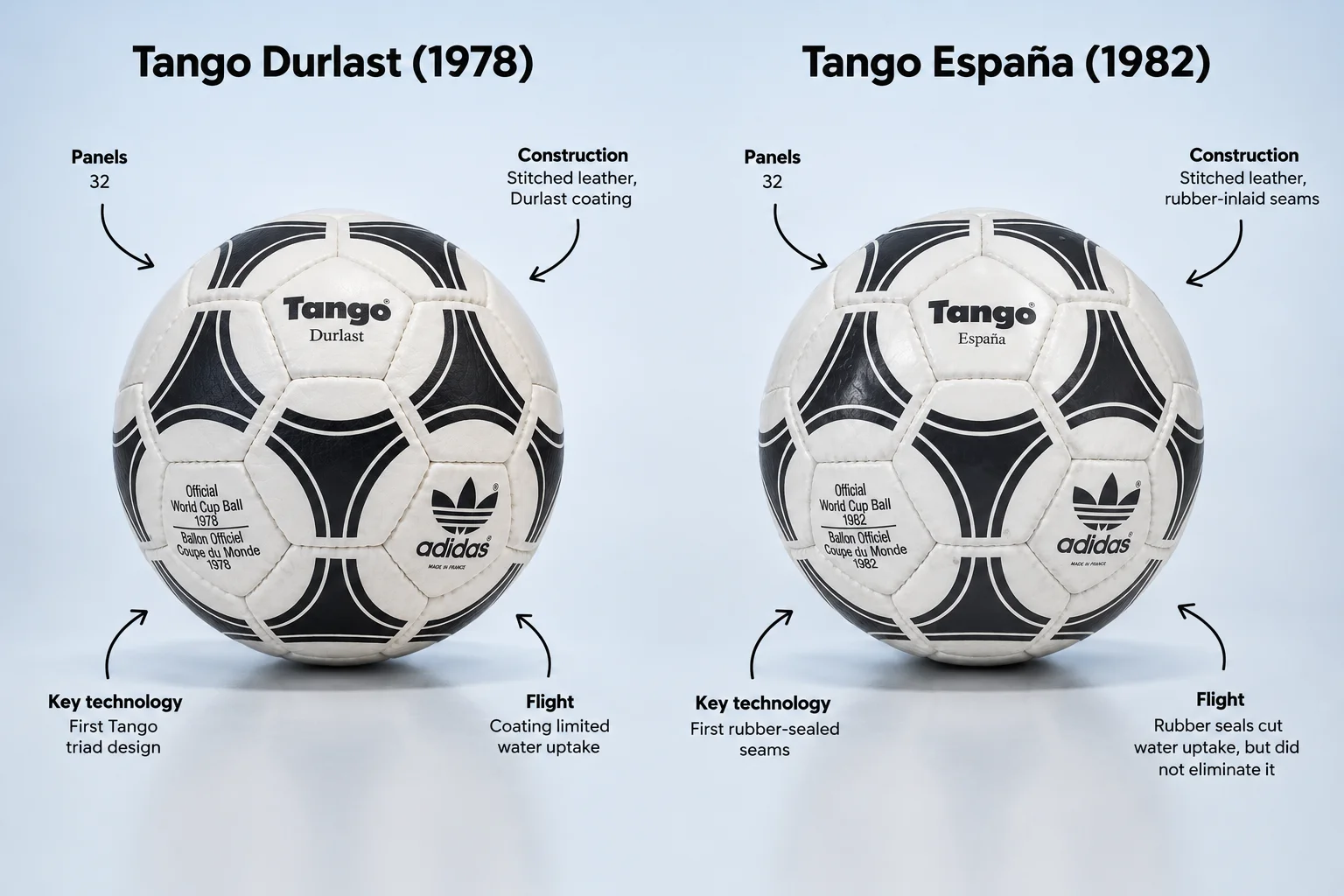
The Tango gave Adidas its longest-running idea. It arrived for Argentina 1978, a ring of 20 panels printed with interlocking triads that created the illusion of 12 identical circles, a look so durable the brand reworked it across the next several tournaments instead of replacing it. The Tango Espana of 1982 added rubber-inlaid seams to keep water out, an early step toward the sealed, bonded balls that would follow. Neither reinvented the game on its own, but together they made the Tango pattern the most copied design football has ever had.
| Specification | Tango Durlast (1978) | Tango Espana (1982) |
|---|---|---|
| Panels | 32 | 32 |
| Construction | Stitched leather, Durlast coating | Stitched leather, rubber-inlaid seams |
| Key technology | First Tango triad design | First rubber-sealed seams |
| Flight | Coating limited water uptake | Rubber seals cut water uptake but did not eliminate it |
| Top scorer | Mario Kempes (Argentina), 6 goals | Paolo Rossi (Italy), 6 goals |
| Top-scoring team | Argentina, 15 goals | France, 16 goals |
| Also used at | Made for the 1978 World Cup; launched the Tango design Adidas reworked for years | Made for the 1982 World Cup |
| Final ball | Same ball used in the final | Same ball used in the final |
3. 1986 Azteca: the first synthetic ball, and Maradona's two goals
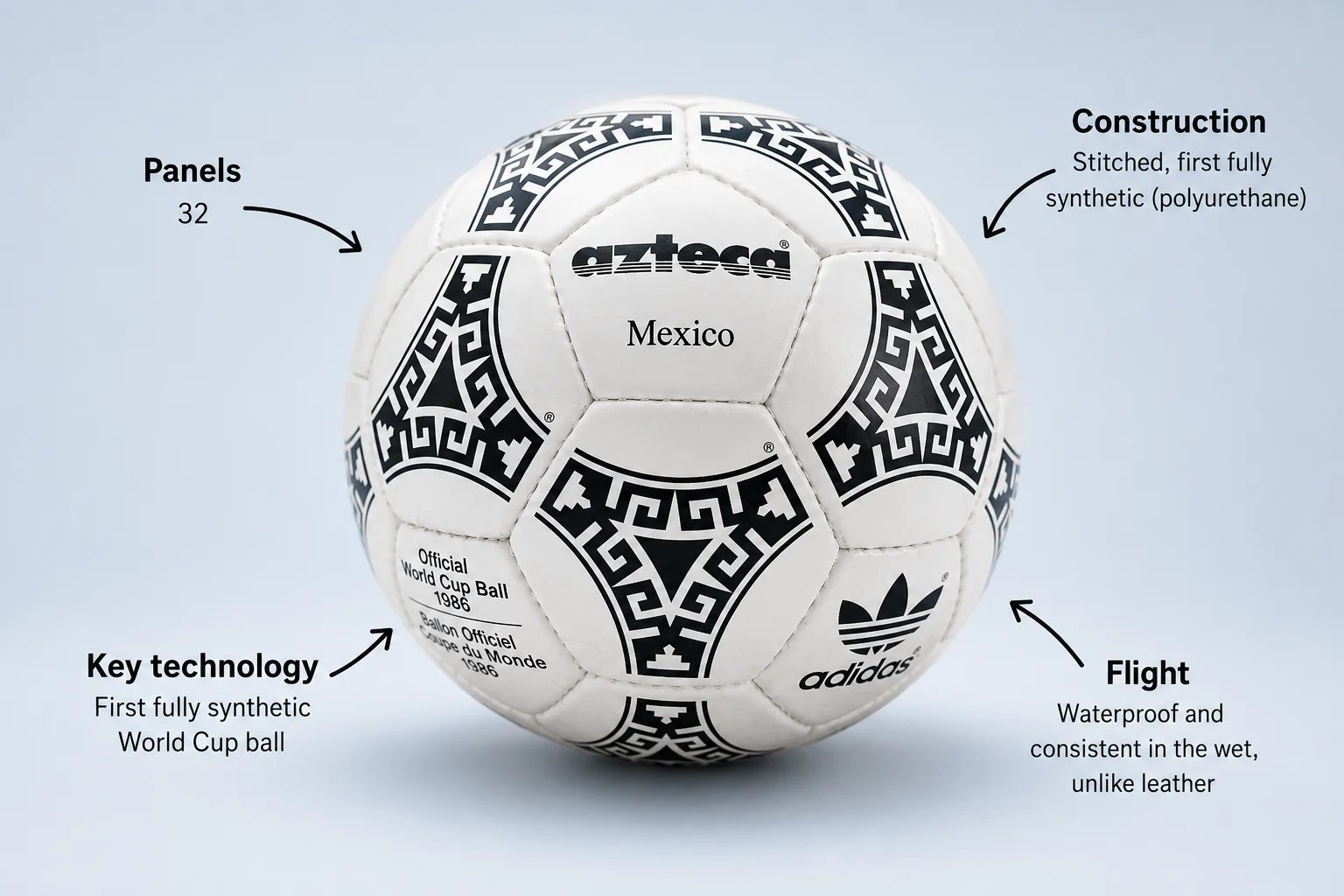
The Azteca was the first World Cup ball made entirely from synthetic materials, which finally freed the game from leather that grew heavy and slow in the wet. It would be a footnote in the design story if it were not also the ball at the centre of the most replayed afternoon in the sport's history. In the quarter-final against England, Diego Maradona used the Azteca for the Hand of God and then, four minutes later, for the slaloming solo run voted the goal of the century. One ball, two moments that still divide opinion and an Argentina side that has rarely been far from the title conversation in the decades since.
| Specification | Detail |
|---|---|
| Panels | 32 |
| Construction | Stitched, first fully synthetic (polyurethane) |
| Key technology | First fully synthetic World Cup ball |
| Flight | Waterproof and consistent in the wet, unlike leather |
| Top scorer | Gary Lineker (England), 6 goals |
| Top-scoring team | Argentina, 14 goals |
| Also used at | Made for the 1986 World Cup |
| Final ball | Same ball used in the final |
4. 1990 and 1994: the Etrusco and the Questra reach the United States
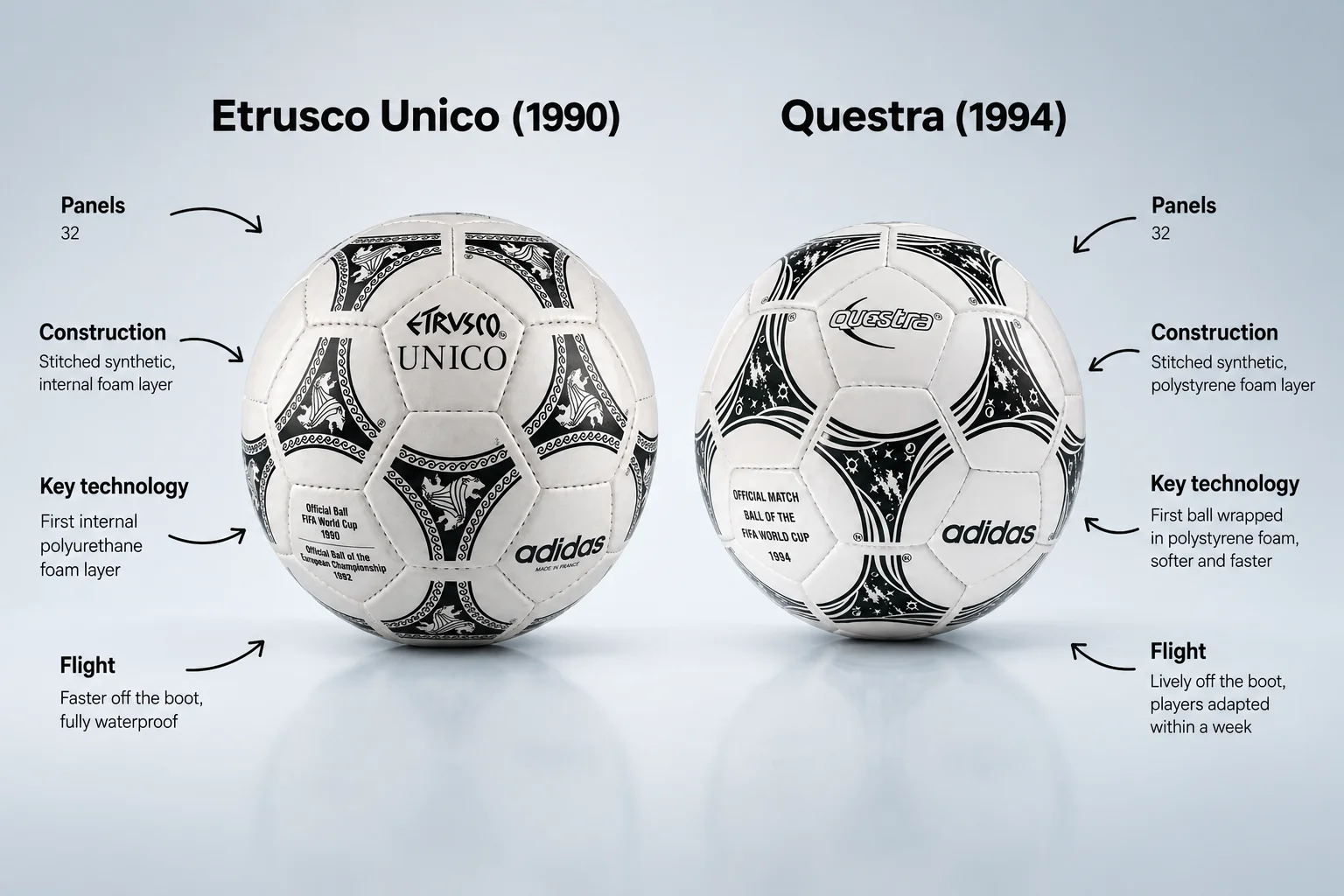
The Etrusco Unico of 1990 was a tidy, well-regarded all-synthetic ball with an internal layer of black polyurethane foam, used as West Germany won in Italy. Four years later, the Questra went further, adding a polyurethane foam layer that made the ball softer on the boot and quicker off it, for the first World Cup ever staged in the United States. That 1994 tournament ended with Brazil beating Italy on penalties after a goalless final, the summer of Romario and of Roberto Baggio's miss from the spot. The United States is back as a co-host in 2026, its star now embossed on the Trionda, and its team page is one of the busier ones for the home crowd.
| Specification | Etrusco Unico (1990) | Questra (1994) |
|---|---|---|
| Panels | 32 | 32 |
| Construction | Stitched synthetic, internal foam layer | Stitched synthetic, polystyrene foam layer |
| Key technology | First internal polyurethane foam layer | First ball wrapped in polystyrene foam, softer and faster |
| Flight | Faster off the boot, fully waterproof | Lively off the boot, players adapted within a week |
| Top scorer | Salvatore Schillaci (Italy), 6 goals | Oleg Salenko (Russia) and Hristo Stoichkov (Bulgaria), 6 goals each |
| Top-scoring team | West Germany, 15 goals | Sweden, 15 goals |
| Also used at | Euro 1992, the 1992 Barcelona Olympics, the 1991 Copa America and the 1991 Women's World Cup | Spanish La Liga, with variants at Euro 1996 and the 1996 Olympics |
| Final ball | Same ball used in the final | Same ball used in the final |
5. 1998 Tricolore: colour arrives as France win at home
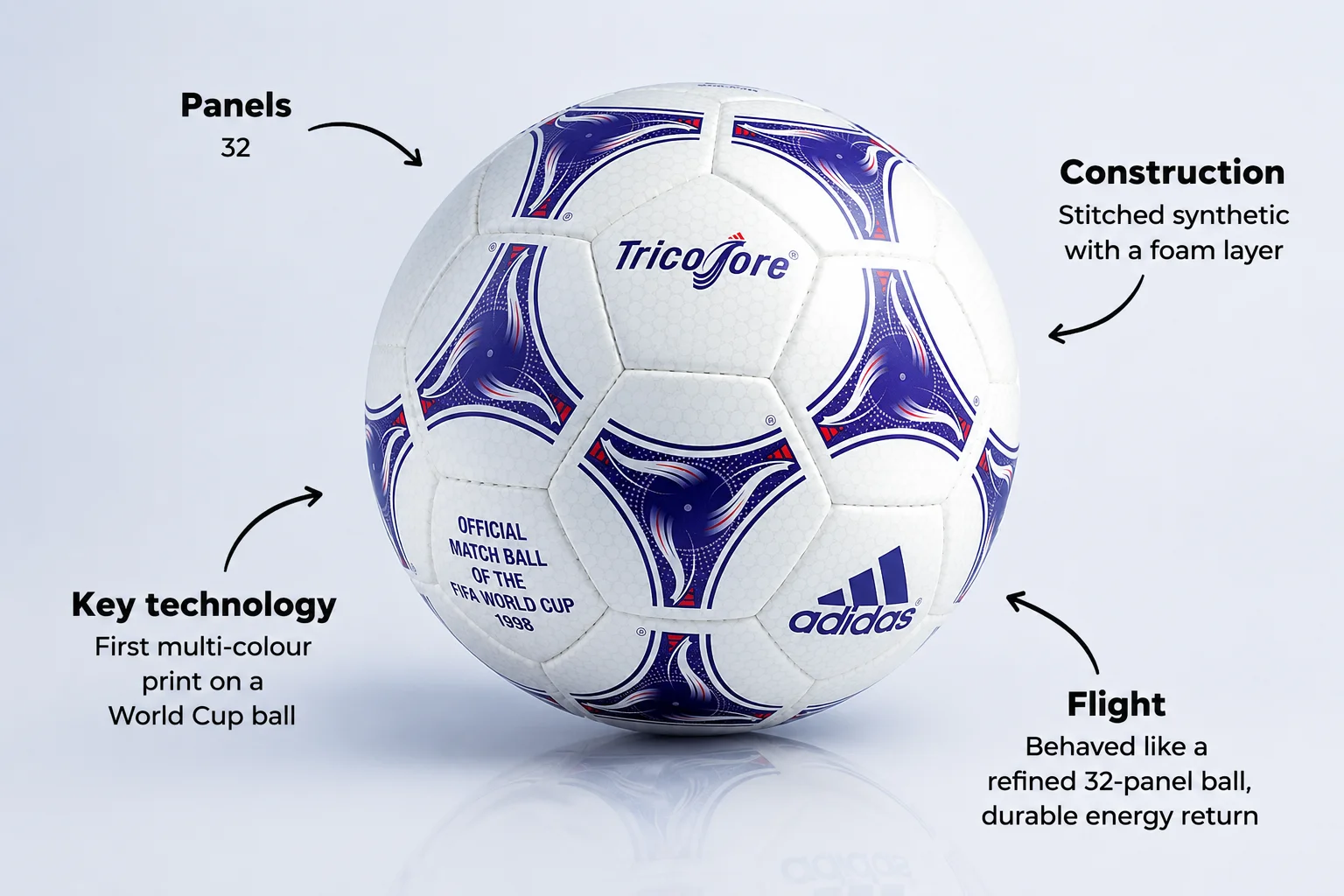
The Tricolore was the first World Cup ball printed in colour, breaking from decades of black-and-white with blue and red detailing drawn from the host flag. It rolled out for a France tournament that ended in the perfect home story, Zinedine Zidane heading twice in a 3-0 final win over a Brazil side that had carried the favourite's tag. France has lifted the trophy again since and reached the final beyond that, which is why their team page stays in steady demand whenever a World Cup comes round.
| Specification | Detail |
|---|---|
| Panels | 32 |
| Construction | Stitched synthetic with a foam layer |
| Key technology | First multi-colour print on a World Cup ball |
| Flight | Behaved like a refined 32-panel ball, durable energy return |
| Top scorer | Davor Suker (Croatia), 6 goals |
| Top-scoring team | France, 15 goals |
| Also used at | Made for the 1998 World Cup |
| Final ball | Same ball used in the final |
6. 2002 Fevernova: the bold redesign that split opinion
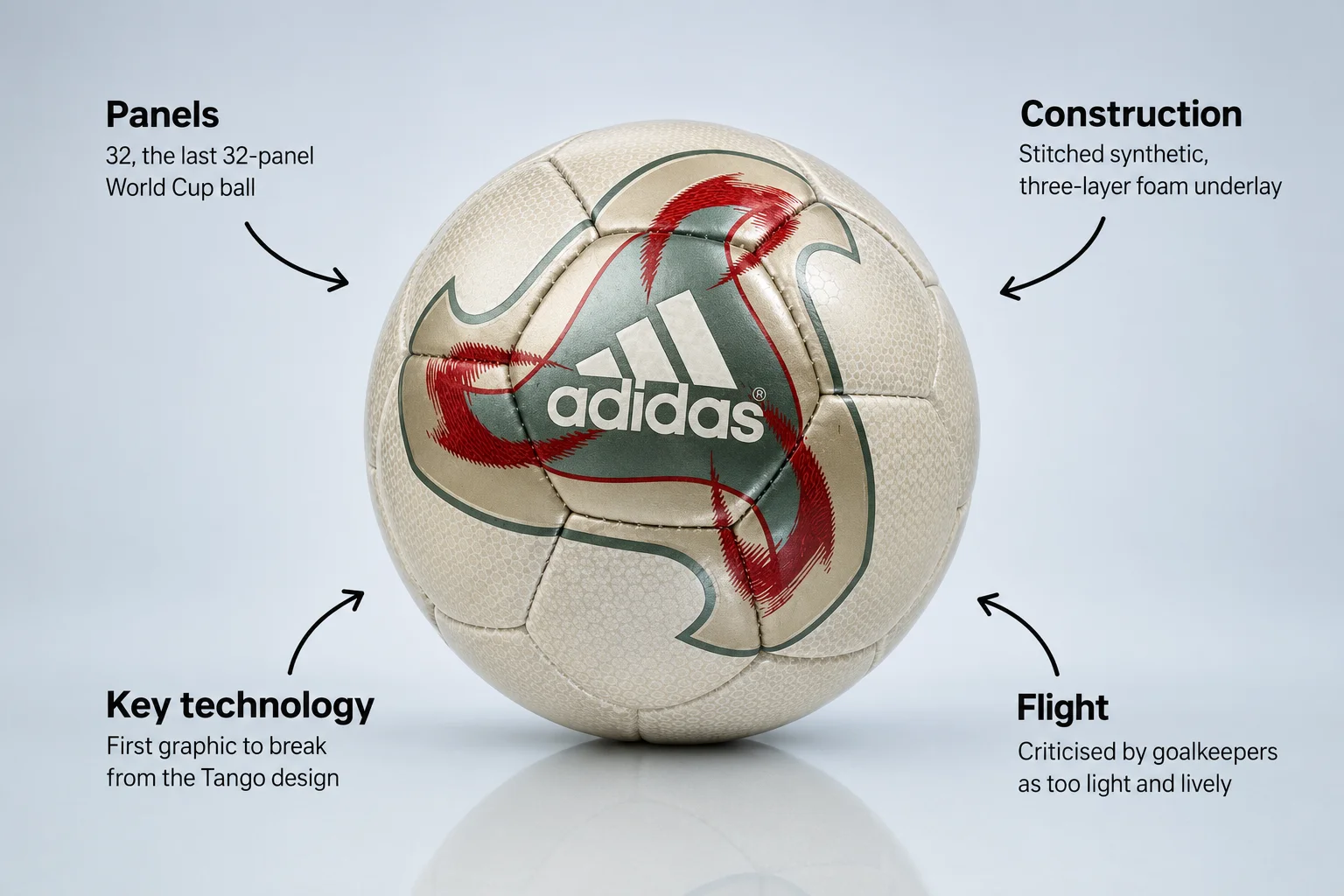
After more than two decades of Tango variations, the Fevernova was the first ball to break the mould completely, with a four-pointed graphic in gold and red replacing the familiar triads. The look was admired, and the marketing was loud, but the reviews from inside the box were not kind: several goalkeepers found it too light and too lively, prone to moving more than they wanted in the air. On the pitch, it served a redemption arc anyway, as a fully fit Ronaldo scored eight goals and settled the final against Germany to win Brazil a fifth world title in Korea and Japan.
| Specification | Detail |
|---|---|
| Panels | 32, the last 32-panel World Cup ball |
| Construction | Stitched synthetic, three-layer foam underlay |
| Key technology | First graphic to break from the Tango design |
| Flight | Criticised by goalkeepers as too light and lively |
| Top scorer | Ronaldo (Brazil), 8 goals |
| Top-scoring team | Brazil, 18 goals |
| Also used at | Made for the 2002 World Cup |
| Final ball | Same ball used in the final, the last before the 2006 tradition |
7. 2006 Teamgeist: seams cut, and Portugal step forward
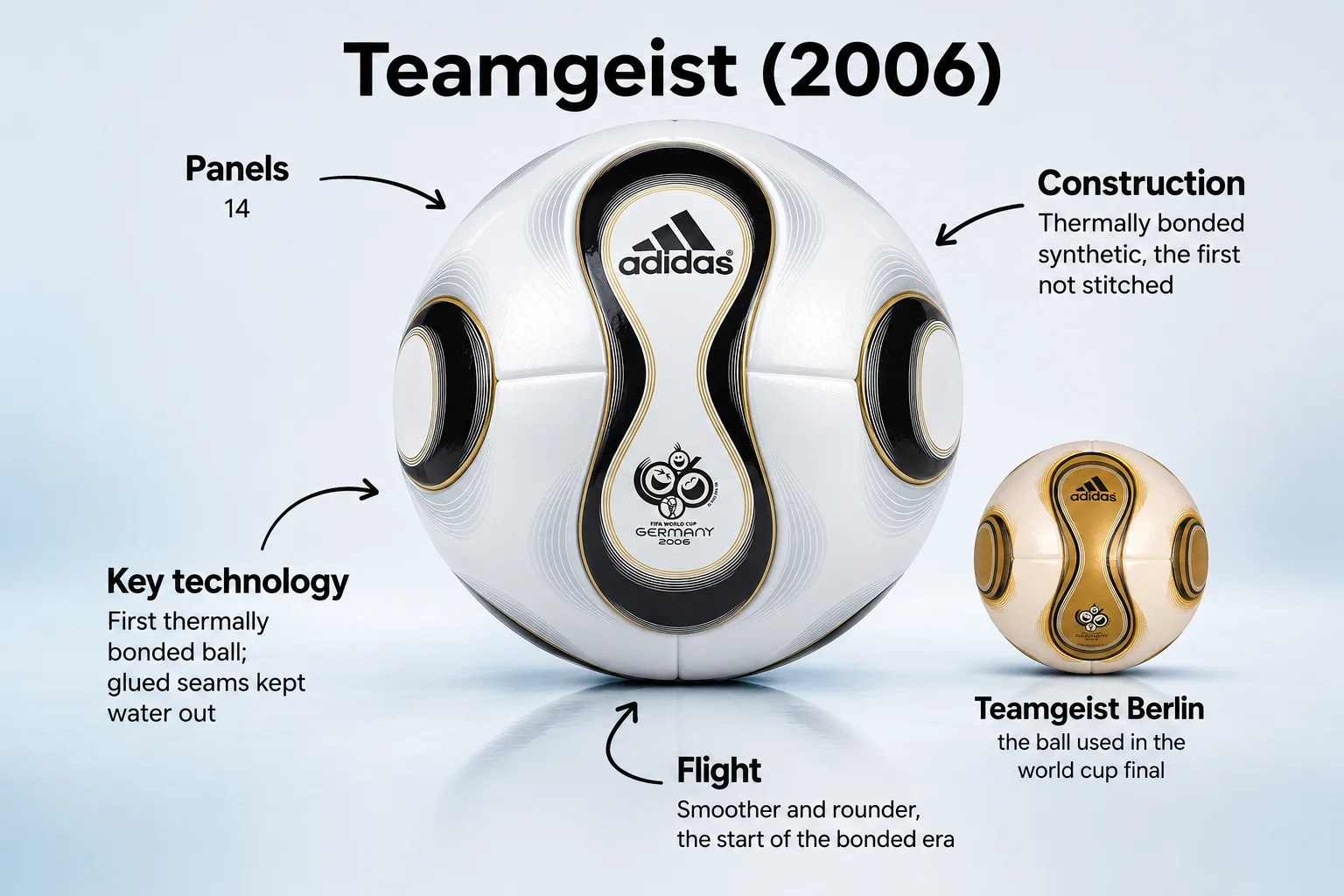
The Teamgeist was a genuine engineering shift, a 14-panel ball that was thermally bonded rather than stitched, the first World Cup ball to abandon the 32-panel layout. Fewer seams meant a smoother, rounder surface, a direction Adidas would keep pushing right up to the four panels of 2026. Italy won the tournament in a final remembered for Zidane's exit. That match also started something that has stuck: the first ball made just for a World Cup final, a gold edition called the Teamgeist Berlin. Every final since has had its own. The summer marked an arrival too, a teenage Cristiano Ronaldo helping Portugal to the semi-finals and a fourth-place finish, the start of a two-decade run at the top of the game. Portugal remains a regular contender, and their team page reflects it.
| Specification | Detail |
|---|---|
| Panels | 14 |
| Construction | Thermally bonded synthetic, the first not stitched |
| Key technology | First thermally bonded ball; glued seams kept water out |
| Flight | Smoother and rounder, the start of the bonded era |
| Top scorer | Miroslav Klose (Germany), 5 goals |
| Top-scoring team | Germany, 14 goals |
| Also used at | Made for the 2006 World Cup |
| Final ball | Teamgeist Berlin, a gold edition, the first ball made for a final |
8. 2010 Jabulani: the ball everyone remembers for the wrong reasons
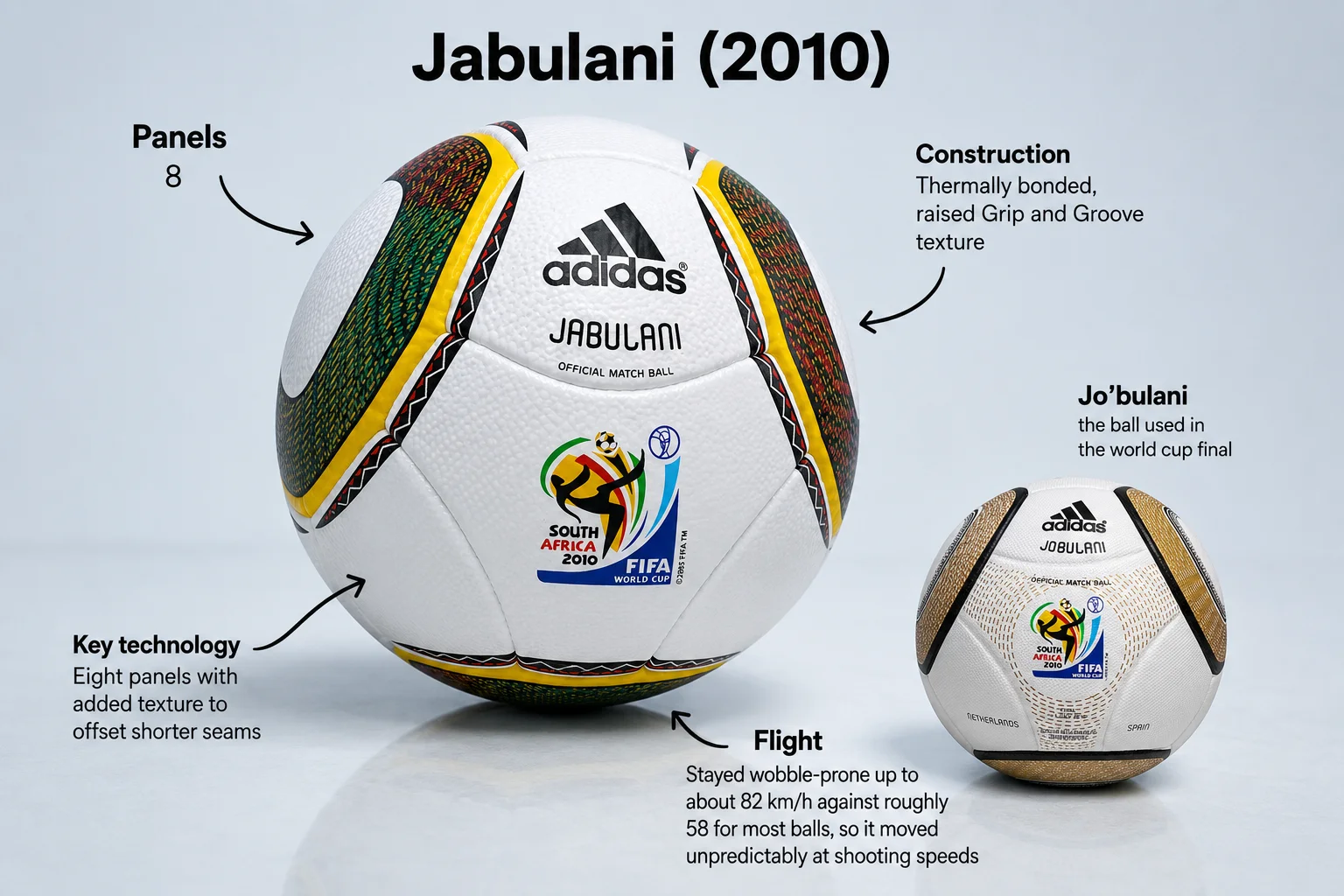
No ball on this list is more notorious. The Jabulani was sold as the most precise World Cup ball yet, with eight thermally bonded panels formed into a near-perfect sphere. In play, it behaved like nothing the players expected, dipping and swerving late in a way wind-tunnel studies later traced to its very smooth surface and unusually low drag. Goalkeepers were the loudest critics, and a long line of attackers joined them. Only a few, Diego Forlan above all, read it well enough to thrive, and Forlan took the Golden Ball as Uruguay reached the semi-finals. The final still produced a classic finish: Andres Iniesta's extra-time strike won Spain a first world title, scored with the gold final ball, the Jo'bulani, named after Johannesburg. Spain remains a heavyweight every cycle, and its team page carries that weight.
| Specification | Detail |
|---|---|
| Panels | 8 |
| Construction | Thermally bonded, raised Grip and Groove texture |
| Key technology | Eight panels with added texture to offset shorter seams |
| Flight | Stayed wobble-prone up to about 82 km/h against roughly 58 for most balls, so it moved unpredictably at shooting speeds |
| Top scorer | Thomas Muller (Germany), 5 goals |
| Top-scoring team | Germany, 16 goals |
| Also used at | Made for the 2010 World Cup |
| Final ball | Jo'bulani, a gold version named after Johannesburg |
9. 2014 Brazuca: redemption, and Goetze's winner
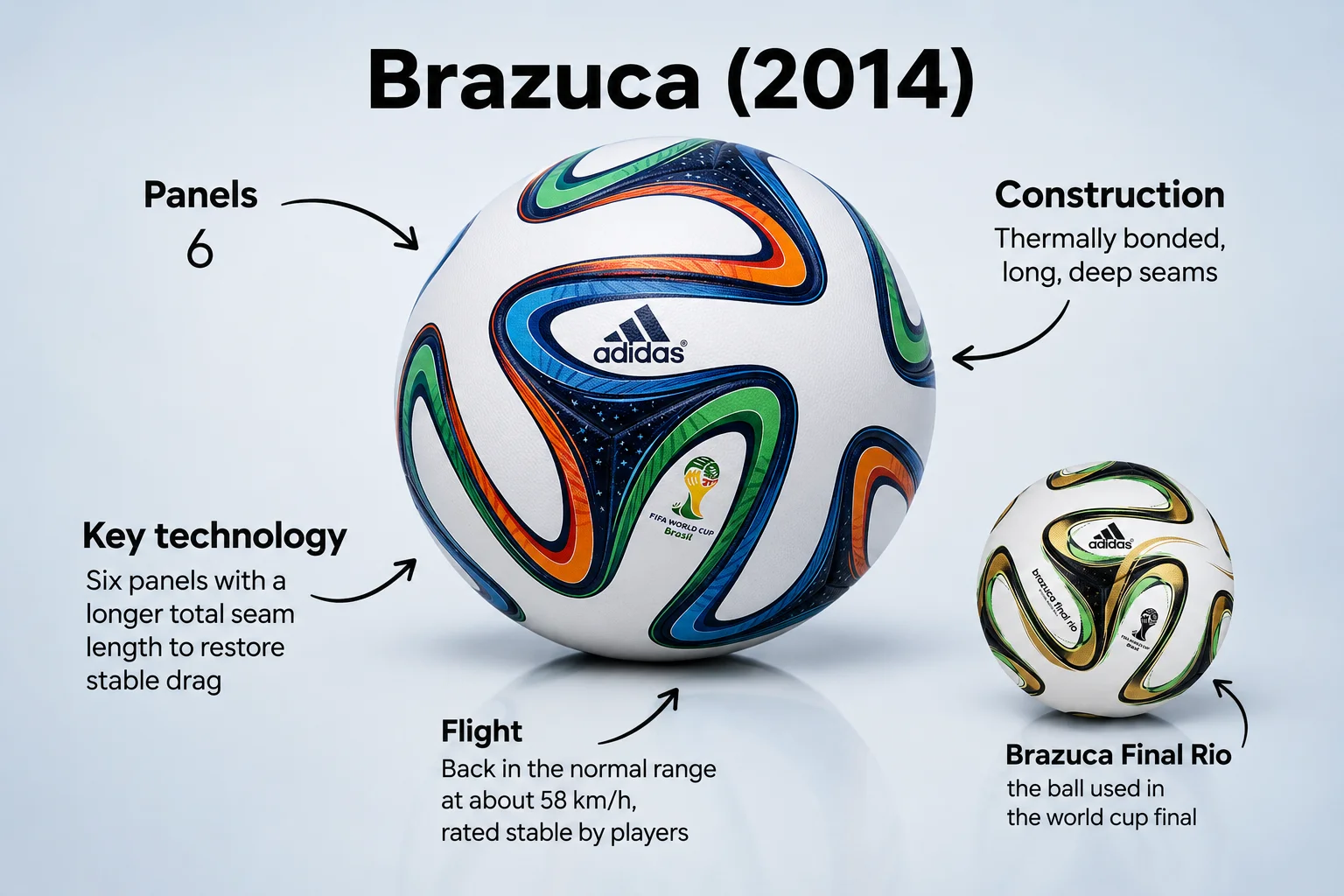
Adidas plainly learned from the backlash. The Brazuca was put through more than two years of testing with hundreds of players before Brazil 2014, and the verdict flipped: footballers found it stable and honest in flight, the anti-Jabulani. Its highlight reel holds up, from James Rodriguez's chest-and-volley against Uruguay, voted goal of the tournament, to Mario Goetze's cushioned volley in the final itself, struck with the green, gold and black Brazuca Final Rio made for the match. That winner sent the trophy to Germany after a 1-0 victory over Argentina, a result that confirmed a generation of German talent at its peak. Germany's team page is among the most-watched for 2026.
| Specification | Detail |
|---|---|
| Panels | 6 |
| Construction | Thermally bonded, long deep seams |
| Key technology | Six panels with longer total seam length to restore stable drag |
| Flight | Back in the normal range at about 58 km/h, rated stable by players |
| Top scorer | James Rodriguez (Colombia), 6 goals |
| Top-scoring team | Germany, 18 goals |
| Also used at | Made for the 2014 World Cup |
| Final ball | Brazuca Final Rio, in green, gold and black |
10. 2018 Telstar 18: trust restored, and England's summer
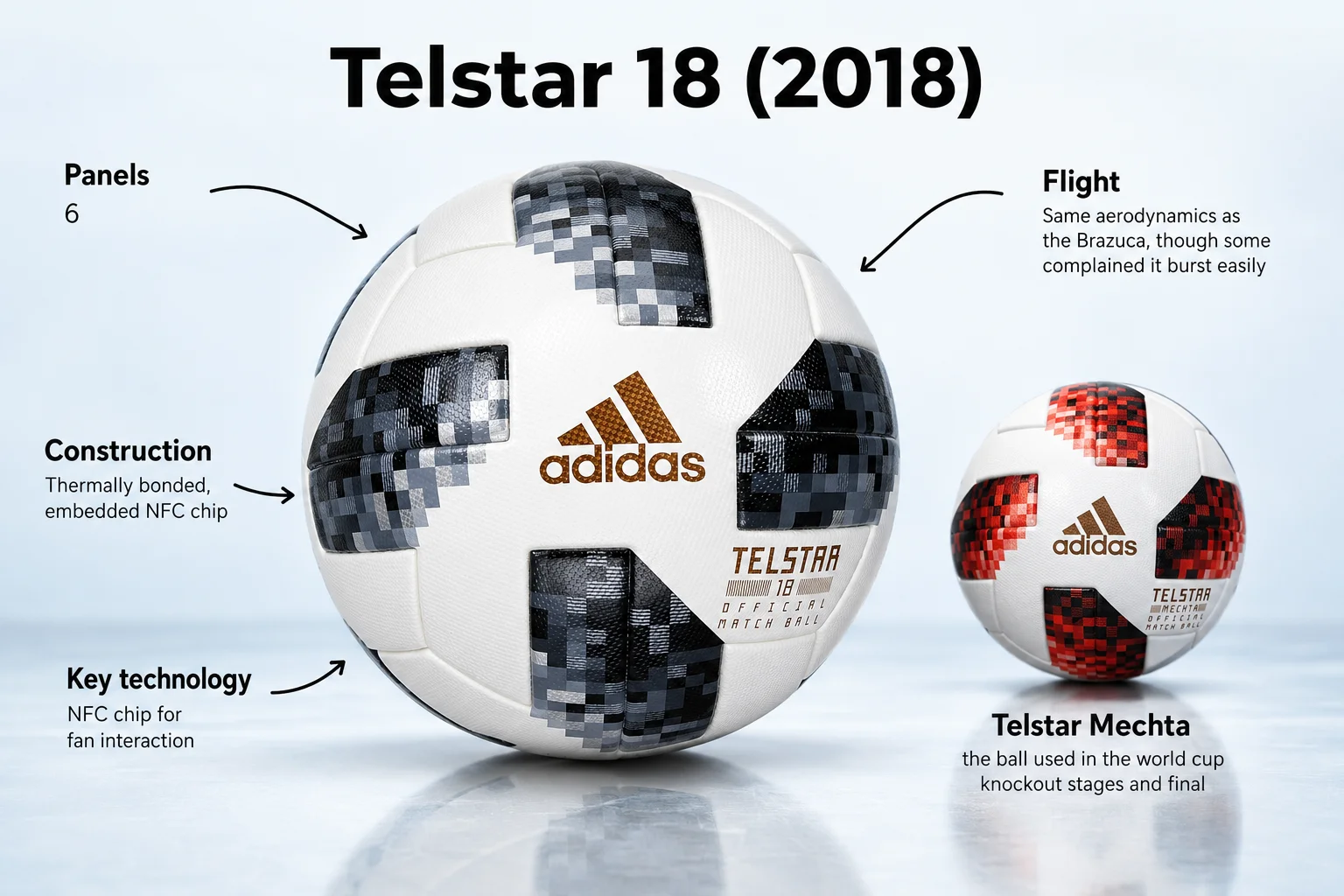
The Telstar 18 nodded straight back to 1970 in name and in its panelled print, and more importantly, it restored confidence in the air after the Jabulani years, with a flight players felt they could read again. It also slipped an NFC chip under the surface so fans could tap a phone to it for product information, a small hint at the connected ball to come. For the knockout rounds, the final included a red version called the Telstar Mechta took over. France won the tournament in Russia behind a teenage Kylian Mbappe, but for one fanbase the abiding memory was different: England reached the semi-finals under Gareth Southgate, their best run in 28 years, and a country sang itself hoarse about football coming home. Their tournament ended against the Croatia side that went on to the final. England arrive among the contenders again in 2026, and their team page is busy for it.
| Specification | Detail |
|---|---|
| Panels | 6 |
| Construction | Thermally bonded, embedded NFC chip |
| Key technology | NFC chip for fan interaction |
| Flight | Same aerodynamics as the Brazuca, though some complained it burst easily |
| Top scorer | Harry Kane (England), 6 goals |
| Top-scoring team | Belgium, 16 goals |
| Also used at | Made for the 2018 World Cup |
| Final ball | Telstar Mechta, a red version for the knockout stage |
11. 2022 Al Rihla: when the ball learned to think
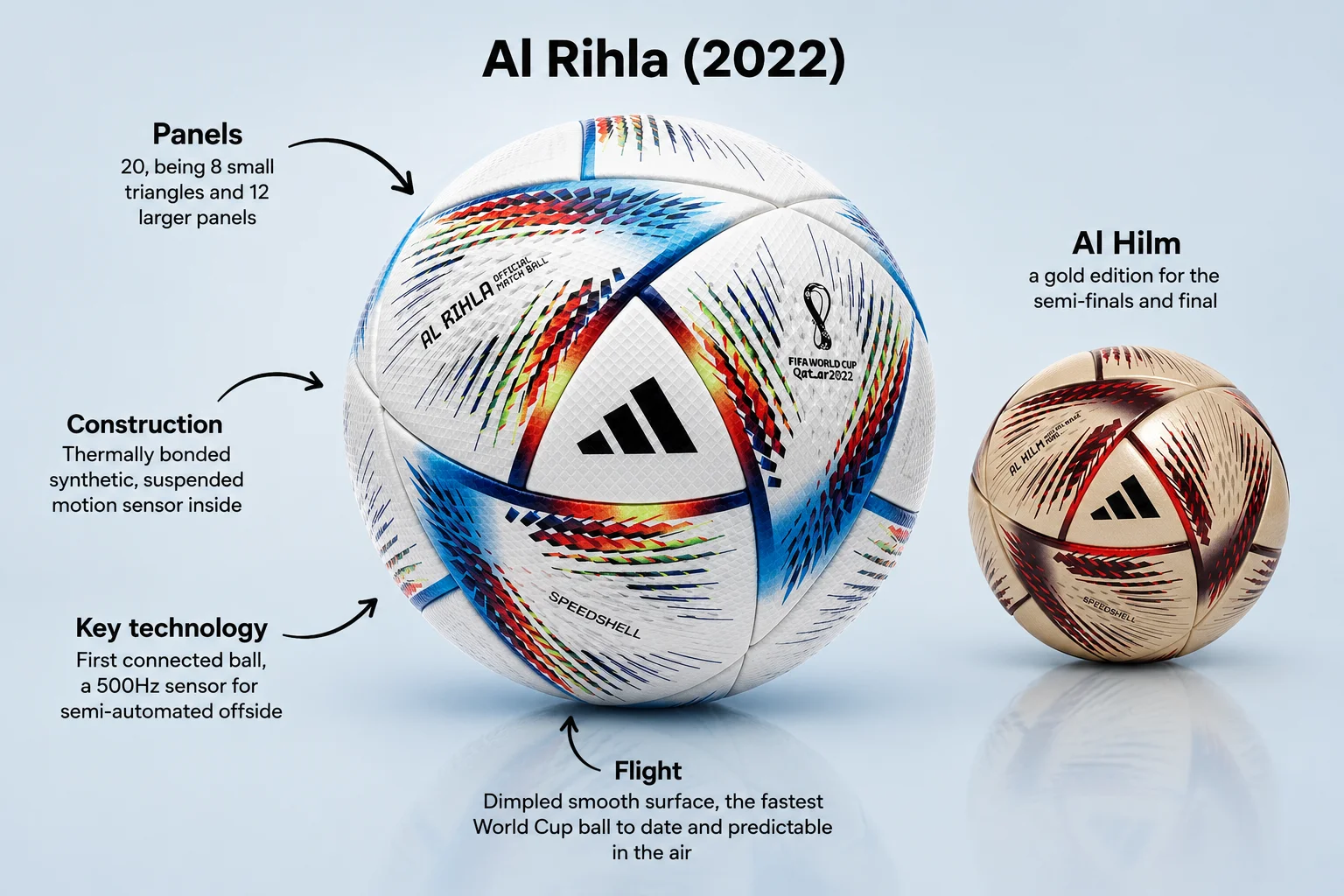
The biggest change in modern World Cup balls is not the surface, it is what sits inside. The Al Rihla introduced connected-ball technology for Qatar 2022, built around a motion sensor that records the ball 500 times a second using an inertial measurement unit suspended at its centre, sending the exact moment of each kick to the video referees and supporting faster, tighter offside decisions. It was not a gimmick. In the win over Uruguay, the ball data showed Cristiano Ronaldo had not touched Bruno Fernandes's cross, settling an argument over who had actually scored. For the semi-finals and final, the gold Al Hilm, meaning "the dream", took over, and it was the ball on the pitch the night Lionel Messi finally won the World Cup, beating France on penalties. Qatar was the tournament of the underdog too, with Morocco becoming the first African side to reach the semi-finals and Japan beating both Germany and Spain in the group stage. It also produced one of the wildest games in recent memory in the quarter-finals, when a ten-man Netherlands clawed back two late goals against Argentina before losing the shoot-out, a night that summed up why the Dutch are never written off. Their team page is one to watch for 2026.
| Specification | Detail |
|---|---|
| Panels | 20, being 8 small triangles and 12 larger panels |
| Construction | Thermally bonded synthetic, suspended motion sensor inside |
| Key technology | First connected ball, a 500Hz sensor for semi-automated offside |
| Flight | Dimpled smooth surface, the fastest World Cup ball to date and predictable in the air |
| Top scorer | Kylian Mbappe (France), 8 goals |
| Top-scoring team | France, 16 goals |
| Also used at | Made for the 2022 World Cup |
| Final ball | Al Hilm, a gold edition for the semi-finals and final |
The sensor inside the ball, and where it goes next
The Al Rihla and the Trionda look like ordinary balls because the important part is hidden. Both carry a small sensor built by the German firm KINEXON, working with Adidas and the game's organisers, and it exists to solve one problem cameras alone could not. Tracking where players stand is something optical systems already manage with great precision. Pinning down the exact instant the ball leaves a foot is far harder because broadcast cameras capture only about 50 frames a second, and an offside call turns on that precise moment. The sensor closes that gap.
Inside the 2022 device, which weighed around 14 grams, sat two sensors working together. An inertial measurement unit, the IMU, records the ball's acceleration and movement in three dimensions 500 times a second, while an ultra-wideband sensor fixes its position far more accurately than GPS or Bluetooth can. That 500Hz rate means the timing of any touch is known to within about two milliseconds, roughly ten times finer than video alone, and the feed is synchronised with the stadium's limb-tracking cameras down to a millionth of a second. The system always knows when the ball was played and where every player stood at that instant.
What is done with the data is the point. It goes live to the video review room, where, combined with the camera tracking and a layer of artificial intelligence, it drives semi-automated offside: the kick point and the player positions are flagged automatically, and a human confirms the call. The same touch detection settled the 2022 argument over whether Cristiano Ronaldo had got a head to Bruno Fernandes's cross, and it can confirm a handball or whether a tackling player actually reached the ball. KINEXON calls the on-screen result a heartbeat, a spike at the exact moment of contact. The same readings feed the three-dimensional replays and the ball-speed and spin figures viewers now see.
The technology has moved fast. It was trialled at the 2021 Arab Cup before the Al Rihla made it standard at a World Cup in 2022, and the Fussballliebe brought it to a European Championship for the first time in 2024. The Trionda is the next step. Where earlier connected balls suspended the sensor in the dead centre, the Trionda houses it in a specially built pocket inside one of the four panels, with counterweights in the other three so the ball still flies true. It is charged before kick-off on a wireless dock rather than a cable, with about ninety minutes of charging covering a full match plus extra time and penalties.
The direction of travel is clear. The system is called semi-automated only because a person still signs off on the offside, and the obvious next move is to remove that delay, where the data leaves no doubt. Away from officiating, every touch, pass speed and spin reading is information a coach or a broadcaster can use, which is why the same KINEXON system already sells to clubs for analysis. The trade-off is that football's defining object now has a battery state. A ball that was leather and air for a century is, at the very top of the game, a data-broadcasting device that somebody has to remember to charge.
So which is the best World Cup ball?
A ranking like this is a judgment, not a measurement, and it is worth being honest about that. The Telstar takes the top spot because it invented the thing every other ball copied, the look that still says football half a century on. The Jabulani sits at the bottom of the clearest evidence of all, the near-unanimous verdict of the people who had to play with it. In between, the order rewards balls that earned the trust of players while leaving a mark beyond the pitch, which is why the Brazuca and the Al Rihla rank above prettier or louder designs that did less. The Trionda enters at four, but that number is provisional. It is earned on specification and pedigree, the most advanced ball yet and the direct heir to the well-received connected-ball generation, rather than on a finished tournament. A ball that has only seen group-stage football has not been tested by the moments that decide tournaments, so expect it to move once the knockouts have had their say.
Can you still buy these balls?
Only the Trionda is still in production. The current ball is on sale through the tournament's own store, Adidas and the usual sports retailers, from a budget club version up to the match-grade Pro. Every other ball in this ranking, from the 1970 Telstar to the 2022 Al Rihla, is long out of production and was never put back into shops, so none can be bought new from the maker.
The rest of the market is second-hand, and it splits into two. Original match balls, whether genuinely used in a tournament or sold boxed at the time, are scarce and can be expensive, with a game-used Jabulani changing hands for thousands and prices for any original swinging widely with condition, rarity and proof of where it came from. Replicas are the easier route, since re-releases and replica versions of the most famous balls were made in large numbers and are easy to find at modest prices, with the catch that they look like the match ball without being one.
For replicas and the more common originals, eBay is the obvious starting point, with the widest choice and buyer protection if a sale goes wrong. Genuine match balls, and anything sold as game-used, are better sought through specialist sports-memorabilia auction houses such as Graham Budd Auctions and Hansons in the UK or Heritage Auctions in the United States, where lots come with cataloguing and provenance. A few rules save grief whichever route you take. Counterfeits are common, above all for the balls people most want, so check a seller's history and feedback and treat a low price on a supposed original as a warning rather than a bargain. On anything sold as an original, ask for proof of authenticity or provenance before paying collector money. The one piece of the past you can still buy new is the 1994 Questra, which Adidas has reissued as a replica in a heritage set alongside the Trionda to mark the tournament's return to North America.
In the end, the balls only matter because of the matches they decide. 1BoxOffice lists resale tickets across the 2026 World Cup, backed by a 150% money-back guarantee if an order is not honoured.
FAQs
1. What is the 2026 World Cup ball called?
-
The Adidas Trionda, a name meaning three waves for the three host nations, has been in use since the opening match in Mexico City on 12 June 2026.
2. Where are World Cup balls made?
-
In Sialkot, Pakistan, where Forward Sports has produced the last four tournament balls, from the Brazuca in 2014 to the Trionda in 2026.
3. Why was Jabulani's flight so unpredictable?
-
Its very smooth, near-spherical surface and few panels cut drag, which made the ball veer and dip suddenly in the air in what is often called the knuckle effect.
4. What is connected-ball technology?
-
A motion sensor inside the ball that records its movement 500 times a second and sends the exact moment of each kick to the video referees to support offside calls.
5. How many panels does the Trionda have?
-
Four, the fewest ever used on a World Cup match ball, is set into deep seams designed to keep its flight stable.
Sources: Adidas, FIFA, UEFA, KINEXON, Forward Sports, Scientific American, The Conversation, Wikipedia, Gulf News, ESPN, BBC Sport.