In this guide
Kolkata: the derby that moves the price of fishArgentina: the league that played without away fans for 12 yearsIstanbul: the night 41,000 women filled a stadium men were barred fromBilbao: the club that has refused to sign outsiders since 1912Germany: the ownership rule that keeps the terrace standingGlasgow: how Celtic quietly brought standing back to BritainAthens: the gate where the poorest supporters satEgypt: the decade played to empty seatsTehran: the stadium called FreedomJeddah: the gate that opened in January 2018Saitama: the banner that emptied a 63,000-seat stadiumAmsterdam: the nickname the city is still arguing aboutIceland and Lanarkshire: the clap that was never VikingWhat these 13 have in commonSeeing them for yourselfFAQsOn the morning after a Kolkata derby, the price of fish in Bengal's markets moves. Win for East Bengal and hilsa climbs. Win for Mohun Bagan and prawns climb instead. Football cultures rarely announce themselves that plainly, but they are almost always that specific, and they are almost never really about the football.
What follows is not a list of loud crowds. It is 13 cases where supporters, courts, governments or club statutes changed what a matchday actually is: who may enter, who may stand, who may be signed and what happens when a stadium is emptied on purpose. If you are planning to see any of it in person, our football tickets listings cover most of the European clubs named below.
Kolkata: the derby that moves the price of fish
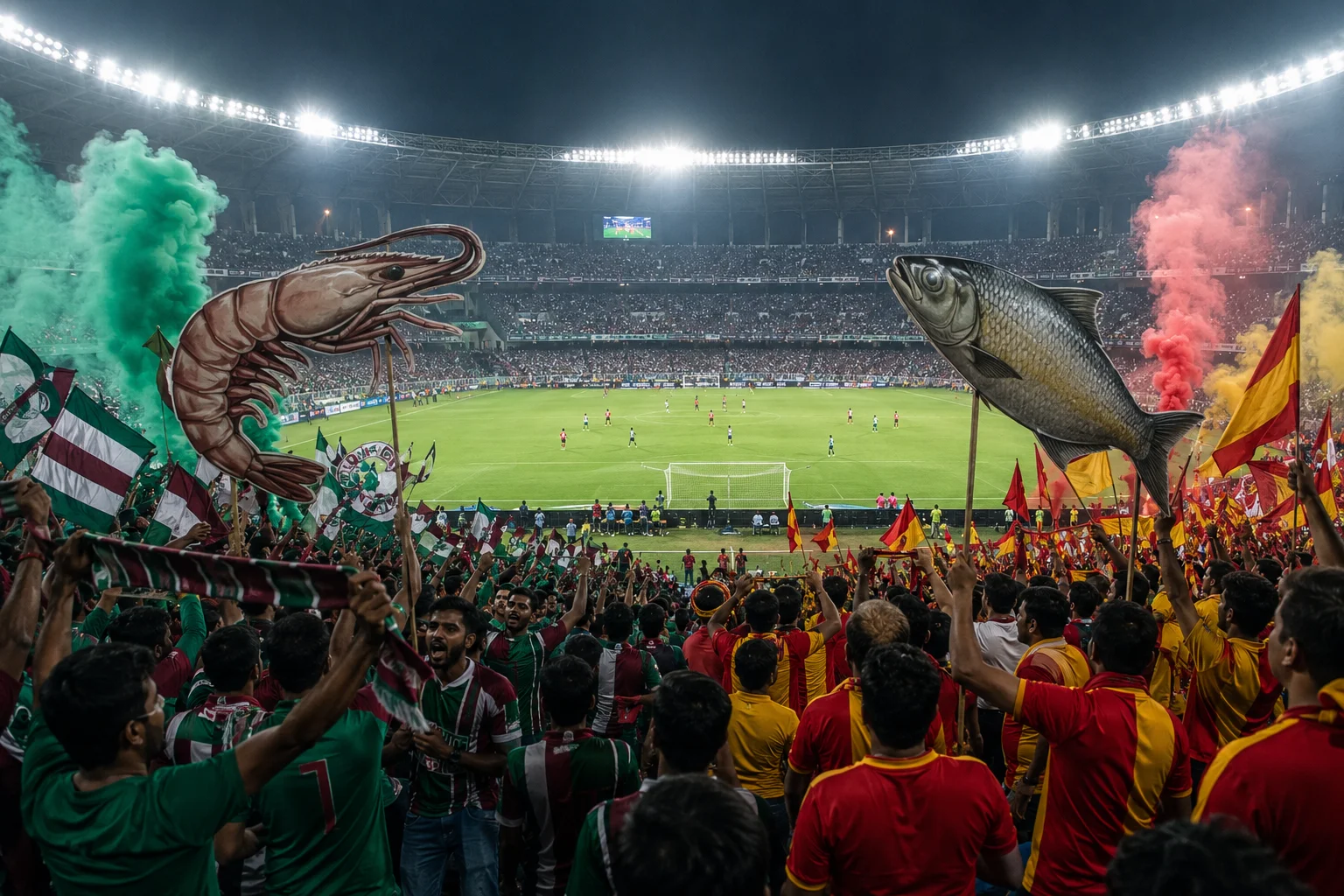
The Kolkata derby between Mohun Bagan and East Bengal is a Partition argument conducted through seafood. Supporters of East Bengal are largely Bangals, families with roots in what is now Bangladesh, and their fish is ilish, the hilsa. Mohun Bagan supporters are largely Ghotis, natives of West Bengal, and theirs is chingri, the prawn.
This is not decorative. Fish retailers across the city stock differently on the eve of the fixture, because the winning side's fish sells out the next morning at inflated prices while the loser's price collapses. Fans carry cut-outs of their fish into the ground. Mohun Bagan, founded in 1889, became a national symbol in 1911 when they beat the East Yorkshire Regiment to win the IFA Shield, the first all-Indian side to take a major trophy from a British team.
No other rivalry in world football has a measurable commodity market attached to it. It is the clearest example of the general rule: the deepest supporter identities are inherited, not chosen, and they usually predate the club.
Argentina: the league that played without away fans for 12 years
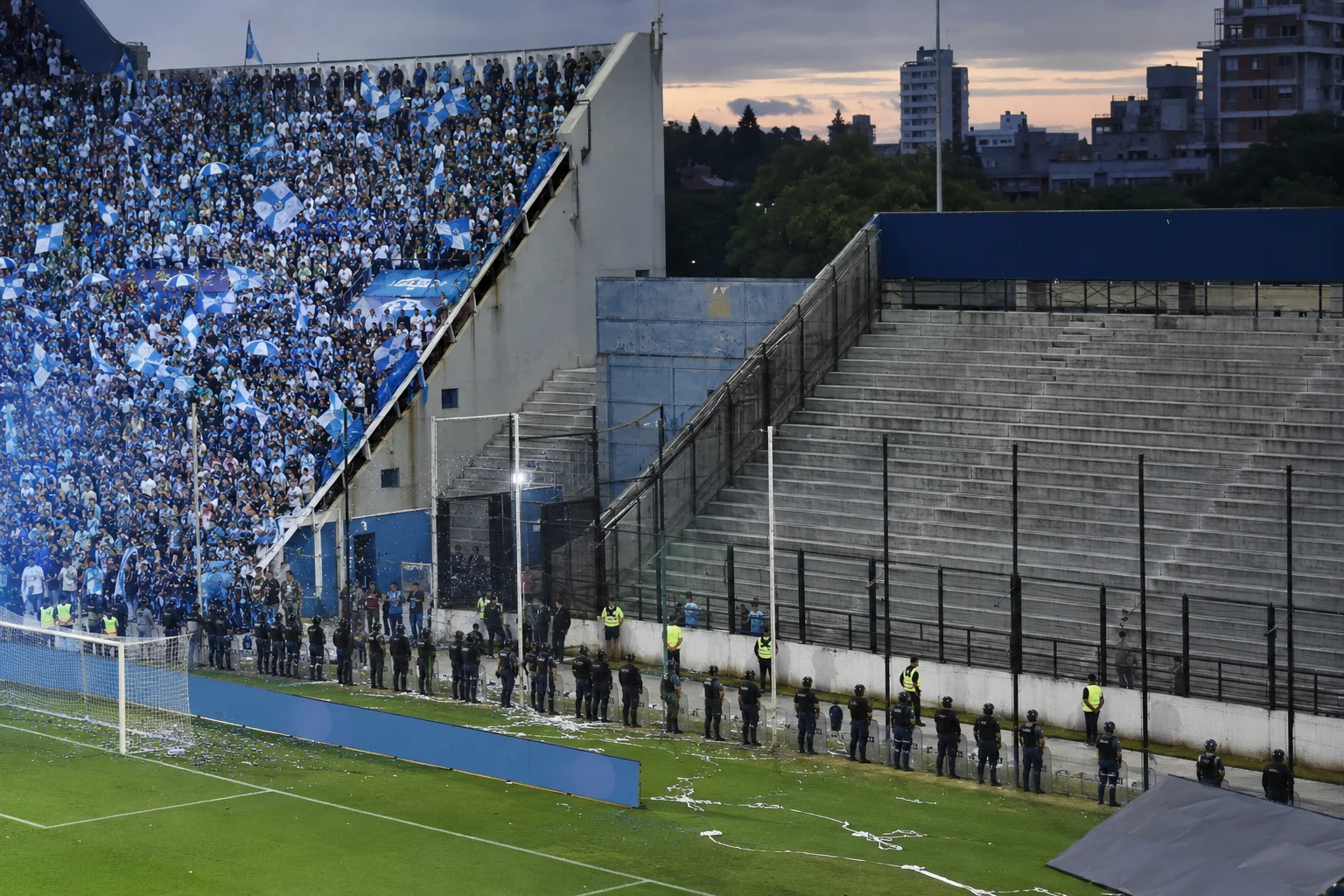
On 10 June 2013, a match between Estudiantes and Lanus at the Estadio Unico in La Plata was abandoned at half time after Lanus supporter Javier Gerez died during clashes with police outside the ground. Within a day, the Argentine Football Association had banned visiting supporters from every division across the country.
That ban held for more than 12 years. An entire generation of Argentine players and supporters grew up in stadiums where one end was permanently empty, in a country where more than 70 supporters had been killed since 2000. The measure did not stop the deaths, which continued in disputes between rival factions of the same club's barrabravas.
In July 2025 the AFA began reversing it, starting with test fixtures in Buenos Aires Province including Rosario Central's visit to Lanus and River Plate's trip to Instituto. Away sections now return club by club, each one requiring separate approval from security authorities. It is the largest deliberate removal of a supporter group in the modern game, and it is only partly undone.
Istanbul: the night 41,000 women filled a stadium men were barred from
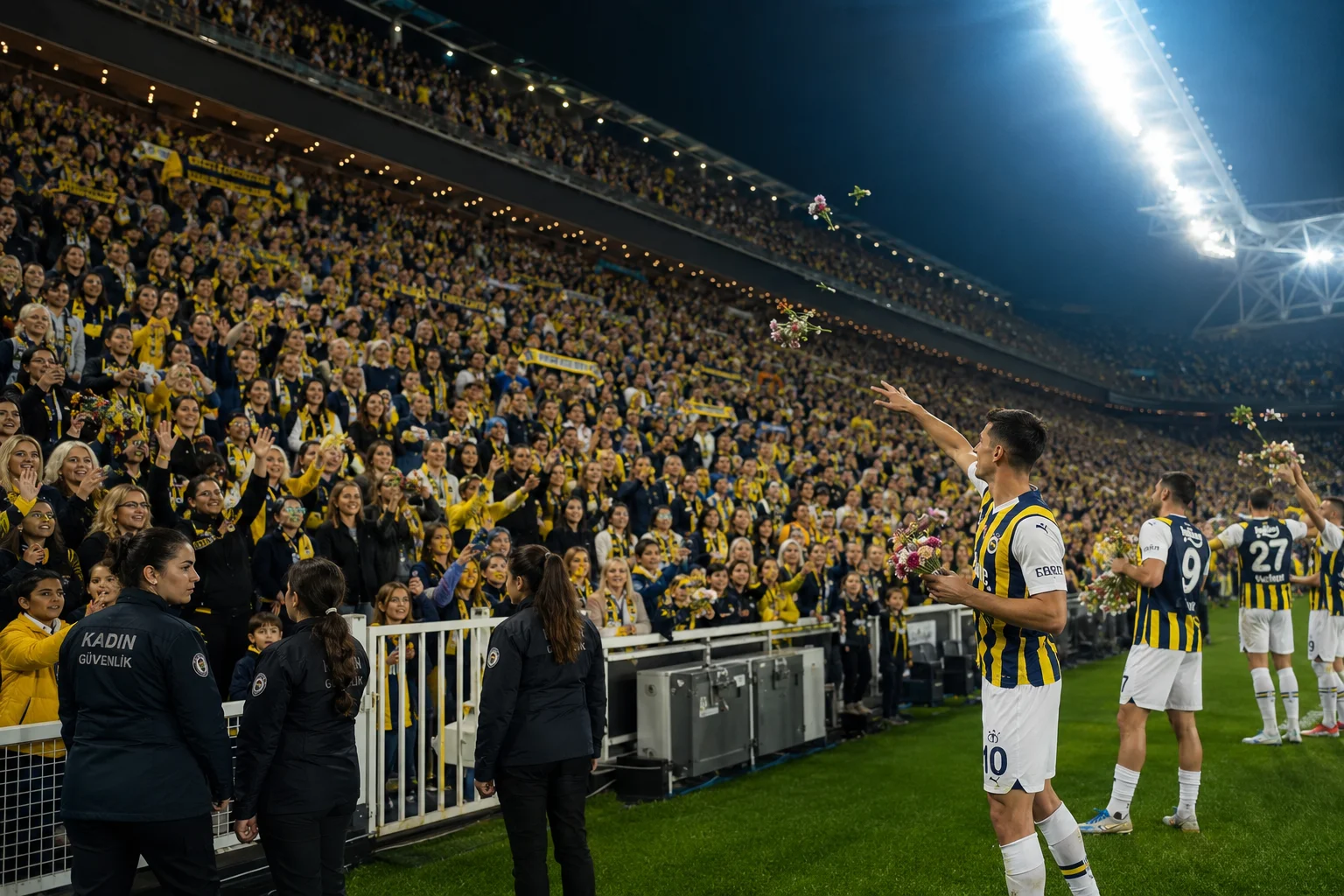
After Fenerbahce supporters invaded the pitch during a pre-season friendly against Shakhtar Donetsk in July 2011, the club was ordered to play two home matches behind closed doors. The Turkish Football Federation then changed the rule. Rather than an empty ground, clubs sanctioned for crowd trouble would admit women and children under 12 only, free of charge.
On 20 September 2011 more than 41,000 women and children filled the Sukru Saracoglu Stadium for the visit of Manisaspor. Female police officers ran the searches. Players from both sides threw flowers into the stands before kick off, and the visiting team was applauded rather than jeered. The match finished 1-1.
The idea has been imitated occasionally elsewhere, but never at that scale. It remains the single most successful punishment in football history, in the sense that the punishment produced a better atmosphere than the crime. Tickets for Fenerbahce fixtures now sit in one of Europe's most competitive resale markets.
WhatsApp channel
Sports news straight to your phone
Match updates, on-sale dates and ticket news from 1BoxOffice.
Bilbao: the club that has refused to sign outsiders since 1912

Athletic Club will only field players born in the Basque Country or developed at a Basque academy. The club names the seven territories it recognises: Biscay, Gipuzkoa, Alava, Navarre, Labourd, Soule and Lower Navarre. The rule has run since 1912, it is not written into competition regulations anywhere, and it applies to the women's team as well as the men's.
The club motto puts it bluntly: con cantera y aficion, no hace falta importacion. With an academy and supporters, imports are not needed. Franco's government demanded the policy be abandoned in 1942 and the club refused. Coaching staff are exempt, which is why Athletic have been managed by Englishmen, Hungarians and Argentines while never signing a player from outside the region.
The commercial argument against it is obvious and it has never won. Athletic are one of only three clubs never relegated from La Liga, alongside Real Madrid and Barcelona, and they have eight league titles. Watching Athletic Bilbao at San Mames is the closest the modern game gets to a squad the crowd genuinely grew itself.
Germany: the ownership rule that keeps the terrace standing
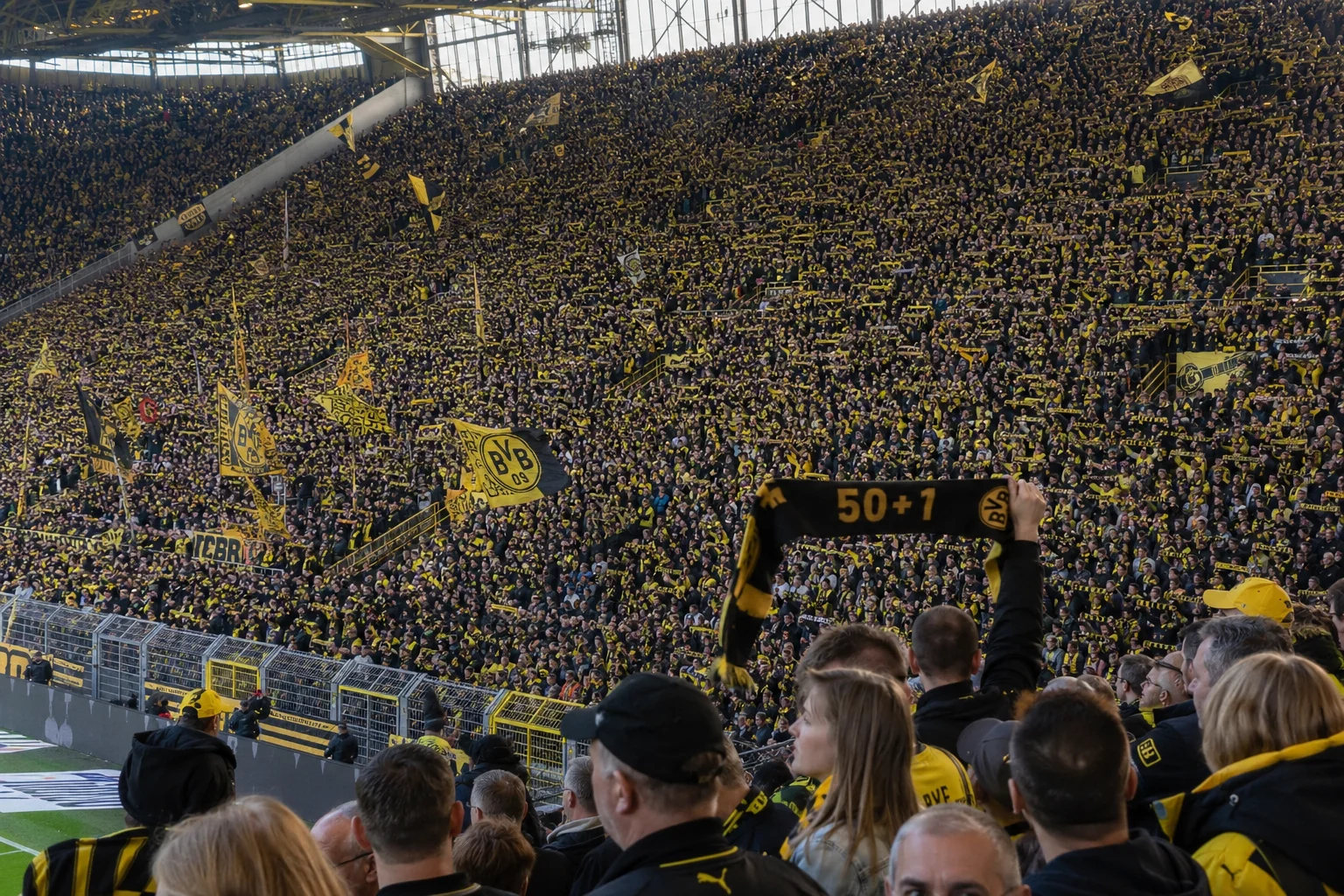
The Yellow Wall at Dortmund is filmed constantly and explained rarely. Its 24,454 standing capacity is the largest terrace in European football, and it exists because of a governance rule rather than a design choice.
The 50+1 rule, written into Deutsche Fussball Liga statutes in 1998, requires the members' association to hold a majority of voting rights in the professional company. Dortmund is the clearest illustration: the members' club holds a small minority of the listed company's shares but owns the management company outright, which is where control actually sits. Investors can buy in. They cannot take over.
The downstream effects are what supporters actually feel. Standing sections survived in Germany when they were legislated away in England. Season tickets stayed within reach of ordinary wages. Average league attendances are the highest in world football. Signal Iduna Park holds 81,365 for Bundesliga matches and drops to 66,099 for UEFA fixtures, because European competition requires all-seated grounds and the terrace has to be converted. That gap of roughly 15,000 seats is the price German supporters pay for European nights, and most of them think the trade is worth it. Borussia Dortmund tickets for the Sudtribune remain among the hardest in Europe to obtain at face value.
Glasgow: how Celtic quietly brought standing back to Britain
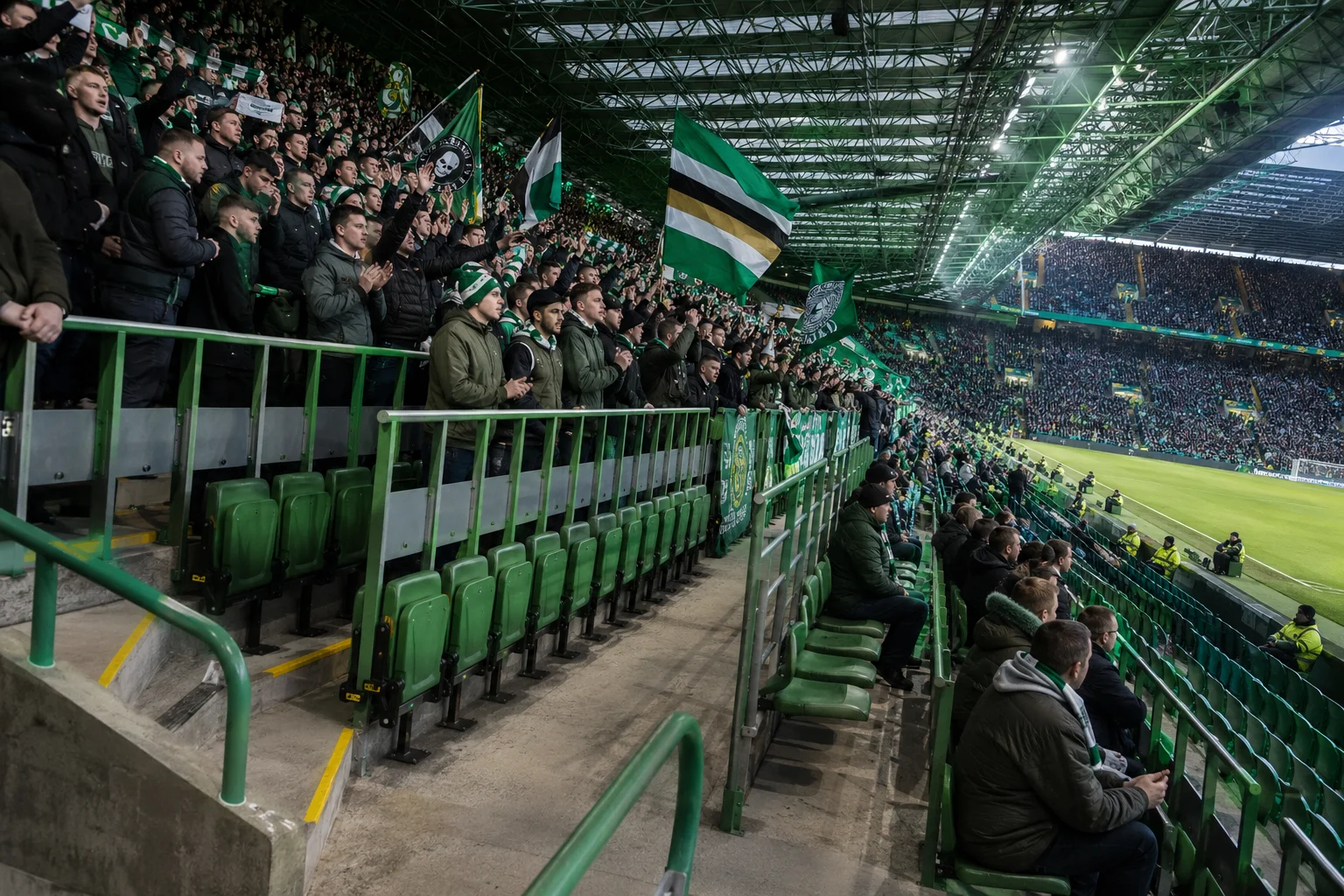
Standing was legislated out of the top two English divisions after the Taylor Report into the Hillsborough disaster. Scotland was never bound by the same law, and Celtic spent five years and two rejected applications persuading Glasgow City Council to let them test an alternative.
In July 2016 the club opened a 2,600-capacity rail seating section in the Lisbon Lions Stand, home to the Green Brigade. Rail seats lock upright for standing and fold down when regulations require seating, so the same section can be reconfigured between a league match and a European tie. Celtic demonstrated exactly that within a week, switching the area to seated for a Champions League qualifier and back to standing for the next friendly.
That single installation is the reason the argument changed in England. Licensed standing was permitted in the Premier League and Championship from the 2022/23 season. Liverpool now operate 13,300 rail seats across the Kop and the lower Anfield Road Stand. If you have stood at Anfield recently, you were standing because of a decision taken at Celtic Park a decade ago.
Athens: the gate where the poorest supporters sat
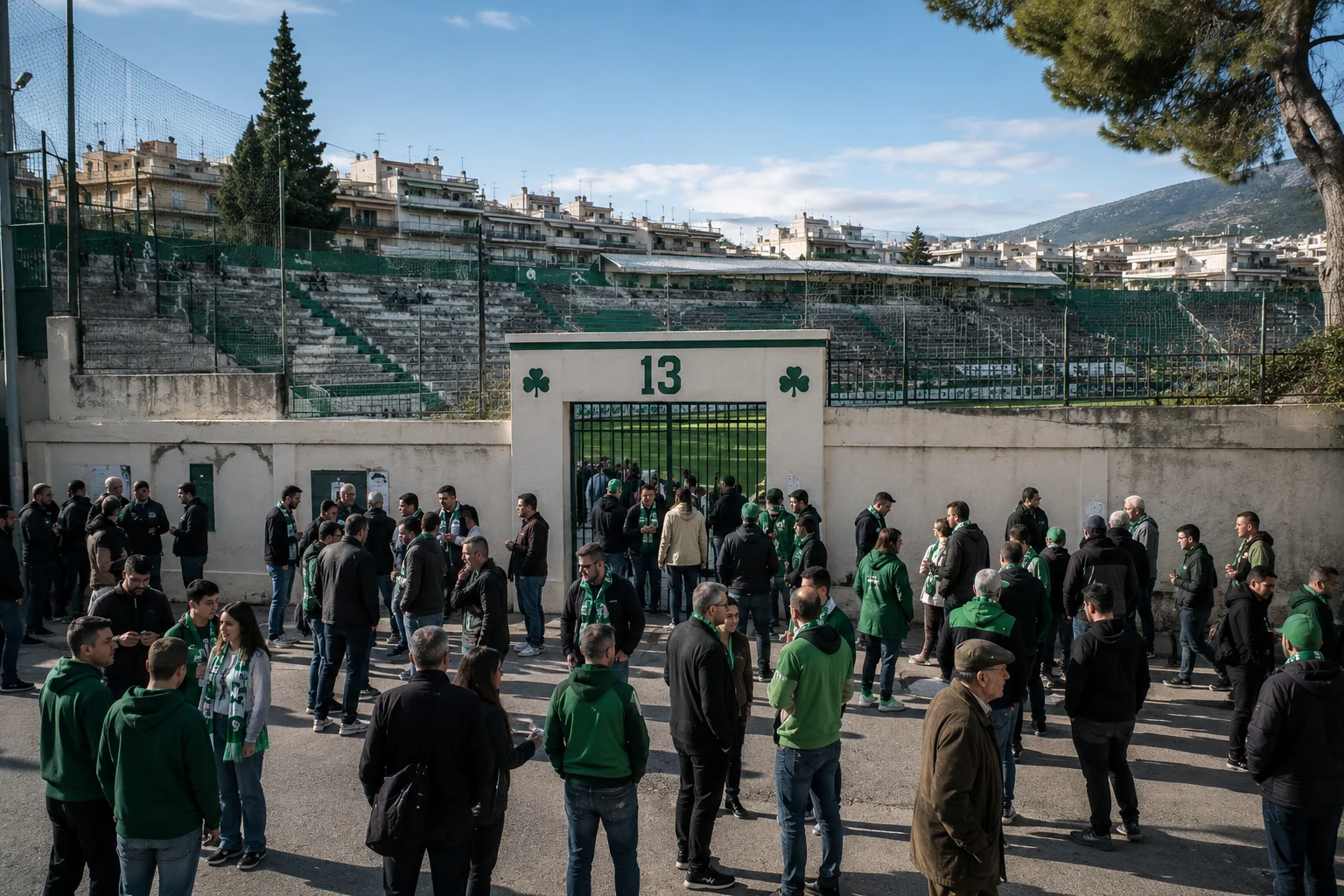
Gate 13 was formally founded on 19 November 1966 and is the oldest supporters' union in Greece. The name is literal. Through the late 1950s the most committed Panathinaikos supporters met at the 13th gate of the Apostolos Nikolaidis Stadium, and they met there for a reason: the seats behind that gate were unnumbered, which made them the cheapest in the ground.
That detail explains a lot about European ultras culture generally. Organised support did not begin with choreography or pyrotechnics. It began with the people who could only afford the worst seats finding each other in the same place every fortnight and deciding that this made them a group.
Gate 13 suspended activity during the military dictatorship between 1967 and 1974, then reformed. It now runs subgroups across Greece, Cyprus and the diaspora, and it holds enough weight to influence club decisions. Panathinaikos tickets for European fixtures sell into a market shaped almost entirely by that group's travel.
Egypt: the decade played to empty seats
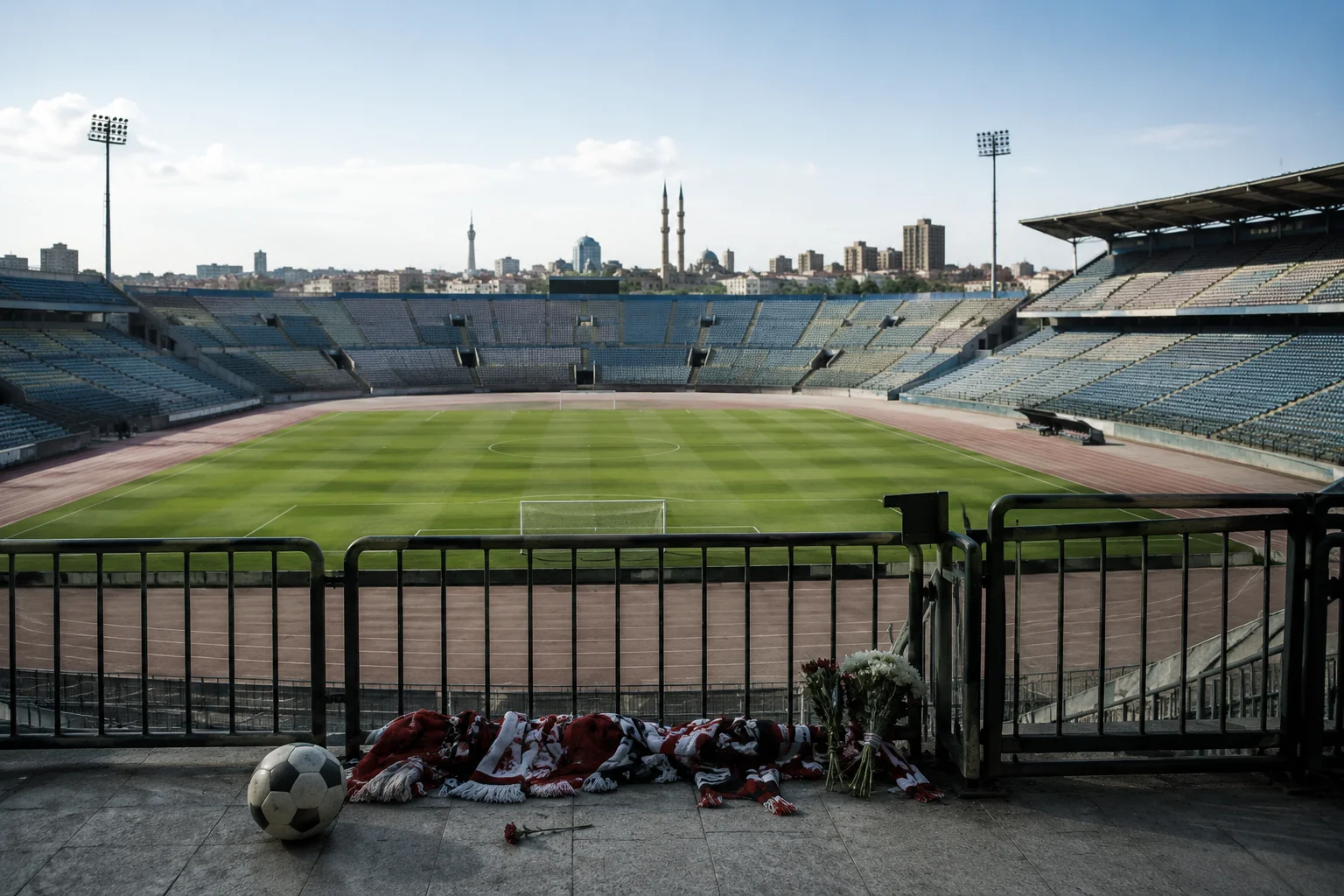
On 1 February 2012, Al Masry beat Al Ahly 3-1 at Port Said Stadium. Home supporters stormed the pitch and the stands. Seventy-four people died, most of them young Al Ahly supporters aged between 13 and 20, and more than 500 were injured. Many of the deaths were caused by a crush at gates that had not been opened.
The domestic league was suspended. When it returned, supporters largely did not. Egyptian football was played in front of empty stands for around six years, with occasional exceptions for continental and international fixtures. An attempted reopening in February 2015 ended with 20 or more Zamalek supporters dying in a crush outside the Air Defence Stadium, and the restrictions were reimposed. Limited crowds were only formally permitted again from 2018, capped initially at 5,000 for domestic matches.
Ultras Ahlawy, founded in 2007, had been a visible force in the 2011 revolution before Port Said, and Egyptian courts later designated ultras groups as terrorist organisations. The point for anyone reading about supporter culture is uncomfortable but worth stating plainly: fan groups are political actors in some countries, and states treat them accordingly. Fixtures for Al Ahly and Zamalek now run in front of crowds again, but nothing about that was inevitable.
Tehran: the stadium called Freedom
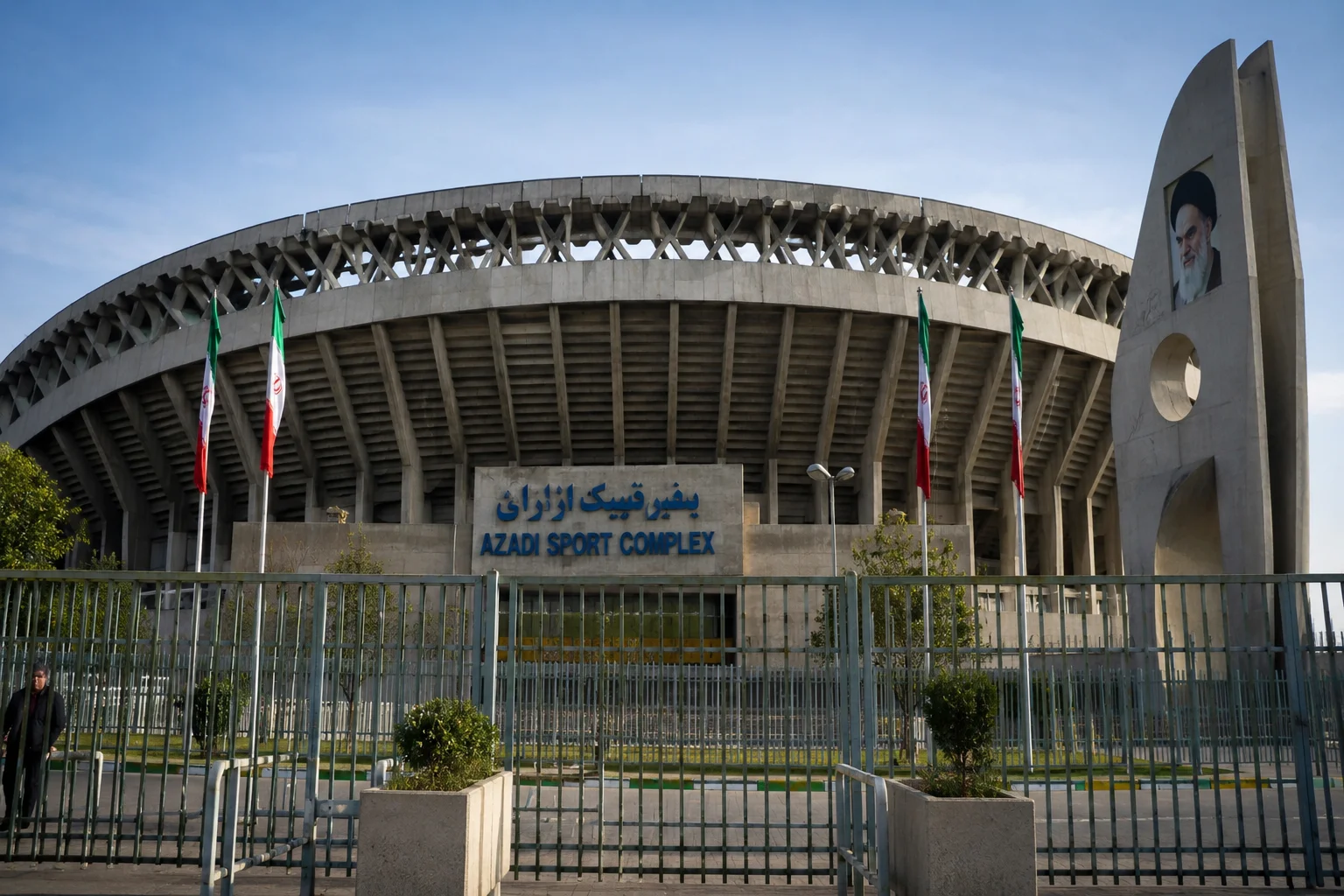
Azadi means freedom in Persian. Iranian women were barred from the stadium that carries that name for close to four decades after 1981, under an enforced convention rather than a written law.
In September 2019 Sahar Khodayari, known as the Blue Girl for Esteghlal's colours, died after setting herself alight outside a Tehran court where she faced prosecution for entering a stadium disguised as a man. Football's world governing body then set a deadline. In October 2019 around 3,500 women attended Iran's World Cup qualifier against Cambodia at Azadi, seated in a separate section under female stewarding.
Access since has been inconsistent rather than resolved. Women were pepper-sprayed while trying to enter a qualifier in Mashhad in March 2022. In May 2025 Iran moved a World Cup qualifier out of Mashhad entirely to Tehran, after reports that local religious authorities would only permit the fixture if women were excluded. Attendance for Iranian women is now decided venue by venue and match by match.
Jeddah: the gate that opened in January 2018
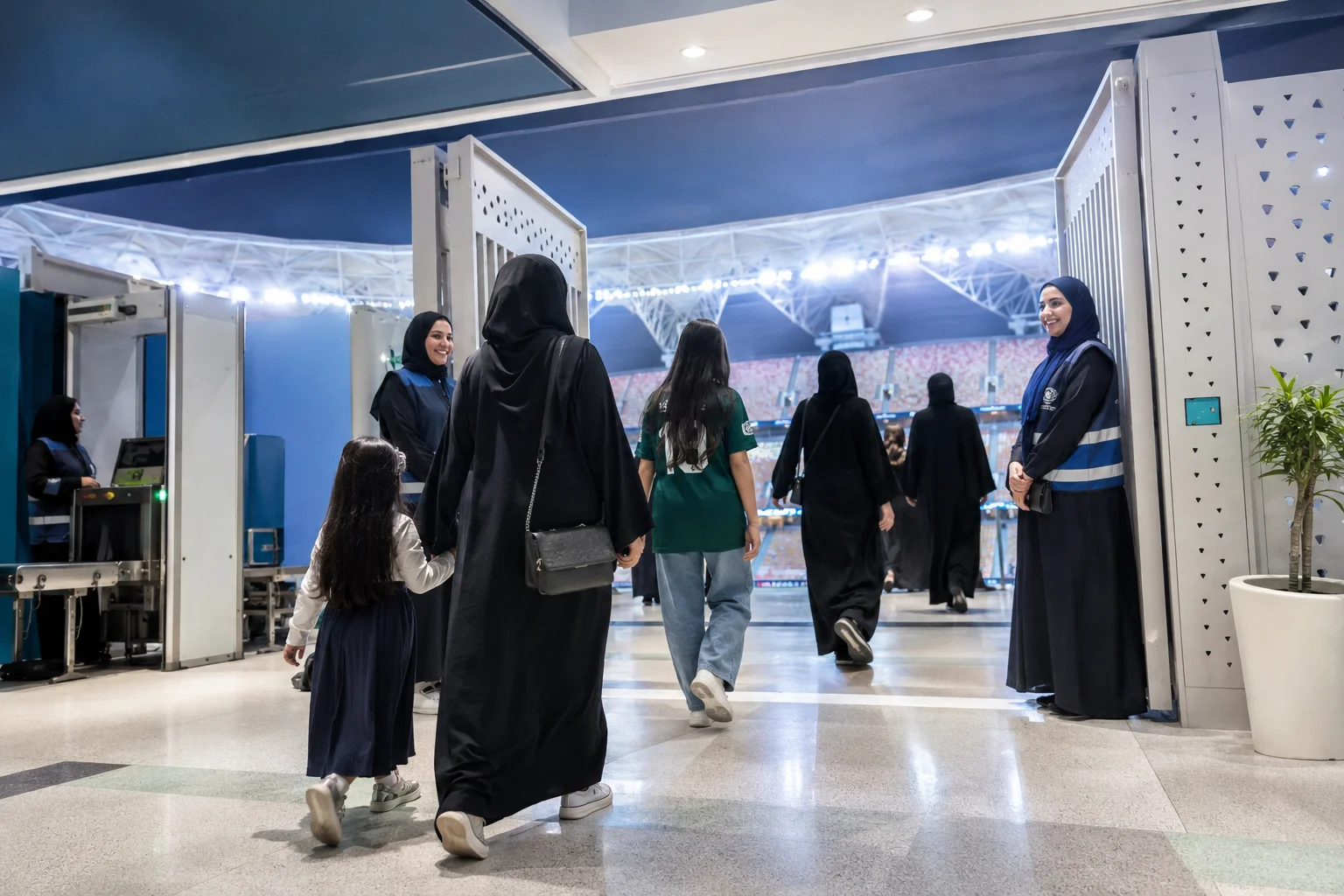
Saudi Arabia admitted women to a football stadium for the first time on 12 January 2018, when Al Ahli played Al Batin at King Abdullah Sports City. Al Ahli won 5-0. Separate family entrances were opened, staffed by female attendants, with dedicated prayer areas and medical facilities inside the designated sections.
Two further fixtures followed within a week, in Riyadh and then Dammam, opening three of the country's largest grounds. The move came months after the decree permitting women to drive, and a women's league followed in 2020.
For anyone travelling from the Gulf, this is the most recent structural change to a matchday anywhere. Riyadh derbies between Al Hilal and Al Nassr now draw crowds that would have been demographically impossible eight years ago, and the domestic league has since become a destination for players who would once have finished their careers elsewhere.
Saitama: the banner that emptied a 63,000-seat stadium
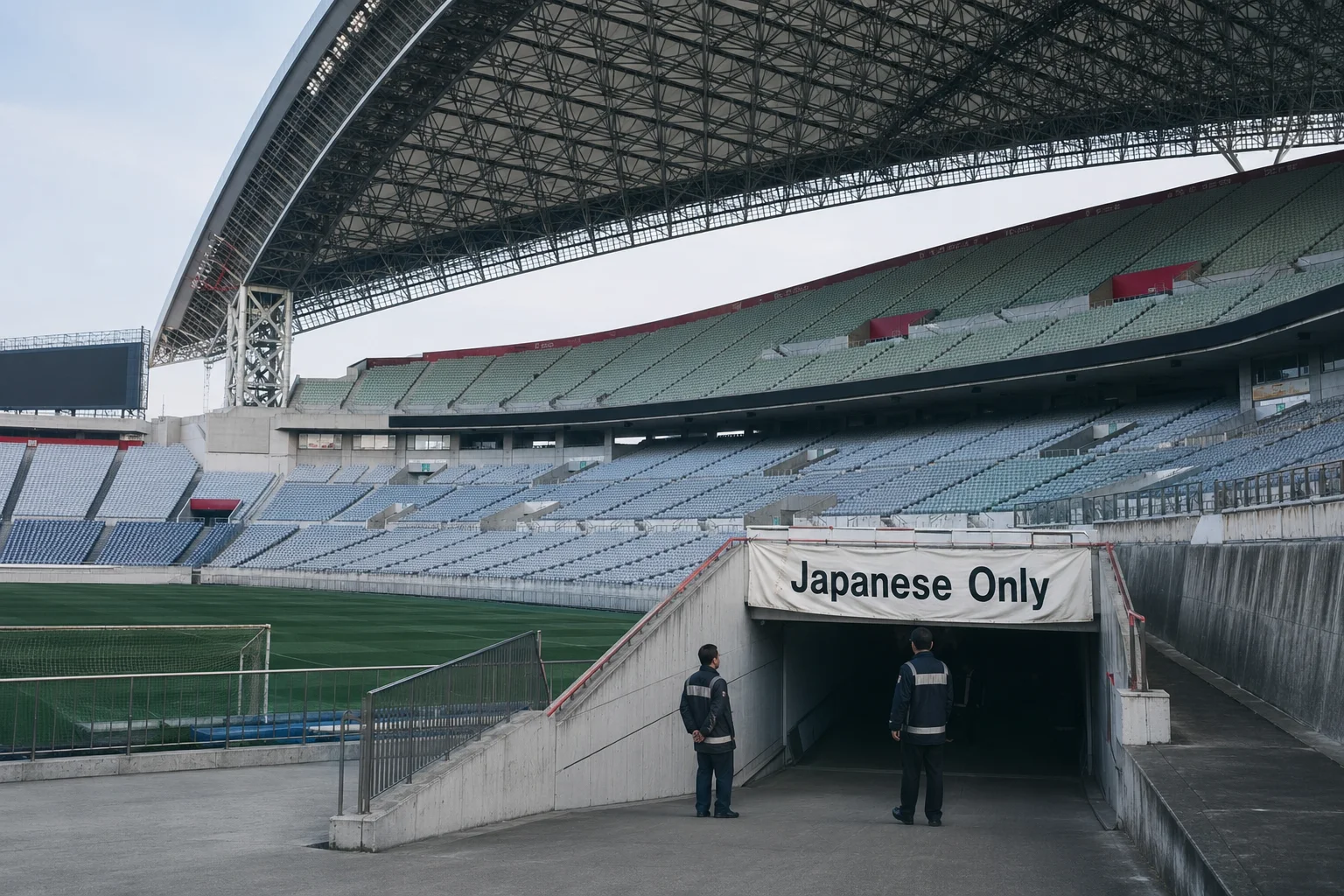
On 8 March 2014, supporters of Urawa Red Diamonds hung a banner reading "Japanese Only" over an entrance to the home end at Saitama Stadium during a match against Sagan Tosu. Stewards flagged it. The club did not remove it until the game had finished, later saying it had not initially judged the banner discriminatory.
The J.League's response was the harshest sanction in its history to that point. Urawa's next home fixture, against Shimizu S-Pulse on 23 March, was played in a completely empty 63,000-seat stadium. The club banned around 20 members of the supporters' group involved, prohibited all banners and flags at home matches, and the president returned three months of salary.
Japanese supporter culture is usually described abroad through the tidying of stands after matches. The more instructive story is this one: a league that punished its best-supported club by taking its crowd away entirely, immediately and in public. Urawa Red Diamonds remain Japan's best-attended club.
Amsterdam: the nickname the city is still arguing about
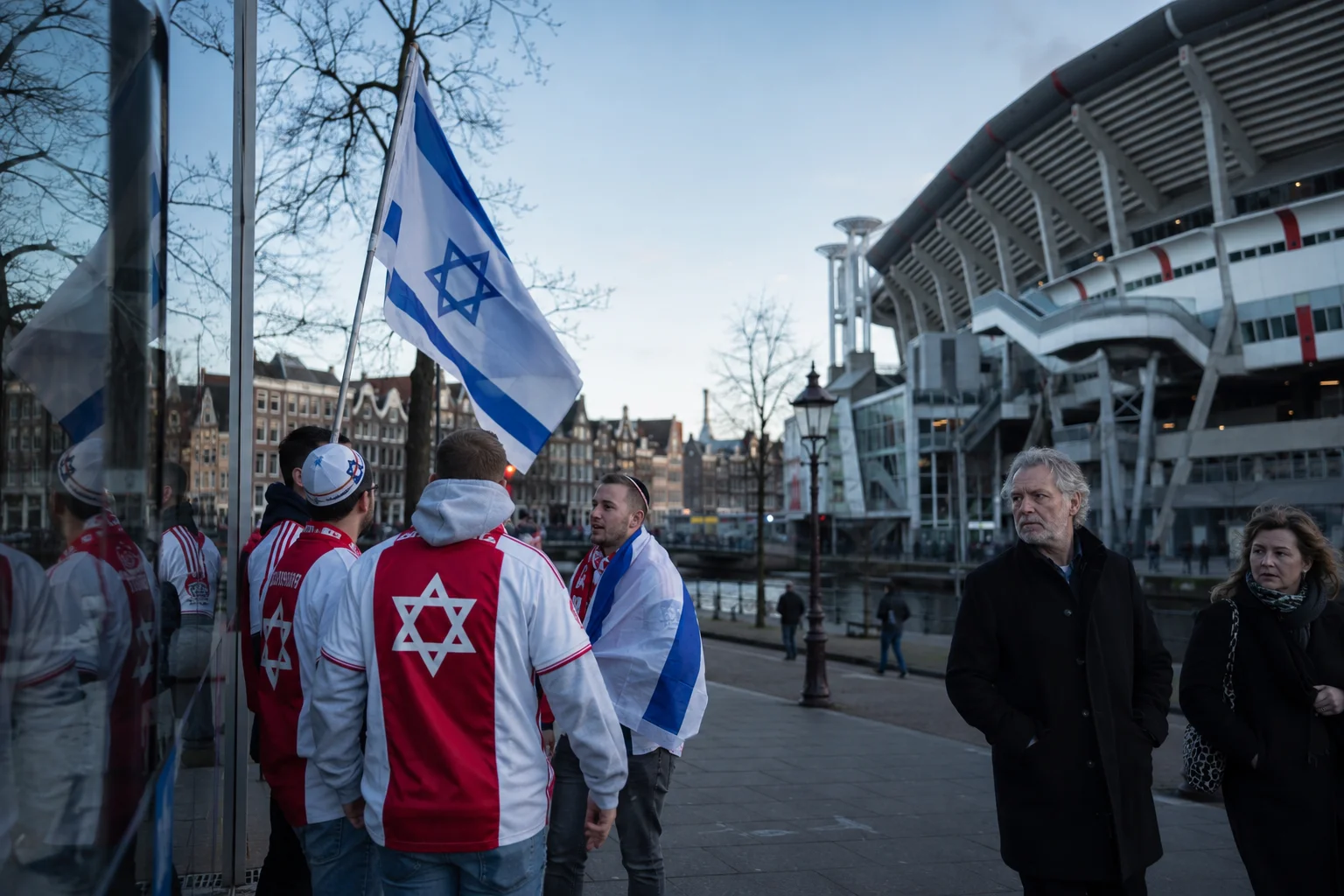
Ajax supporters call themselves Super Joden, Super Jews. They wave Israeli flags, wear the Star of David and chant about being Jewish. Very few of them are.
The origin is geographic and historical. Amsterdam had a large Jewish population before 1940, concentrated in neighbourhoods that opposing supporters walked through to reach the old ground, and Ajax had prominent Jewish directors and players in the 1960s and 1970s. Rival supporters used that as an insult. From the 1970s, Ajax supporters took the insult and wore it.
The result is genuinely contested. Reappropriation normally involves the group being targeted, and here it mostly does not. Many Jewish Amsterdammers find the practice offensive, the club has spent years discouraging it, and rival chants about gas chambers have never stopped. It is the strongest available argument that supporter identity, once formed, cannot simply be corrected by the institution that carries it. Ajax tickets for European fixtures sell to an audience that mostly does not know any of this.
Iceland and Lanarkshire: the clap that was never Viking
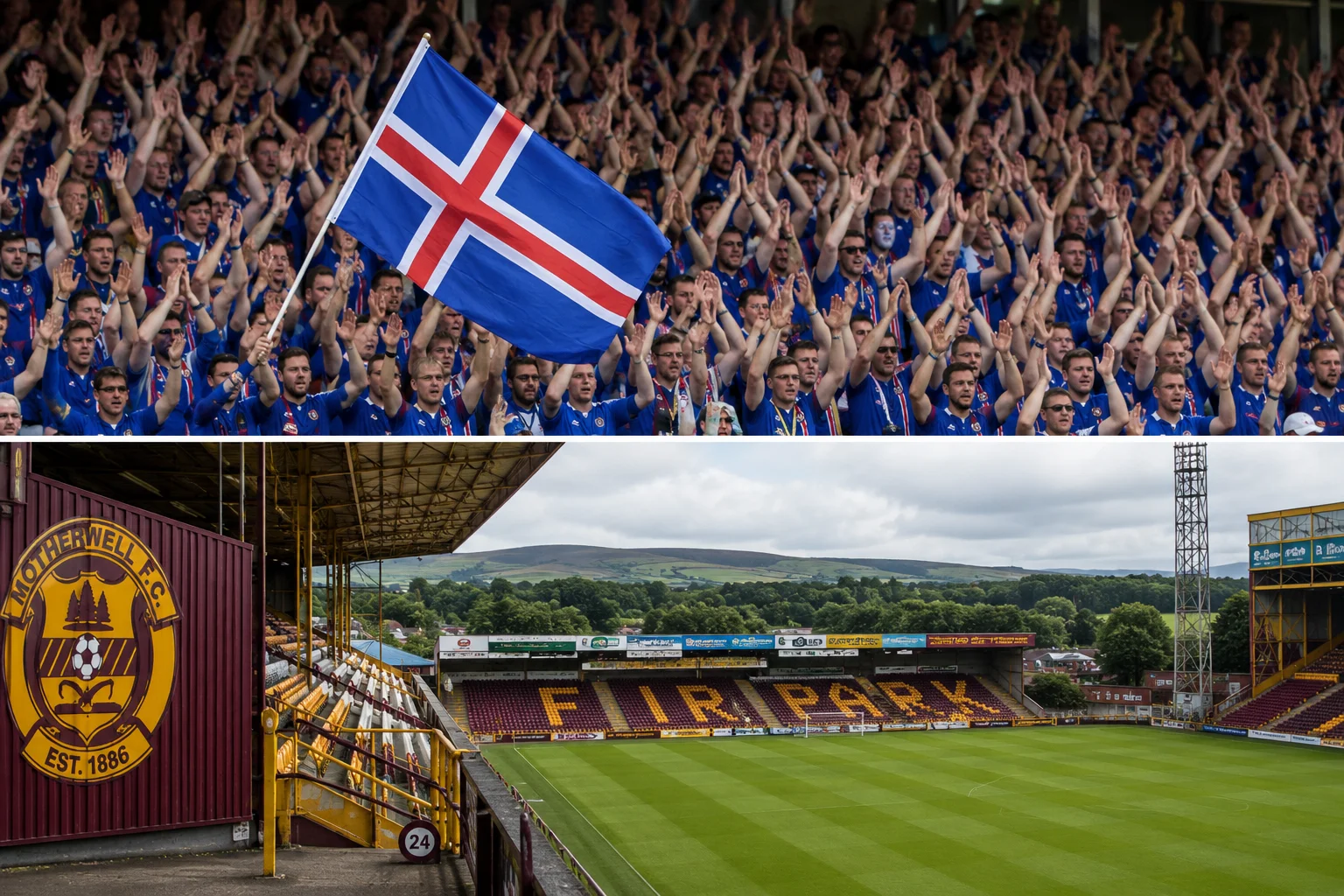
The slow, accelerating clap that Iceland's supporters made famous at Euro 2016 has no connection to Norse history whatsoever. It arrived at Fir Park.
In July 2014, Icelandic side Stjarnan drew 2-2 with Motherwell in a Europa League qualifier in Lanarkshire before winning the tie 5-4 on aggregate. A small group of travelling Stjarnan supporters heard the Motherwell version and took it home. Iceland's national supporters' group adopted it, and by 2016 the world had decided it was ancient. The treasurer of the Tolfan supporters' group has said plainly that it came from Scotland and owes more to the film 300 than to Vikings.
The claim is not entirely uncontested. Supporters of RC Lens argue a version of it existed in northern France decades earlier, and AEK Athens fans used a similar clap from the mid-1990s. What is clear is that the specific chant the world copied travelled from a 12,000-capacity ground in Scotland to a European Championship in two years.
What these 13 have in common
Read together, a pattern emerges that most coverage of supporter culture misses entirely.
- Atmosphere is usually downstream of law and governance, not temperament. Germany stands because of an ownership rule. England stopped standing because of legislation, then restarted because a Scottish club proved a technical alternative worked.
- Most great supporter groups began with the cheapest seats in the ground, not the most passionate people in the city.
- Identity is inherited. Kolkata's fish, Bilbao's territories and Amsterdam's nickname all predate anyone currently in the stand.
- The most drastic sanctions in football history have been applied to crowds rather than players: an empty Japanese stadium, an empty Egyptian league, an entire country without away supporters for 12 years.
- Access is the live issue everywhere. Who is allowed in has changed more in the past decade, in Saudi Arabia, Iran, Argentina and England, than anything about how the game is played.
Seeing them for yourself
Nine of the 13 clubs and leagues named here are reachable on a standard European or Gulf itinerary. If you are building a trip around atmosphere rather than fixtures, the practical advice is dull but sound: buy for the competition rather than the opponent, check whether the ground converts between standing and seated for European nights, and read the away allocation rules before assuming you can sit with the home crowd.
Our Estádio da Luz guide covers the same ground for a single venue, with transport, seating and entry detail.
FAQs
1. What is a tifo and who pays for one?
-
A tifo is a large coordinated display of banners, cards or painted sheets, and it is almost always funded by the supporters' group itself through collections rather than by the club.
2. Do visiting supporters get a guaranteed allocation in European competition?
-
UEFA regulations require host clubs to make at least five per cent of stadium capacity available to the visiting club in its senior club competitions, which is why away ends exist in Europe even where domestic leagues restrict them.
3. Are flares and pyrotechnics legal inside stadiums?
-
In England and Wales, possessing a flare or smoke device at a designated football match is a criminal offence under the Sporting Events (Control of Alcohol etc.) Act 1985, and pyrotechnics are prohibited across UEFA competitions regardless of local tolerance.
4. Can a visiting fan buy a ticket in an ultras section?
-
Usually not directly, because most organised sections are allocated through membership schemes or the group itself, and several clubs also require a registered fan card for those areas.
5. Which league has the highest average attendance in the world?
-
The Bundesliga, which combines large capacities with retained standing areas and comparatively low admission prices.
1BoxOffice has been listing tickets for clubs across Europe, the Gulf and Asia since 2006, and every order carries a 150% money-back guarantee if an event is cancelled and not rescheduled.
Sources: BBC Sport, Bundesliga, Borussia Dortmund, Human Rights Watch, Arab News, Olympics.com, Inside FIFA, Buenos Aires Herald, Inside World Football.