In this guide
What Actually Happens When a Player MovesThe Six Main Ways a Deal Can Be StructuredTransfer Windows: Why Deals Only Happen Twice a YearWho Sits Around the TableThe Rulebook, From Bosman to DiarraThe Money Rules That Now Drive Every WindowRecords, Sagas and Deadline Day ChaosReading Transfer News Like an InsiderFAQsClubs spent a record $9.76 billion on international football transfers in 2025, according to FIFA, a jump of roughly 50 per cent on the year before. Yet the system that moved all that money is being rewritten. A European court ruling won by former midfielder Lassana Diarra in October 2024 forced FIFA to tear up parts of its rulebook, and a full replacement takes effect on 1 January 2027. If you have ever wondered what a Bosman actually is, why Spanish clubs talk about release clauses or how a deal really gets done on deadline day, this guide covers all of it.
Transfers shape everything supporters care about, from title races to ticket demand. A marquee signing can transform interest in a fixture overnight, which is why Premier League tickets for a new star's debut are often among the fastest sellers of any season. Understanding how players move helps you understand why those matches matter.
What Actually Happens When a Player Moves

A transfer is not really the sale of a player. It is one club paying another to release a player from his contract early so he can sign a new one elsewhere. The fee is compensation for tearing up the old deal. That distinction explains almost everything else about the system, including why out-of-contract players move for nothing.
A typical deal runs through six stages. First, the buying club approaches the selling club for permission to talk. Speaking to a contracted player without it is called tapping up, and it carries real consequences: the 2005 Ashley Cole affair, sparked by a secret London hotel meeting between Cole, Jose Mourinho and Chelsea officials, ended with £450,000 in combined fines. Second, the clubs agree a fee, usually structured as an up-front payment plus instalments, add-ons and often a sell-on clause giving the seller a cut of any future sale.
Third come personal terms: wages, signing-on fee, image rights, agent fees and contract length, which FIFA caps at five years, or three for players under 18. Fourth is the medical, and deals genuinely die here. Loic Remy's 2014 move to Liverpool collapsed over a heart concern, while Nabil Fekir's 2018 switch to the same club fell apart so late that a welcome interview had reportedly already been filmed. Fifth, for cross-border moves, the selling association issues an International Transfer Certificate through FIFA's Transfer Matching System. Sixth, the player is registered with his new league, and only then is he eligible to play.
England adds one more hurdle since Brexit. Every overseas signing needs a Governing Body Endorsement from the FA, earned automatically through international appearances or via a points system covering league quality, minutes played and continental pedigree.
The Six Main Ways a Deal Can Be Structured
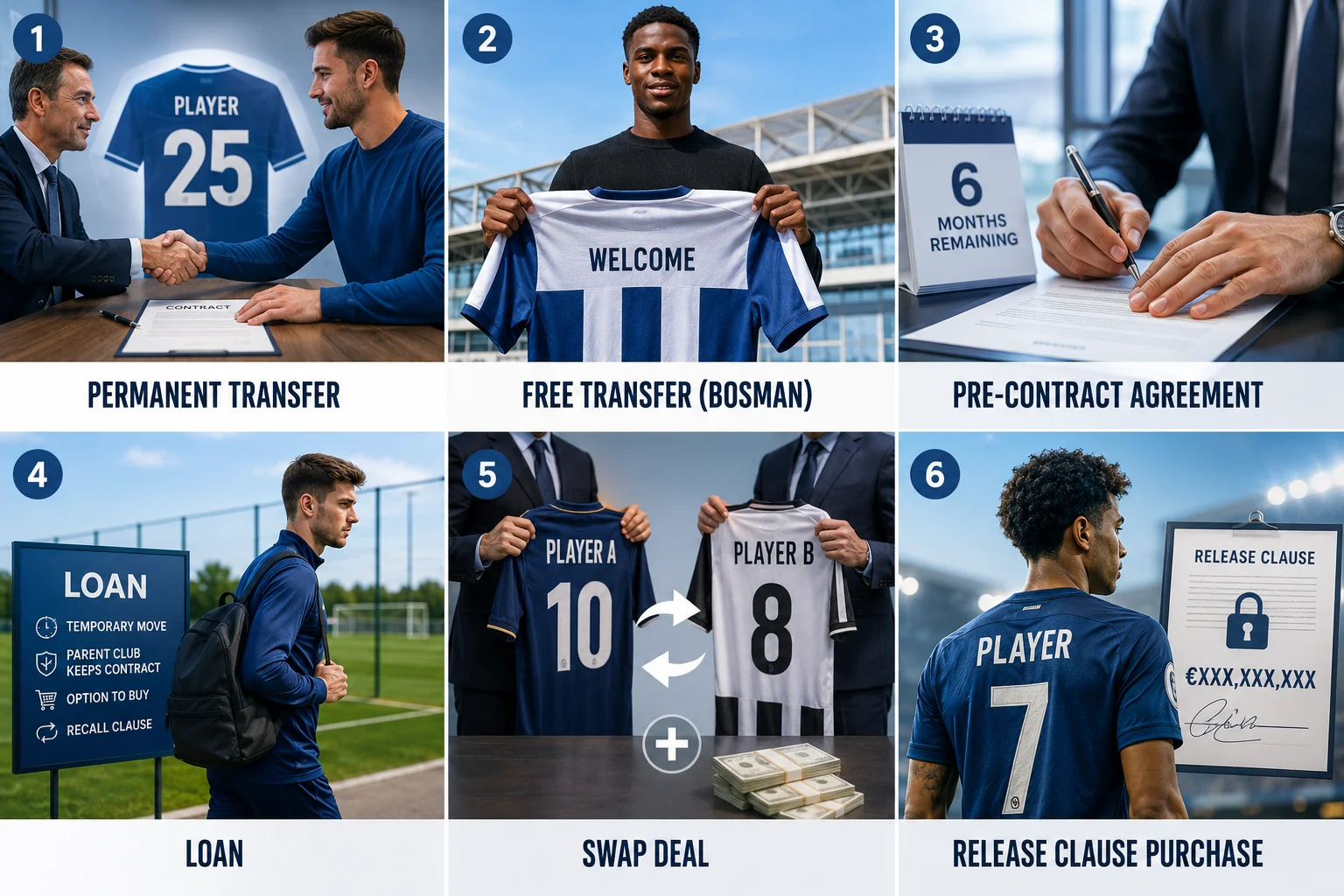
Not every move involves a nine-figure fee. These are the structures that cover almost every transfer you will read about.
- Permanent transfer. The standard move: a fee, a new contract, registration transferred for good. Fees are increasingly back-loaded with instalments and performance-based add-ons, which is why headline figures often say "up to".
- Free transfer, or Bosman. A player whose contract has expired moves for no fee. Sol Campbell walking from Tottenham to Arsenal in 2001 remains the most notorious example, and Robert Lewandowski and Andrea Pirlo both changed European football on frees.
- Pre-contract agreement. In the final six months of his deal, a player can sign with a foreign club in advance and join for nothing at expiry. This is the Bosman rule working forwards rather than backwards.
- Loan. A temporary move while the parent club keeps the underlying contract. Variants include options to buy, obligations to buy triggered by promotion or appearances, wage splits such as Manchester United subsidising Alexis Sanchez's salary at Inter and recall clauses. FIFA now caps clubs at six international loans in and six out per season to kill off so-called loan armies.
- Swap deal. Two players exchanged, sometimes with cash to balance the books. The Arthur Melo and Miralem Pjanic exchange of 2020 was structured as two separate sales so Barcelona and Juventus could each book a paper profit, an arrangement that later fed the Juventus accounting scandal and a points deduction.
- Release clause purchase. A pre-agreed figure at which the selling club must let a player go. Spain goes further: every contract in La Liga must contain a buy-out clause the player himself can pay to walk away.
That Spanish quirk produced the most famous transfer of all. In August 2017 Neymar's lawyers deposited €222 million with La Liga on his behalf, funded by Paris Saint-Germain, to buy out his Barcelona contract. Nine years on, no club has come close to breaking that record.
Transfer Windows: Why Deals Only Happen Twice a Year
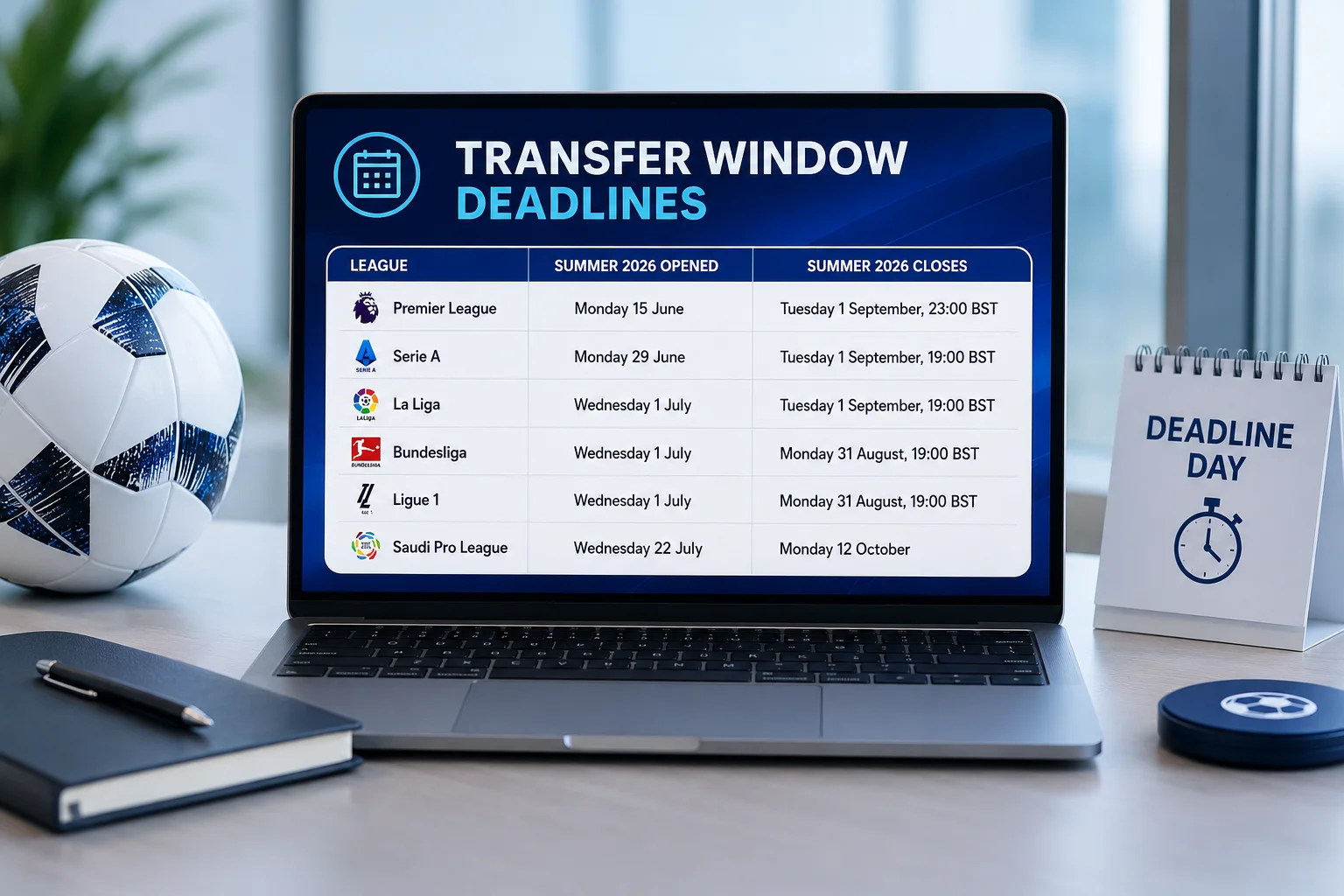
Registration periods, to give windows their formal FIFA name, arrived in the 2002-03 season as part of a compromise with the European Commission after the Bosman ruling. Before that, English clubs could trade through the season up to a late-March deadline, a system dating back decades. FIFA now permits two windows per year: a longer between-seasons window of up to 12 weeks and a mid-season window of up to four, with exact dates set by each national association.
One detail catches many fans out. A window only restricts incoming signings. A club whose window has shut can still sell to a league whose window remains open, which is exactly how Saudi clubs kept buying European players deep into autumn.
| League | Summer 2026 opened | Summer 2026 closes |
|---|---|---|
| Premier League | Monday 15 June | Tuesday 1 September, 23:00 BST |
| Serie A | Monday 29 June | Tuesday 1 September, 19:00 BST |
| La Liga | Wednesday 1 July | Tuesday 1 September, 19:00 BST |
| Bundesliga | Wednesday 1 July | Monday 31 August, 19:00 BST |
| Ligue 1 | Wednesday 1 July | Monday 31 August, 19:00 BST |
| Saudi Pro League | Wednesday 22 July | Monday 12 October |
The 2026 summer window has been an odd one, overlapping the World Cup in the USA, Mexico and Canada, with the new Premier League season pushed back to 22 August to give players recovery time. England's deadline also returned to 11pm this year after two seasons of a 7pm finish, with the familiar two-hour grace period for deals whose paperwork, the deal sheet, was lodged in time. The winter window across Europe's big five leagues then runs from 1 January to early February 2027. Free agents, players with no club at all, can sign at any point of the year, window or not.
WhatsApp channel
Sports news straight to your phone
Match updates, on-sale dates and ticket news from 1BoxOffice.
Who Sits Around the Table

Every deal involves at least three parties: the player, the buying club and the selling club. Around them sits a small industry. Sporting directors and recruitment departments identify targets and lead negotiations. Lawyers draft the contracts. Leagues and national associations act as registrars, FIFA regulates the whole system globally and its Clearing House, launched in late 2022, routes training rewards to the clubs that developed each player: training compensation for youth development plus a solidarity payment of five per cent of every international fee, shared among the clubs that trained the player between 12 and 23.
Then there are the agents. FIFA reintroduced a licensing exam in 2023 and tried to cap agent fees, but courts in England and Germany found the caps breached competition law and FIFA suspended them worldwide at the end of that year. As of mid-2026 the caps remain frozen while Europe's top court considers the question, which tells you how contested this corner of the business is. One thing is banned outright: third-party ownership, where investment funds own slices of a player's transfer rights. The Carlos Tevez and Javier Mascherano saga at West Ham in 2006, which cost the club a £5.5 million fine and a settlement with Sheffield United reported north of £20 million, led England to prohibit it in 2008 and FIFA to ban it globally in 2015.
The Rulebook, From Bosman to Diarra
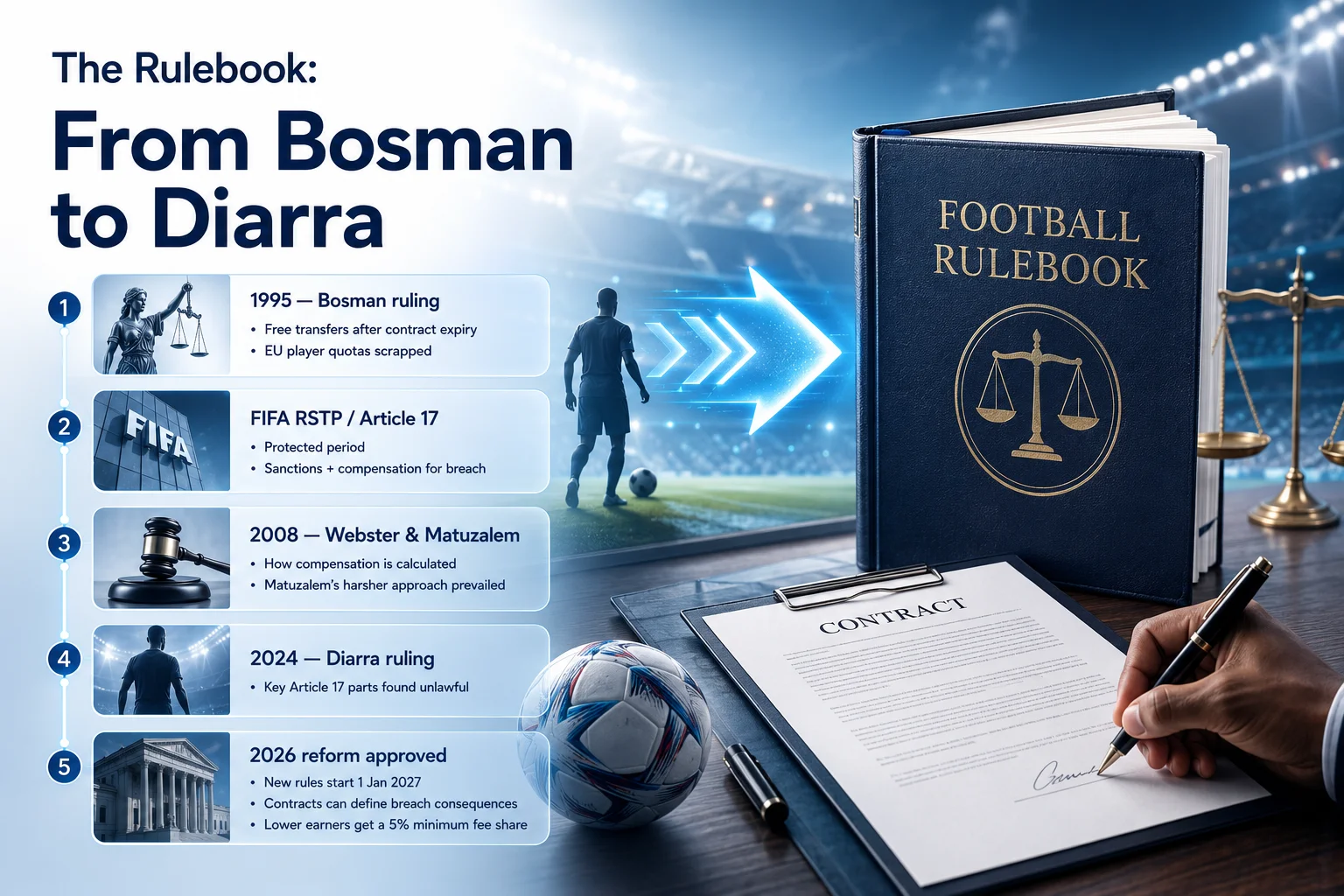
Modern transfer law starts on 15 December 1995, when the European Court of Justice ruled in favour of Jean-Marc Bosman, a Belgian midfielder whose club had demanded a fee even though his contract had expired. The judgment established free movement for out-of-contract players and abolished quotas on EU nationals, reshaping squads across the continent. Bosman himself never benefited: the five-year fight effectively ended his career.
The framework that followed, FIFA's Regulations on the Status and Transfer of Players, built in a protected period during which breaking a contract triggers sporting sanctions and an Article 17 mechanism for calculating compensation when a player walks afterwards. Two 2008 cases at the Court of Arbitration for Sport, Webster and Matuzalem, fought over how that compensation should be measured, with the harsher Matuzalem approach, based on a club's full loss, winning out.
Then came Diarra. On 4 October 2024 the Court of Justice of the EU found core parts of Article 17 unlawful: the rule making a player's new club automatically liable for his compensation, the presumption that the new club induced the breach and the power to withhold a transfer certificate during a dispute. FIFA issued emergency interim rules within three months, was hit by a collective claim said to represent around 100,000 players and, on 10 June 2026, approved a wholesale reform agreed with the players' union FIFPRO, club and league bodies. The new system, in force from 1 January 2027, lets clubs and players define breach consequences in their contracts up front and guarantees lower-earning players a minimum five per cent share of their own transfer fee. It is the biggest rewrite of the transfer system since 2001, and its effects will play out for years.
The Money Rules That Now Drive Every Window

Financial regulation increasingly decides who can buy. UEFA's squad cost ratio caps spending on wages, amortised fees and agent costs at 70 per cent of football revenue. The Premier League voted in November 2025 to replace its £105 million three-year loss limit with its own squad cost ratio of 85 per cent from the 2026-27 season, aligning at 70 per cent for clubs in Europe.
Accounting shapes deals too. Transfer fees are amortised, spread across the length of a contract, so an £80 million signing on an eight-year deal costs only £10 million a year on paper. Chelsea pushed this to its limit with contracts such as Mykhailo Mudryk's eight and a half years, the longest in Premier League history, until UEFA and then the Premier League capped amortisation at five years in 2023. Break the rules elsewhere and the punishment is a transfer ban: Barcelona in 2014, Real Madrid and Atletico Madrid in 2016 and Chelsea in 2019 were all barred from registering players over breaches of FIFA's strict protections on signing minors, which prohibit most international moves for under-18s.
Records, Sagas and Deadline Day Chaos

The world record has travelled a long way from Willie Groves, whose £100 move from West Bromwich Albion to Aston Villa in 1893 scandalised Victorian England, and Alf Common, the first £1,000 player in 1905. Trevor Francis became Britain's first £1 million footballer in 1979, Diego Maradona broke the world record twice in the 1980s and Zinedine Zidane's £46 million switch to Real Madrid set the 21st century benchmark before Neymar's €222 million redefined it entirely.
British records keep tumbling even if the world mark stands. In summer 2025 Liverpool paid a guaranteed £100 million for Florian Wirtz, then smashed the British record on deadline day with a £125 million move for Alexander Isak, capping a window in which Premier League clubs spent £3.19 billion, obliterating the previous high of £2.46 billion. The women's game is accelerating even faster: the world record has jumped from Keira Walsh's roughly £400,000 move to Barcelona in 2022 to Naomi Girma becoming the first million-dollar player in January 2025, Olivia Smith's £1 million switch to Arsenal that July and Lizbeth Ovalle's $1.5 million transfer to Orlando Pride weeks later.
Deadline day supplies the folklore. David de Gea's 2015 move to Real Madrid collapsed amid a paperwork and fax machine fiasco minutes from the deadline. Peter Odemwingie famously drove himself to QPR in January 2013 only to be turned away because the clubs had never agreed a deal. Contracts hide their own oddities: Stefan Schwarz's Sunderland deal reportedly banned him from space travel after an adviser booked a seat on an early commercial flight.
Reading Transfer News Like an Insider
 A few conventions decode the daily rumour churn. "Undisclosed fee" simply means neither club chose to confirm a number, so most published figures are journalists' estimates. "Up to £X" bundles conditional add-ons that may never be paid, meaning the guaranteed fee is always lower than the headline. A "medical pending" deal is agreed but not done, and plenty have died at that stage. And the tier system of transfer journalists, crowned by Fabrizio Romano's "here we go", exists because reliability varies wildly: club-verified reporting sits at the top, aggregator accounts at the bottom.
Deals collapse for four main reasons: failed medicals, fee disputes resurfacing late, personal terms breaking down and simple paperwork missing the deadline. When a big one completes, though, the effect reaches the stands quickly. Debut fixtures, derby meetings with a player's former club and a new signing's first home game are consistently among the highest-demand matches of any season, in England and across the Saudi Pro League alike.
FAQs
1. Can a club refuse to sell a player who wants to leave?
-
Yes, a club can reject any offer for a contracted player unless his contract contains a release clause that a bidder meets in full.
2. Do players receive a share of their transfer fee?
-
Traditionally no, although from January 2027 FIFA's reformed rules guarantee players earning up to €150,000 a season at least five per cent of their fee.
3. What happens to a transfer if the player fails his medical?
-
The buying club can walk away, renegotiate the fee downwards or restructure the deal around the medical risk, and nothing is binding until registration completes.
4. Are transfers between clubs in the same league treated differently?
-
Domestic deals skip the International Transfer Certificate but follow the same window, registration and financial rules as cross-border moves.
5. Why do some managers get sacked for tapping up but agents rarely do?
-
Agents are permitted to sound out interest on a player's behalf in ways clubs and their staff are not, which is why enforcement lands hardest on club officials.
Whenever the next record signing lands, the surest way to see them in the flesh is through a marketplace you can trust. 1BoxOffice has connected fans with matchday seats since 2006, backed by a 150% money-back guarantee on every order.
Sources: FIFA (inside.fifa.com, Regulations on the Status and Transfer of Players and 2025 international transfer report), Court of Justice of the EU judgment C-650/22 (Diarra, 4 October 2024), Premier League (premierleague.com), ESPN citing FIFA's Transfer Window Calendar (window dates), Sky Sports and BBC Sport transfer records reporting.