In this guide
1. The lines that end in handcuffs2. To sit or to stand3. Reading the away end4. The code nobody prints on a sign5. Matchday at the 2026 World Cup6. Sort this before you leave the house7. Beyond England: how the rules change abroadFAQsPolice made 1,932 football-related arrests across England and Wales in the 2024/25 season, according to the most recent Home Office figures, and public disorder was the single largest category at 32 per cent. A lot of that trouble was avoidable. Good football stadium etiquette is not really about manners: it is about knowing which behaviour earns you a criminal record, which gets you thrown out and which just earns you a row of unimpressed regulars.
Matchday conduct splits into three layers. There is the law, which can end in arrest and a banning order. There are the ground regulations printed on the back of your ticket, which stewards enforce on the day. And there is the unwritten code that every season-ticket holder knows, but no sign explains. This guide covers all three, whether you are heading to a Premier League fixture, a European away day or one of the knockout ties at the 2026 World Cup now underway across the United States, Canada and Mexico.
1. The lines that end in handcuffs
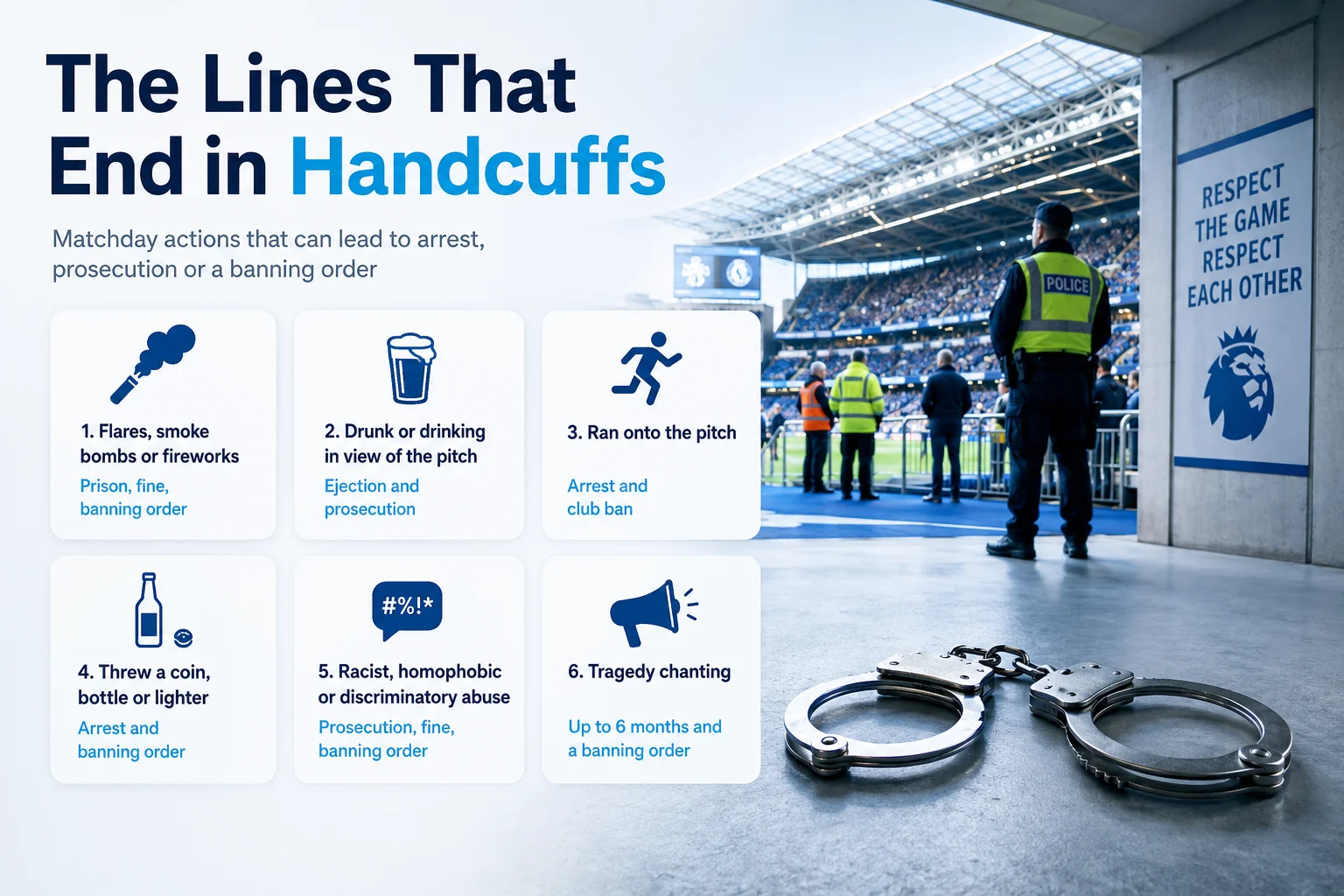
Some matchday behaviour is not a question of taste. It is a criminal offence, and the courts treat it seriously. The table below covers the ones that catch fans out most often, with the law behind each and the realistic consequence.
| What you did | The law | What can happen |
|---|---|---|
| Carried a flare, smoke bomb or firework | Section 2A, Sporting Events (Control of Alcohol etc.) Act 1985 | Up to 3 months in prison, a fine and a Football Banning Order |
| Drank alcohol in view of the pitch or arrived drunk | Sporting Events (Control of Alcohol etc.) Act 1985 | Ejection and prosecution |
| Ran onto the playing area | Football (Offences) Act 1991 | Arrest and an automatic club ban |
| Threw a coin, bottle or lighter | Football (Offences) Act 1991 | Arrest and a banning order |
| Racist, homophobic or discriminatory abuse | Football (Offences) Act 1991 and Crime and Disorder Act 1998 | Prosecution, a fine and a banning order |
| Mocked a disaster, known as tragedy chanting | Public Order Act 1986 | Up to 6 months and a banning order |
Flares and smoke bombs
Pyrotechnics look dramatic on a phone screen and ruin lives off it. Under section 2A of the Sporting Events (Control of Alcohol etc.) Under the 1985 Act, it is a criminal offence simply to have a flare, smoke bomb or firework while entering or inside a designated football ground. You do not have to light it. Courts hand out genuine custodial sentences, and fans with no previous convictions have been jailed for carrying a smoke bomb in a pocket. A conviction also forces the court to consider a banning order. The devices burn fiercely, cannot be put out with water and throw off thick, choking smoke in a packed stand, which is why stewards treat them as a serious threat rather than a bit of colour.
Drinking in your seat
England and Wales have an unusual rule that surprises visitors: you cannot drink alcohol in view of the pitch. The 1985 Act makes it an offence to possess alcohol anywhere the match can be directly watched, and to be drunk inside the ground or while trying to enter. It even bans carrying alcohol on a coach or train laid on to take fans to a game. That is why the concourse bars close before kick-off and shut again at half-time, and why stewards turn away anyone who has clearly had too much. You will not get your money back if you are refused entry.
Racist and discriminatory abuse
Racist abuse is treated as a crime in its own right, not as part of the atmosphere. Section 3 of the Football (Offences) Act 1991 makes indecent or racialist chanting at a designated match a specific offence, covering anything threatening, abusive or insulting to a person because of their colour, race, nationality or ethnic origins. Since 1999, the law has applied to a single person chanting alone, not only to a group, so "everyone else was doing it" is no defence. Where the abuse is racially or religiously aggravated, prosecutors charge the more serious offences under the Crime and Disorder Act 1998, which carry heavier sentences. On conviction, the court must consider a banning order, and clubs add their own bans on top.
This is not only a stadium problem. Online racist abuse aimed at players is pursued under the same approach, and the Home Office recorded 212 hate crimes connected to football in the 2024/25 season. Clubs and stewards want this reported, and most grounds run an anonymous text line for exactly that. If you hear it, the right move is to report it, not film it.
Tragedy chanting
The newest line in the law concerns tragedy chanting. In August 2023, the Crown Prosecution Service confirmed that abuse mocking disasters, whether in chants, on banners, on shirts or through gestures, is prosecuted as a public order offence. It covers references to Hillsborough, the Munich air crash, the Bradford fire and similar tragedies. The maximum sentence is six months, and a conviction can trigger a banning order. Prosecutors do not need to prove that anyone actually felt distress, only that the words were likely to cause it.
What a banning order means
A Football Banning Order, created by the Football Spectators Act 1989, is not a slap on the wrist. It bars you from attending matches for between three and ten years, can stop you going within a set distance of grounds on matchdays and can require you to surrender your passport before England play abroad or before a major tournament. Conduct counts as football-related even if it happens on the train home or up to 24 hours either side of the game. One bad decision can cost you several seasons.
2. To sit or to stand
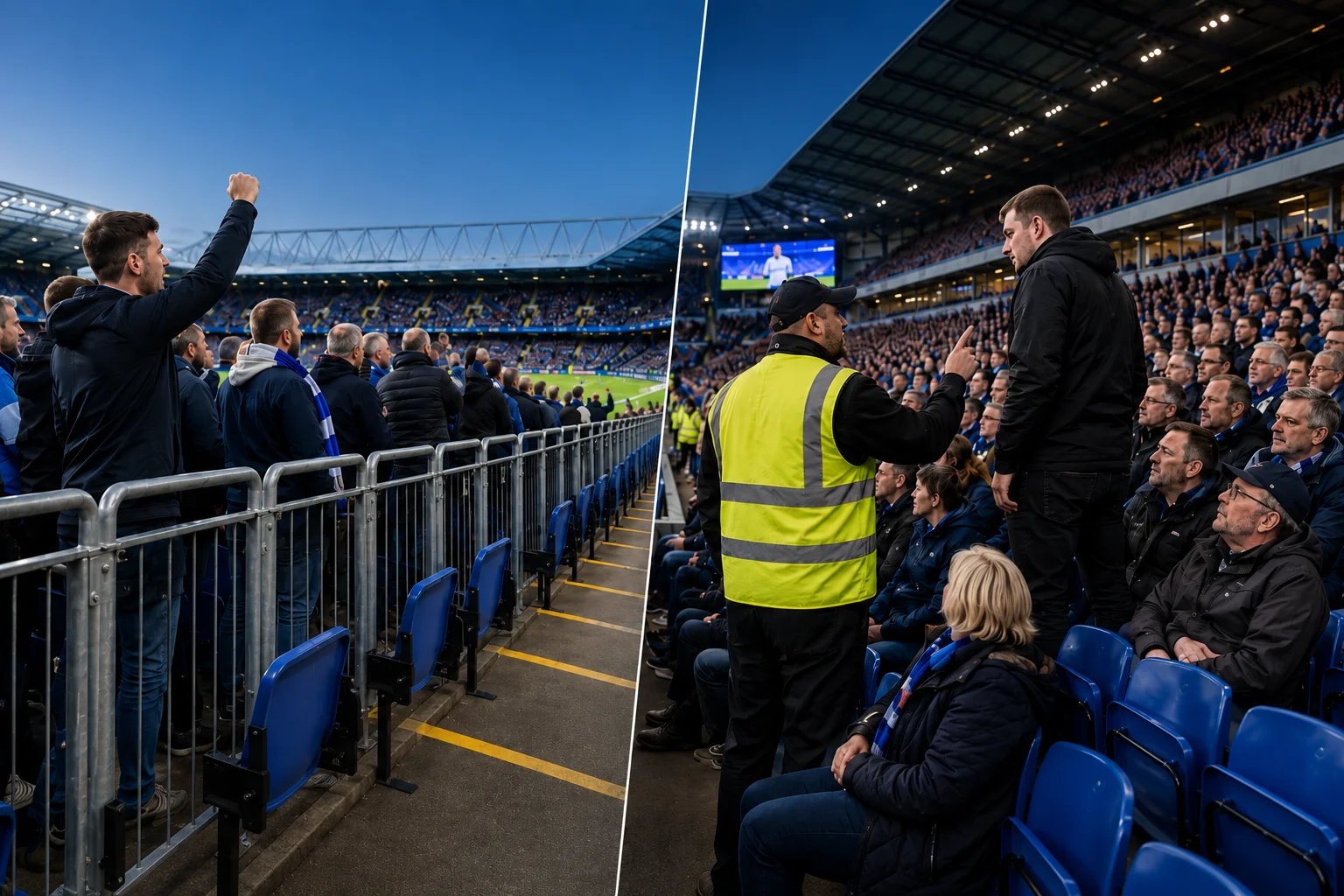
The most common matchday confusion is whether you are allowed to stand. The honest answer is: it depends on exactly where you are sitting. Licensed safe standing returned to the top two divisions from January 2022, starting with five early adopters and rolling out to all eligible clubs from the 2022/23 season. By 19 January 2026, the Sports Grounds Safety Authority had licensed safe-standing sections at 39 grounds. In those areas, each fan gets one numbered space behind a rail or barrier, and the seats are not locked, so you can still sit during a lull.
Outside a licensed rail-seated section, the rules are different. Grounds that have spent three seasons in the Premier League or Championship since 1994/95 are all-seater, a policy that followed Lord Justice Taylor's report into Hillsborough. Persistent standing in a normal seated area breaks ground regulations, blocks the view of people behind you and is exactly the safety problem the rails were built to fix. Stewards can ask you to sit and can eject repeat offenders. Some of the best-known ends now have rails, including the Kop at Liverpool, while showpiece venues such as Wembley stay overwhelmingly seated. If you want to stand for the whole match, buy into a safe-standing section. Standing terraces have been normal in Germany's Bundesliga for years, which is part of why English fans pushed so hard to get them back.
3. Reading the away end
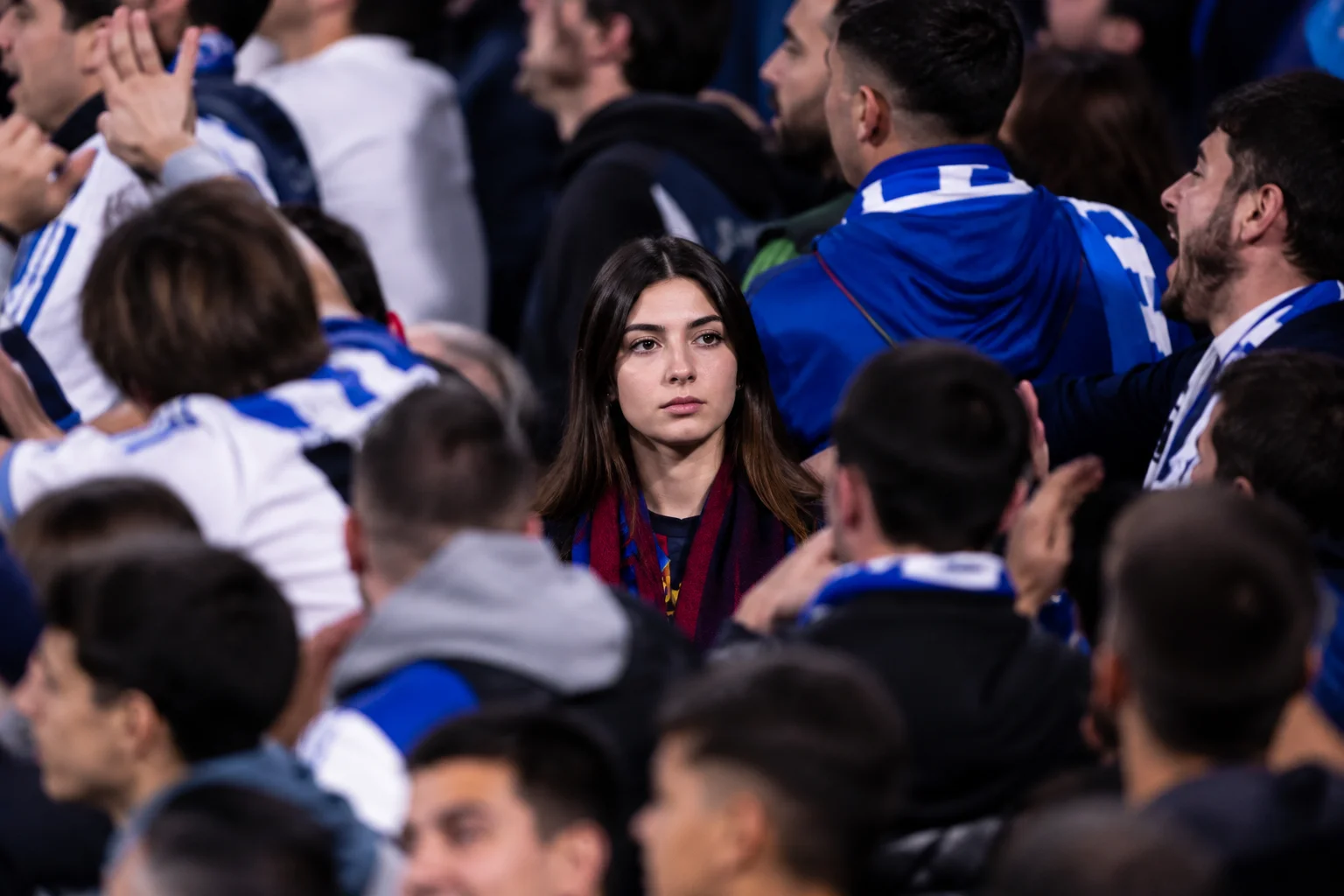
Away days have their own etiquette, and getting it wrong can be the difference between a great trip and a stressful one. Segregation is real, stewarded and there for a reason.
- Buy through the proper allocation. Turning up at the home end with an away ticket, or the reverse, is the quickest way to be moved or refused.
- Do not wear your colours in the home sections. Stewards may ask you to cover up, and in some grounds you will be relocated for your own safety.
- Standing is more widely tolerated in away ends, but the seats are still seats unless the section is rail-seated. Read the room and follow the stewards.
- Keep your phone in your pocket when you celebrate. Filming yourself in a packed away end, then losing your footing, is how people get hurt.
- Half-and-half scarves printed with both clubs' badges mark you out as a tourist in most home ends. Harmless, but expect the comments.
WhatsApp channel
Sports news straight to your phone
Match updates, on-sale dates and ticket news from 1BoxOffice.
4. The code nobody prints on a sign
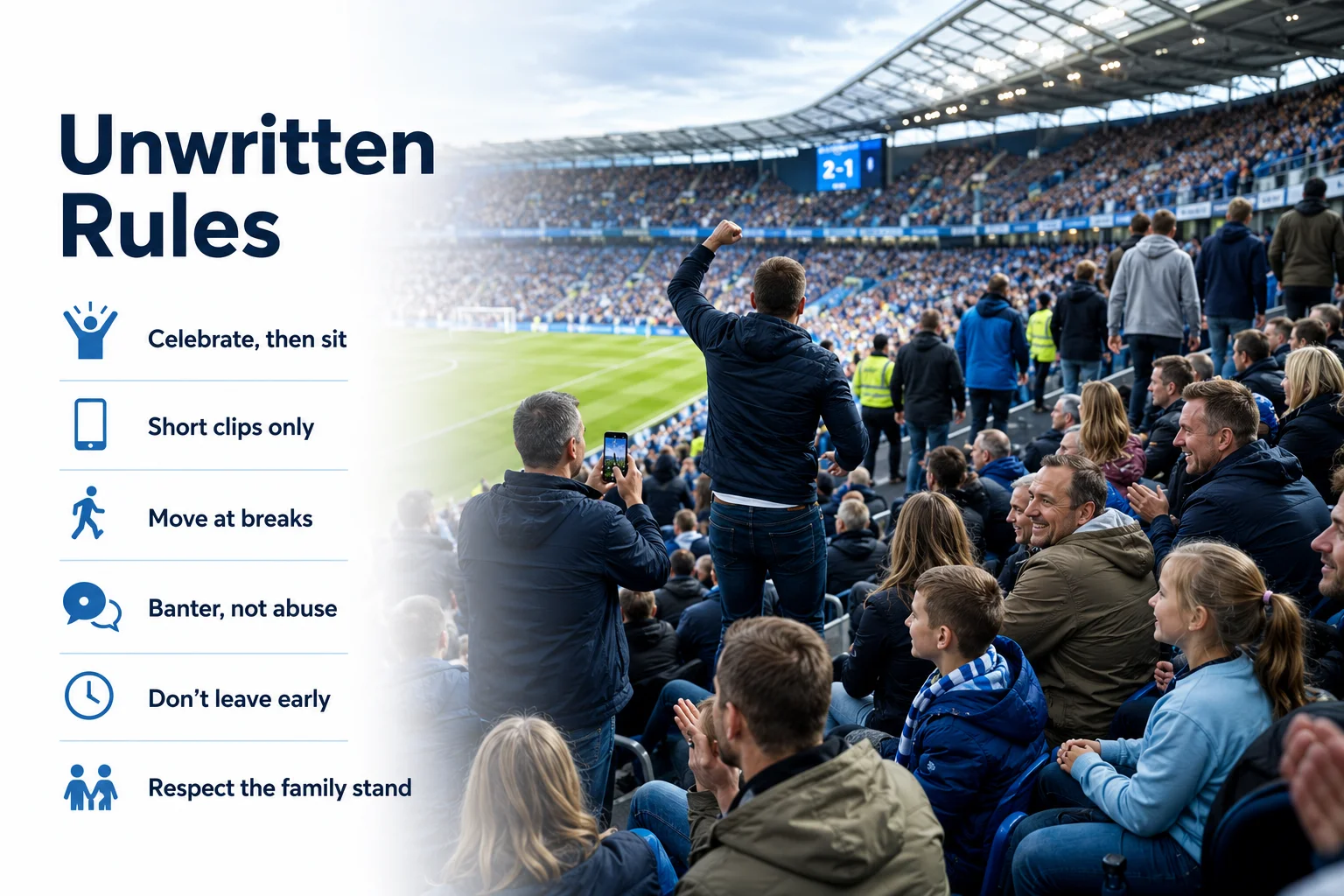
Beyond the law and the regulations sits the etiquette that regulars actually judge you on. None of it will get you arrested. All of it shapes whether the people around you are glad you turned up.
- Stand to celebrate a goal, then sit back down if you are in a seated area. Standing for the full match because you are excited blocks everyone behind you.
- Do not film the whole game. A few clips are fine. A raised phone for 90 minutes ruins the view for the row behind, and you will watch the match through a screen anyway.
- Time your trips to the concourse for the break in play, not the moment your team is on the attack. Shuffling along a packed row mid-move is a quick way to annoy a hundred people.
- Banter is part of the game; abuse is not. There is a clear line between winding up the away end and the kind of personal or discriminatory shouting that gets you reported.
- If you leave 85 minutes to beat the traffic, expect the ironic chant. It is your seat and your choice, but the culture frowns on it, especially when your side needs backing.
- Mind the family stand. Constant swearing in a row from a children's section is the fastest way to a steward conversation you did not want.
5. Matchday at the 2026 World Cup

The 2026 World Cup is the biggest tournament ever staged, with 48 teams across 16 host cities in the United States, Canada and Mexico, and the knockout rounds are under way now. The rules you know from your local ground do not all travel with you. Three things change the moment you walk into a World Cup venue.
- You are seated by allegiance, not simply home and away. Tickets go to supporters of both nations and to neutrals, and segregation at a neutral venue is tighter than on a domestic away day. Sit where your ticket places you and keep any rivalry to the football.
- The alcohol rule is not the English one. The ban on drinking in view of the pitch is an England and Wales law and does not apply in North America, so alcohol is sold inside many of the host stadiums. Policies still vary by venue and city, and public drinking laws differ across US states, Canadian provinces and Mexico.
- Entry is built around mobile tickets and tight security. Expect digital-only ticketing, strict bag limits and thorough screening at the gate. Some host venues may also ask for supporter identification, so our guide to whether a Fan ID will be required is worth a read before you book.
One home rule does follow England fans across the Atlantic. Anyone serving a Football Banning Order is required to surrender their passport for the tournament and is stopped from travelling to it at all. The conduct that earns a ban, the flares, the pitch incursions and the discriminatory abuse set out above, applies just as much at an England match in Atlanta or New York as it does at a league game in Manchester. A neutral crowd packed with families and first-time tournament-goers is also far less forgiving of it.
6. Sort this before you leave the house

Plenty of matchday stress is logistics, not conduct. A few minutes of preparation remove most of it.
- Check the bag policy. Most Premier League grounds now limit bags to roughly A4 size or run a bag-free policy, so confirm your club's rule before you set off.
- Carry a card. Many stadiums are cashless, including the bars and food kiosks, so do not rely on coins.
- Arrive early. Turnstiles, searches and mobile-ticket scanning all take time, and gates can shut to latecomers near kick-off.
- Charge your phone. Mobile tickets are now standard at most grounds, and a flat battery at the turnstile is a real problem. A screenshot often will not scan.
- Know your stand and entrance before you travel. Walking the long way round a 60,000-seat bowl in the rain is avoidable.
- Taking children? Pick a family section and bring ear defenders for younger ones; a full ground is louder than most people expect.
7. Beyond England: how the rules change abroad
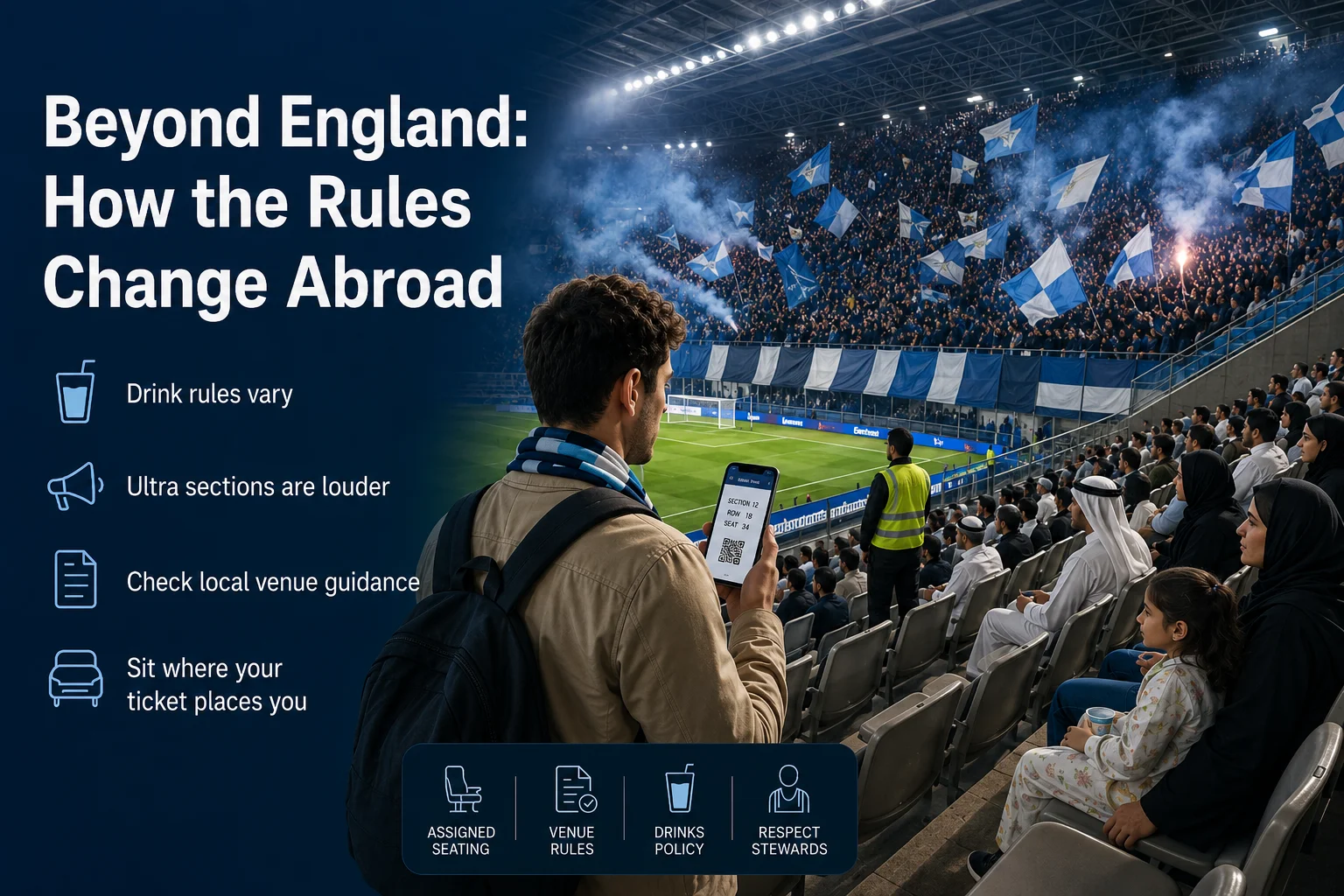
Step outside England and Wales and the rulebook shifts again, even before you reach a World Cup. The alcohol-in-view-of-the-pitch ban is a domestic rule, so across much of Europe, you can drink in your seat, and crowd customs vary just as much. Italian and Spanish grounds run on organised ultra sections with their own choreography, so a seat in the LaLiga end behind the goal is rarely a quiet one. In the Saudi Pro League and other MENA fixtures, dress codes and family-area rules differ again, so it pays to check before you travel.
The common thread everywhere is simple. Read the ticket conditions and the host venue guidance for every match, sit where you are placed and treat the stewards as the people who decide whether you stay. The rules you grew up with at your local ground are a starting point, not a passport.
FAQs
1. Is it illegal to buy a ticket from a tout outside the ground?
-
Reselling football match tickets without the organiser's authority is an offence under section 166 of the Criminal Justice and Public Order Act 1994, so buying from a tout is risky as well as unreliable.
2. Can stewards search me and my bag on the way in?
-
Yes, entry is conditional on agreeing to a search under the ground regulations, and anyone who refuses one can be turned away.
3. Are vapes treated the same as cigarettes inside the grounds?
-
Most grounds ban both smoking and vaping in the seated bowl, so check your club's policy rather than assume a vape is fine where a cigarette is not.
4. Can I take a flag or banner into the stadium?
-
Usually, yes, within size limits and if the material is flame-retardant, though large banners and poles often need clearing with the club in advance.
5. Can I leave the ground and come back in during the match?
-
Most clubs run a no re-admission policy, so once you pass through the turnstile, you cannot leave and return on the same ticket.
6. Are the rules different at the 2026 World Cup?
-
Yes, at a neutral World Cup venue, you are seated by allegiance with tighter segregation, security is stricter, and alcohol is sold inside many North American stadiums, unlike the in-view-of-the-pitch ban at home.
1BoxOffice lists resale tickets for domestic, European and World Cup fixtures, backed by a 150 per cent money-back guarantee if a valid ticket fails to arrive or get you through the gate. Knowing the rules before you travel means the result is the only thing left to worry about.
Sources: Sporting Events (Control of Alcohol etc.) Act 1985, Football (Offences) Act 1991 section 3 and Crime and Disorder Act 1998, legislation.gov.uk; Crown Prosecution Service guidance on football-related offences and tragedy-related abuse, updated August 2023; Sports Grounds Safety Authority licensed standing guidance, 39 grounds as of January 2026; Home Office football-related arrest and online hate crime figures, 2024/25.