In this guide
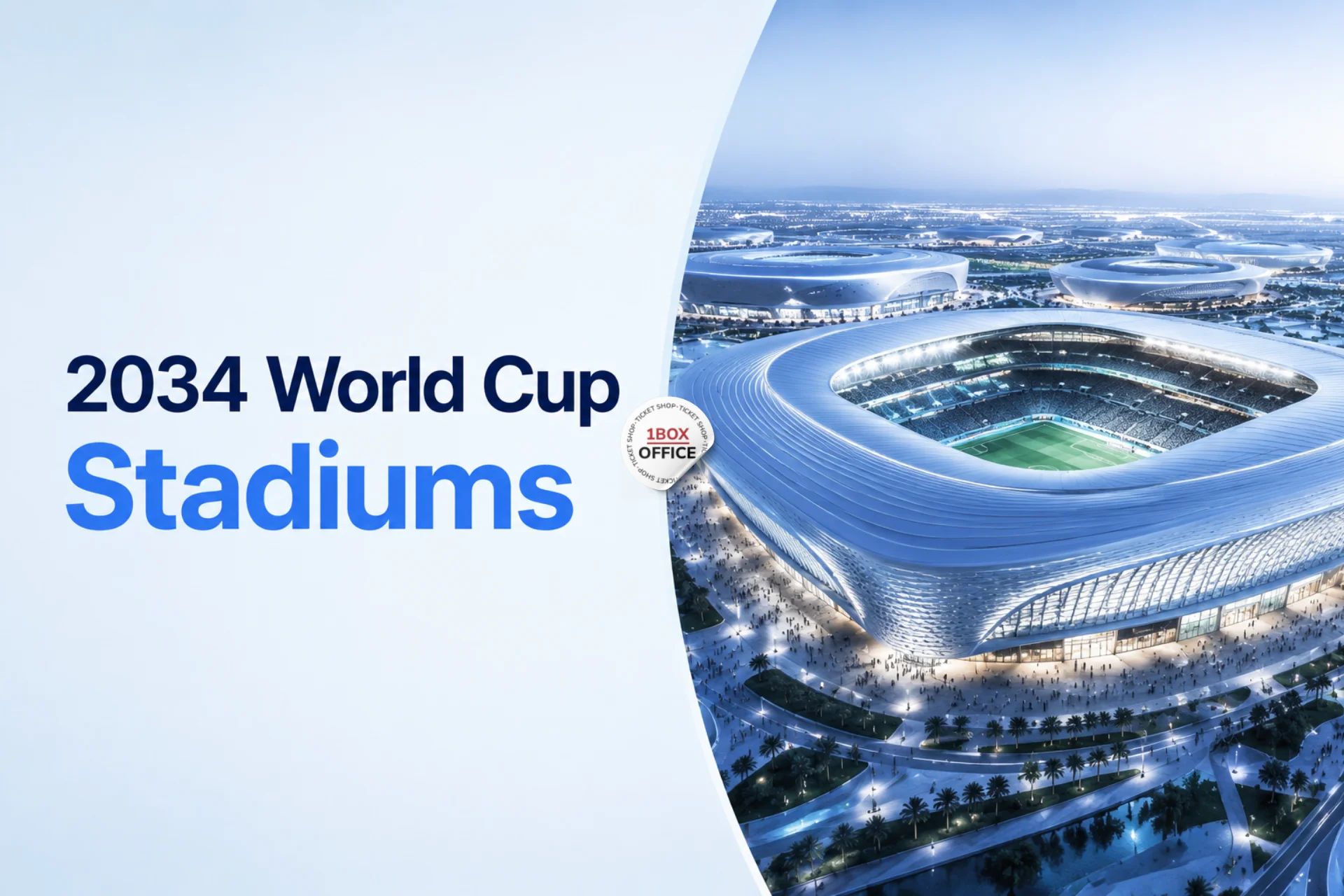
What is confirmed, and what is still movingWhy Saudi Arabia, and what the 48-team format meansRiyadh: eight stadiums and the heart of the tournamentJeddah: the Red Sea hostAl Khobar: the Gulf coast venueAbha: the cool highland escapeNEOM: the futuristic host with a question markAll 15 stadiums at a glanceHow the five host cities compareWhen will the 2034 World Cup be played?Getting around: travel between the host citiesWhat fans should know before they goHow to buy tickets for the 2034 World CupBeyond the host cities: base camps and the wider tripFAQsSaudi Arabia will stage the 2034 World Cup across five host cities and 15 stadiums, with the showpiece 92,000-seat King Salman International Stadium in Riyadh hosting both the opening match and the final. The 2034 World Cup host cities are Riyadh, Jeddah, Al Khobar, Abha, and NEOM, and they are located hundreds of kilometres apart across a country roughly the size of Western Europe. That spread, plus a clutch of brand-new stadiums still on the drawing board, makes early planning worthwhile for any fan thinking about the trip.
FIFA confirmed the kingdom as host by acclamation at an Extraordinary Congress on 11 December 2024, with Saudi Arabia the only bidder once the hosting rights were restricted to Asia and Oceania. It will be the first 48-team World Cup held in a single country, a 104-match tournament that dwarfs anything the competition has seen before. If you are already weighing up a trip, the natural next step is to follow Saudi Arabia national team matches in the build-up, and our companion 2030 World Cup venue guide covers the edition immediately before this one.
What is confirmed, and what is still moving
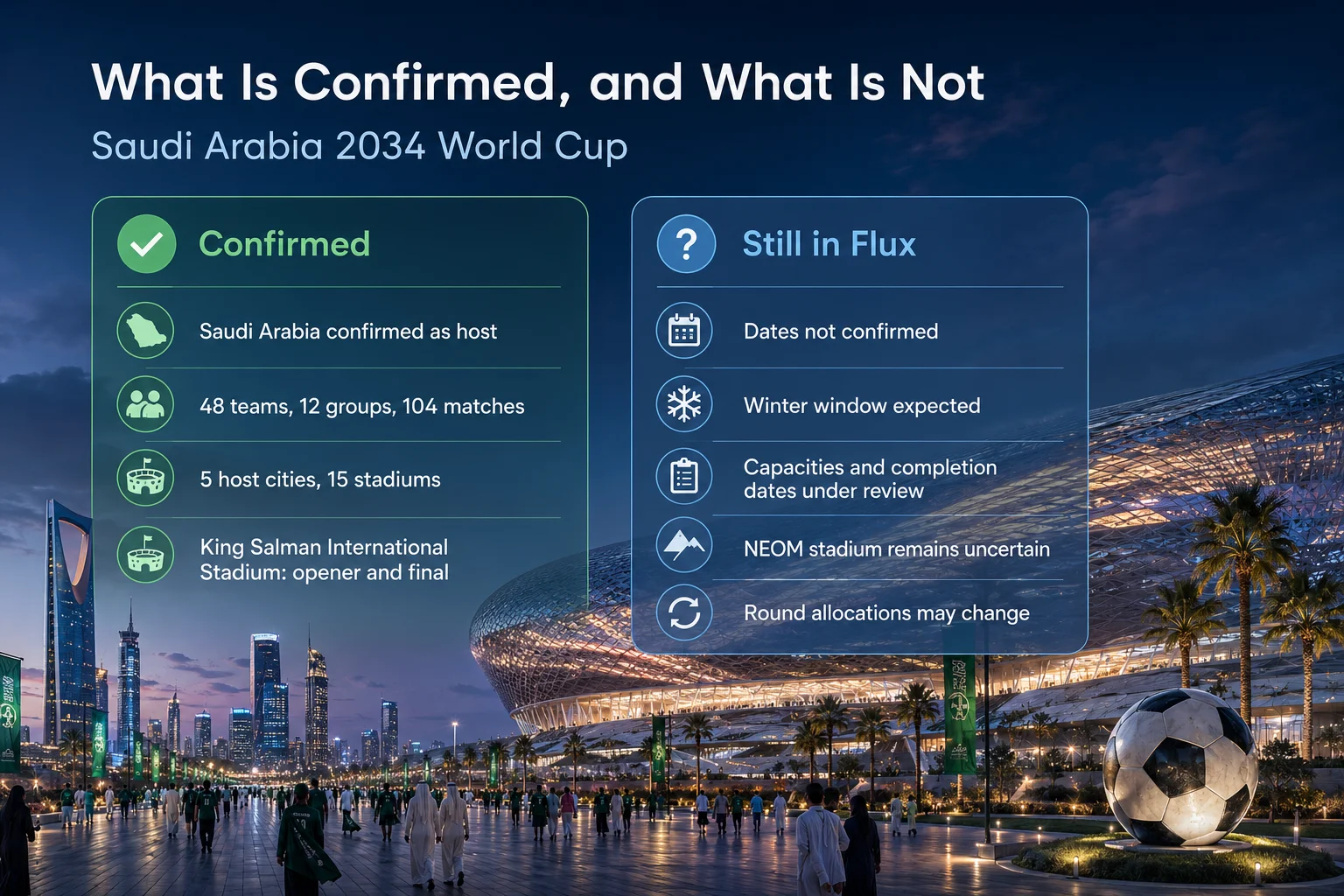
The award itself is settled. Everything below it, from exact dates to the viability of one entire host city, is still in motion. It helps to separate the two before planning anything.
Confirmed as of mid-2026:
- Saudi Arabia is the host. FIFA's bid evaluation, published on 30 November 2024, scored the bid 419.8 out of 500, the highest technical rating in World Cup bidding history (FIFA Bid Evaluation Report).
- The format is 48 teams in 12 groups of four, across 104 matches, in a single nation for the first time.
- Five host cities and 15 stadiums, of which 11 are new builds, and four are renovations or expansions of existing grounds (Saudi 2034 bid book).
- The King Salman International Stadium in Riyadh is earmarked for the opening match and the final.
Still unconfirmed or in flux:
- The dates. Summer is widely considered unworkable because of the heat, so a winter window is expected, but FIFA has not confirmed it. More on the scheduling puzzle below.
- Stadium capacities and completion dates. Several figures differ across sources, and several new builds are under cost review.
- NEOM. Its proposed venue sits inside The Line, the megaproject whose construction was suspended in September 2025, which leaves a real question over whether the stadium gets built at all.
- Which stadium hosts which round, beyond the opener and final? Allocations come from the bid book and may change when the schedule is finalised.
Why Saudi Arabia, and what the 48-team format means
The hosting process was uncontested. After the 2030 edition was spread across three continents (Spain, Portugal and Morocco, with three centenary matches in Uruguay, Argentina and Paraguay), FIFA's rotation policy effectively limited 2034 to Asia and Oceania. A short expression-of-interest window left Saudi Arabia as the sole candidate once Australia stood aside, and the bid book was launched in Paris on 31 July 2024.
The football itself has changed beyond recognition inside the country. Heavy investment through the Public Investment Fund has reshaped the Saudi Pro League into a destination for senior internationals, and the national side qualified for the 2026 finals before a ball was kicked in this tournament. The result is a host nation with genuine domestic football culture rather than a blank stage, and clubs whose home grounds double as several of the 2034 venues. Cristiano Ronaldo's Al Nassr and the record-chasing Al-Hilal both call Riyadh home and will move into the new Qiddiya stadium, while Jeddah's two heavyweights have their own World Cup-grade plans.
For fans used to a compact tournament, the 48-team format is the headline practical shift. More teams mean more matches, more groups and a longer competition, and in a single country, that translates to a lot of internal travel. The pay-off is that almost every footballing nation has a realistic route to qualification, so the pool of travelling supporters will be wider than ever.
Riyadh: eight stadiums and the heart of the tournament
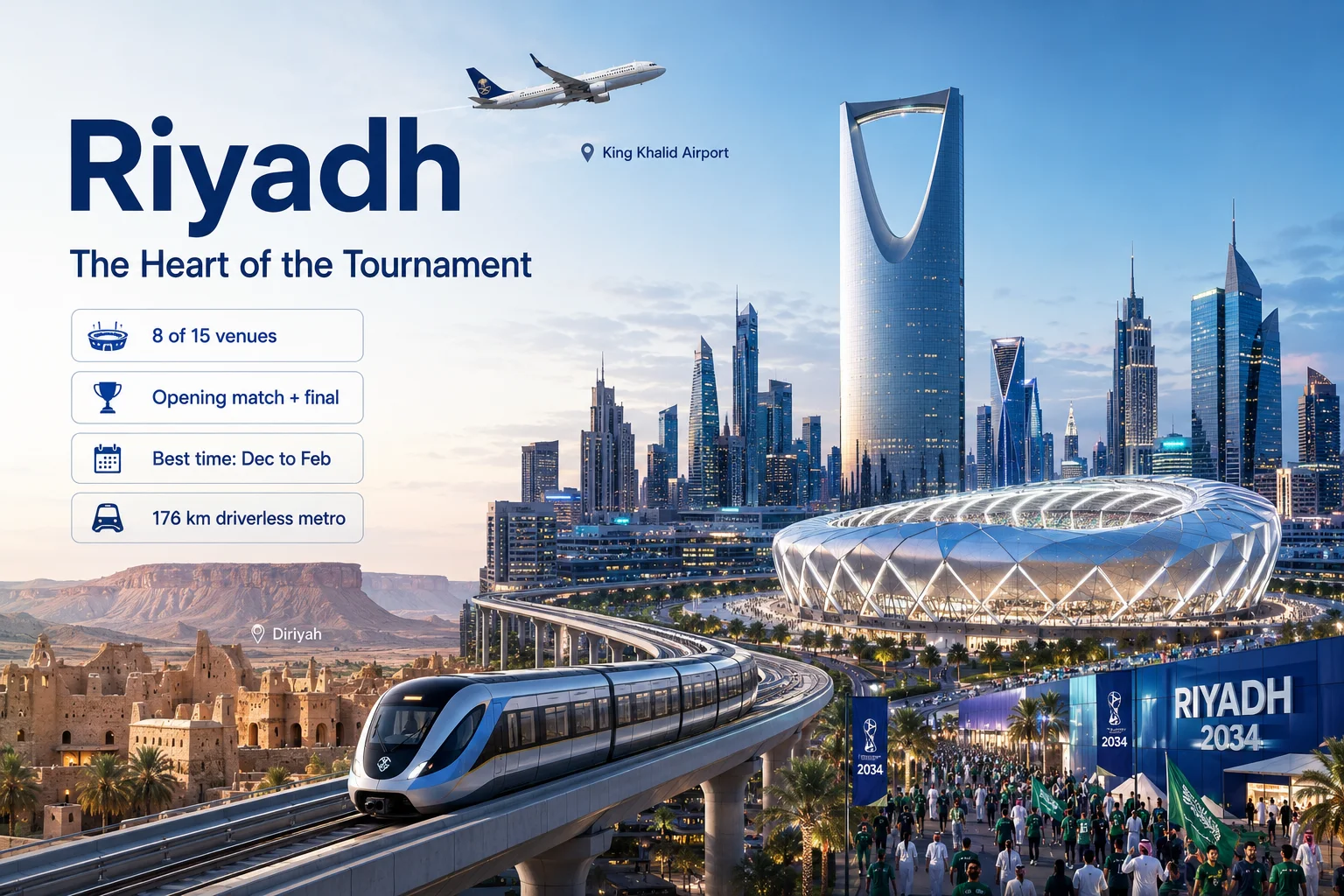
Riyadh is the centre of gravity for 2034, with eight of the 15 venues, the opening match and the final. The capital sits at around 600 metres on the Najd plateau in central Arabia and is home to roughly 7.7 million people, a number the government wants to push past 9 million by 2030.
The weather is the first thing to plan around. Riyadh has a hot desert climate, with summer daytime temperatures routinely above 45 °C and cool, dry winters where evenings can drop into single figures. That gap is exactly why a winter tournament is so widely expected. For visitors, December to February is comfortable for walking, sightseeing and outdoor fan zones.
What there is to do has grown quickly. The standout is Diriyah, the UNESCO-listed mud-brick birthplace of the Saudi state at At-Turaif, now restored alongside the Bujairi Terrace dining district. Add Masmak Fort and the old city, the National Museum, the Kingdom Centre skybridge for the skyline view, and the Edge of the World cliffs, a couple of hours out of town, for anyone hiring a car. During the season, the Riyadh Season entertainment programme floods the city with concerts, shows and food.
Getting around just got far easier. The Riyadh Metro opened in phases between December 2024 and early 2025, a six-line, 176km network recognised by Guinness World Records as the world's longest driverless metro. Line 3 links the airport to the centre in around 23 minutes. The main gateway is King Khalid International Airport, which is being expanded into the vast King Salman International Airport, designed by Foster and Partners and targeting up to 120 million passengers a year by 2030.
The Riyadh venues
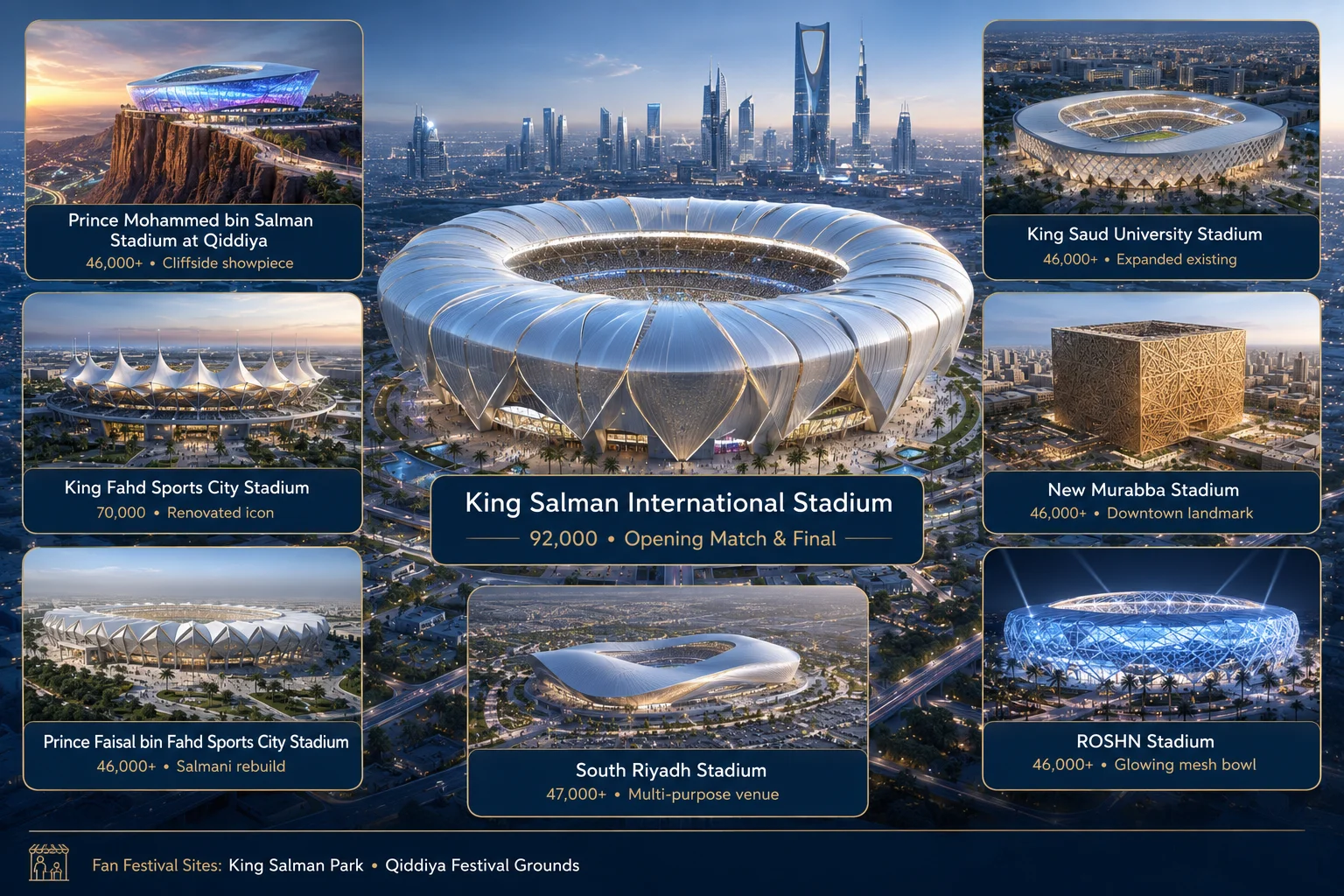
The eight grounds split into one genuine super-stadium, two cliffside and downtown showpieces and a cluster of new 46,000-seat bowls plus two renovations.
- King Salman International Stadium (new, around 92,000). Designed by Populous in northern Riyadh, this becomes the national team's home and hosts the opening match, the final and matches through every knockout round. Pre-qualification for the main construction works was launched by the Ministry of Sport in late 2025, with completion targeted for around 2029.
- Prince Mohammed bin Salman Stadium at Qiddiya (new, 46,000-plus). Built on the edge of a 200-metre Tuwaiq cliff, with a futuristic finish of iridescent glass and shimmering metal, looking out over the valley. Future home of Al-Hilal and Al-Nassr, and the proposed venue for the third-place playoff. Ground was broken in December 2024.
- King Fahd Sports City Stadium (renovation, expanding from around 58,000 to roughly 70,000). The iconic tent-roofed national stadium, modernised for the tournament and lined up to host matches into the semi-finals.
- Prince Faisal bin Fahd Sports City Stadium (rebuild, 46,000-plus). A complete redevelopment of the older ground in the Salmani architectural style.
- King Saud University Stadium (existing, expanded to 46,000-plus for the finals before reverting afterwards). It currently hosts Saudi Pro League football next to the U Walk development.
- New Murabba Stadium (new, 46,000-plus). Part of the New Murabba downtown development built around the cube-shaped Mukaab, with a design inspired by acacia bark.
- ROSHN Stadium (new, 46,000-plus). A crystalline mesh bowl designed to glow after dark.
- South Riyadh Stadium (new, listed at 47,000-plus in the bid documentation). A multi-purpose ground in the Salmani architectural style, set to become home to a professional club after the tournament.
The proposed Fan Festival sites in Riyadh are King Salman Park, billed as the world's largest urban park, and the Qiddiya Large Festival Grounds beneath the Tuwaiq cliffs.
WhatsApp channel
Sports news straight to your phone
Match updates, on-sale dates and ticket news from 1BoxOffice.
Jeddah: the Red Sea host
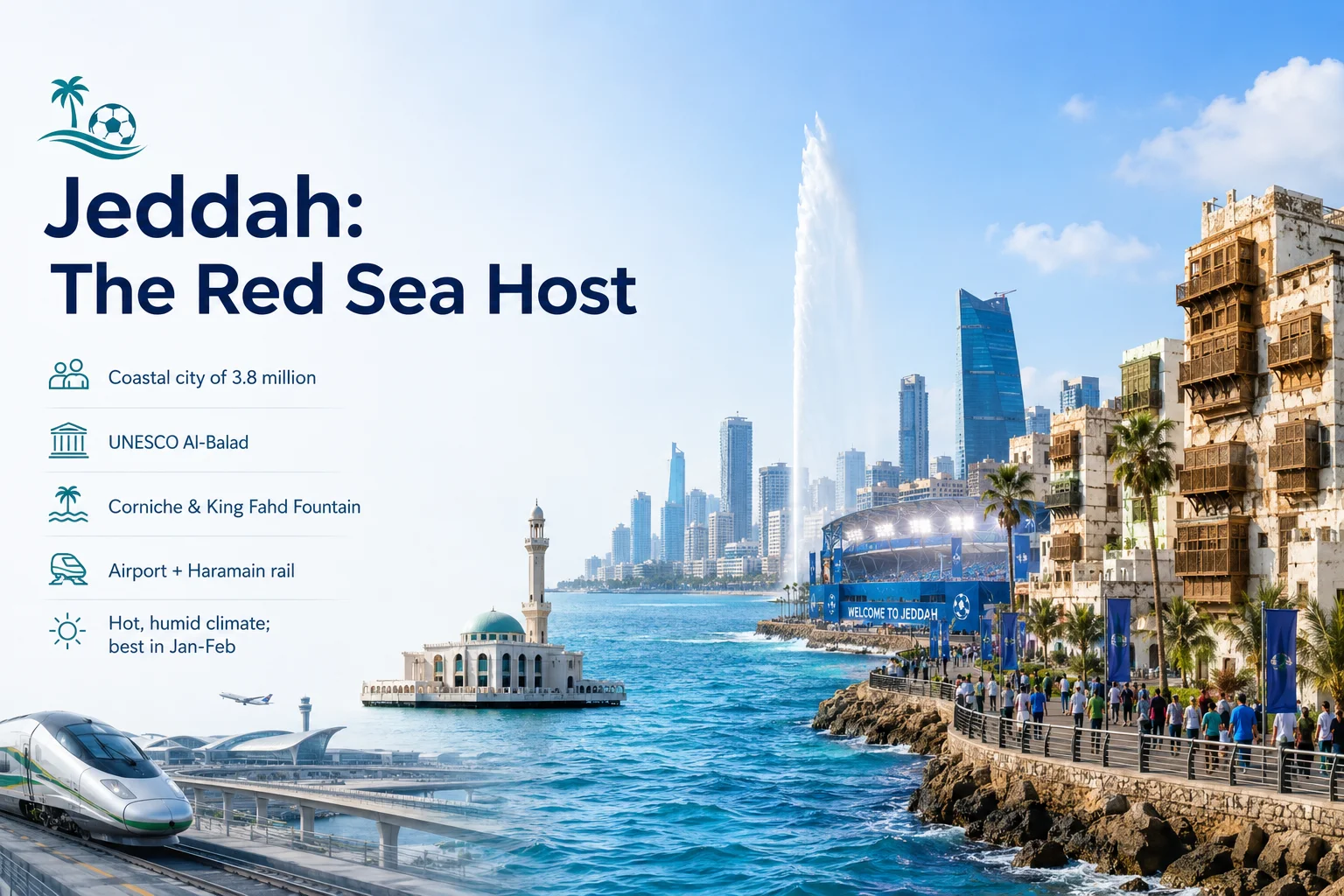
Jeddah is the kingdom's second city and its most relaxed, a coastal commercial hub of around 3.8 million people and the historic gateway to Makkah. The climate is hot and humid year-round, with January and February the most pleasant months for a visit, when overnight lows sit comfortably in the high teens.
It is also the most rewarding host city to wander. The UNESCO-listed Al-Balad old town is a warren of coral-stone houses and wooden rawasheen balconies, and the 30km Corniche runs the length of the waterfront past the King Fahd Fountain, which throws seawater 312 metres into the air and ranks as the tallest of its kind. Add Red Sea diving, the floating Al-Rahma Mosque and a major open-air sculpture collection, and there is plenty to fill the days between matches. Jeddah also hosts an annual Formula 1 night race, so the city is no stranger to a major sporting crowd.
Air links are strong. King Abdulaziz International Airport is the busiest in the country and handled a record 53.4 million passengers in 2025, and it connects to the Haramain high-speed railway, which runs to Makkah and Madinah at up to 300km/h. The city's two big clubs, Al Ittihad and Al Ahli, give the place a strong matchday culture of its own.
The Jeddah venues
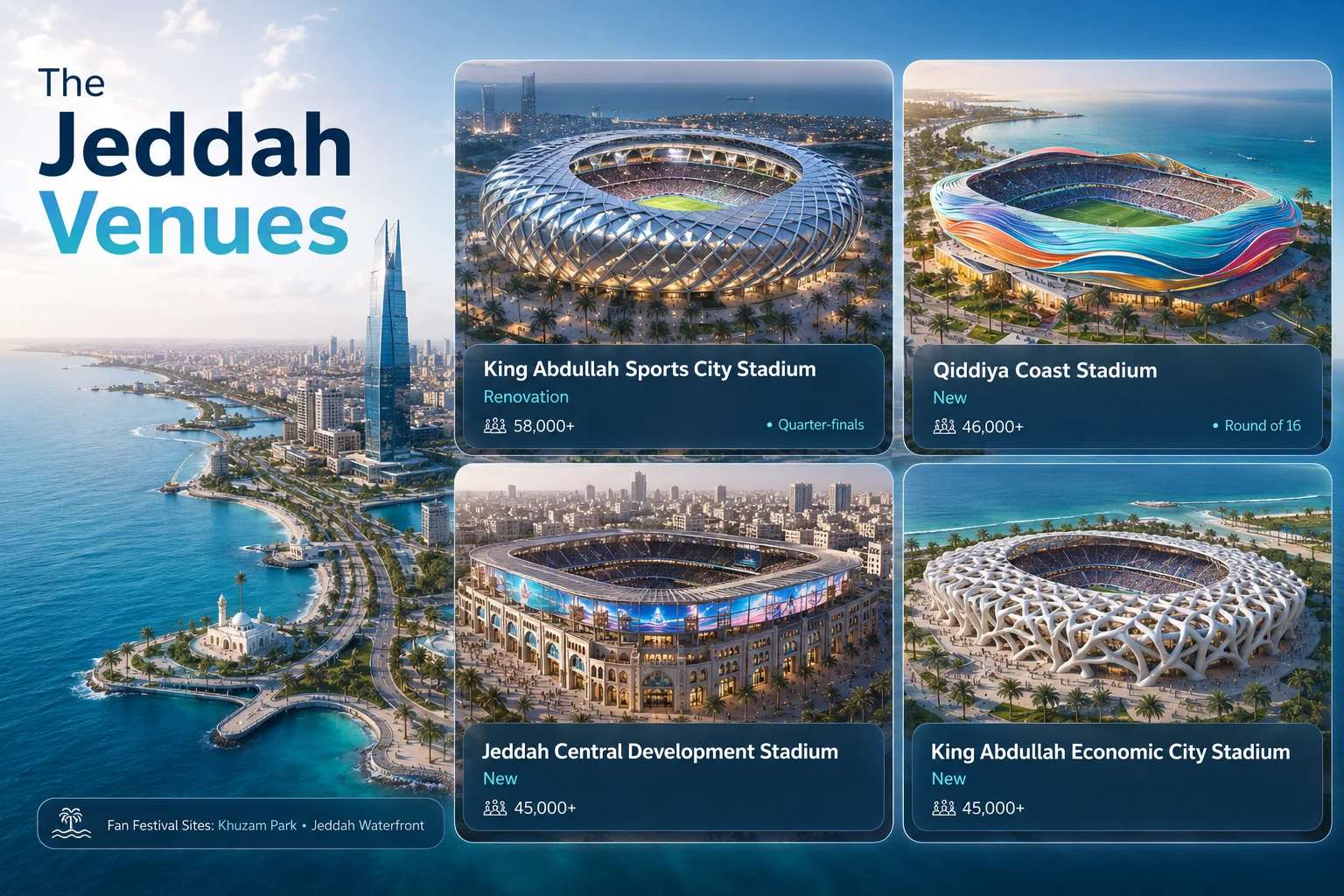
- King Abdullah Sports City Stadium (renovation, 58,000-plus). Known as the Shining Jewel and opened in 2014, this Arup-designed ground is the most match-ready in Jeddah and hosted the 2023 Club World Cup. Proposed to host matches through the quarter-finals.
- Qiddiya Coast Stadium (new, 46,000-plus). An undulating, brightly coloured bowl on the shores of the Red Sea at the Qiddiya Coast development, roughly 45km north of the city, is proposed for matches up to the round of 16.
- Jeddah Central Development Stadium (new, 45,000-plus). A downtown ground inspired by the historic Al-Balad district, anchoring the planned Sport Park, with three tiers and a 360-degree screen.
- King Abdullah Economic City Stadium (new, 45,000-plus). A coral-reef-inspired design on the Red Sea coast north of the city.
Jeddah's proposed Fan Festival sites are Khuzam Park, next to Al-Balad, and the Jeddah Waterfront, which has previously staged the Saudi Arabian Grand Prix.
Al Khobar: the Gulf coast venue
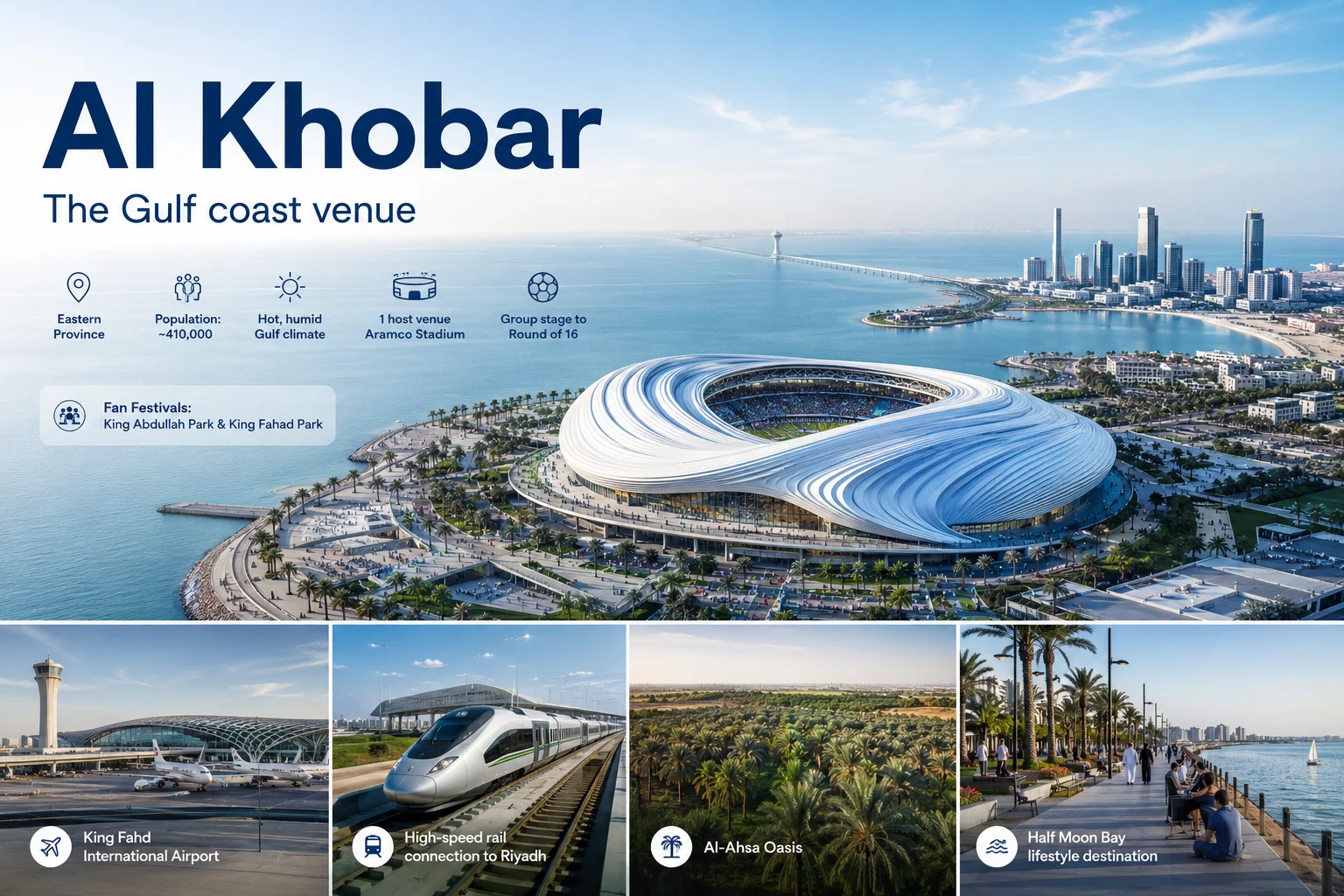
Al Khobar anchors the tournament in the Eastern Province, on the Arabian Gulf and is part of the wider Dammam metropolitan area that is home to the oil giant Aramco. It is the smallest of the host cities by population, at around 410,000, with a hot, humid Gulf climate.
The draw here is the coast and the surroundings. Khobar has a long waterfront, the Half Moon Bay beaches sit just down the road, the King Fahd Causeway runs across to Bahrain, and the ancient Al-Ahsa oasis, another UNESCO site, is within reach inland. The gateway is King Fahd International Airport in Dammam, and one of the country's main rail lines connects the province to Riyadh.
Al Khobar has a single venue, but it is one of the most advanced in the whole programme.
- Aramco Stadium (new, 46,000-plus and expandable for concerts). A Populous design whose swirling, sail-like form takes its cue from Gulf waters. Backed by Aramco and being delivered ahead of the 2027 Asian Cup, it is the home of Al Qadsiah and is proposed to host group-stage matches through to the round of 16. The proposed Fan Festival sites in Al Khobar are King Abdullah Park and King Fahad Park.
Abha: the cool highland escape
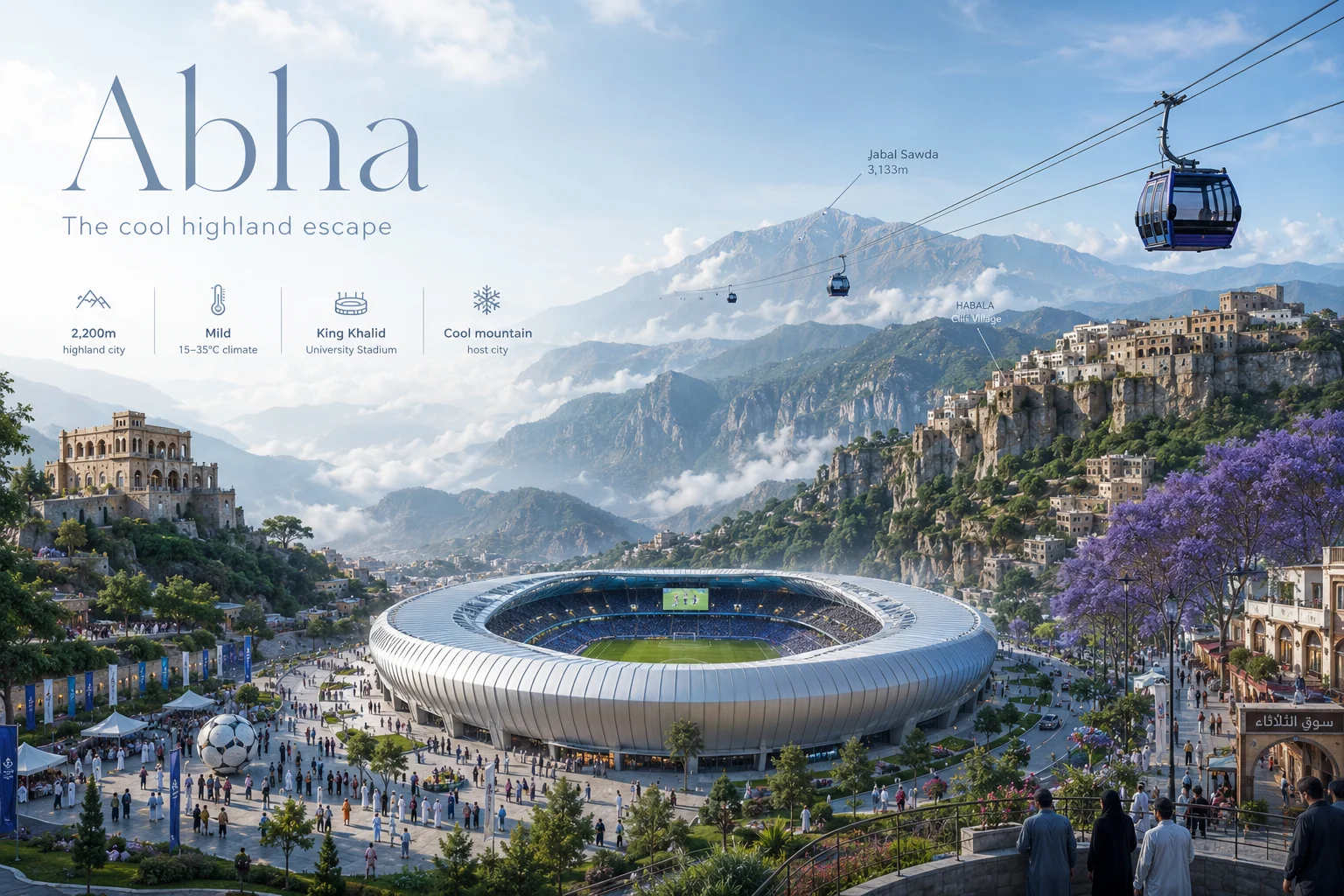
Abha is the outlier, and for football in a hot country, that is a good thing. The capital of Asir province sits at around 2,200 metres in the south-western highlands, beside Jabal Sawda, the highest peak in the kingdom. Its population is roughly 420,000, and crucially, its weather is mild: daytime temperatures typically sit between 15C and 35C, far cooler than the lowland cities, with two rainy seasons and frequent mist that locals call the city's natural air conditioning.
The setting is the attraction. Asir National Park, the cable cars, the cliff-hanging village of Habala, Shadda Palace and the Tuesday Market all sit within easy reach, and the spring jacaranda blooms along Art Street draw domestic tourists in their own right. Abha International Airport handles domestic and some regional routes. For fans who want a break from the heat and the big-city pace, this is the host city to target.
- King Khalid University Stadium (renovation, expanding to more than 45,000). The existing university ground, redeveloped by Populous in south-eastern Abha and proposed for group-stage matches through to the round of 16.
Abha's proposed Fan Festival sites are Al Bihar Square in the city centre and Al Dhabab Park on the south side, which looks out towards the Aseer mountains.
NEOM: the futuristic host with a question mark
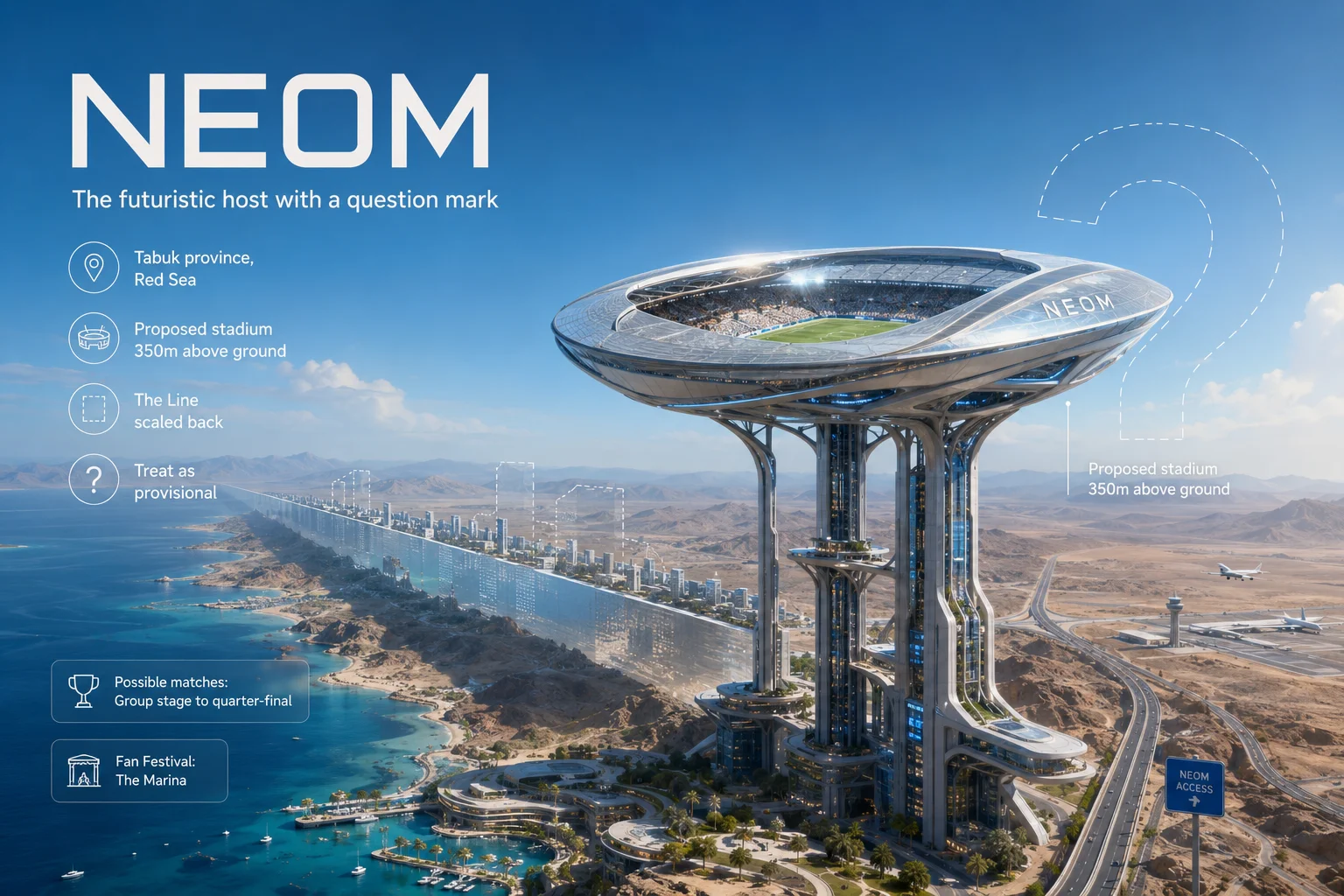
NEOM is the most ambitious entry on the list and the most uncertain. It is a planned region in Tabuk province in the far north-west, on the Red Sea near the borders with Jordan and Egypt, and the flagship of the country's economic diversification plans. Its proposed World Cup venue, the NEOM Stadium, is described in the bid material as the most unique in the world, with a pitch more than 350 metres above ground and, in the bid's words, a roof created from the city itself. The proposed allocation runs from the group stage through to a quarter-final, and the planned Fan Festival sites are The Marina and The Marina Steps at the entrance to The Line.
That is where the problem lies. The Line, originally a 170km linear, mirrored, car-free city for 9 million residents, has been heavily scaled back. The Public Investment Fund suspended construction in September 2025, with only around 2.4km of foundation work completed, and reporting since has pointed to a reduced near-term population target and a pivot towards industrial uses and data centres. No construction has begun on the stadium, and no FIFA or Saudi authority has publicly explained how a venue inside a suspended city will be ready for 2034.
A practical note for anyone tempted to build a trip around a NEOM fixture: do not book around it until the venue and schedule are confirmed. NEOM has very limited tourism infrastructure today; access is mainly by car via NEOM Bay Airport, and it is plausible that any matches allocated here are redistributed to Riyadh or Jeddah, which both have ample spare capacity. Treat NEOM as provisional.
All 15 stadiums at a glance
Here is the full venue list in one place, with capacities and proposed stages of competition taken from the bid documentation. A plus sign marks where the bid lists a minimum capacity, and every figure remains subject to change as contracts are finalised. The status shows whether a ground is a new build or a renovation of an existing stadium.
| Stadium | Host city | Capacity | Status | Proposed stages |
|---|---|---|---|---|
| King Salman International Stadium | Riyadh | 92,000+ | New build | Opening, group stage, all knockout rounds and final |
| King Fahd Sports City Stadium | Riyadh | 70,000+ | Renovation | Group stage to semi-final |
| Prince Mohammed bin Salman Stadium (Qiddiya) | Riyadh | 46,000+ | New build | Group stage, last 16 and third-place playoff |
| Prince Faisal bin Fahd Sports City Stadium | Riyadh | 46,000+ | Rebuild | Group stage and last 32 |
| King Saud University Stadium | Riyadh | 46,000+ | Existing, expanded | Group stage and last 32 |
| New Murabba Stadium | Riyadh | 46,000+ | New build | Group stage and last 32 |
| ROSHN Stadium | Riyadh | 46,000+ | New build | Group stage and last 32 |
| South Riyadh Stadium | Riyadh | 47,000+ | New build | Group stage and last 32 |
| King Abdullah Sports City Stadium | Jeddah | 58,000+ | Renovation | Group stage to quarter-final |
| Qiddiya Coast Stadium | Jeddah | 46,000+ | New build | Group stage, last 32 and last 16 |
| Jeddah Central Development Stadium | Jeddah | 45,000+ | New build | Group stage and last 32 |
| King Abdullah Economic City Stadium | Jeddah | 45,000+ | New build | Group stage and last 32 |
| Aramco Stadium | Al Khobar | 46,000+ | New build | Group stage, last 32 and last 16 |
| King Khalid University Stadium | Abha | 45,000+ | Renovation | Group stage, last 32 and last 16 |
| NEOM Stadium | NEOM | 46,000+ | New build (status uncertain) | Group stage to quarter-final |
Eight of these are in Riyadh, which gives the capital the lion's share of matches. For context on which grounds around the world are worth a visit in their own right, our rundown of the best stadiums to visit sets the bar these new venues are aiming at.
How the five host cities compare
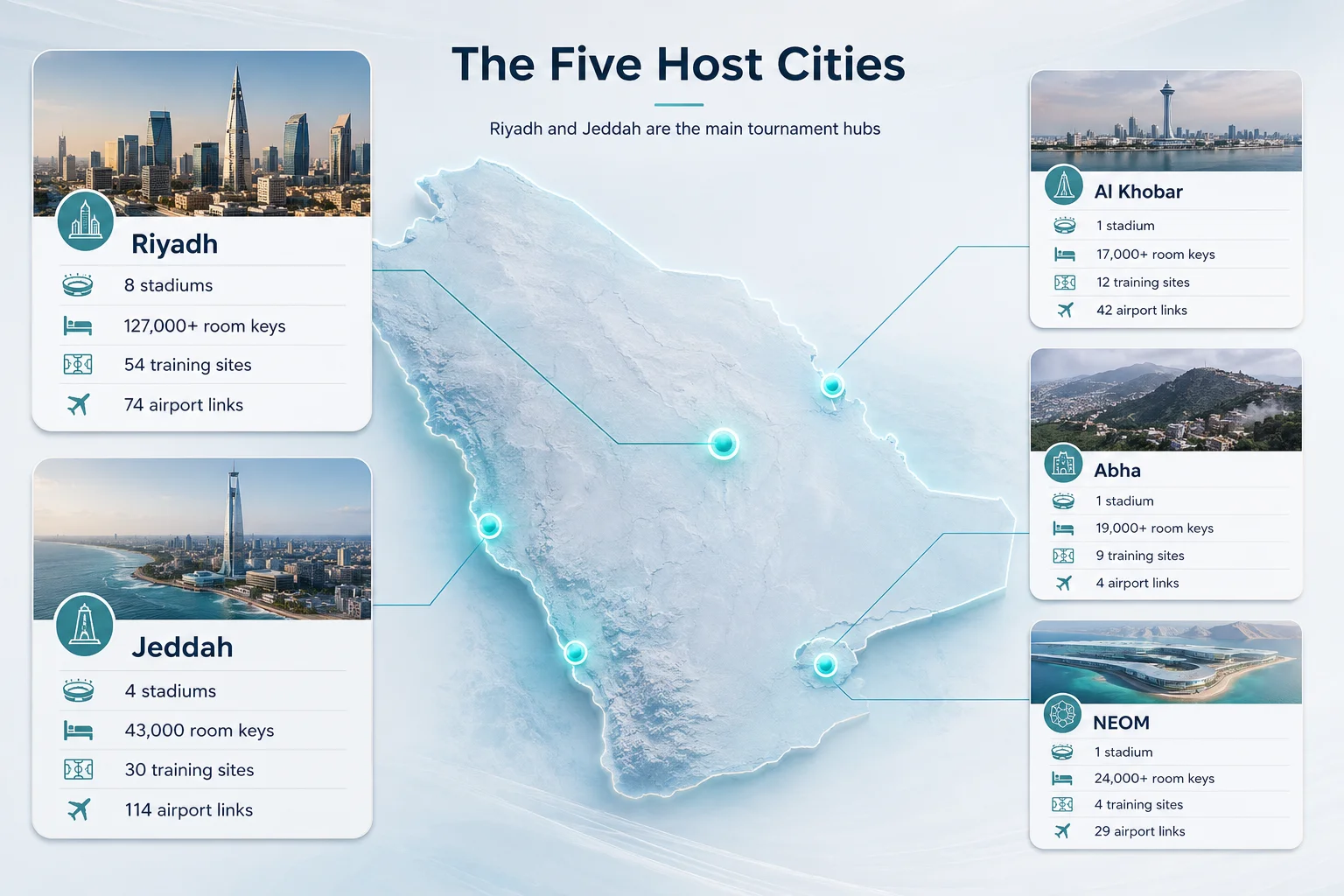
The bid documentation sets out how unevenly the tournament is spread. Riyadh and Jeddah carry the bulk of the stadiums, the hotel capacity and the air links, while Abha and NEOM are far smaller operations. The figures below are the tournament numbers the bid sets out for each city, and they explain why most fans will end up basing themselves in one of the two big hubs.
| Host city | Proposed stadiums | Tournament room keys | Training sites | International airport links |
|---|---|---|---|---|
| Riyadh | 8 | 127,000+ | 54 | 74 |
| Jeddah | 4 | 43,000 | 30 | 114 |
| Al Khobar | 1 | 17,000+ | 12 | 42 |
| Abha | 1 | 19,000+ | 9 | 4 |
| NEOM | 1 | 24,000+ | 4 | 29 |
The room-key totals are the clearest signal of scale. Riyadh alone is targeting more than 127,000 tournament rooms, and the five cities together account for well over 200,000, which is the kind of capacity a 48-team event needs. Jeddah's 114 international air links, more than any other host city, make it the natural arrival point for many overseas fans.
When will the 2034 World Cup be played?
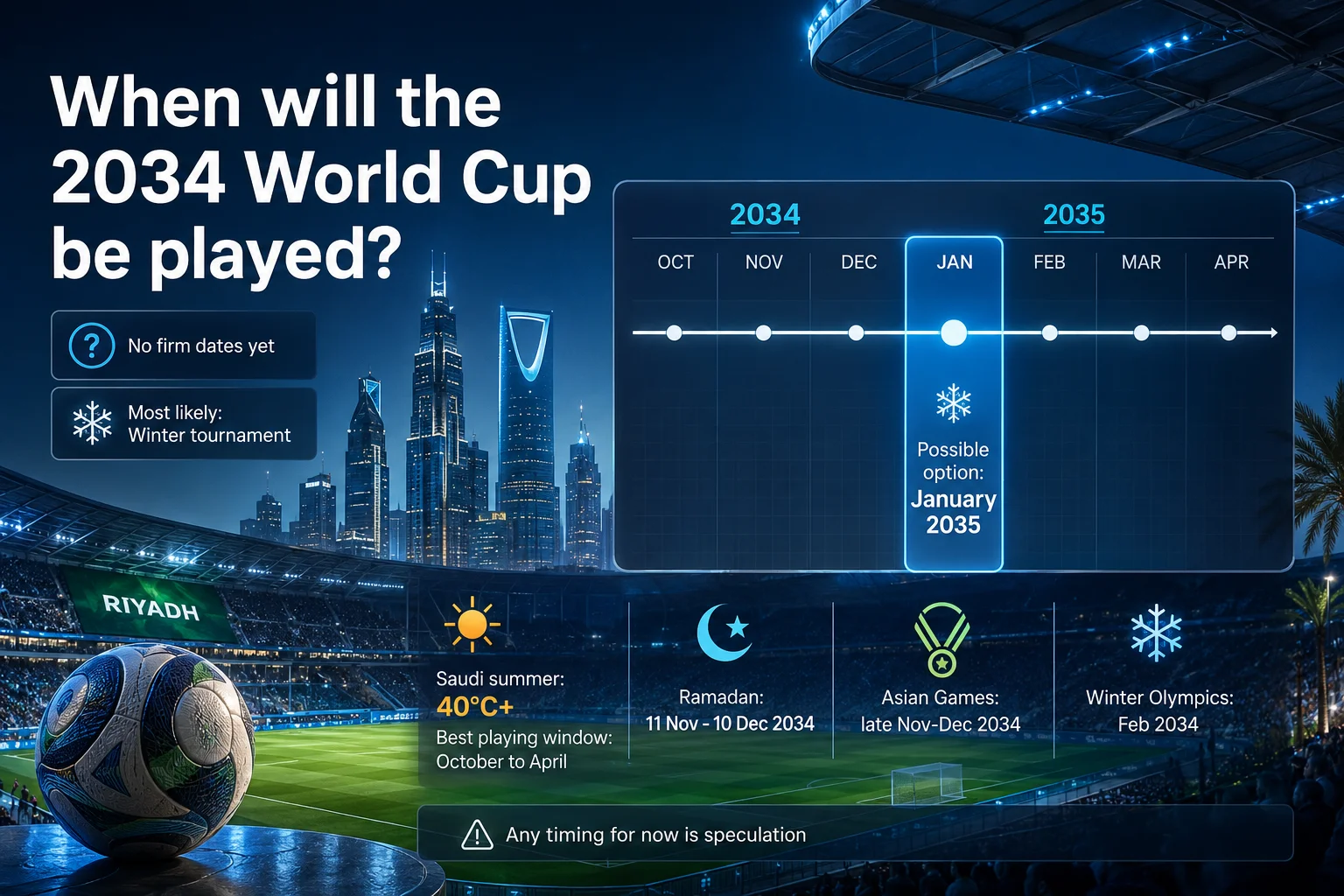
No firm dates exist yet, and that is the single biggest open question for travelling fans. The likeliest answer is a winter tournament, in the mould of Qatar 2022, because Saudi summers are simply too hot. FIFA's own evaluation noted that Riyadh exceeds 40 °C in summer and that local conditions favour play between October and April.
A winter slot is complicated by the calendar, though. Three factors collide in late 2034:
- Ramadan is expected to fall from around 11 November to 10 December 2034. A tournament running through the holy month would carry obvious cultural sensitivities in the host country.
- Riyadh is due to host the Asian Games in late November and December 2034, which cannot realistically overlap with a World Cup in the same city.
- The Winter Olympics in Salt Lake City are scheduled for February 2034, narrowing the window at the other end of the year.
Because of the Ramadan clash in particular, several reports have floated January 2035 as a genuine possibility, which would push the competition into the calendar year after the one it is named for. FIFA President Gianni Infantino has said he is open to flexible scheduling. Until a date is published, treat any specific timing you see as informed speculation rather than fact.
Getting around: travel between the host cities
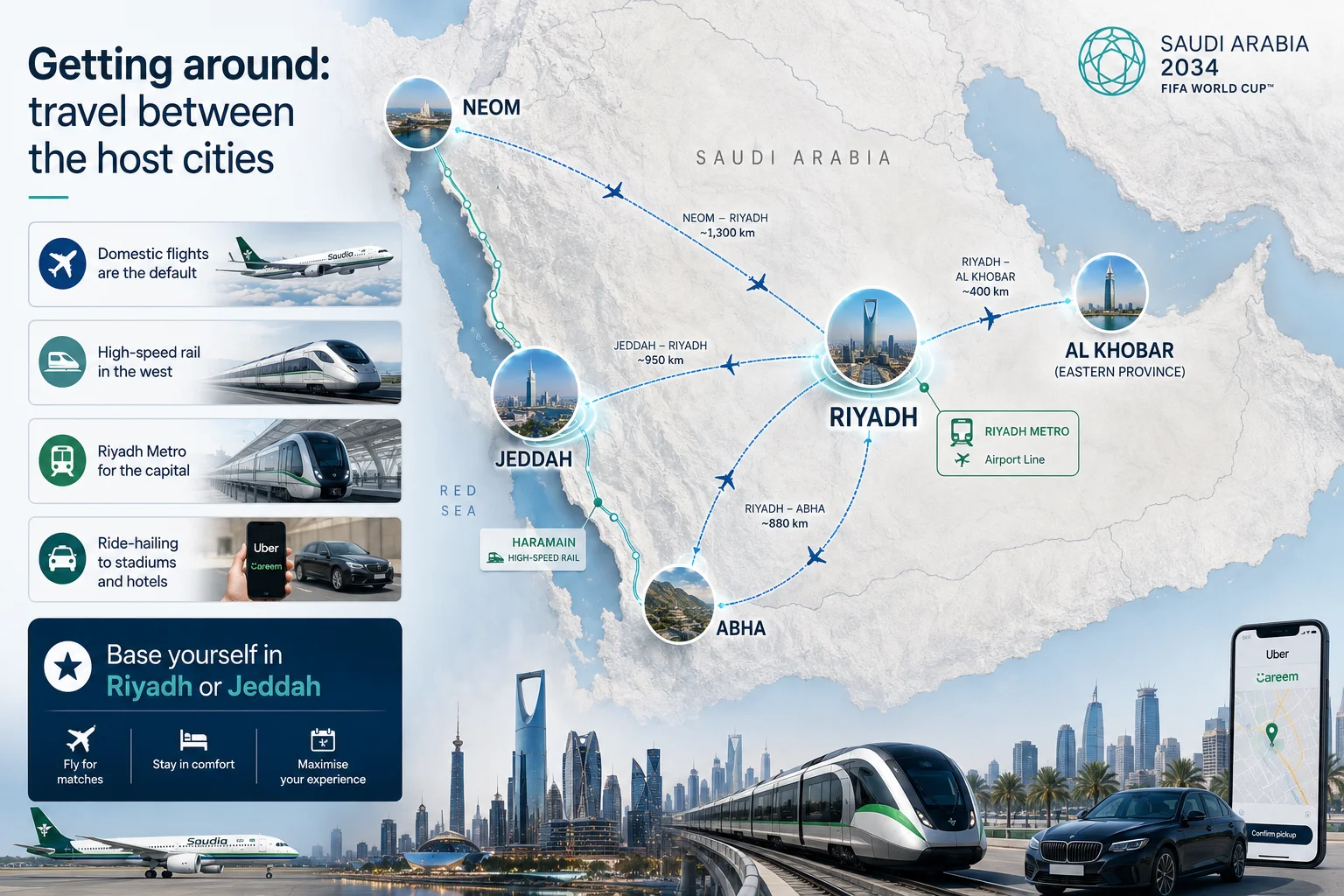
This is where the scale of Saudi Arabia matters. The host cities are not a short hop apart. Riyadh to Jeddah is around 950km, Riyadh to the Eastern Province is about 400km, Abha sits deep in the south-west, and NEOM is in the far north-west, a long way from everything else. Driving between them is impractical for most match schedules.
The realistic options:
- Domestic flights. The default way to move between host cities. Saudia, flynas and flyadeal all run frequent internal routes, and connections between Riyadh, Jeddah and Dammam are especially well served. Book early, as capacity will be tight during the tournament.
- High-speed rail in the west. The Haramain railway links Jeddah, Makkah and Madinah at up to 300km/h, which is useful if you are basing yourself on the Red Sea coast. There is no equivalent high-speed line between Riyadh and Jeddah yet.
- The Riyadh Metro. Excellent for getting around the capital itself, including a direct airport line, which matters given Riyadh hosts eight venues.
- Ride-hailing. Uber and Careem operate widely across the cities and are the simplest way to reach the grounds and get back to your hotel after a match.
The most practical approach for a multi-match trip is to base yourself in Riyadh or Jeddah, see as much as you can locally and fly out for fixtures in the outlying cities rather than trying to criss-cross the country by road.
What fans should know before they go
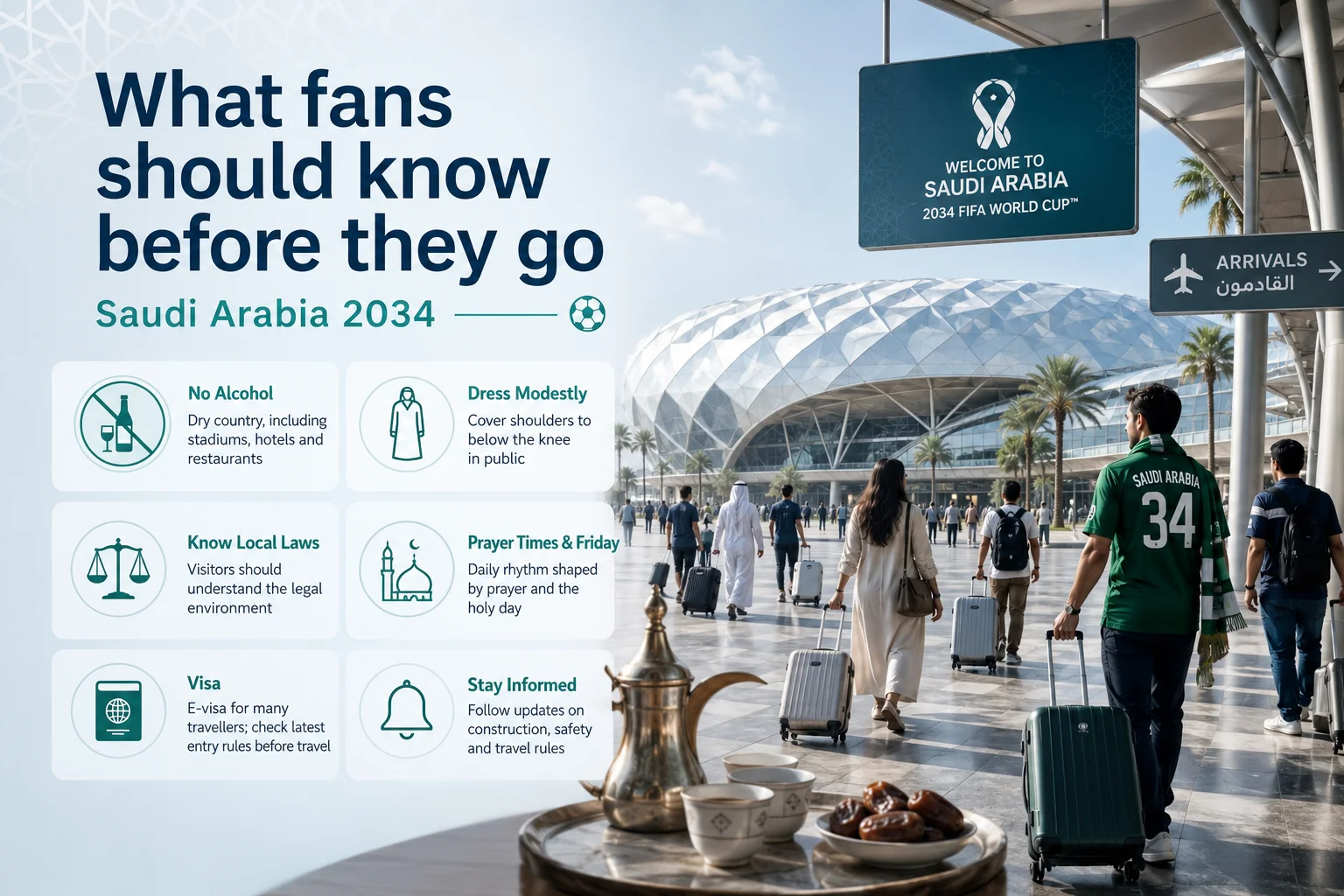
A trip to the 2034 World Cup will differ from recent editions in a few important ways, and it is better to know them up front than to be caught out.
- Alcohol. Saudi Arabia is a dry country, and the ban will apply during the tournament, including in stadiums, hotels and restaurants. The country's ambassador to the UK confirmed in February 2025 that there will be no alcohol at the event. Plan your matchday and evenings around that.
- Dress and conduct. Modest clothing covering the shoulders to below the knee is expected for everyone in public. Women are not required to wear an abaya and can travel and drive freely, but lightweight, conservative clothing is the norm.
- LGBTQ+ travellers. Same-sex relations are criminalised in Saudi Arabia. Visitors should be aware of the legal environment before deciding to travel.
- Culture and rhythm. Friday is the holy day, and daily life is shaped by prayer times. Saudi hospitality, coffee and dates are central, and the food, from kabsa to mandi, is a highlight in its own right.
- Construction and human rights. The building programme has drawn scrutiny from rights groups, and there has been at least one reported worker death on a World Cup-related site. It is a live issue worth following as the tournament approaches.
On entry, most visitors from more than 60 eligible countries can apply online for a one-year, multiple-entry tourist e-visa allowing stays of up to 90 days, typically issued within a day or two. A tournament-specific entry scheme is likely by 2034, in the same vein as the Fan ID systems used at recent World Cups, which we covered in our piece on whether a Fan ID will be used in 2026. Always check the current requirements close to travel, as visa rules change.
How to buy tickets for the 2034 World Cup
General ticket sales for 2034 have not opened, and with the tournament years away, no on-sale dates or pricing have been announced. For now, the sensible groundwork is to follow the build-up, watch the host nation and get your account details in order so you are ready when sales begin.
A few practical steps:
- Set up your account in advance so checkout is quick when demand spikes. You can create an account ahead of any release.
- Keep an eye on Saudi Arabia national team fixtures and the warm-up tournaments, which are the most direct way to follow the squad before the finals.
- Once you have bought, you can track your order through to delivery.
- Plan flights and accommodation in parallel with tickets, not after. Hotel and flight capacity in the host cities will be the real constraint, not just the seats.
Beyond the host cities: base camps and the wider trip
The five host cities are only part of the picture. Ten further locations, including AlUla, Madinah, Tabuk, Taif and Al Ahsa, are lined up as team base camps, which means some of the most interesting parts of the country will see World Cup activity even without staging matches. AlUla in particular, with its Nabataean tombs at Hegra, is one of the kingdom's genuine highlights and pairs well with a trip built around games in Jeddah or Riyadh.
Domestic clubs outside the headline cities are also worth a look for fans who want to see Saudi football beyond the giants. Sides such as Al Taawoun in Buraidah give a sense of the league's depth away from the Riyadh and Jeddah powerhouses. With a country this large and this varied, the smart move is to treat the matches as the spine of a longer trip rather than the whole of it.
FAQs
1. Which cities are hosting the 2034 World Cup?
-
Riyadh, Jeddah, Al Khobar, Abha and NEOM are the five host cities, though NEOM's status remains uncertain because its proposed stadium sits inside a suspended megaproject.
2. How many stadiums will the 2034 World Cup use?
-
The bid lists 15 stadiums, with 11 brand-new builds and four renovations of existing grounds.
3. Where will the 2034 World Cup final be played?
-
The final is set for the new 92,000-seat King Salman International Stadium in Riyadh, which also hosts the opening match.
4. Will the 2034 World Cup be in summer or winter?
-
A winter tournament is widely expected because of the summer heat, and a January 2035 window has been reported as possible, but FIFA has not confirmed the dates.
5. Is the NEOM stadium actually being built?
-
Construction has not started, and with The Line suspended in September 2025, the venue's future is genuinely in doubt, so fans should not plan a trip around a NEOM fixture yet.
6. How do I travel between the Saudi host cities?
-
Domestic flights are the practical option given the distances, with high-speed rail linking the western cities and the metro covering Riyadh internally.
7. Can I drink alcohol at the 2034 World Cup?
-
No, the host country has confirmed there will be no alcohol during the tournament, in stadiums, hotels or restaurants.
8. Do I need a visa to attend the 2034 World Cup?
-
Most visitors can currently apply for a one-year tourist e-visa online, and a dedicated entry scheme for the tournament is likely closer to the event.
Saudi Arabia's 2034 tournament is still taking shape, and the picture will keep shifting as stadiums break ground and the schedule firms up. 1BoxOffice will keep this guide current as venues and fixtures are confirmed, and every purchase is backed by the 150% money-back guarantee for added peace of mind on a trip this far ahead.
Sources: FIFA tournament announcements and Bid Evaluation Report, Saudi 2034 bid book, Saudi Arabian Football Federation bid materials, Saudi Arabian Ministry of Sport, Public Investment Fund, Populous, Reuters, BBC, The Guardian, Associated Press.