In this guide
What's confirmed and what's still moving in 2026The 2030 World Cup format and historic contextSpain: World Cup 2030 venues and host citiesPortugal: World Cup 2030 venues and host citiesMorocco: World Cup 2030 venues and host citiesThe three centenary matches: Uruguay, Argentina and ParaguayWhere will the 2030 World Cup final be played?How to buy tickets for the 2030 World CupTravel and visa logistics for the 2030 World CupFAQsThe World Cup 2030 venues span six nations across three continents. Spain, Portugal and Morocco share the main tournament from 8 June to 21 July 2030, with three opening centenary matches staged in Uruguay, Argentina and Paraguay over the weekend of 8-9 June to mark 100 years since the inaugural 1930 World Cup hosted by Uruguay. Use this guide to compare confirmed and candidate host stadiums, the South American centenary venues, the practical travel logistics for attending fixtures across multiple countries and the ticket-buying strategy for international visitors. Live secondary listings, once match pairings are confirmed, will be tracked at the FIFA World Cup tickets hub on 1BoxOffice, established in 2006 and operating with a 150% money-back guarantee on every order. For visitors planning, our companion guide to the Fan ID system at the 2026 World Cup sets the precedent for what FIFA may require for 2030 entry.
What's confirmed and what's still moving in 2026
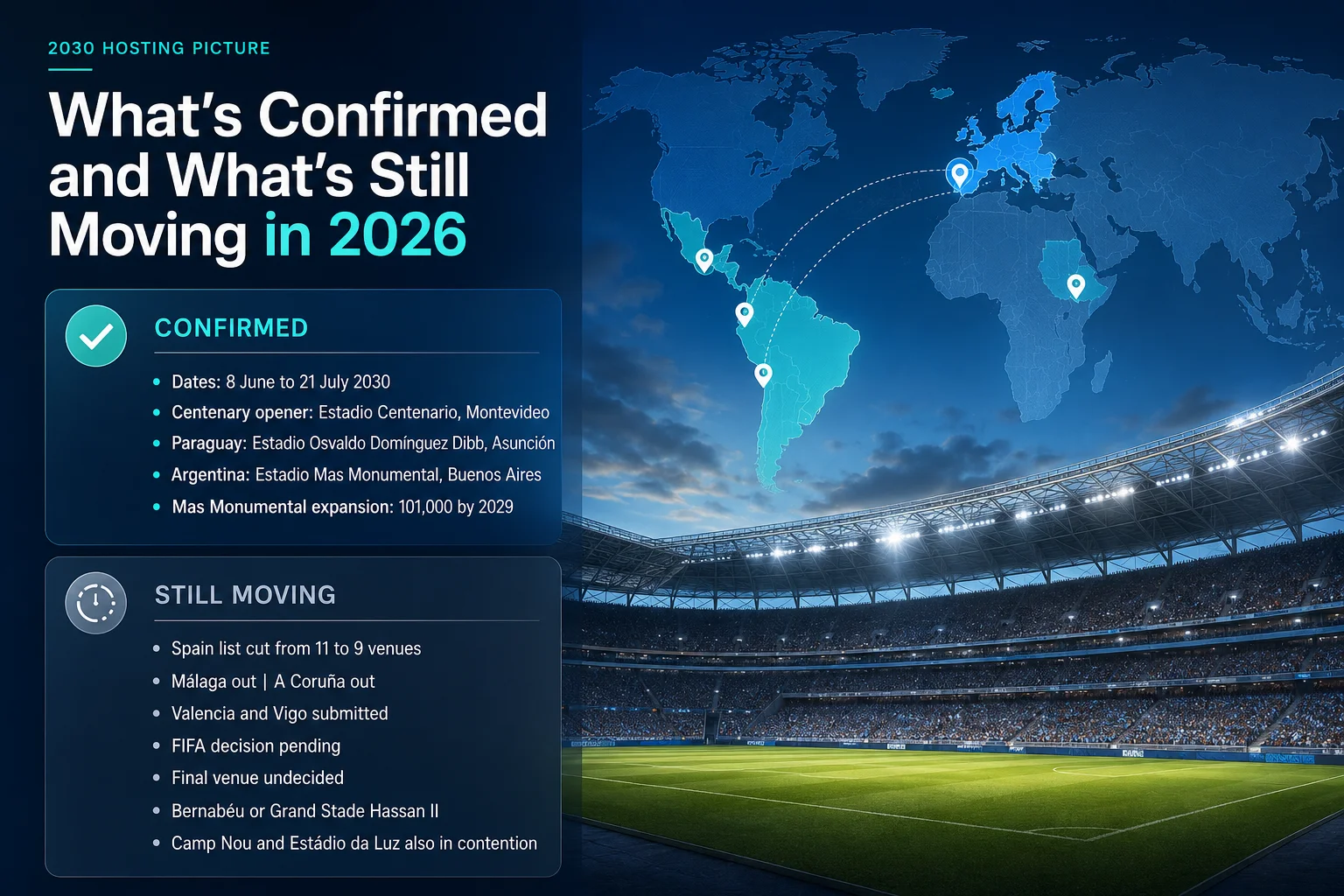
The 2030 hosting picture has shifted multiple times since the FIFA Council's October 2023 decision and is still moving as Spain reshapes its venue list. The state of play as of May 2026:
| Item | Status as of May 2026 |
|---|---|
| Tournament dates | Confirmed by FIFA: 8 June 2030 (centenary opening match) to 21 July 2030 (final). |
| Centenary opening venue | Confirmed: Estadio Centenario, Montevideo, on 8 June 2030. |
| Spain venue list | Reduced from 11 to 9 confirmed: Málaga (La Rosaleda) withdrew on 12 July 2025, and A Coruña (Riazor) withdrew on 15 March 2026. Valencia (Nou Mestalla) and Vigo (Balaídos) submitted by RFEF as replacement candidates in late March 2026; FIFA decision pending. |
| Final venue | Pending. Disputed between the Santiago Bernabéu (Madrid) and the Grand Stade Hassan II (Casablanca), with Spotify Camp Nou and Estádio da Luz also in contention. |
| Paraguay centenary venue | Confirmed: rebuilt Estadio Osvaldo Domínguez Dibb in Asunción, target completion 2027. |
| Argentina centenary venue | Confirmed: Estadio Mas Monumental, Buenos Aires. River Plate announced a 101,000-capacity expansion in January 2026, scheduled 2026-2029. |
The 2030 World Cup format and historic context
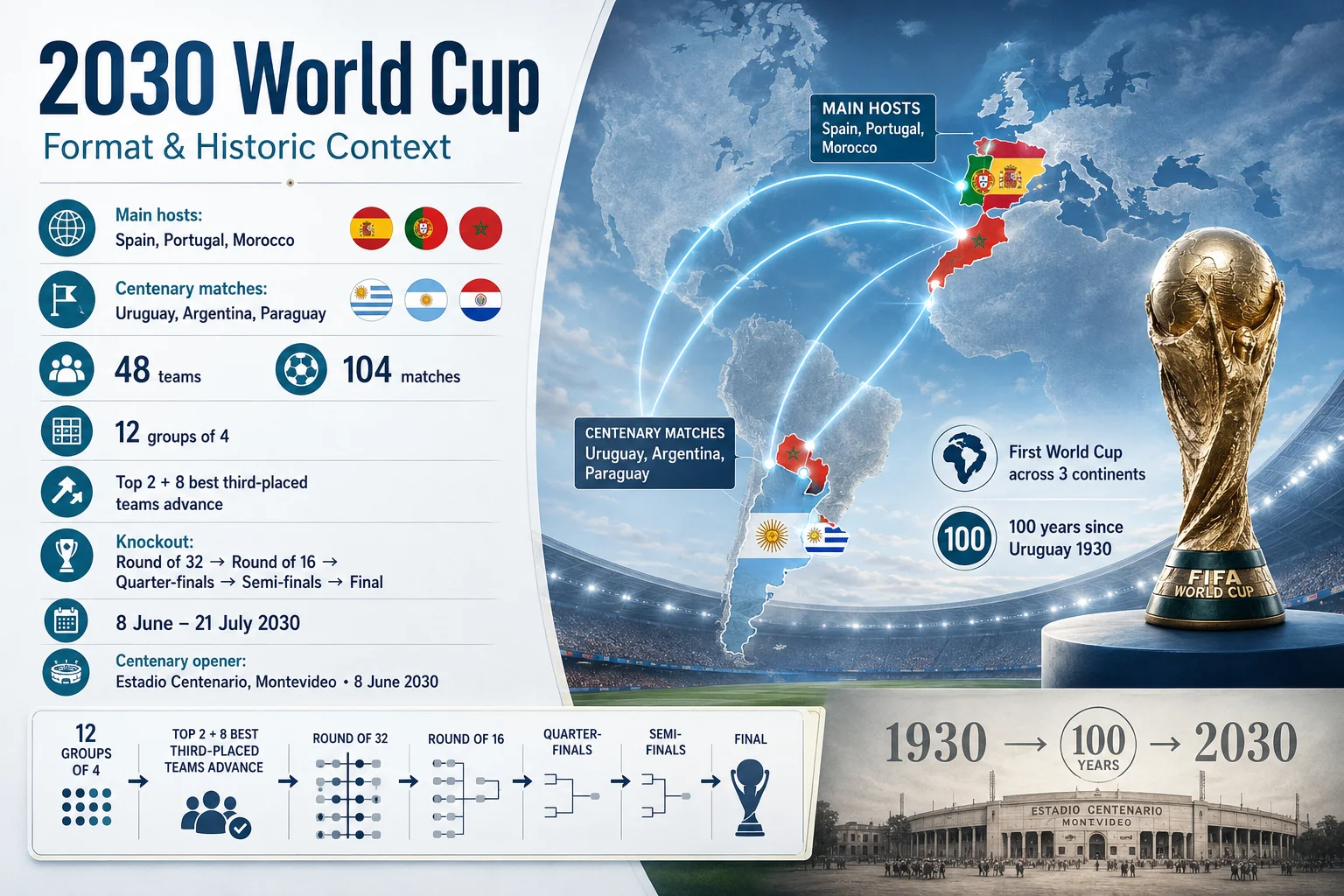
The 2030 World Cup pathway began on 4 October 2023, when the FIFA Council unanimously approved Spain, Portugal and Morocco as the sole bid for the tournament. The hosting decision was formally ratified at the Extraordinary FIFA Congress on 11 December 2024, alongside the award of the 2034 tournament to Saudi Arabia. The same FIFA Congress confirmed three centenary matches in Uruguay, Argentina and Paraguay, recognising the 100th anniversary of the inaugural 1930 World Cup hosted solely by Uruguay and won by Uruguay (4-2 against Argentina in the final at Estadio Centenario in Montevideo). The 2030 tournament marks the first World Cup played on three continents and the first played across the Mediterranean Sea.
| Detail | Information |
|---|---|
| Tournament | 2030 World Cup (centenary edition) |
| Main hosts | Spain, Portugal, Morocco |
| Centenary host nations | Uruguay, Argentina, Paraguay (one match each) |
| Format | 48 teams, 104 matches (matching the structure introduced in 2026) |
| Group stage | 12 groups of four teams |
| Knockout stage | Round of 32, Round of 16, quarter-finals, semi-finals, final |
| Tournament dates | 8 June to 21 July 2030 (FIFA-confirmed) |
| Centenary match weekend | 8-9 June 2030; Estadio Centenario hosts on 8 June |
| Original bid-book plan | 20 stadiums across 17 main-host cities (Spain 11, Portugal 3, Morocco 6) plus 3 centenary venues in South America. Spain's confirmed list now stands at 9 after the Málaga and A Coruña withdrawals. |
| Final venue | Pending. Leading candidates: Grand Stade Hassan II (Casablanca) and Santiago Bernabéu (Madrid), with Spotify Camp Nou as an alternative. |
| Centenary opener | Estadio Centenario, Montevideo (FIFA-confirmed) |
The 48-team format, expanded from the previous 32-team structure starting at the 2026 World Cup hosted across Canada, the United States and Mexico, produces 104 matches. That figure is up from the 64-match standard that ran from 1998 to 2022. Twelve groups of four teams play a single round-robin, with the top two from each group plus the eight best third-placed sides qualifying for the knockout phase.
The new knockout structure begins with a Round of 32 stage rather than starting at the Round of 16 as previous tournaments did. The practical effect is more matches spread across more venues and host cities than at any previous edition.
The expanded format also produces a heavier group-stage schedule, with 12 groups of four teams playing 72 matches before the knockout phase begins.
Spain: World Cup 2030 venues and host cities
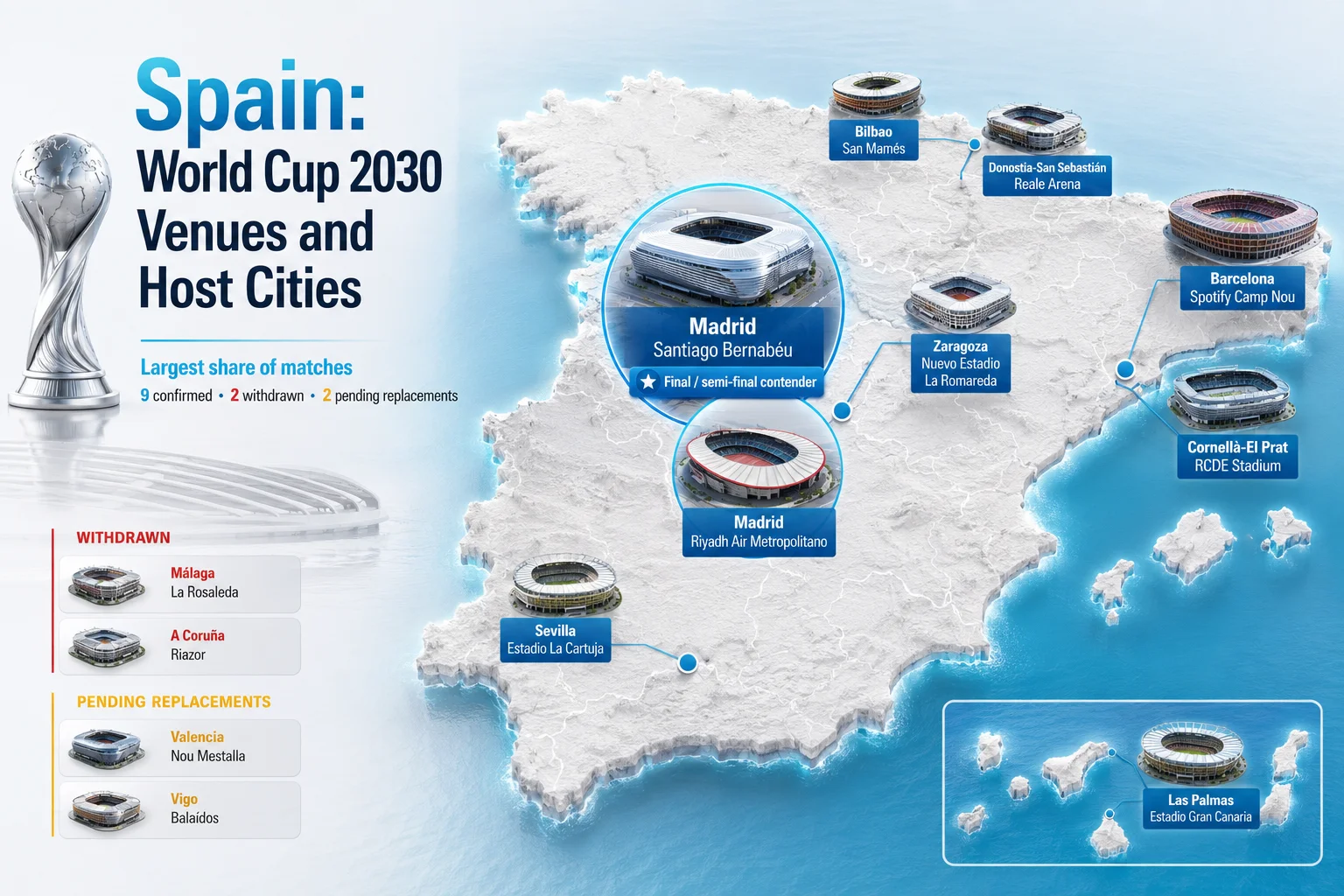
Spain will host the largest share of the 2030 World Cup matches, although the country's venue list has been reshaped in 2025 and 2026. The Royal Spanish Football Federation (RFEF) submitted 11 stadiums in July 2024. Málaga withdrew on 12 July 2025 over La Rosaleda renovation costs, and A Coruña withdrew on 15 March 2026 over funding gaps and a capacity shortfall against the FIFA 40,000 minimum (Riazor currently holds 32,490). RFEF formally requested two replacement candidates in late March 2026: Valencia's Nou Mestalla, expected to complete in 2027 or 2028, and Vigo's Estadio de Balaídos. The FIFA decision on those replacements is still pending. For Spanish national-team listings as 2030 fixtures are confirmed, the Spain tickets hub on 1BoxOffice tracks live availability across World Cup fixtures, friendlies and qualifiers.
| City | Stadium | Current capacity | 2030 target capacity | Status |
|---|---|---|---|---|
| Madrid | Santiago Bernabéu (Real Madrid) | 78,297 | 78,297 | Confirmed; strong final or semi-final candidate |
| Madrid | Riyadh Air Metropolitano (Atlético Madrid) | 70,460 | 70,460 | Confirmed; 2019 Champions League final venue |
| Barcelona | Spotify Camp Nou (FC Barcelona) | ~50,000 during phased reopening | 105,000 target on completion | Confirmed; subject to renovation timeline |
| Cornellà-El Prat | RCDE Stadium (RCD Espanyol) | 40,000 | 40,000 | Confirmed |
| Sevilla | Estadio La Cartuja | 57,600 | ~70,000 (renovation planned) | Confirmed; recent Copa del Rey final host |
| Bilbao | San Mamés (Athletic Bilbao) | 53,289 | 53,289 | Confirmed |
| Donostia-San Sebastián | Reale Arena (Real Sociedad) | 39,500 | ~42,300 (expansion planned) | Confirmed; group-stage expected |
| Las Palmas | Estadio Gran Canaria | 32,000 | ~44,500 (expansion planned) | Confirmed; Canary Islands hub |
| Zaragoza | Nuevo Estadio La Romareda | Renovation in progress | ~43,144 (rebuild target) | Confirmed; subject to rebuild completion |
| Málaga | Estadio La Rosaleda (Málaga CF) | 30,000 | n/a | Withdrawn (12 July 2025) over renovation cost and logistics |
| A Coruña | Estadio Riazor (Deportivo) | 32,490 | n/a | Withdrawn (15 March 2026) over funding gap and FIFA capacity minimum |
| Valencia | Nou Mestalla (Valencia CF, in construction) | n/a (under construction) | ~70,000 target on completion | Replacement candidate; awaiting FIFA decision |
| Vigo | Estadio de Balaídos (Celta Vigo) | 29,000 | ~44,000 (expansion planned) | Replacement candidate; awaiting FIFA decision |
The Madrid pairing anchors the Spanish hosting profile. The Santiago Bernabéu reopened in stages from 2023 to 2024 with a fully covered, 78,297-capacity venue, a retractable pitch and a 360-degree video board, making it one of the most modern stadiums in Europe and a strong contender for the final or a semi-final fixture. Real Madrid use the Bernabéu weekly for LaLiga and continental fixtures, which means non-tournament Bernabéu inventory will be available throughout the build-up to 2030.
Atlético Madrid's home was rebranded as the Riyadh Air Metropolitano in October 2024 under a sponsorship deal with the Saudi Arabian airline. The 70,460-capacity stadium hosted the 2019 Champions League final and is widely expected to draw a knockout fixture or two during the 2030 tournament. Atlético Madrid remains the venue's primary tenant. Visiting fans planning a non-tournament trip can use Atlético's domestic and continental fixtures as a way to scout the venue ahead of 2030.
In Barcelona, Spotify Camp Nou's renovation target capacity of 105,000 would make it the largest football stadium in Europe if delivered before 2030. The renovation timeline has slipped multiple times since 2023, and visiting fans should not assume the post-renovation capacity will be available for tournament fixtures. FC Barcelona have alternated between Estadi Olímpic Lluís Companys and a partially reopened Camp Nou as renovation phases are completed, with the club targeting a full return as the rebuild concludes.
Spain's smaller hosting venues handle predominantly group-stage fixtures. Sevilla contributes to Estadio La Cartuja with a renovation targeting roughly 70,000. The city's anchor club, Sevilla FC, plays at Estadio Ramón Sánchez Pizjuán and provides regular non-tournament inventory across LaLiga and the Europa League. Bilbao contributes to San Mamés at 53,289 seats. The stadium was originally selected for Euro 2020 before its four matches were moved to Estadio La Cartuja in Seville; it remains one of Spain's most atmospheric modern football grounds. Athletic Bilbao are the resident club at San Mamés and play the venue's full LaLiga and continental schedule. Donostia-San Sebastián adds Reale Arena, the home of Real Sociedad, with an expansion programme targeting roughly 42,300 by 2030.
If approved, the two replacement candidates would broaden the geographic spread. Nou Mestalla in Valencia would deliver one of the country's newest top-tier venues, with the existing Estadio Mestalla remaining in use until the new ground opens. Estadio de Balaídos in Vigo would also fill the gap left by A Coruña's withdrawal as Galicia's only host city. Visitors planning multi-fixture trips through Spain will benefit from the country's high-speed AVE rail network connecting Madrid, Barcelona, Sevilla, Bilbao and Valencia within practical day-trip distances. For wider Spanish football fixtures across the season, the LaLiga tickets hub tracks live availability.
WhatsApp channel
Sports news straight to your phone
Match updates, on-sale dates and ticket news from 1BoxOffice.
Portugal: World Cup 2030 venues and host cities
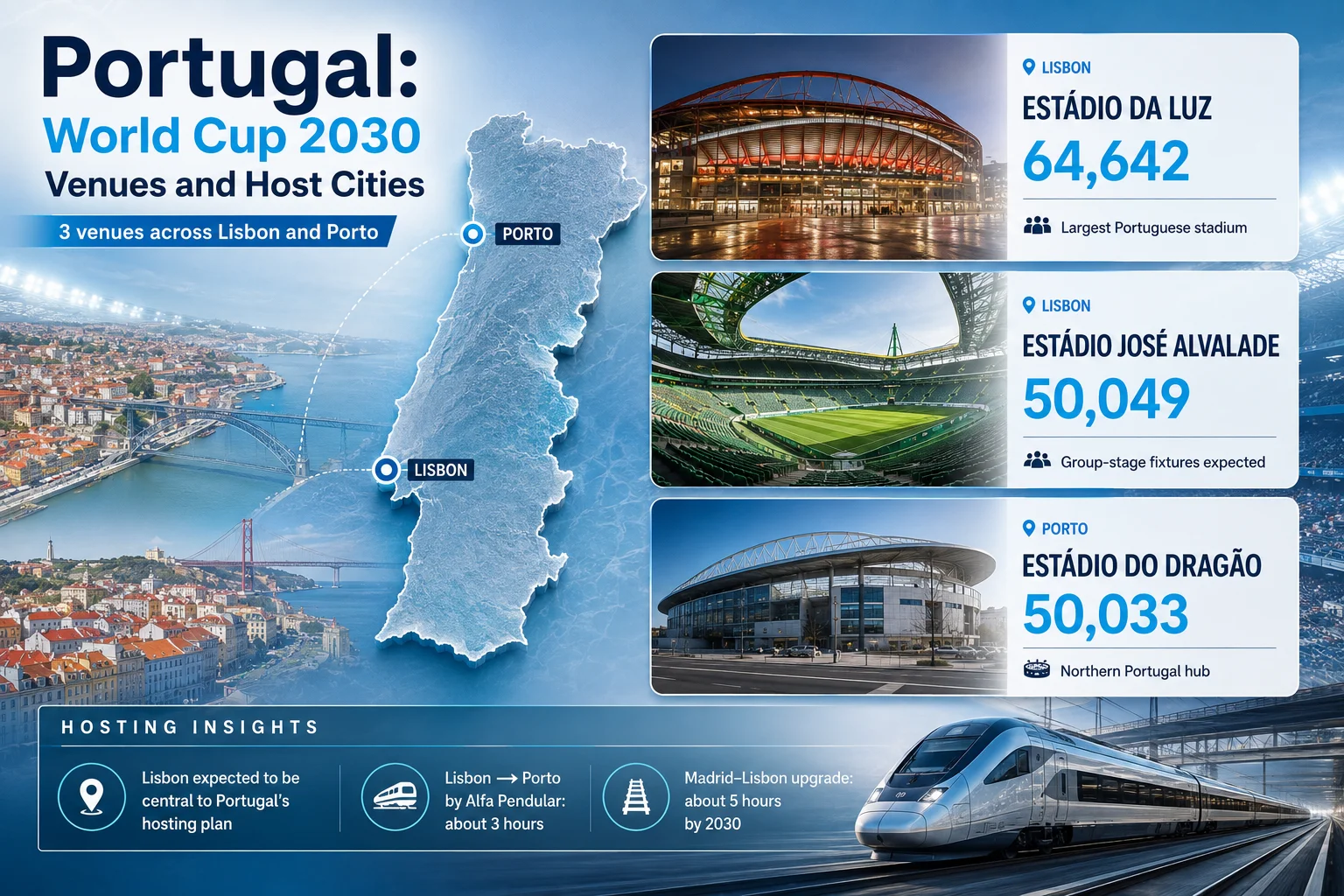
Portugal will host a smaller share of the 2030 World Cup matches than Spain, with three primary venues nominated by the Portuguese Football Federation. The smaller scale reflects Portugal's domestic football infrastructure, dominated by Benfica and Sporting in Lisbon alongside Porto in the north. For tournament-wide listings as Portuguese fixtures are confirmed, the Portugal tickets hub on 1BoxOffice tracks live availability.
| City | Stadium | Capacity | Notes |
|---|---|---|---|
| Lisbon | Estádio da Luz (SL Benfica) | 64,642 | Largest Portuguese stadium; group and knockout fixtures expected |
| Lisbon | Estádio José Alvalade (Sporting CP) | 50,049 | Group-stage fixtures expected |
| Porto | Estádio do Dragão (FC Porto) | 50,033 | Northern Portugal hub; mixed fixture allocation |
Portugal's three primary venues span Lisbon and Porto, with the Lisbon-Porto distance manageable by the high-speed Alfa Pendular service in approximately three hours. Visitors planning multi-fixture trips through Portugal will combine Lisbon and Porto fixtures with day trips to Coimbra, Braga and Faro. Lisbon is expected to be central to Portugal's hosting plan, although the exact knockout allocation remains subject to final tournament scheduling. The Madrid-Lisbon high-speed connection is being upgraded; the European Commission and Portuguese government have set a timeline of approximately five hours by 2030, with a three-hour target by 2034.
Morocco: World Cup 2030 venues and host cities
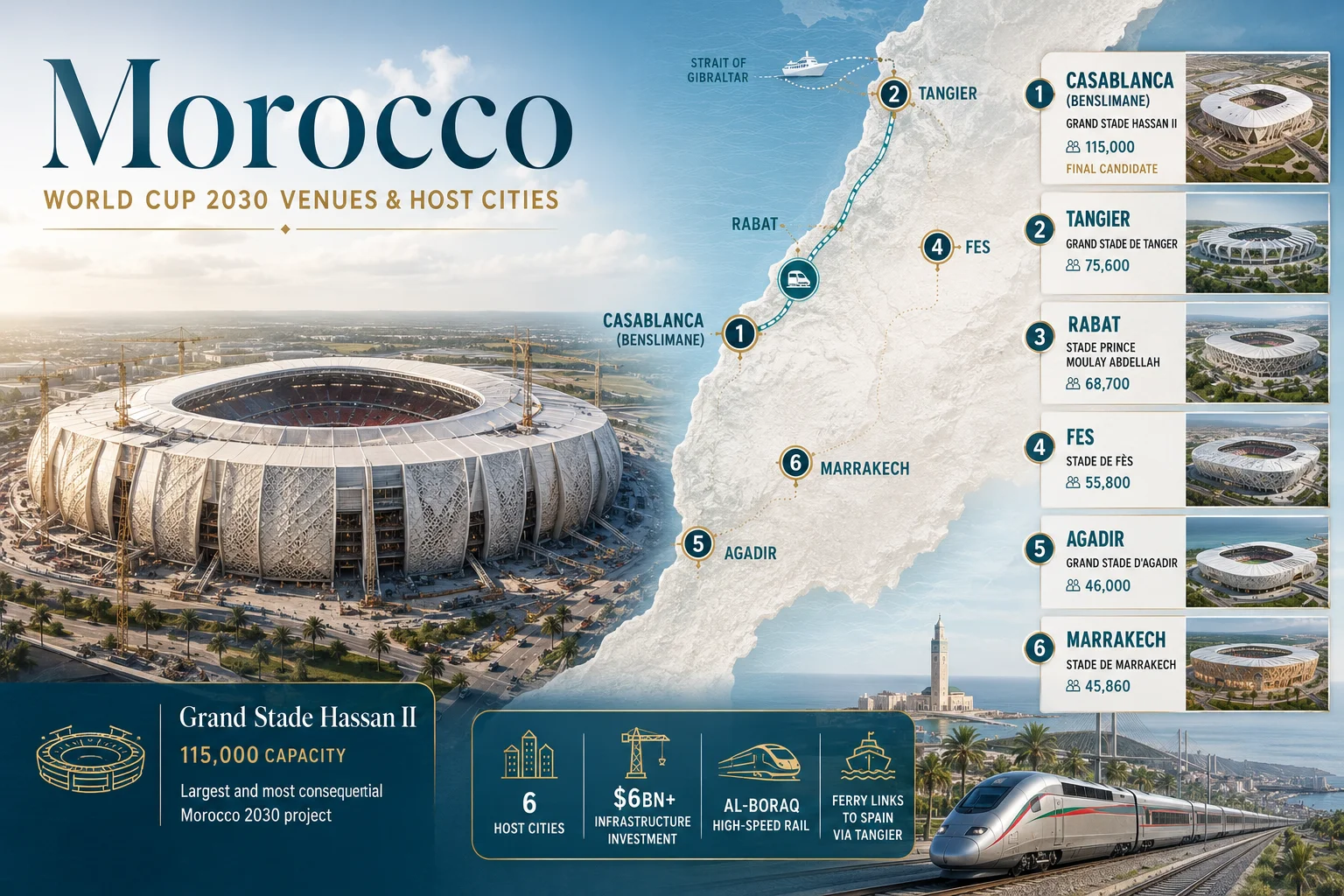
Morocco will host a substantial share of the 2030 World Cup matches across six cities. The Royal Moroccan Football Federation has nominated Casablanca, Rabat, Marrakech, Tangier, Fes and Agadir as the country's six host cities, anchored by the planned Grand Stade Hassan II in Casablanca. The Moroccan stadium-build programme is the most ambitious of any 2030 host nation, with total infrastructure investment exceeding $6 billion across stadiums, airports, rail and renewable energy. For tournament-wide listings as Moroccan fixtures are confirmed, the Morocco tickets hub on 1BoxOffice tracks live availability.
| City | Stadium | 2030 capacity | Notes |
|---|---|---|---|
| Casablanca (Benslimane) | Grand Stade Hassan II (under construction) | 115,000 | Final candidate, targeting completion ahead of 2030 |
| Tangier | Grand Stade de Tanger (Ibn Battouta, expansion) | 75,600 | Expansion from approximately 65,000 to the northern Morocco hub |
| Rabat | Stade Prince Moulay Abdellah (rebuilt) | 68,700 | Capital city venue; reopened 2025; mixed fixture allocation |
| Fes | Stade de Fès (rénovation) | 55,800 | Expansion from 35,500; historic city venue |
| Agadir | Grand Stade d'Agadir (Adrar, rénovation) | 46,000 | Atlantic coast venue; group fixtures expected |
| Marrakech | Stade de Marrakech (rénovation) | 45,860 | Tourist hub; group-stage fixtures expected |
The Grand Stade Hassan II in Casablanca is the most consequential single piece of infrastructure for the 2030 World Cup. Designed by Populous in collaboration with Paris-based Moroccan architect Tarik Oualalou of OUALALOU + CHOI, the new stadium is being built specifically for the tournament with a projected 115,000 capacity, which would surpass Estadio Mas Monumental in Buenos Aires and Spotify Camp Nou's post-renovation target. The stadium is widely tipped to host the World Cup final, although FIFA has not yet formally confirmed the final venue. We covered the Casablanca build in detail when Morocco revealed the plan to construct the largest football stadium in the world; the project remains the headline infrastructure story across all three main host nations.
Morocco's hosting profile is the most logistically distinctive of the three main host nations. The country sits across the Strait of Gibraltar from southern Spain, with ferry connections from Tarifa and Algeciras to Tangier providing an option that visitors based in Spain's southern coast may consider for shorter cross-border trips, subject to ferry schedules and match timing. The Al-Boraq high-speed rail line connects Casablanca and Tangier in approximately two hours and 10 minutes, with extensions to Marrakech and Agadir under construction as part of Morocco's tourism infrastructure programme. Visa requirements for international visitors travelling to Morocco are different from those in Spain and Portugal, which sit within the European Union Schengen Area.
The three centenary matches: Uruguay, Argentina and Paraguay
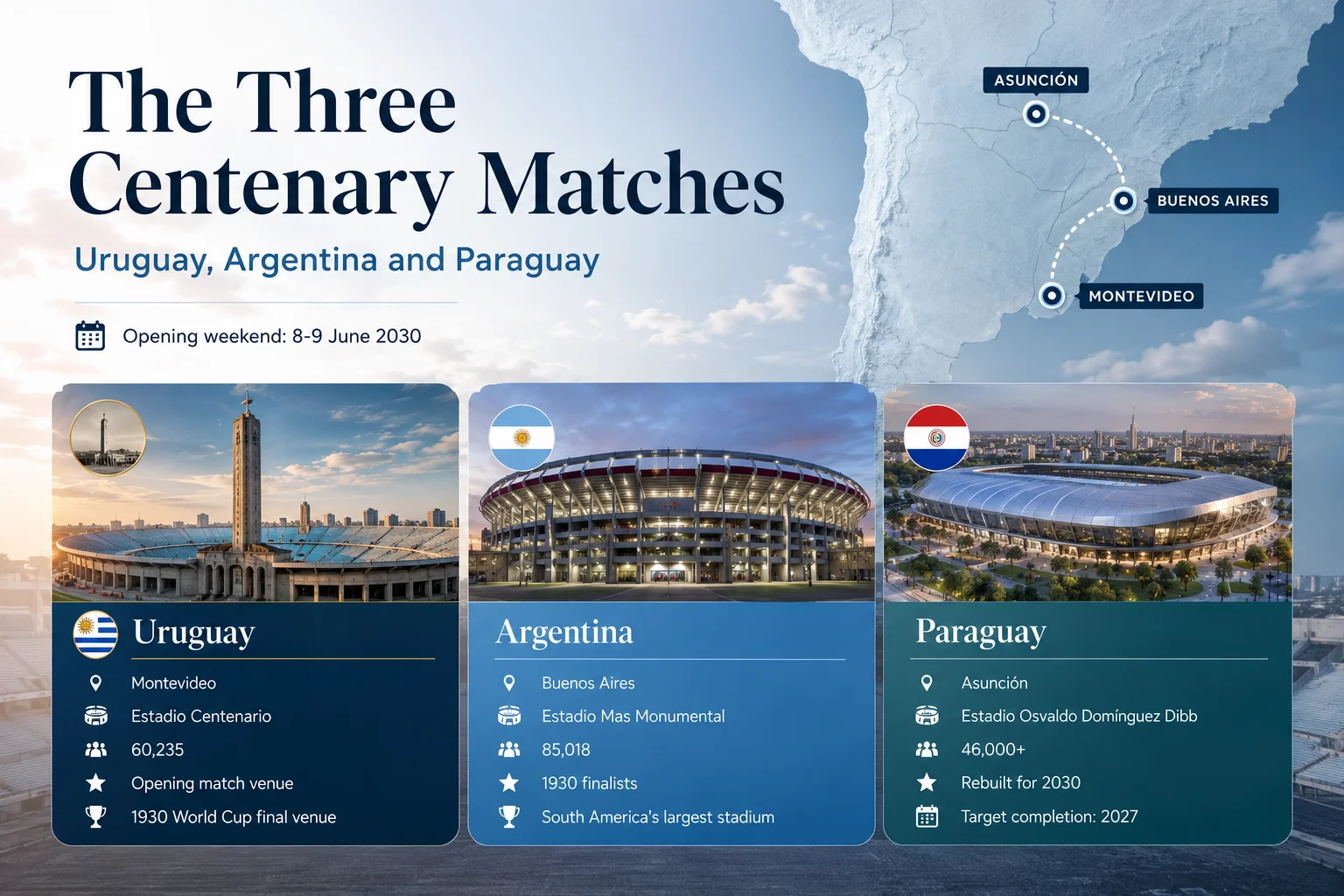
The 2030 World Cup will open with three centenary matches in South America over the weekend of 8-9 June 2030, recognising the tournament's 1930 origins in Uruguay and the wider South American centenary tribute. FIFA confirmed the centenary recognition as part of the 2024 hosting award, with Estadio Centenario in Montevideo confirmed as the opening match venue on 8 June 2030. The remaining two centenary fixtures fall on the same opening weekend before the main tournament begins in Spain, Portugal and Morocco.
| Country | Stadium | City | Capacity | 1930 World Cup connection |
|---|---|---|---|---|
| Uruguay | Estadio Centenario | Montevideo | 60,235 | Hosted the 1930 World Cup final and most fixtures of the inaugural tournament; FIFA-confirmed centenary opening venue on 8 June 2030 |
| Argentina | Estadio Mas Monumental (River Plate) | Buenos Aires | 85,018 (post-2025 renovation; 101,000 expansion announced January 2026, work scheduled 2026-2029) | Argentina's primary national-team venue; 1930 finalists, beaten by Uruguay |
| Paraguay | Estadio Osvaldo Domínguez Dibb (Club Olimpia) | Asunción | 46,000+ (rebuild target) | Paraguay's centenary venue; rebuilt for 2030 after the original Estadio CONMEBOL and Estadio Defensores del Chaco proposals were superseded; rebuild targeting 2027 completion |
Tickets for Uruguay's centenary match at Estadio Centenario in Montevideo carry a unique place in football history. The stadium was specifically built for the 1930 tournament and hosted the inaugural World Cup final, where Uruguay beat Argentina 4-2 to win the first global title. The Centenario remains in active use today; the centenary match returns the venue to global tournament hosting after a 100-year gap, a choice widely cited as the most poetic single venue decision in the 2030 tournament.
Tickets for Argentina's centenary match at Estadio Mas Monumental in Buenos Aires (the home of Club Atlético River Plate) recognise Argentina's status as 1930 finalists. The stadium completed a major renovation in 2025 that brought capacity to 85,018 (the largest in South America). In January 2026, River Plate announced a $100 million expansion to take capacity above 101,000 and add a roof over the stands, with construction scheduled between 2026 and 2029, designed by Schlaich Bergermann Partner. The expansion is intended to be completed ahead of the 2030 centenary match, although the timeline carries delivery risk given the scale.
Tickets for Paraguay's centenary match are tied to the new Estadio Osvaldo Domínguez Dibb in Asunción. The Paraguayan venue selection has the messiest backstory of any 2030 stadium choice. CONMEBOL first proposed a brand-new Estadio CONMEBOL in March 2023. The July 2024 bid book then listed Estadio Defensores del Chaco as the principal venue, with Pablo Rojas and Olimpia's old Manuel Ferreira ground as alternates. On 11 December 2024, the day FIFA awarded the tournament, Olimpia's rebuilt stadium (renamed in March 2024 after late former president Osvaldo Domínguez Dibb, father of CONMEBOL president Alejandro Domínguez) was confirmed instead, a switch that bypassed the formal tender process and has since been challenged by Paraguayan football journalism. Club Olimpia's reconstructed home will hold approximately 46,000 spectators when complete, with the rebuild targeting 2027 delivery.
For visitors planning to attend the centenary matches before the main tournament, the 8-9 June weekend timing allows a South American leg followed by a transatlantic flight to Spain, Portugal or Morocco. The travel logistics are demanding but workable for visitors with the time and budget. South American visa requirements differ from European Union and Moroccan requirements; visitors from outside the Mercosur region should confirm visa requirements for Uruguay, Argentina and Paraguay before booking travel.
Where will the 2030 World Cup final be played?
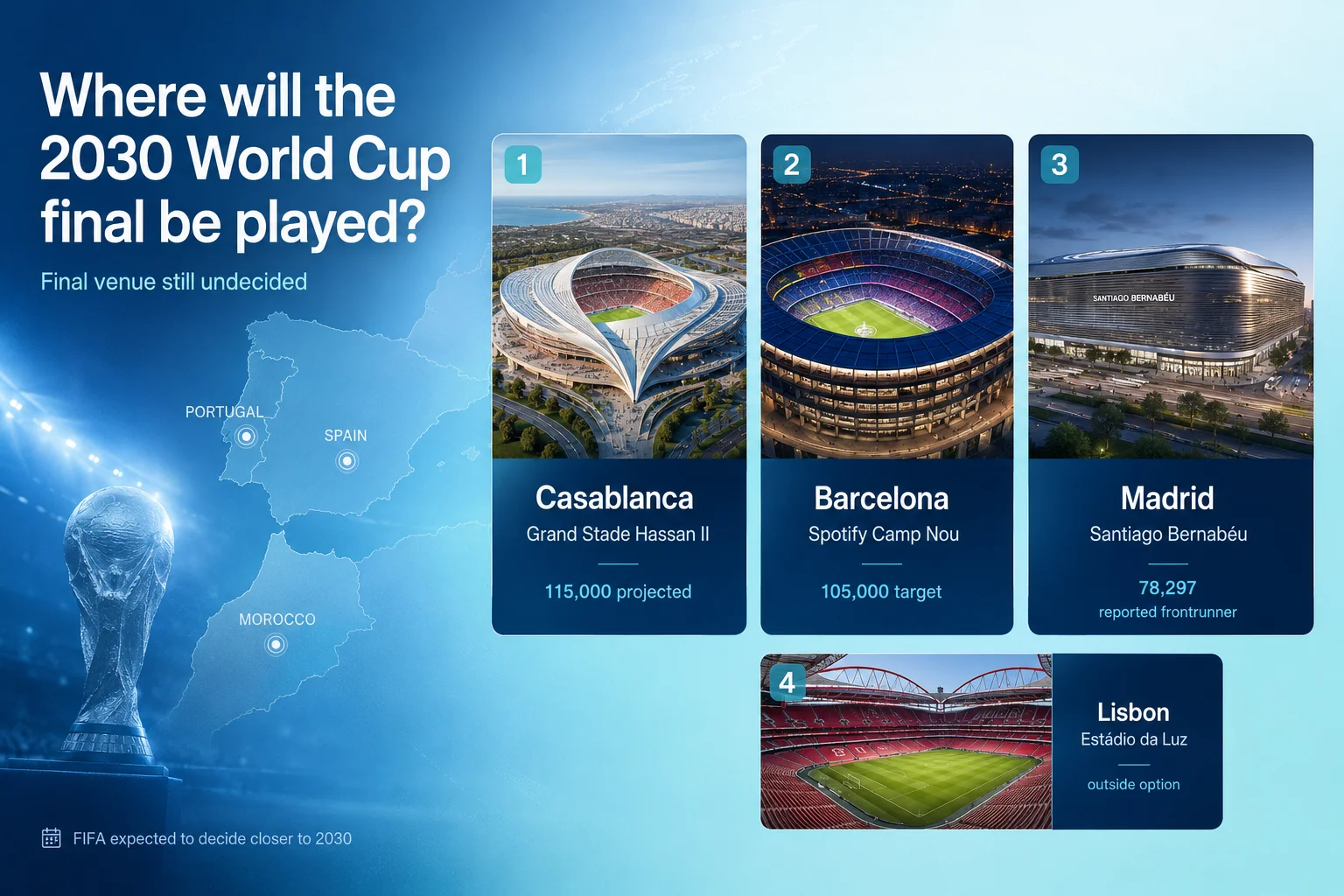
The 2030 World Cup final venue is the most politically charged single decision still pending. Three stadiums meet the FIFA 80,000-seat requirement for a final: the Grand Stade Hassan II in Casablanca (115,000 projected), Spotify Camp Nou in Barcelona (105,000 target on completion) and the Santiago Bernabéu in Madrid (78,297, with FIFA reportedly willing to accept the slight shortfall). Marca has reported a Real Madrid agreement with FIFA on hosting the final at the Bernabéu. The architect of the Grand Stade Hassan II, Tarik Oualalou, has publicly stated the stadium was "designed for the 2030 final," and Morocco has lobbied hard for the showpiece fixture. The Spanish Sports Council president confirmed in July 2025 that Portugal had also expressed interest in hosting the final at Estádio da Luz, although Lisbon is widely seen as the third option behind the Spanish and Moroccan candidates. FIFA retains the final say and is expected to decide closer to the tournament.
How to buy tickets for the 2030 World Cup
Ticket sales for the 2030 World Cup are expected to open in late 2027 or early 2028 through FIFA's primary ticketing channels. Sales typically run through multiple ballot phases (random allocation), conditional supporter sales (priority for confirmed-team supporters once the group draw is complete), tour-operator hospitality packages and final open sales as inventory becomes available.
The standard ticket sale phases for major World Cup tournaments are:
- First random ballot, 12 to 18 months before the tournament, with no team-specific allocation.
- Conditional supporter sales after the group draw, with priority for fans of confirmed teams.
- Last-minute sales in the final weeks before kick-off.
Hospitality packages are sold through FIFA's appointed hospitality partners. On Location operates as the FIFA hospitality partner for the 2026 World Cup; the 2030 hospitality partner has not yet been publicly confirmed. Hospitality runs at significantly higher prices than standard tickets but includes reserved seating, food and drink and dedicated facilities. Hospitality is the most reliable route for international visitors who do not qualify for any conditional supporter sales tier.
Stage-specific listings on the secondary market are tracked across dedicated hubs on 1BoxOffice as match pairings are confirmed. Round of 32 listings open as the bracket is set after the group stage. Round of 16, quarter-final, semi-final, third-place playoff and final hubs follow as those fixtures are determined.
The secondary market for World Cup tickets is the practical route for international visitors who do not secure tickets through the primary sales phases. 1BoxOffice operates as a verified secondary marketplace, established in 2006, with a 150% money-back guarantee: if your tickets are not delivered, the platform refunds 150% of the price paid. That guarantee is useful for international buyers who often book flights and accommodation before ticket delivery is complete. New buyers can register an account to manage purchases, alerts and notifications across the build-up to the tournament. Existing buyers can track their order through to delivery, including delivery method and any updates from the seller.
Pricing for the 2030 tournament has not been confirmed. As an illustrative reference (not a 2030 forecast), FIFA's published 2022 World Cup pricing in Qatar set lower-category group-stage tickets in approximately the EUR 80 to EUR 200 band, with the final and semi-finals running into four-figure prices for premium categories. The 48-team format spreads more group-stage fixtures across more host cities than at previous tournaments, which may shift the lower-category supply, although no confirmed 2030 prices have been published. All 2030 figures will be added to this guide once FIFA releases the 2030 ticket pricing schedule.
Travel and visa logistics for the 2030 World Cup
The 2030 World Cup will involve more travel logistics than any previous tournament because of the six-nation, three-continent format. Spain and Portugal sit within the European Union Schengen Area, where visa-free travellers and Schengen visa holders are generally limited to 90 days in any 180 days. Morocco operates separate visa requirements but maintains visa-free entry for many nationalities for tourist stays under 90 days. South American visa requirements vary by visitor nationality across Uruguay, Argentina and Paraguay.
For visitors planning to attend fixtures across multiple host nations, the practical itinerary options break down into four routes:
- Spain-Portugal only. The simplest option, with high-speed rail and direct flights connecting the two countries.
- Spain-Portugal-Morocco. Adds the ferry from Tarifa or Algeciras to Tangier, or a short flight to Casablanca.
- South American centenary leg only. Uruguay, Argentina and Paraguay are connected by short regional flights and overland routes.
- Full multi-continent itinerary. Combines the South American centenary leg with the European-North African main tournament, requiring intercontinental travel and careful date planning.
Spain and Portugal share the high-speed AVE and Alfa Pendular rail networks providing fast links between Madrid, Barcelona, Lisbon, Porto and Sevilla within practical day-trip distances. Within Morocco, the Al-Boraq high-speed rail line connects Casablanca and Tangier in approximately two hours and 10 minutes, with extensions to Marrakech under construction.
For the South American centenary leg, regional flights connect Montevideo, Buenos Aires and Asunción within practical journey times. Visitors planning to combine the centenary matches with the main tournament should allow at least a three-day buffer between the South American leg on 8-9 June and the European-North African leg, given the transatlantic flight times and time-zone differences. Direct services from Buenos Aires to Madrid are operated by Aerolíneas Argentinas, Iberia and other major carriers, with typical flight times in the 12 to 13 hour range.
Accommodation strategy for the 2030 World Cup will benefit from booking ahead. Major host cities, including Madrid, Barcelona, Lisbon and Casablanca, already operate at high tourism occupancy outside tournament periods, and World Cup demand will compound this. Industry advice from previous World Cup tournaments has been to book accommodation 12 to 18 months ahead of the opening fixture to secure standard hotel pricing; for 2030, that points to bookings by the end of 2028 or early 2029. Hospitality packages typically include accommodation as part of the bundle.
FAQs
Where will the 2030 World Cup be held?
-
The 2030 World Cup will be hosted across six nations on three continents, the first World Cup staged across six nations and three continents, and the first played across the Mediterranean Sea. The main tournament will run across Spain, Portugal and Morocco from 8 June to 21 July 2030, while three opening centenary matches will be played in Uruguay, Argentina and Paraguay over the weekend of 8-9 June 2030 to commemorate the 100th anniversary of the 1930 World Cup. FIFA ratified the joint hosting decision at the Extraordinary FIFA Congress on 11 December 2024, recognising the unique centenary context of the inaugural 1930 tournament hosted solely by Uruguay.
When does the 2030 World Cup start and finish?
-
FIFA has confirmed the 2030 World Cup tournament dates as 8 June 2030 (the centenary opening match at Estadio Centenario in Montevideo) to 21 July 2030 (the final). The three South American centenary matches in Uruguay, Argentina and Paraguay are staged over the weekend of 8-9 June 2030 before the main tournament begins in Spain, Portugal and Morocco. The exact match-by-match schedule will be confirmed once the tournament draw is complete.
How many venues and host cities will the 2030 World Cup have?
-
The original 2030 bid book proposed 20 stadiums across 17 main-host cities, with Spain allocated 11 stadiums, Portugal 3 and Morocco 6, plus 3 South American centenary venues. The Spanish list has been reshaped during 2025 and 2026: Málaga withdrew on 12 July 2025 and A Coruña on 15 March 2026. Valencia (Nou Mestalla) and Vigo (Balaídos) were submitted by RFEF in late March 2026 as replacement candidates, with the FIFA decision still pending. The final host venue list is expected to be confirmed by FIFA ahead of the tournament draw.
Where will the 2030 World Cup final be held?
-
The 2030 World Cup final venue has not yet been confirmed. The two leading candidates are the Grand Stade Hassan II in Casablanca (currently under construction with a projected 115,000 capacity, which would make it the largest football stadium in the world) and the Santiago Bernabéu in Madrid (78,297 post-2024 renovation), with Spotify Camp Nou (105,000 target post-renovation) and Estádio da Luz in Lisbon also in contention. Spain and Morocco are reportedly in dispute over the showpiece fixture; FIFA retains the final decision and is expected to confirm the venue closer to the tournament.
Where will the 2030 World Cup open?
-
FIFA has confirmed Estadio Centenario in Montevideo as the centenary opening match venue on 8 June 2030. Estadio Centenario hosted the 1930 World Cup final, where Uruguay beat Argentina 4-2 to win the inaugural tournament, and the centenary match returns the stadium to global tournament hosting after a 100-year gap. The two other centenary matches at Estadio Mas Monumental in Buenos Aires and the new Estadio Osvaldo Domínguez Dibb in Asunción will follow on 8-9 June 2030. The exact match allocation across the three centenary venues will be confirmed in the 2030 tournament draw.
Where is Paraguay's centenary match being played?
-
Paraguay's centenary match will be played at Estadio Osvaldo Domínguez Dibb in Asunción, the home of Club Olimpia, which is being completely rebuilt for the tournament with a target capacity of approximately 46,000 and a delivery date in 2027. The new venue replaces the originally proposed Estadio Defensores del Chaco and the separate Estadio CONMEBOL project, both of which featured in earlier bid materials before the December 2024 FIFA Congress confirmed Olimpia's rebuilt ground instead. The switch bypassed the formal tender process and has since drawn scrutiny from Paraguayan football journalists.
How do I buy tickets for the 2030 World Cup?
-
Tickets for the 2030 World Cup will be sold through FIFA's primary ticketing channels, with sales expected to open in late 2027 or early 2028. The standard sale phases include a first random ballot 12 to 18 months before the tournament, conditional supporter sales after the group draw, with priority for fans of confirmed teams and last-minute sales in the final weeks before the tournament. Hospitality packages run through FIFA's appointed hospitality partners; On Location is the partner for the 2026 World Cup, with the 2030 partner not yet publicly confirmed. The secondary market is the practical route for international visitors who do not qualify for primary sale priority, and the 1BoxOffice 150% money-back guarantee covers buyers who book before fixtures are confirmed.
Will I need a visa for the 2030 World Cup?
-
Visa requirements depend on your nationality and which host nations you plan to visit. Spain and Portugal sit within the European Union Schengen Area, where visa-free travellers and Schengen visa holders are generally limited to 90 days in any 180 days. Morocco maintains visa-free entry for many nationalities for tourist stays under 90 days. South American visa requirements vary across Uruguay, Argentina and Paraguay, and FIFA may issue a Fan ID or accreditation requirement alongside standard visas; the precedent from the 2026 World Cup Fan ID system gives an indication of what may apply. Confirm your specific requirements with each host nation's primary immigration channels before booking travel.
Once the 2030 World Cup fixtures and venues are confirmed, the dedicated tournament hub on 1BoxOffice will track live secondary listings as the bracket is set. The platform's 150% money-back guarantee covers every order, with stage-specific listings rolling out across the group, knockout and final pages as match pairings are drawn.
Sources: FIFA tournament announcements, FIFA 2022 World Cup ticket pricing schedule (Qatar), Royal Spanish Football Federation (RFEF), Portuguese Football Federation, Royal Moroccan Football Federation (FRMF), Asociación Uruguaya de Fútbol (AUF).