In this guide
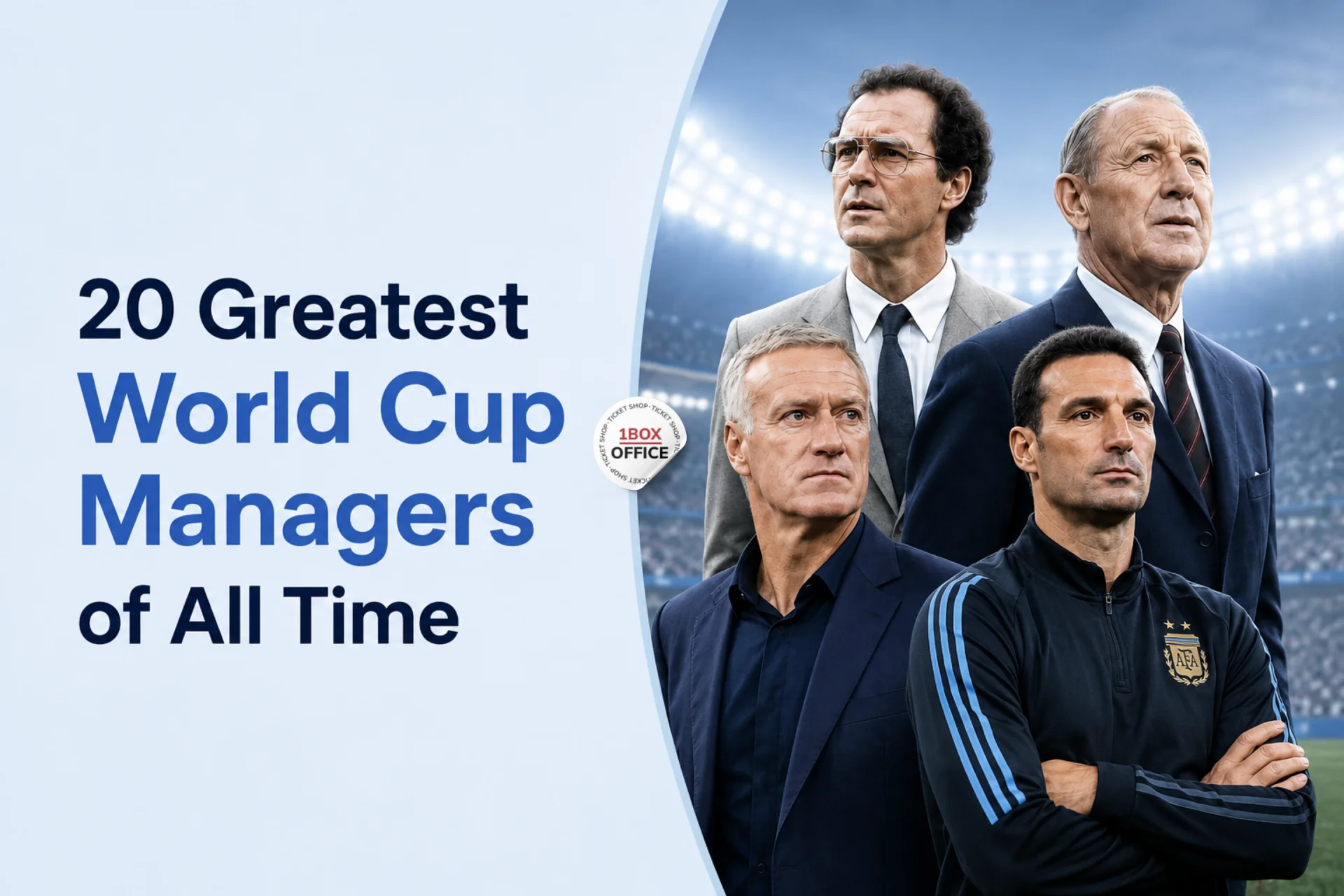
How We Ranked ThemRanks 1 to 5: The UntouchablesRanks 6 to 10: Champions Across ErasRanks 11 to 15: One Title, One IdeaRanks 16 to 20: Overachievers and InnovatorsThe Records That Frame the DebateWinning Managers Who Missed the CutFAQsTwenty-two World Cups have produced just 21 winning managers, and only one of them has ever won it twice. That scarcity is what makes the argument over the greatest World Cup managers so durable: the tournament hands a coach seven matches, once every four years, and a single bad afternoon erases four years of work. Didier Deschamps has just made the debate live again, passing Helmut Schön's 48-year-old record for World Cup match wins during the 2026 group stage.
This ranking weighs every manager in tournament history against six criteria, from titles to tactical legacy, and it will keep moving while the 2026 World Cup does. If the knockout rounds have pulled you in, seats for the remaining matches are still listed on the World Cup tickets hub, every order covered by a 150% money-back guarantee.
How We Ranked Them
International tournament football is a small-sample sport, so a ranking built on win percentage alone rewards luck. We scored every candidate on six factors, weighted to reward repeated achievement over a single hot month. A title in a 13-team invitational field in the 1930s is not identical to a title in a 32-team field in 2022, and the scoring reflects that tension rather than pretending it away.
| Criterion | What it measures | Weighting |
|---|---|---|
| Titles won | World Cups lifted as head coach | Highest |
| Finals and semi-finals | Consistency of deep runs beyond the trophy itself | High |
| Longevity | Tournaments managed and record across them | High |
| Era-adjusted record | Wins per match relative to field size and format | Medium |
| Opposition strength | Quality of teams beaten in knockout football | Medium |
| Tactical legacy | Whether the manager changed how the game is played | Medium |
One deliberate choice: winning the trophy is not an automatic pass into the top 20, and missing it is not an automatic bar. Four title-winning managers sit outside this list, while three men who never lifted the trophy make it in on the strength of what they changed.
Ranks 1 to 5: The Untouchables
| Rank | Manager | Team(s) | World Cups | P | W-D-L | Best finish |
|---|---|---|---|---|---|---|
| 1 | Vittorio Pozzo | Italy | 2 (1934-38) | 9 | 8-1-0 | Champion x2 |
| 2 | Didier Deschamps | France | 4 (2014-26) | 24 | 19-3-2* | Champion (2018) |
| 3 | Mário Zagallo | Brazil | 3 (1970-98) | 20 | 13-3-4 | Champion (1970) |
| 4 | Franz Beckenbauer | West Germany | 2 (1986-90) | 14 | 8-4-2 | Champion (1990) |
| 5 | Helmut Schön | West Germany | 4 (1966-78) | 25 | 16-5-4 | Champion (1974) |
Shoot-outs count as draws, per statistical convention. *Deschamps' figures include all five France wins at the 2026 tournament to 9 July; his assistant oversaw the Norway match after a family bereavement, which is why some outlets quote 18.
1. Vittorio Pozzo (Italy)
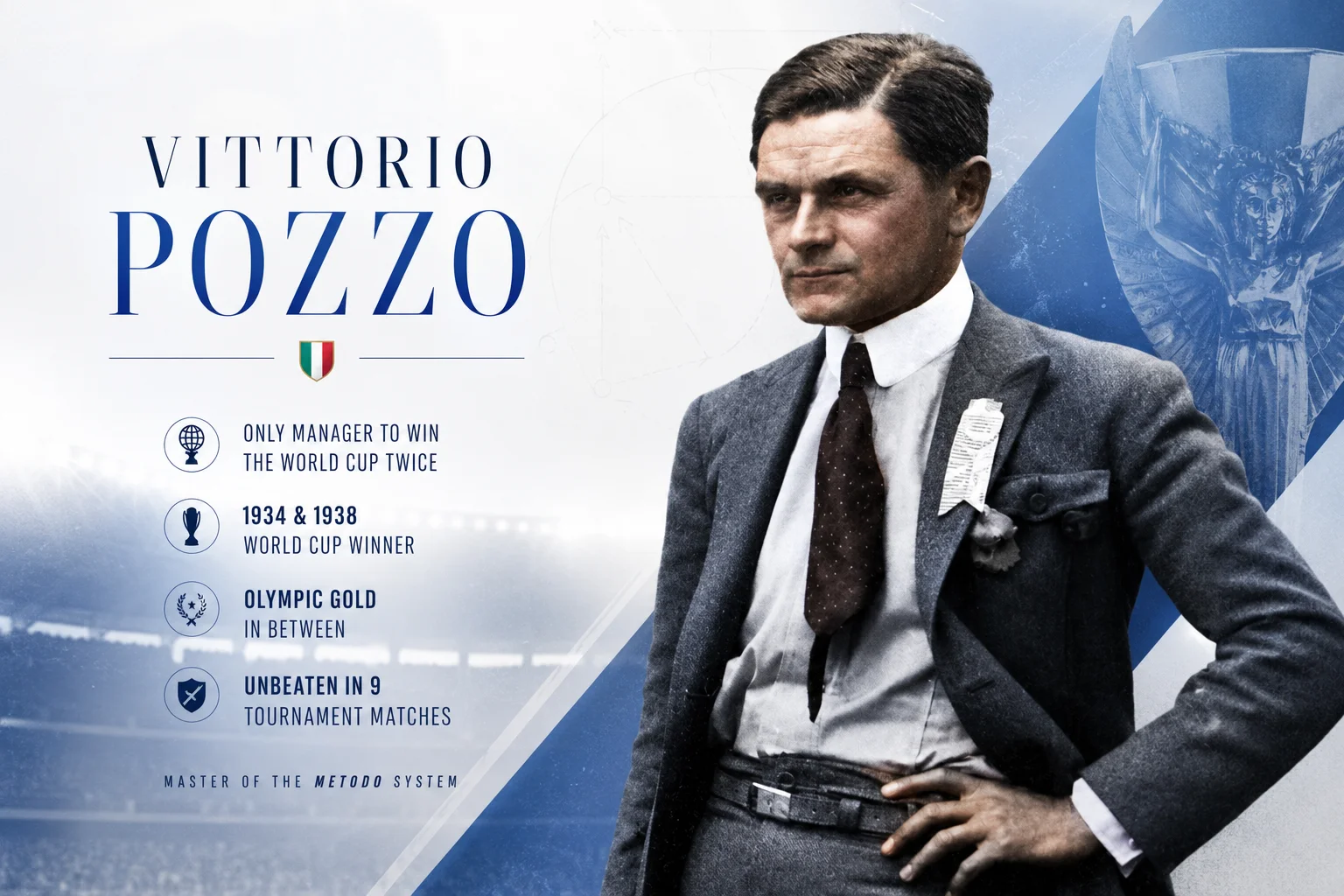
The only manager to win the World Cup twice, in 1934 and 1938, with an Olympic gold in between and no defeat in nine tournament matches. Pozzo rebuilt Italy around the Metodo system and man-managed a squad under intense political pressure. Until someone matches the double, the top spot is not seriously contested.
2. Didier Deschamps (France)
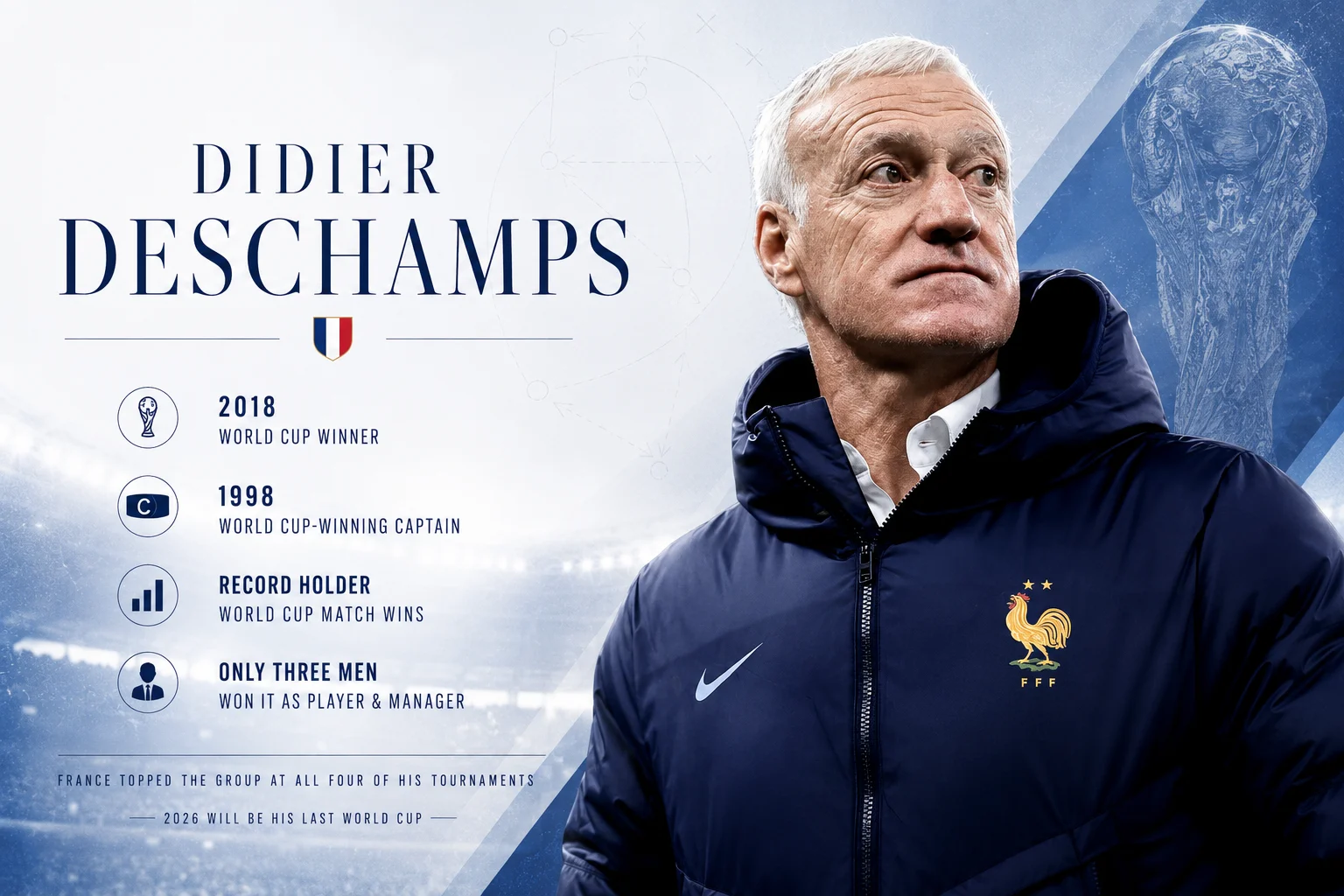
Champion in 2018, a penalty shoot-out from retaining it in 2022, and now the record holder for World Cup match wins after overtaking Schön's mark of 16 during the 2026 group stage. He also lifted the trophy as captain in 1998, one of only three men to win it as player and manager. France have topped their group at all four of his tournaments, and he has already said 2026 is his last. Win it and the Pozzo conversation starts in earnest.
3. Mário Zagallo (Brazil)
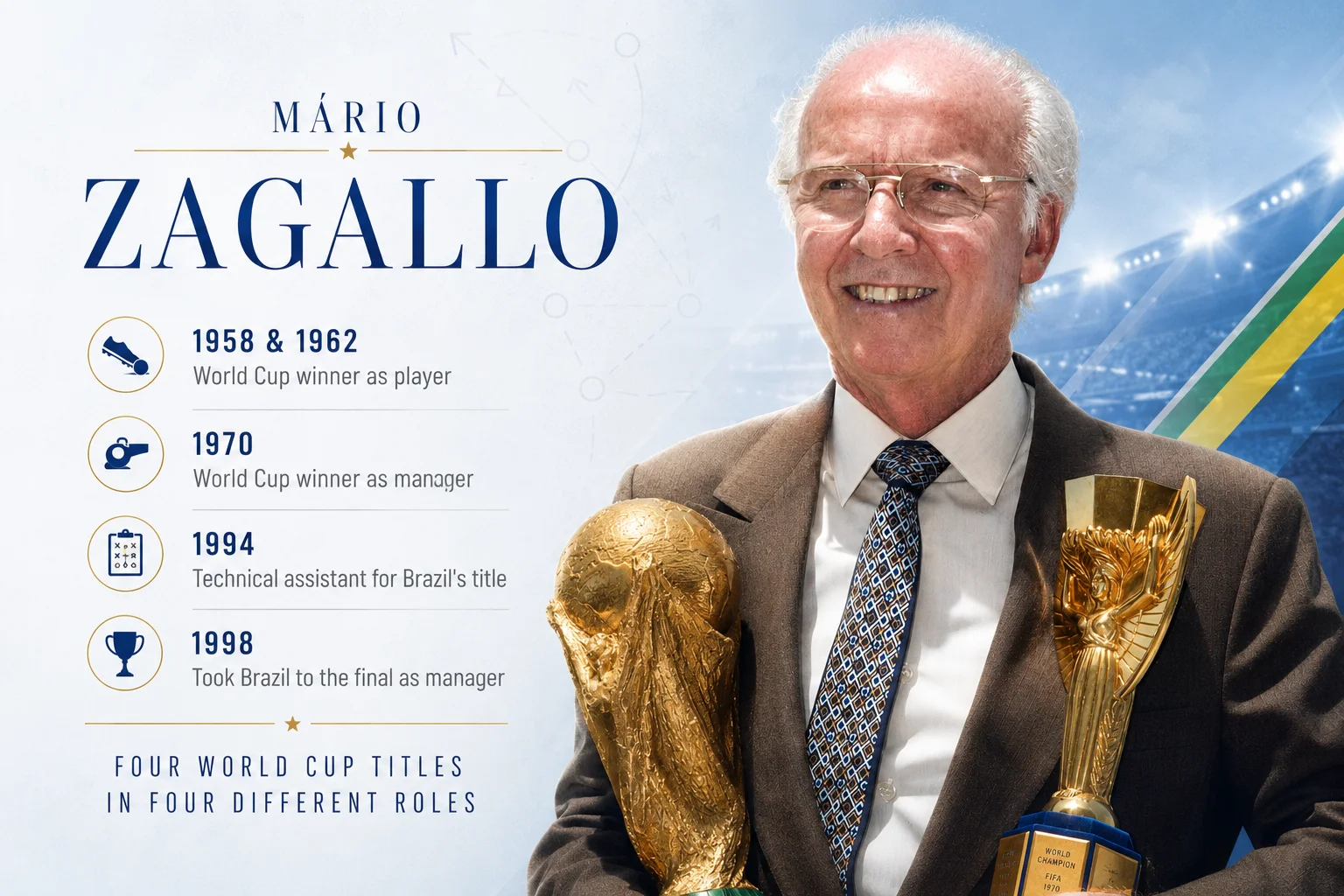
Won the World Cup as a player in 1958 and 1962, then managed the 1970 Brazil side that most observers still call the greatest team ever assembled. He returned as technical assistant for the 1994 title and took Brazil back to the final as manager in 1998. Four titles in four different roles is a footprint nobody else in football history has.
4. Franz Beckenbauer (West Germany)
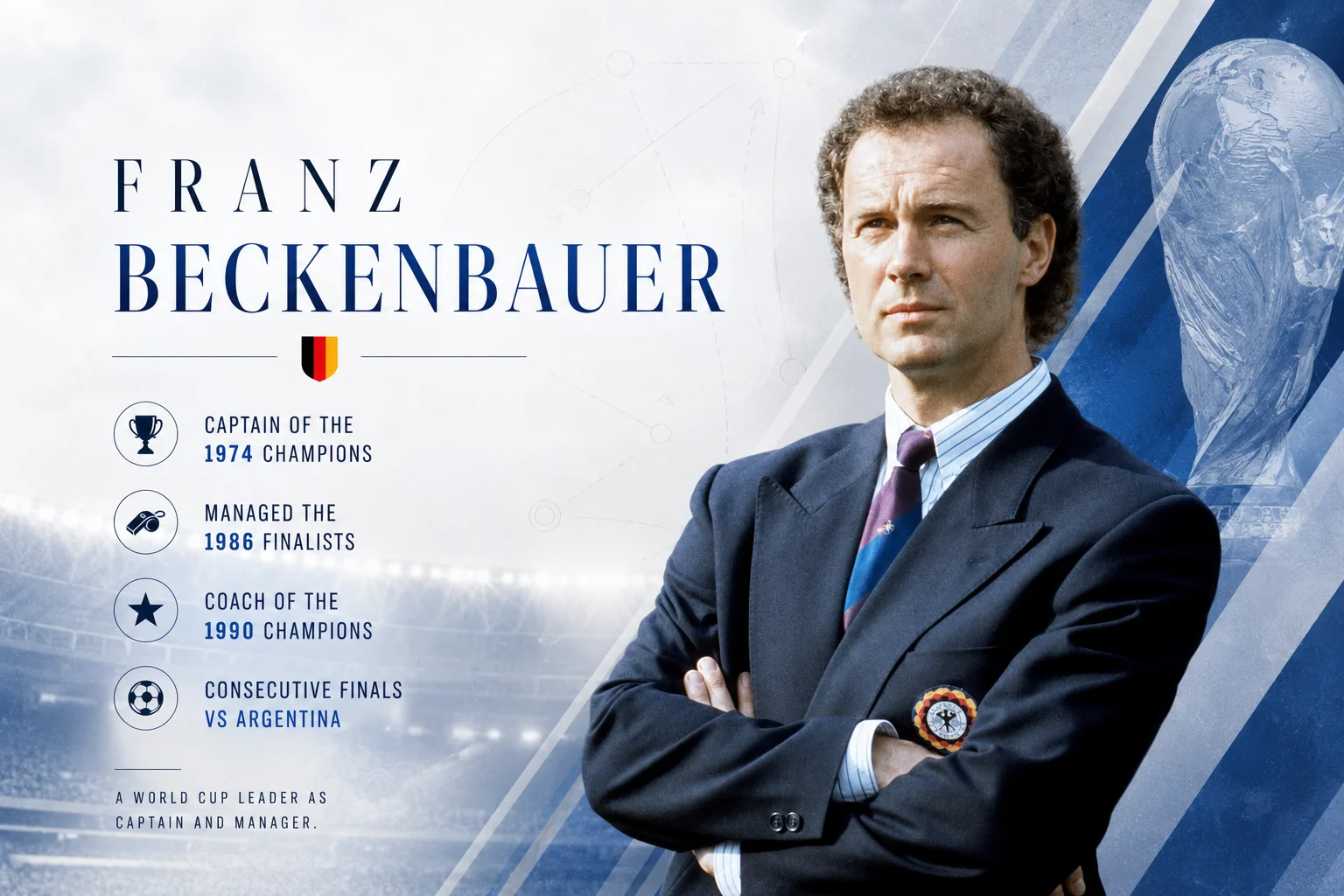
Captain of the 1974 champions, manager of the 1990 champions, and the man who dragged an unfancied squad to the 1986 final in between. Reaching consecutive finals against Maradona's Argentina, losing the first and winning the rematch, is one of the great managerial arcs the tournament has produced.
5. Helmut Schön (West Germany)
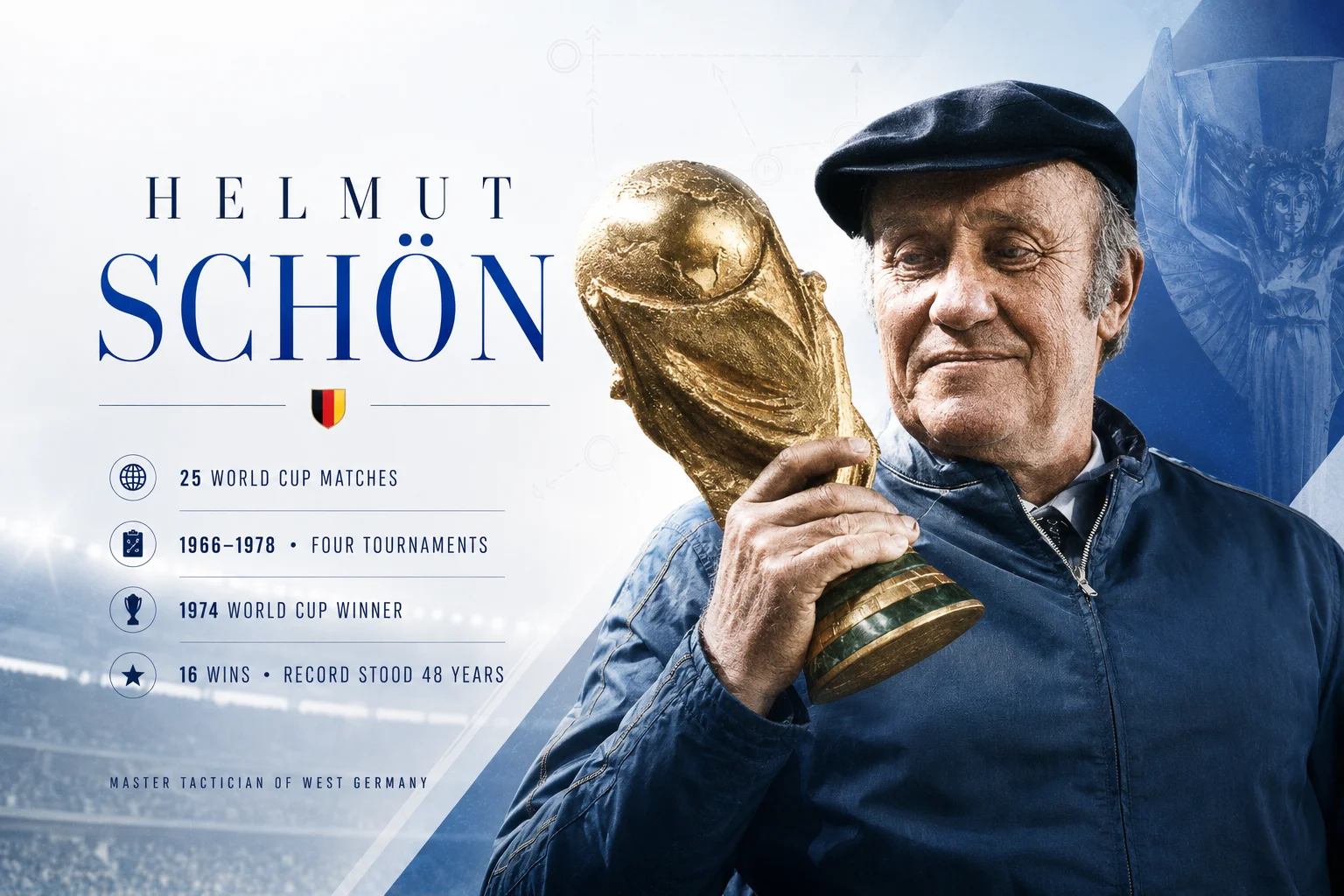
No one has managed more World Cup matches: 25 across four tournaments from 1966 to 1978. His return reads final, third place, champion, second group stage. The 1974 title came against Cruyff's Netherlands at the peak of Total Football, a tactical problem no other manager of the era solved in a final. His 16 wins stood as the record for 48 years.
Ranks 6 to 10: Champions Across Eras
| Rank | Manager | Team(s) | World Cups | P | W-D-L | Best finish |
|---|---|---|---|---|---|---|
| 6 | Carlos Alberto Parreira | Kuwait, UAE, Brazil, Saudi Arabia, South Africa | 6 (1982-2010) | 23 | 10-4-9 | Champion (1994) |
| 7 | Lionel Scaloni | Argentina | 2 (2022-26) | 7** | 4-2-1** | Champion (2022) |
| 8 | Sepp Herberger | Germany / West Germany | 4 (1938-62) | 18 | 9-4-5 | Champion (1954) |
| 9 | Enzo Bearzot | Italy | 3 (1978-86) | 18 | 9-6-3 | Champion (1982) |
| 10 | Alf Ramsey | England | 2 (1966-70) | 10 | 7-1-2 | Champion (1966) |
**Scaloni's figures cover 2022 only; Argentina's 2026 campaign is in progress, with a quarter-final against Switzerland on 11 July.
6. Carlos Alberto Parreira (Brazil)
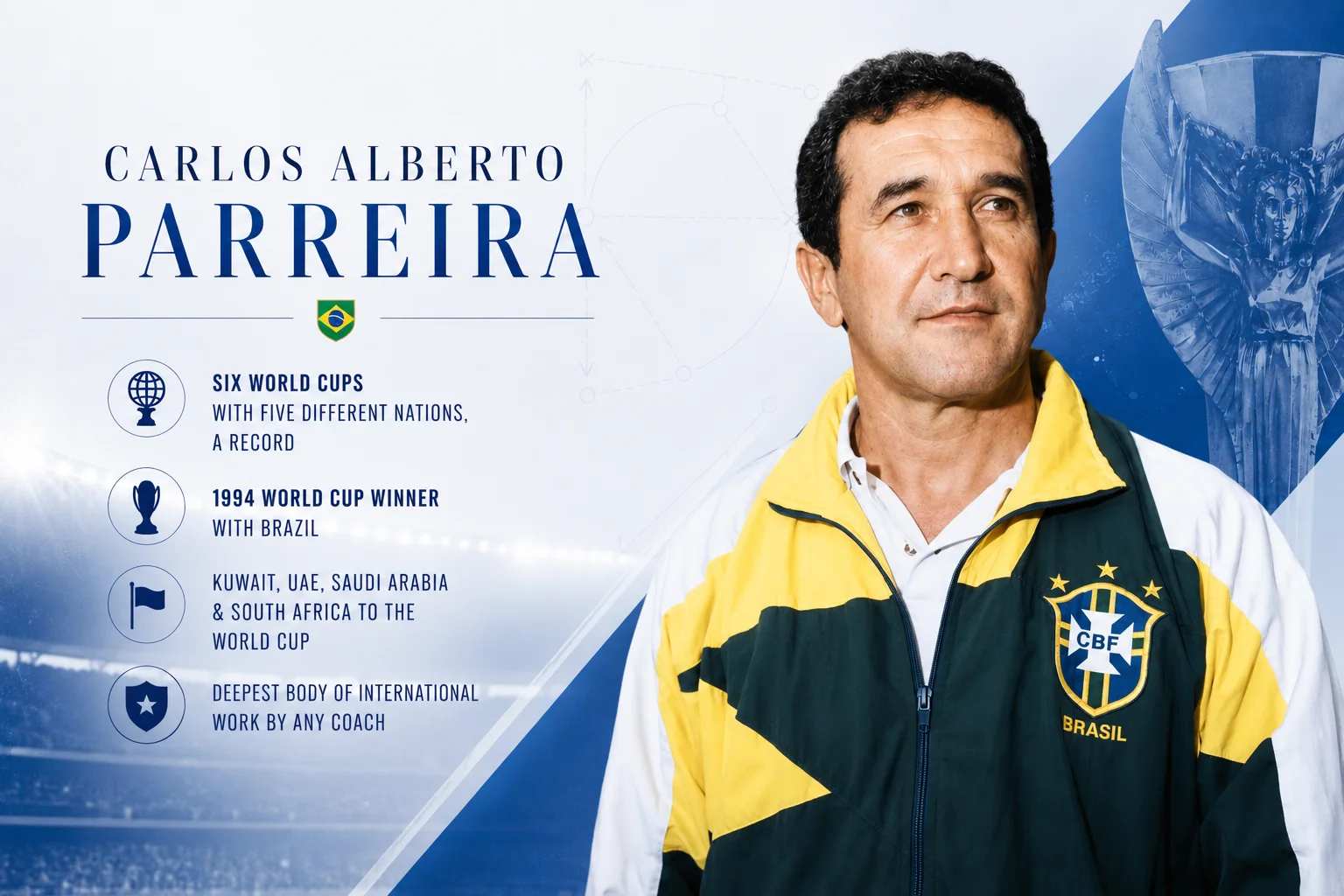
Six World Cups with five different nations, a record, and the 1994 title with a Brazil side he deliberately built against the national grain: pragmatic, compact and ruthless on penalties against Italy. Taking Kuwait, the UAE, Saudi Arabia and South Africa to the finals in between is the deepest body of international work any coach has compiled.
7. Lionel Scaloni (Argentina)
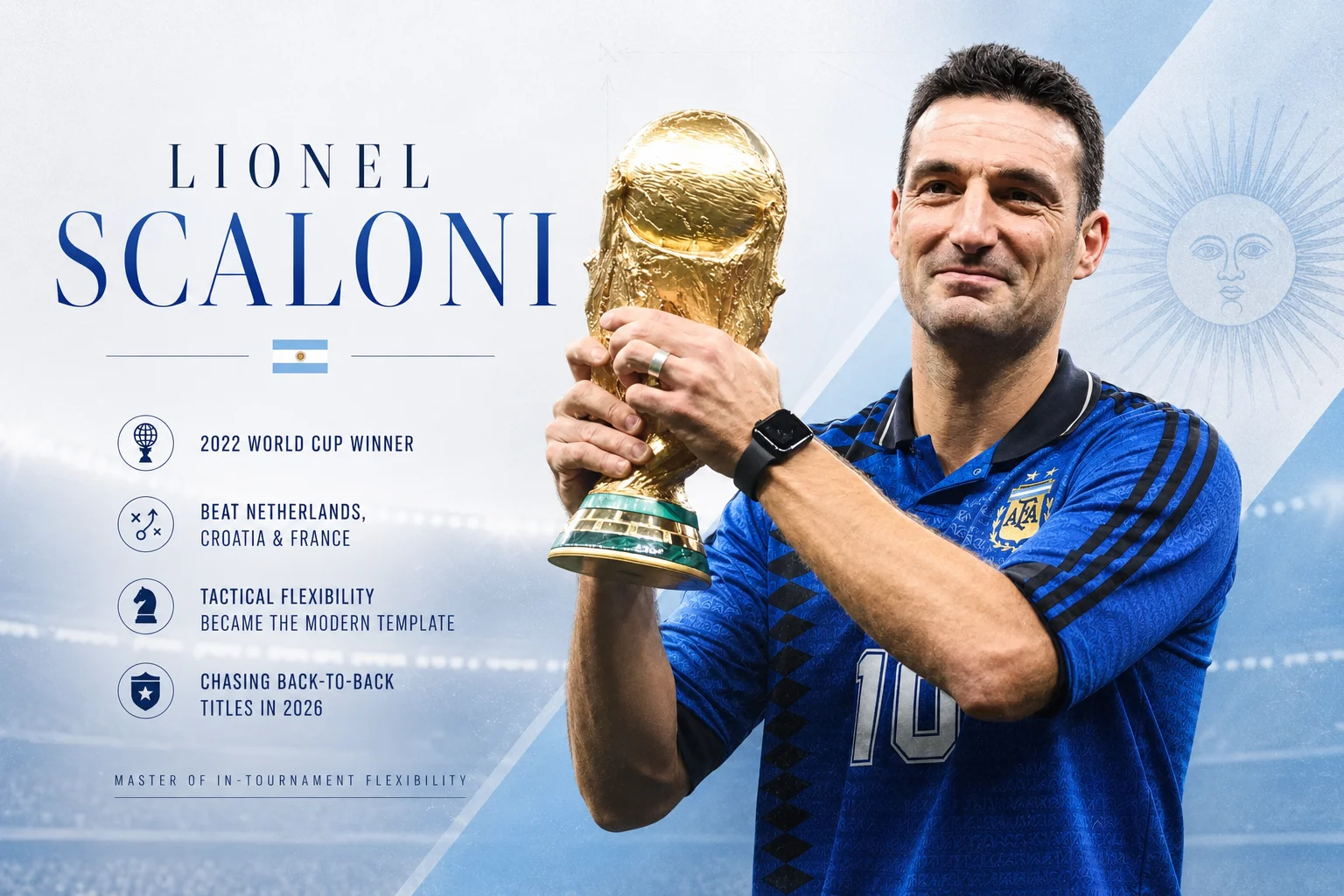
Appointed as a caretaker with no senior management experience, he delivered the 2022 title through a knockout run that included beating the Netherlands, Croatia and France. His in-tournament flexibility, changing shape almost match to match, has become the modern template. Argentina are alive in the 2026 draw, chasing the first back-to-back titles since Pozzo. This ranking will move if he does it.
8. Sepp Herberger (West Germany)
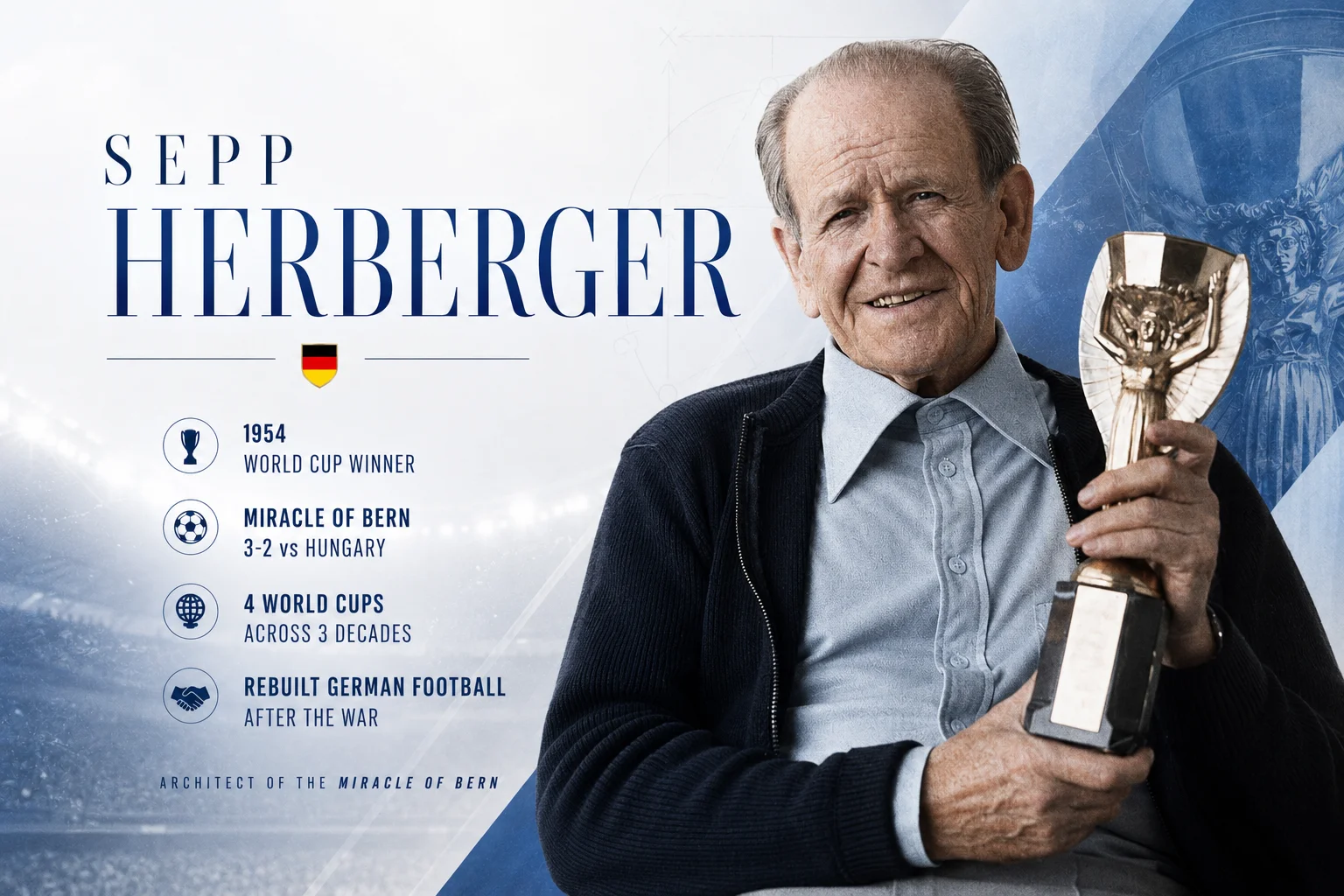
The Miracle of Bern in 1954 remains the biggest final upset in tournament history: a 3-2 win over a Hungary side unbeaten for four years, achieved partly by fielding a weakened team against them in the group stage to engineer the rematch. Herberger managed at four World Cups across three decades and rebuilt German football from nothing after the war.
9. Enzo Bearzot (Italy)
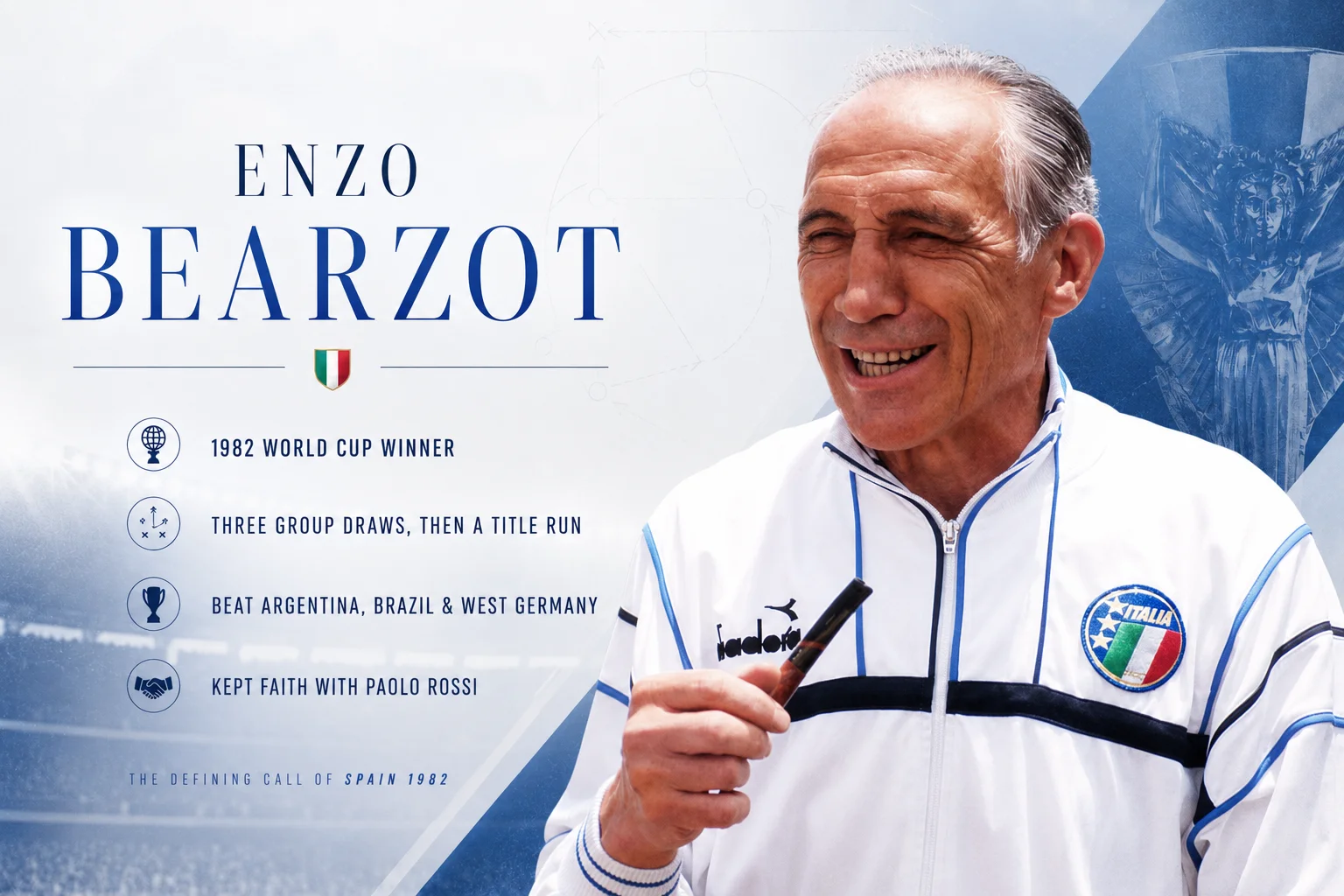
His 1982 champions arrived in Spain in crisis, drew all three group games, then beat Maradona's Argentina, a great Brazil side and West Germany in succession. Sticking with Paolo Rossi, fresh from a betting ban and out of form, was the single best selection call any World Cup manager has made.
10. Alf Ramsey (England)
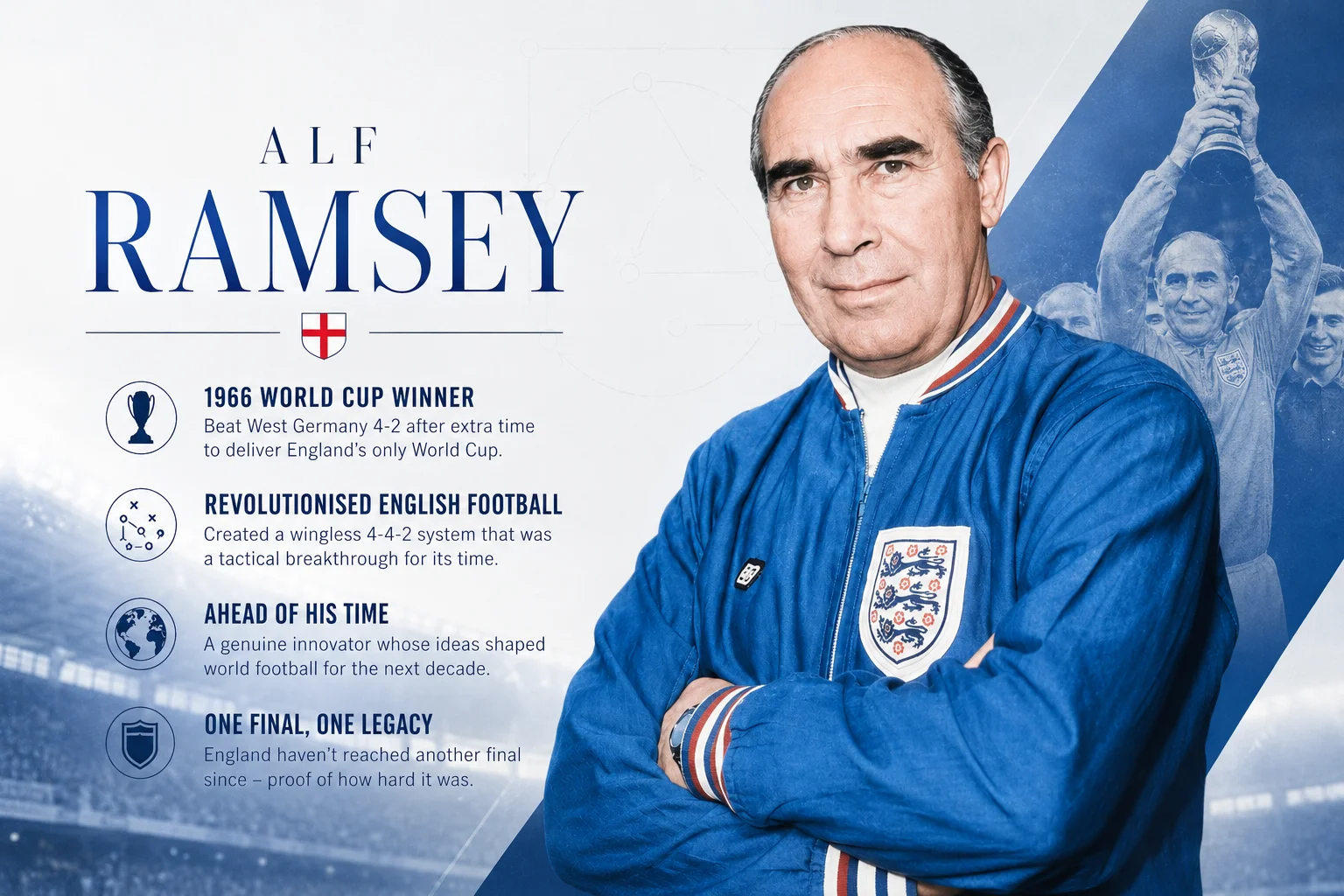
Promised England would win the 1966 World Cup, then did it, 4-2 after extra time against West Germany. The wingless 4-4-2 he built was a genuine tactical departure that the rest of the world spent a decade absorbing. England have not reached a final since, which tells you how hard what he did actually was.
WhatsApp channel
Sports news straight to your phone
Match updates, on-sale dates and ticket news from 1BoxOffice.
Ranks 11 to 15: One Title, One Idea
| Rank | Manager | Team(s) | World Cups | P | W-D-L | Best finish |
|---|---|---|---|---|---|---|
| 11 | Marcello Lippi | Italy | 2 (2006-10) | 10 | 5-4-1 | Champion (2006) |
| 12 | Vicente del Bosque | Spain | 2 (2010-14) | 10 | 7-0-3 | Champion (2010) |
| 13 | Carlos Bilardo | Argentina | 2 (1986-90) | 14 | 8-4-2 | Champion (1986) |
| 14 | César Luis Menotti | Argentina | 2 (1978-82) | 12 | 7-1-4 | Champion (1978) |
| 15 | Aimé Jacquet | France | 1 (1998) | 7 | 6-1-0 | Champion (1998) |
11. Marcello Lippi (Italy)
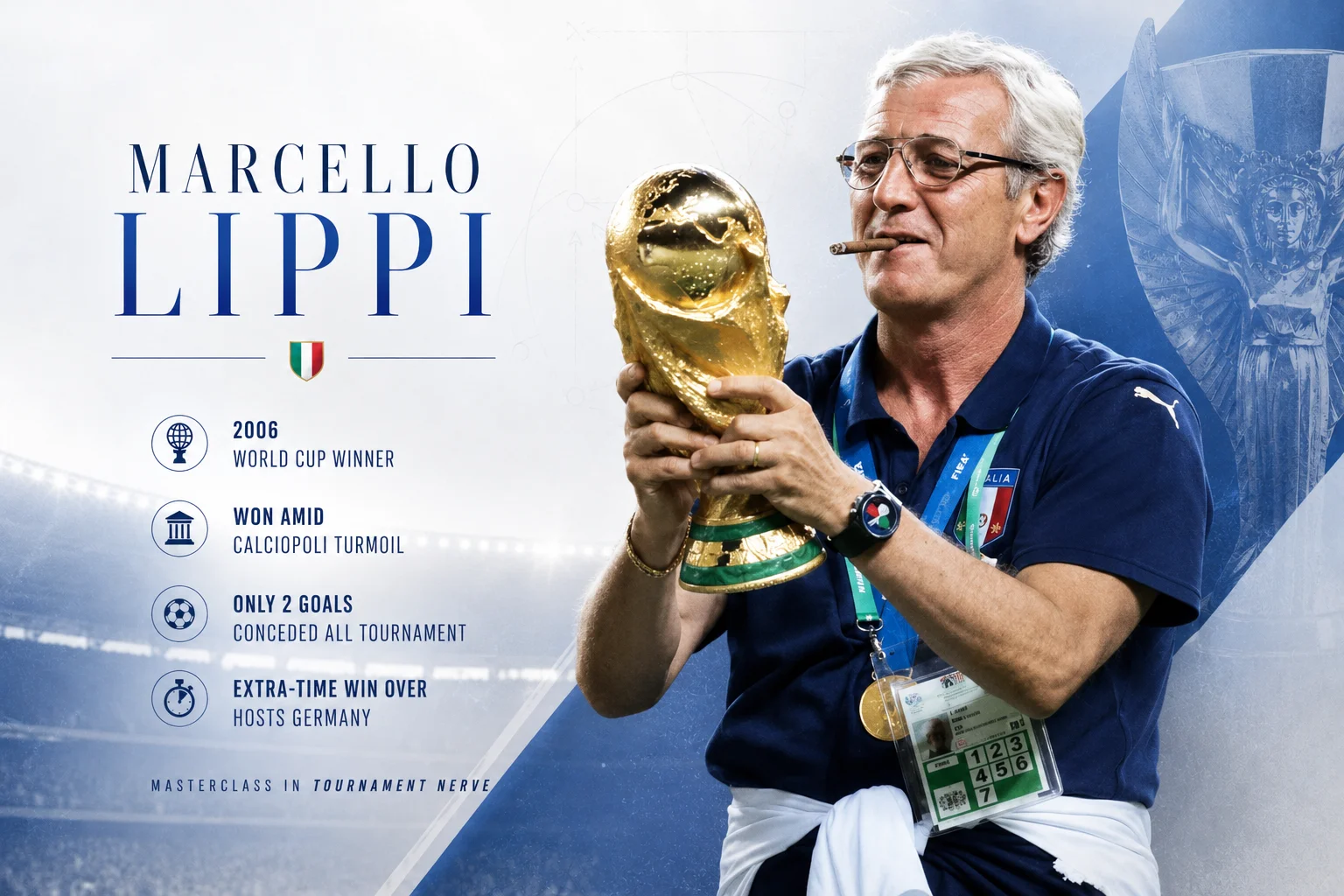
Took charge of a squad engulfed by the Calciopoli scandal and won the 2006 title, conceding twice all tournament, one an own goal and one a penalty. His semi-final dismantling of hosts Germany in extra time, throwing on attackers when everyone expected a shoot-out, was a masterclass in tournament nerve.
12. Vicente del Bosque (Spain)
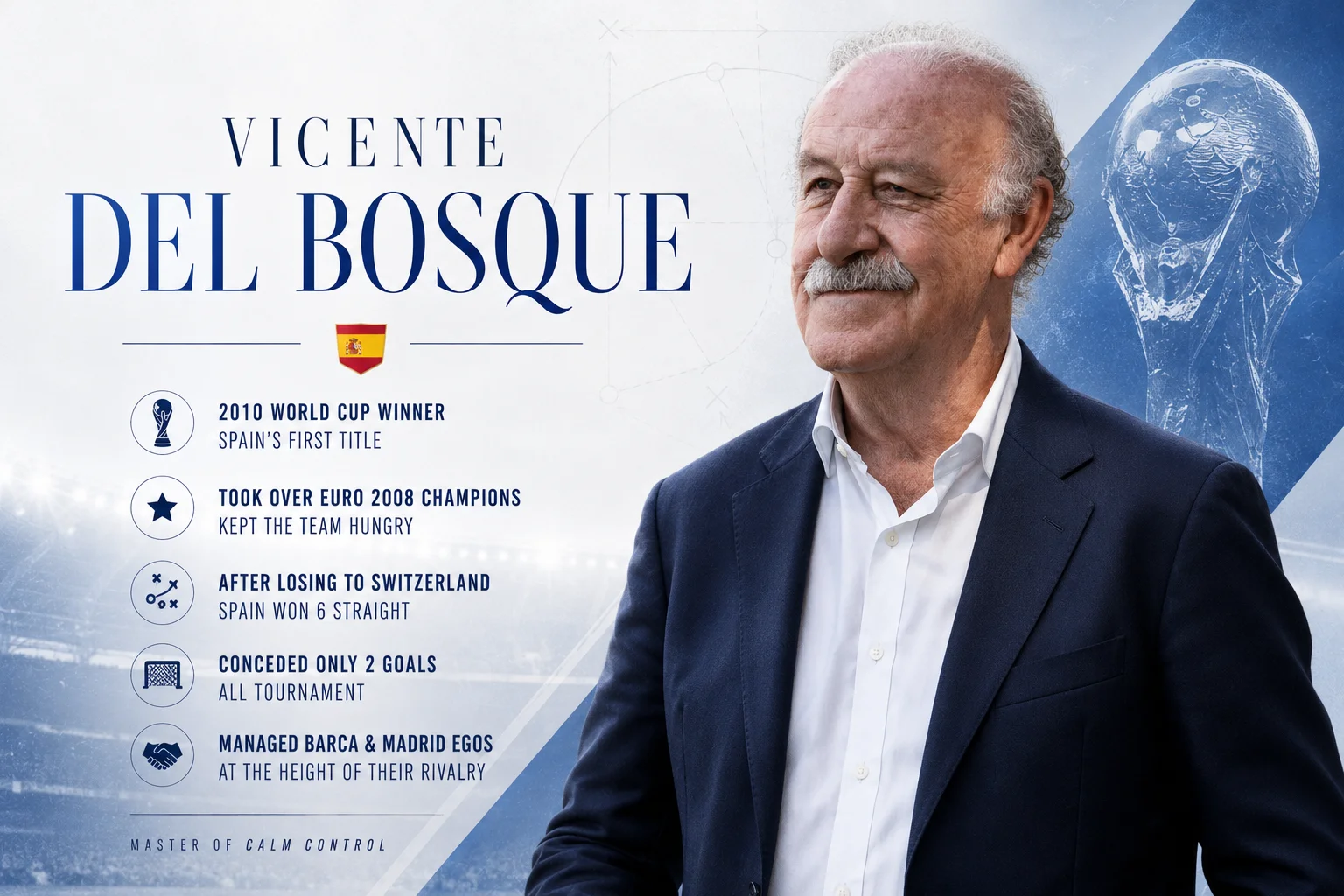
Inherited a European champion side in 2008 and did the harder thing: kept it hungry. Spain lost their 2010 opener to Switzerland, then won six straight, conceding twice all tournament, to claim a first title. Managing the egos of the Barcelona and Real Madrid blocs at the height of their rivalry was as impressive as anything on the pitch.
13. Carlos Bilardo (Argentina)
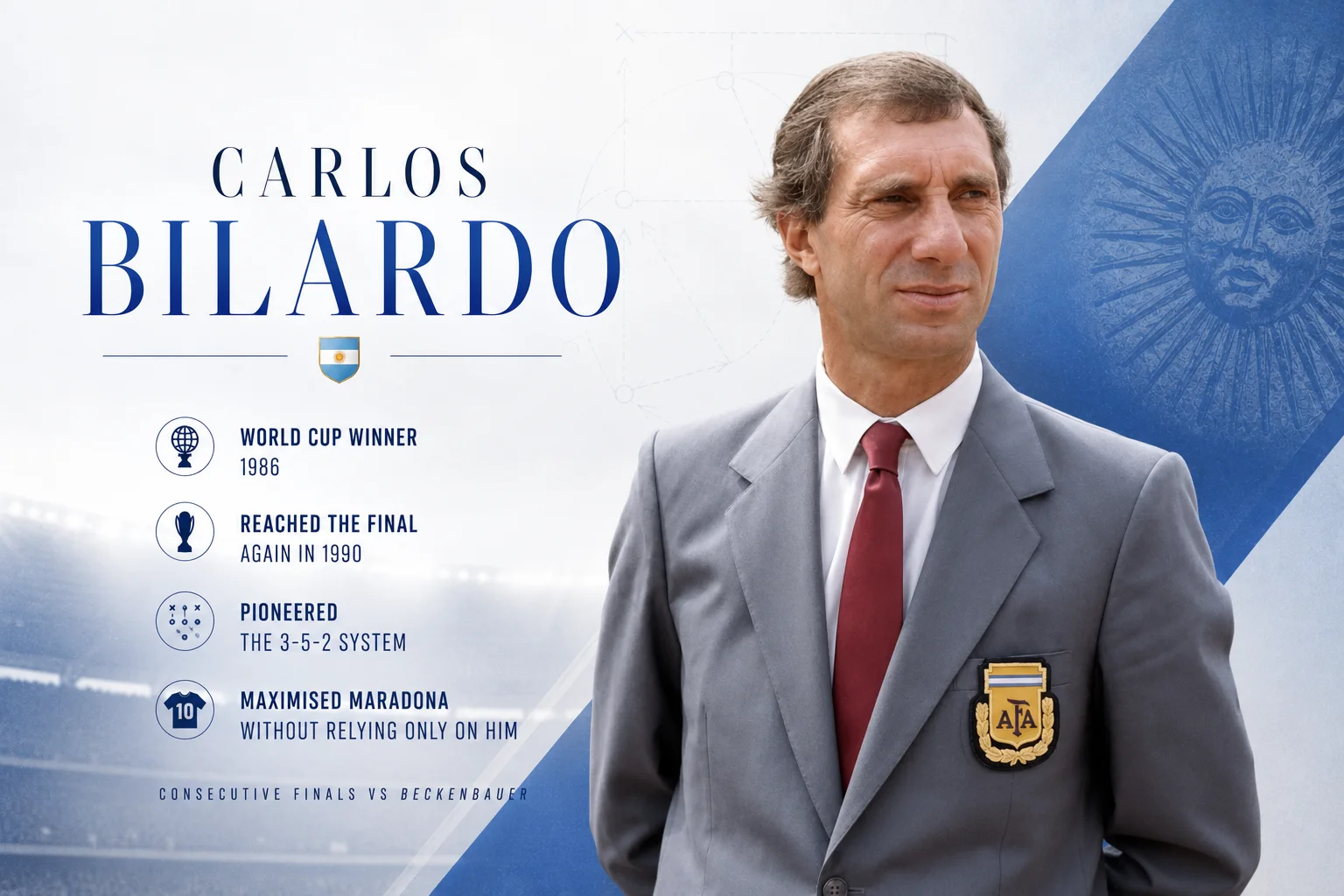
Won in 1986 with a 3-5-2 nobody else was playing and a plan that maximised Maradona without depending solely on him, then reached the 1990 final with a far weaker squad. He and Beckenbauer contested consecutive finals against each other, a two-man rivalry the tournament has never repeated.
14. César Luis Menotti (Argentina)
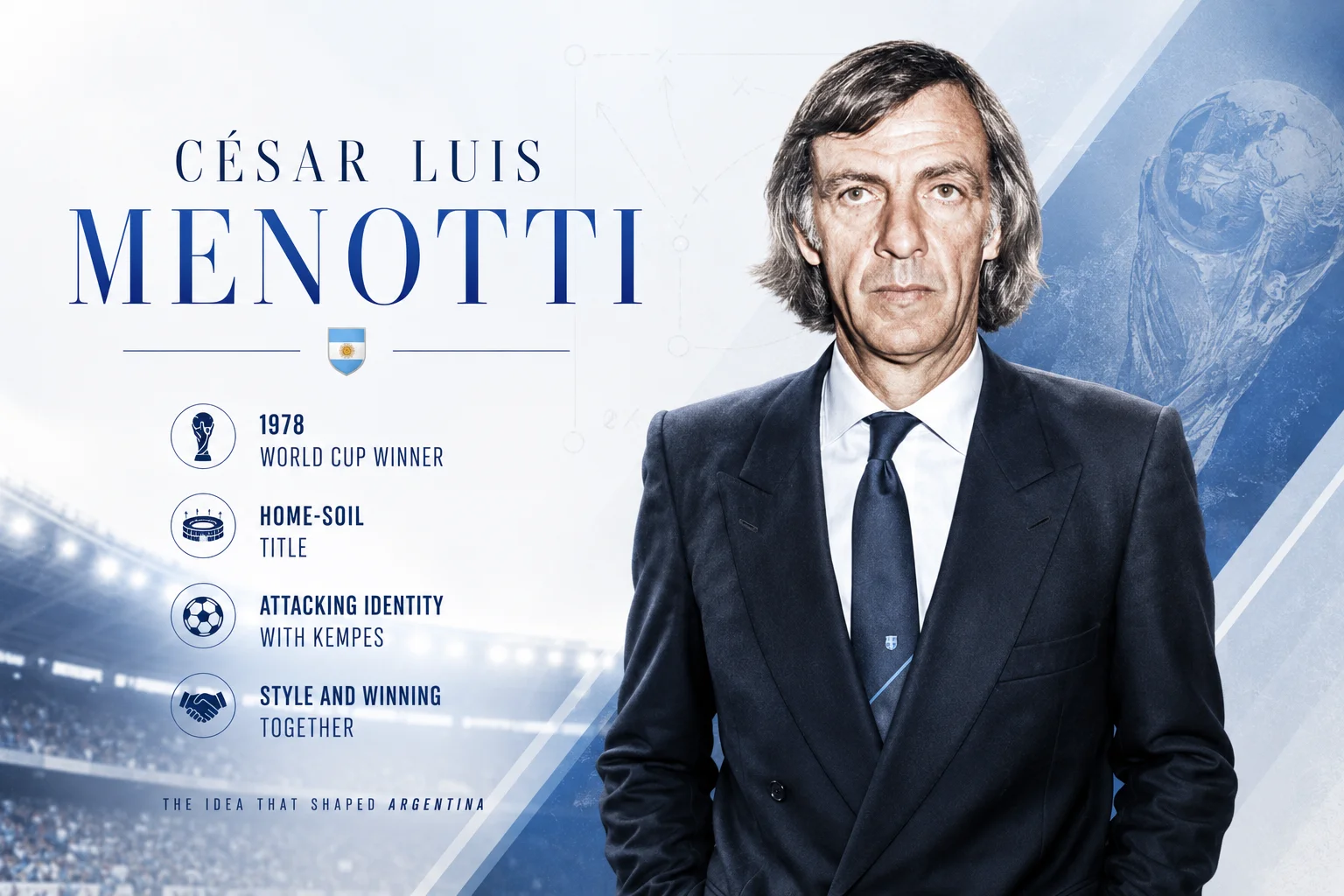
The 1978 title on home soil, built on an attacking identity he imposed as a direct philosophical statement, with Mario Kempes as its spearhead. Menotti's insistence that style and winning were not in conflict shaped Argentine football's self-image for two generations, and the Menotti-Bilardo argument still structures how the country talks about the game.
15. Aimé Jacquet (France)
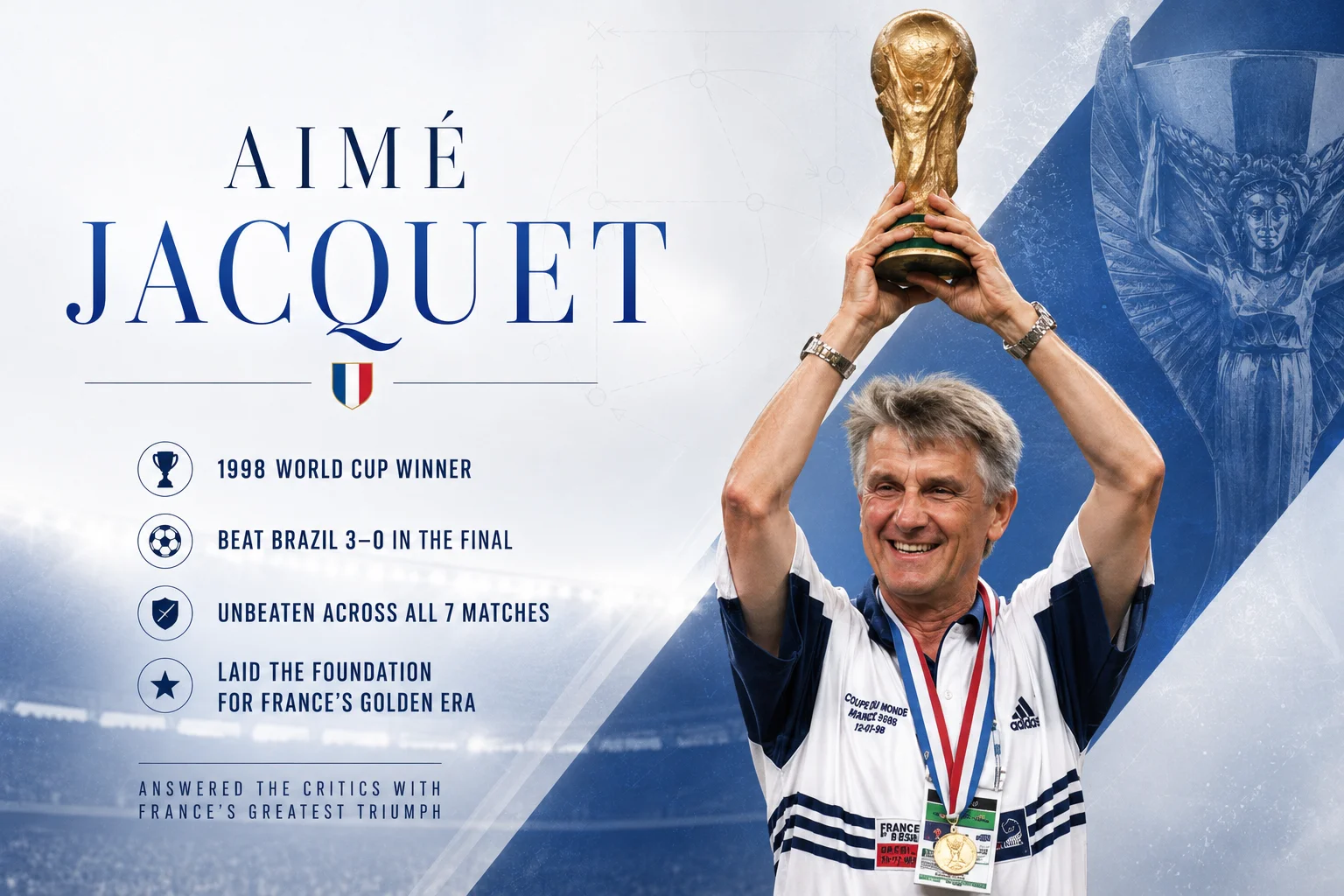
Mocked by parts of the French press for two years, he answered with the 1998 title, beating Brazil 3-0 in the final, unbeaten across all seven matches. Jacquet built the defensive platform around Zidane, integrated a multicultural squad under real political scrutiny and left the structure that France's golden two decades were built on.
Ranks 16 to 20: Overachievers and Innovators
| Rank | Manager | Team(s) | World Cups | P | W-D-L | Best finish |
|---|---|---|---|---|---|---|
| 16 | Luiz Felipe Scolari | Brazil, Portugal | 3 (2002-14) | 21 | 14-3-4 | Champion (2002) |
| 17 | Joachim Löw | Germany | 3 (2010-18) | 17 | 12-1-4 | Champion (2014) |
| 18 | Rinus Michels | Netherlands | 1 (1974) | 7 | 5-1-1 | Runner-up (1974) |
| 19 | Guus Hiddink | Netherlands, South Korea, Australia | 3 (1998-2006) | 18 | 7-6-5 | Fourth x2 (1998, 2002) |
| 20 | Bora Milutinović | Mexico, Costa Rica, USA, Nigeria, China | 5 (1986-2002) | 20 | 8-3-9 | Quarter-final (1986) |
16. Luiz Felipe Scolari (Brazil)
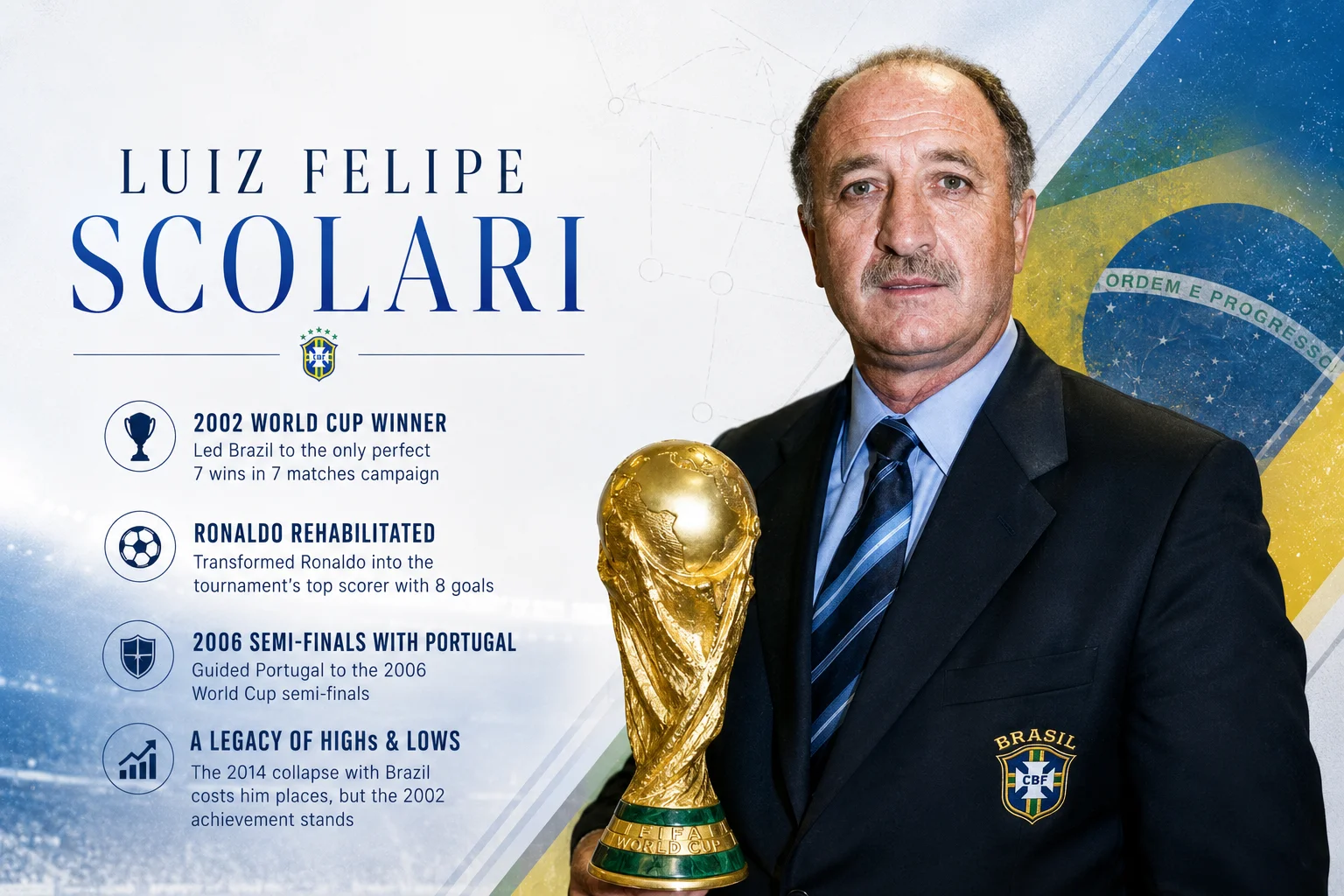
Brazil's 2002 campaign was the last time a team won all seven matches at a World Cup, with Scolari rehabilitating Ronaldo after years of injury into an eight-goal tournament. He then took Portugal to the 2006 semi-finals. The 2014 collapse with Brazil costs him places here, but the 2002 achievement stands.
17. Joachim Löw (Germany)
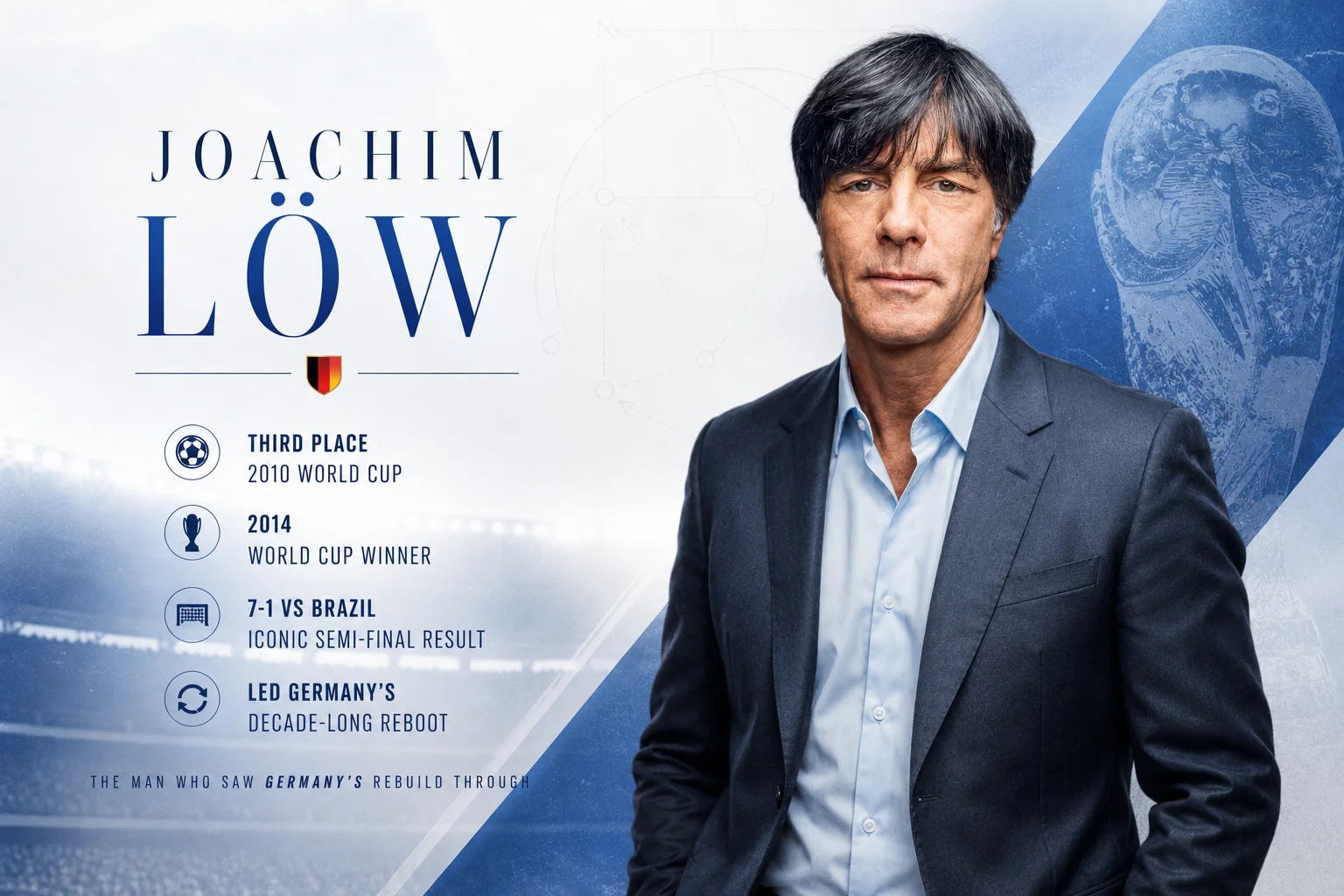
Third in 2010, champion in 2014, with the 7-1 semi-final against Brazil as the most extraordinary single result in tournament history. Löw's Germany were the finished product of a decade-long national reboot, and he saw it through. The 2018 group-stage exit as holders is the asterisk, and it is why he sits no higher.
18. Rinus Michels (Netherlands)
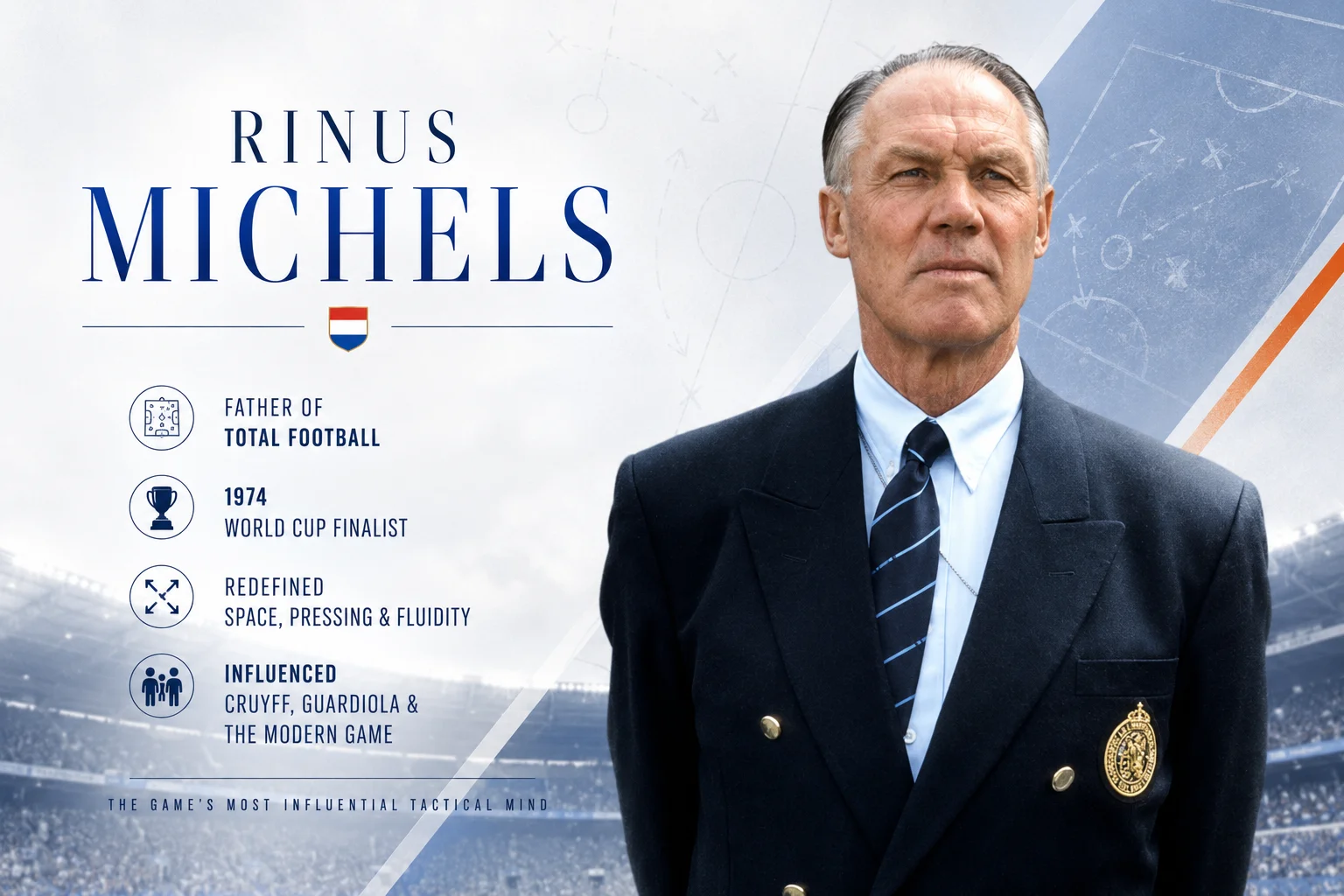
No title, and still indispensable. The 1974 Netherlands side lost the final but won the argument: Total Football reorganised how the sport thinks about space, pressing and positional fluidity, and its fingerprints are on Cruyff, Guardiola and half the teams at the 2026 tournament. Influence is a criterion, and nobody scores higher on it.
19. Guus Hiddink (Netherlands/South Korea)
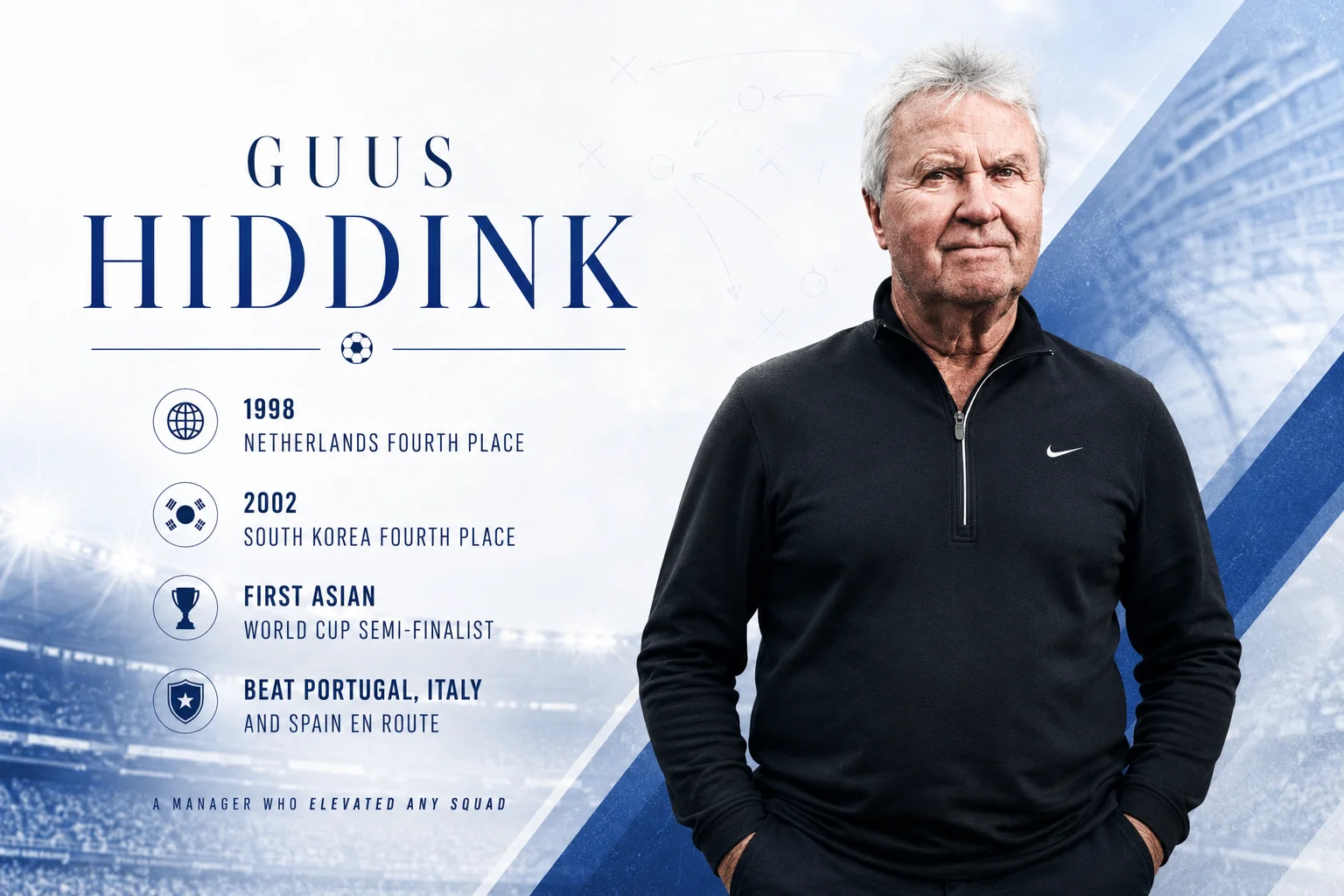
Fourth place with the Netherlands in 1998, then fourth with co-hosts South Korea in 2002, making them the first Asian semi-finalists and beating Portugal, Italy and Spain on the way. Two deep runs with two squads of completely different profiles is the strongest evidence in this list of a manager adding value beyond his players.
20. Bora Milutinović (five nations)
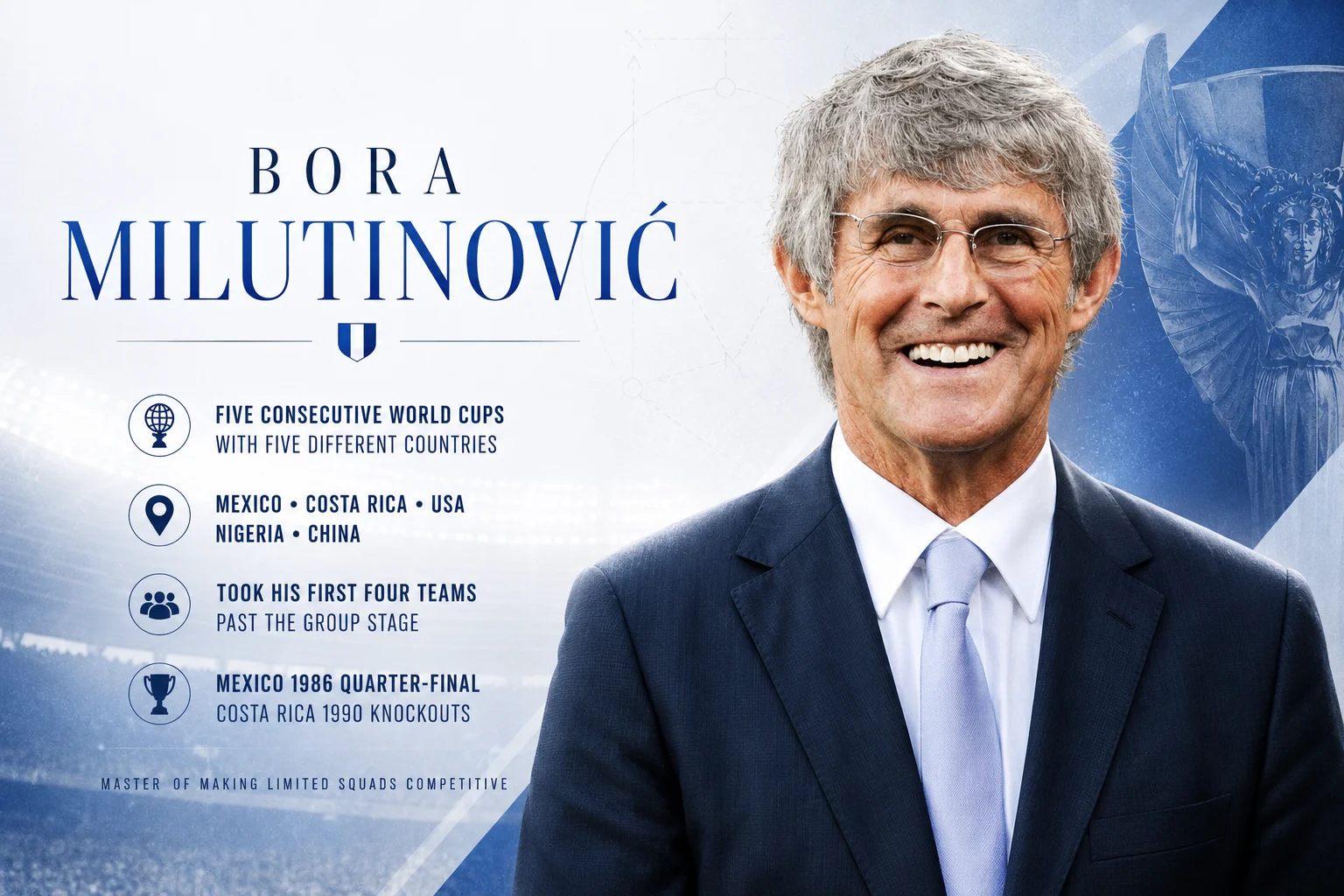
Five consecutive World Cups with five different countries: Mexico, Costa Rica, the United States, Nigeria and China. He took the first four past the group stage, including hosts Mexico to a 1986 quarter-final and a Costa Rica side of part-timers into the 1990 knockouts. Nobody has ever been better at making limited squads competitive in a month-long window.
The Records That Frame the Debate
A few numbers anchor every argument on this topic. Pozzo's two titles have gone unmatched for 88 years. Schön's 25 matches managed remain the volume record, though his 16 wins fell to Deschamps in 2026.
| Record | Holder | Detail |
|---|---|---|
| Most titles | Vittorio Pozzo | Two, with Italy in 1934 and 1938 |
| Most match wins | Didier Deschamps | Passed Schön's 16 during the 2026 group stage |
| Most matches managed | Helmut Schön | 25, all with West Germany, 1966 to 1978 |
| Most tournaments | Carlos Alberto Parreira | Six, between 1982 and 2010 |
| Most nations managed | Parreira and Bora Milutinović | Five different countries each |
| Won as player and manager | Zagallo, Beckenbauer, Deschamps | The complete list, 1970, 1990 and 2018 |
| Youngest winner | Alberto Suppici | 31 years old, Uruguay 1930 |
| Oldest winner | Vicente del Bosque | 59 years old, Spain 2010 |
| Foreign managers in a final | George Raynor and Ernst Happel | Sweden 1958 and Netherlands 1978; both lost |
Winning Managers Who Missed the Cut
Four champions sit outside the top 20, and the omissions are deliberate. One-tournament winners need either a second deep run or a lasting tactical idea to displace the multi-tournament names above them.
| Manager | Title | Why he sits outside the 20 |
|---|---|---|
| Alberto Suppici | Uruguay 1930 | Won against a 13-team invitational field, in four matches |
| Juan López | Uruguay 1950 | The Maracanazo was a four-team final pool, not a knockout run |
| Vicente Feola | Brazil 1958 | Separating his contribution from Pelé and Garrincha is genuinely hard |
| Aymoré Moreira | Brazil 1962 | Inherited the 1958 core; Garrincha carried the knockouts |
FAQs
1. Who was the first man to be a World Cup player and later a World Cup manager?
-
Milorad Arsenijević, who played for Yugoslavia at the 1930 World Cup and managed them at the 1950 tournament.
2. Who are the youngest and oldest managers to appear at a World Cup?
-
Juan José Tramutola co-managed Argentina aged 27 in 1930, while Dick Advocaat became the oldest at 78 with Curaçao at the 2026 tournament.
3. Which manager has appeared at the most World Cups without winning one?
-
Walter Winterbottom with England and Óscar Tabárez with Uruguay both managed at four World Cups without winning one.
4. How many managers have won the World Cup as hosts?
-
Six: Suppici (1930), Pozzo (1934), Ramsey (1966), Schön (1974), Menotti (1978) and Jacquet (1998) all won on home soil.
5. Which country has produced the most World Cup-winning managers?
-
Brazil, whose five titles were won under five different managers, more winning coaches than any other nation.
The list above will be argued with, which is the point, and the 2026 knockout rounds may force revisions within the fortnight. If you want to watch the next chapter written in person, 1BoxOffice lists verified seats for every remaining match, backed by its 150% money-back guarantee.
Sources: FIFA, RSSSF, Wikipedia's FIFA World Cup records and statistics, ESPN, Al Jazeera, FOX Sports and beIN Sports.