In this guide
How the con actually worksWhy social media has no safety netThe same script in the GulfThe warning signsWhat a traceable purchase looks likeIn May 2022, a Liverpool supporter from the Wirral sent £19,000 for 19 Champions League final tickets he found through a seller on Twitter. The account vanished the moment the transfer cleared. He later joined a WhatsApp group of around 50 fans, all caught by the same person, and stories like his fill the figures on social media about ticket scams.
According to Lloyds Bank, more than three-quarters of football ticket scams now start on social media, and football is now the biggest category of ticket fraud it records. With the World Cup running through the summer and league games selling out in minutes, anyone after World Cup 2026 tickets or a sold-out domestic seat is a target.
How the con actually works
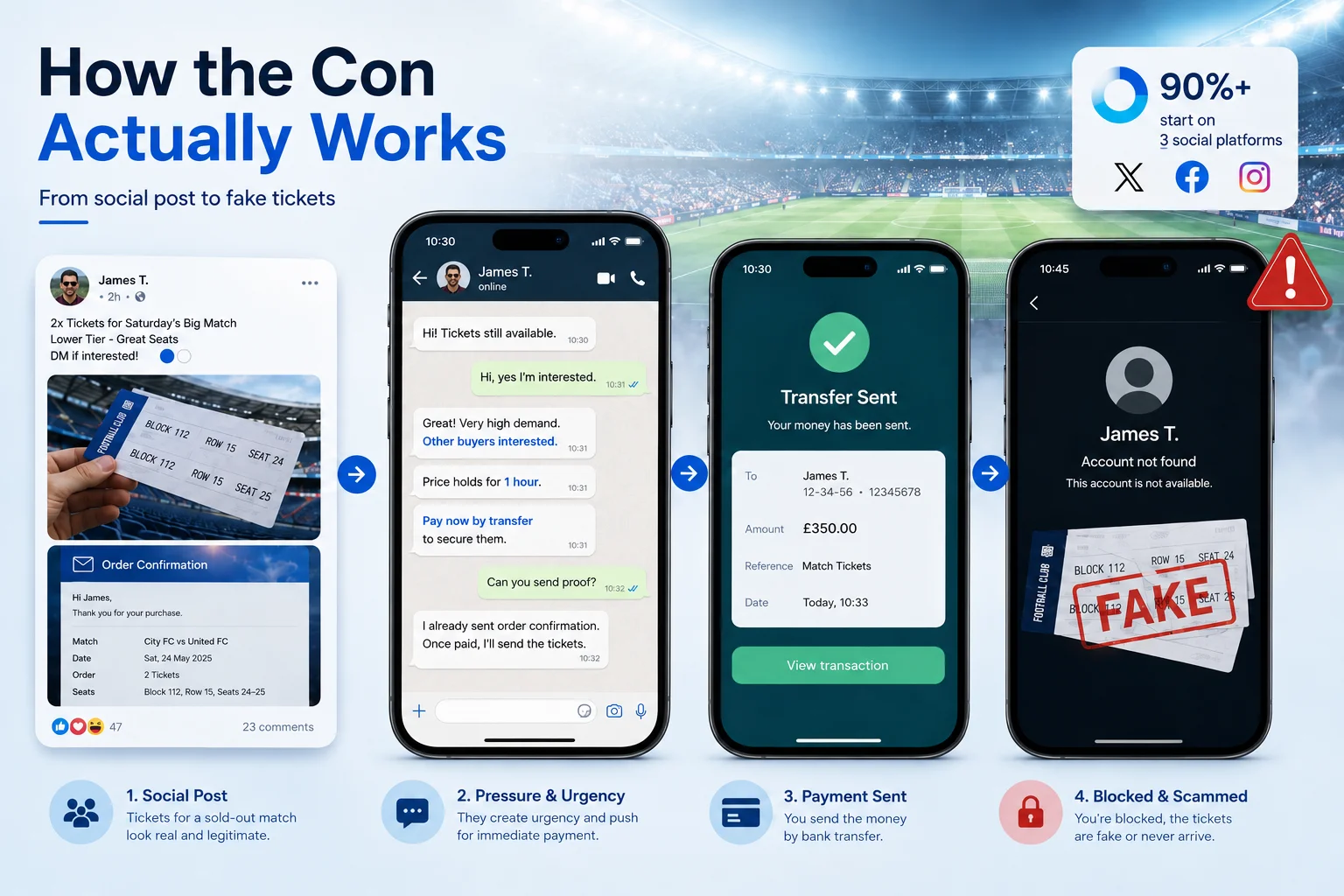
The mechanics rarely change. A fan spots a post offering tickets to a sold-out match, usually on Facebook or Instagram, sometimes inside a supporters' group where the seller looks like a regular. The profile seems real, with a couple of ticket photos and a screenshot of a confirmation email.
Then comes the move that defines almost every case: the seller asks to continue on WhatsApp, away from public comments where complaints might show. The pressure follows fast. Other buyers are interested; the price holds for an hour; pay now by transfer. Lloyds Bank found that more than 90% of football ticket scams in one recent season started on just three platforms: Twitter, Facebook and Instagram. Once the transfer lands, the account blocks you, and the tickets are never real.
Why social media has no safety net
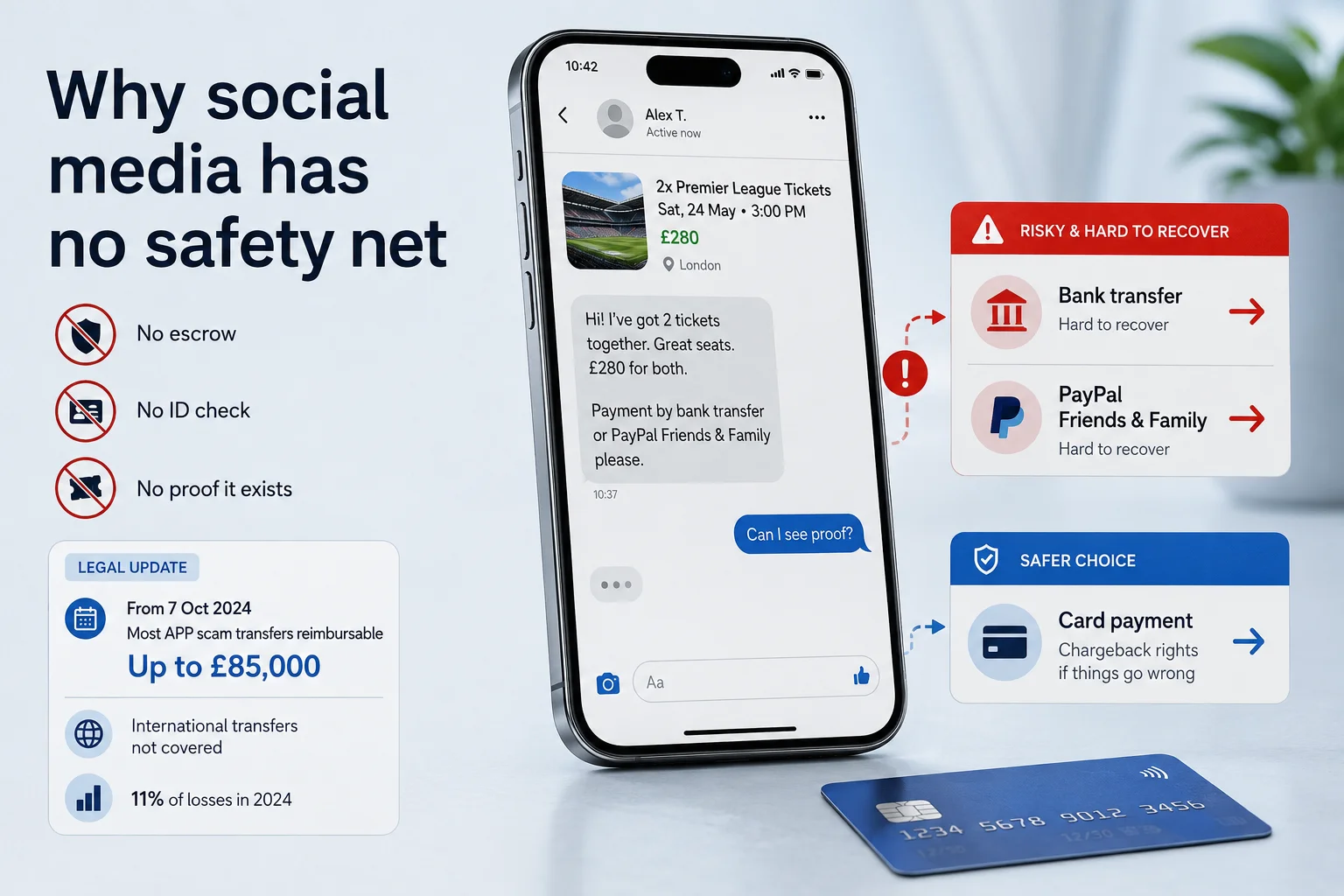
A stranger on social media offers no escrow, no identity check and no promise that what you paid for exists. The payment method is the trap. Fraudsters insist on a bank transfer or PayPal Friends and Family because those routes are hard to claw back. Pay by card, and you keep chargeback rights; send a transfer and the money is usually gone.
Banks once refused refunds because the victim approved the payment, known as authorised push payment fraud. That changed on 7 October 2024, when the Payment Systems Regulator made reimbursement mandatory for most transfer scams, up to £85,000. The gaps still matter: international transfers are not covered, and those reached 11% of these losses in 2024.
The same script in the Gulf
The Middle East sees the identical playbook. When Coldplay played in Abu Dhabi in January 2025, fans were caught by sellers in Facebook groups asking for part payment into a personal bank account. One buyer told Khaleej Times she sent Dh400 and later met a woman who had lost Dh1,500. The authorised seller had warned that entry was by mobile ticket released only 72 hours before kick-off, so anyone selling earlier had no real ticket.
Dubai Police and Abu Dhabi Police run public warnings to buy only through approved platforms and never to send money or one-time passcodes to private sellers. In November 2024, an Abu Dhabi court ordered a fake-ticket seller to repay a victim and pay compensation. The threat scales with the event: before the 2026 World Cup, researchers at Fortinet counted more than 1,700 fake accounts impersonating the tournament's organiser, nearly all on Facebook and Instagram.
WhatsApp channel
Sports news straight to your phone
Match updates, on-sale dates and ticket news from 1BoxOffice.
The warning signs
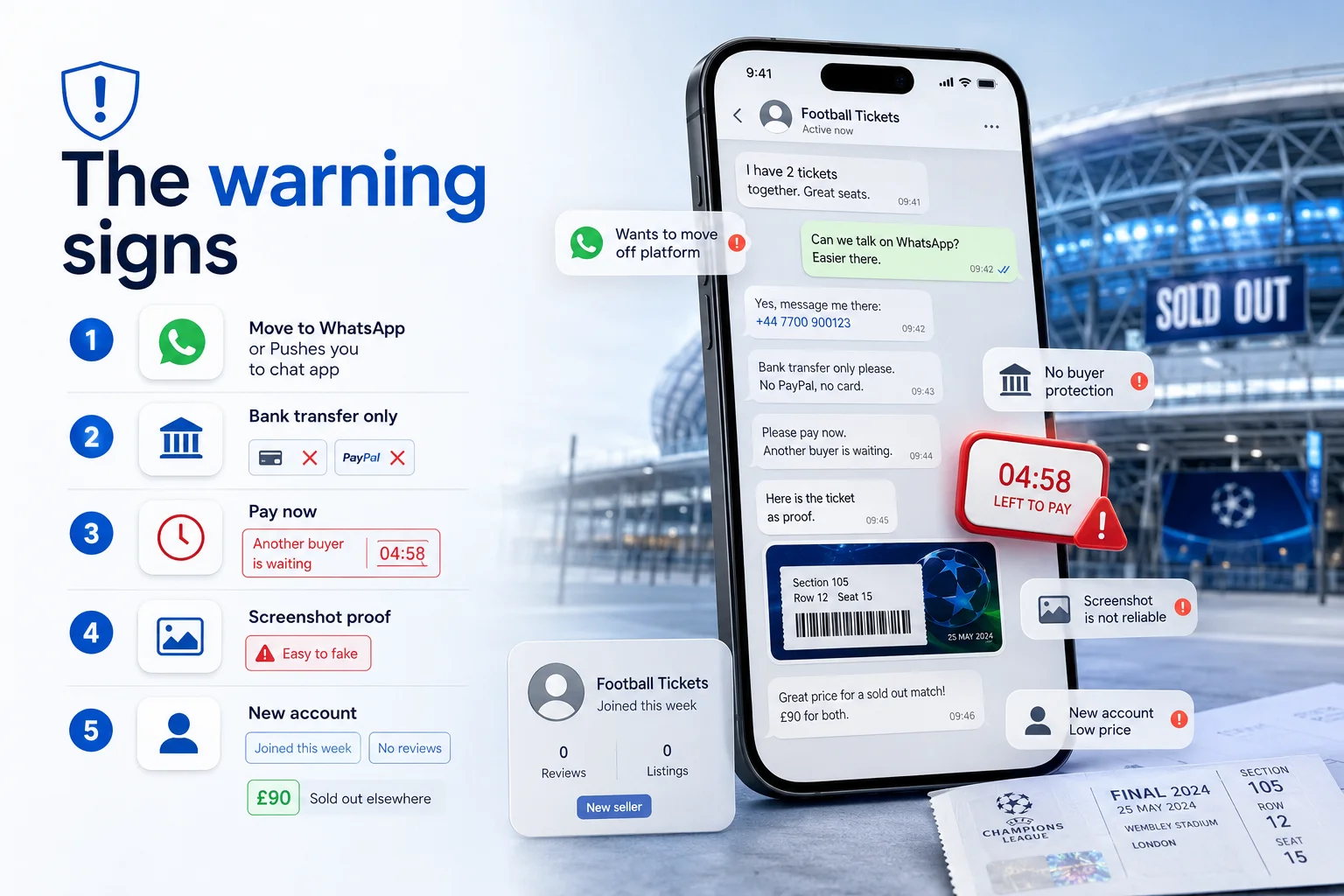
Fraud officers and banks point to the same tells.
- The seller pushes you onto WhatsApp before anything has been agreed.
- Payment must be by bank transfer, with card or buyer-protected options refused.
- You are pressured to pay within minutes because someone else is supposedly waiting.
- A screenshot is offered as proof, but the same image is sold to many buyers, and a refreshing barcode cannot be checked from a picture.
- The account is new or recently renamed, and the price is too good for a sold-out match.
What a traceable purchase looks like
A purchase you can trust leaves a paper trail and puts someone accountable at the other end, so a seller cannot block you and disappear. Through a verified marketplace, you register an account and can track the order from payment to delivery, the opposite of a chat that goes silent once a transfer lands. In the UK, the Society of Ticket Agents and Retailers runs an accreditation scheme whose logo shows that a seller follows a code of practice and a refund policy.
You can read who stands behind the platform before spending anything.
1. What should I do if I have already paid a social media seller?
-
Contact your bank straight away to attempt a recall before the money is moved on, then report it to the national fraud reporting service.
2. Can a ticket be genuine but still get me turned away?
-
Yes, organisers routinely cancel tickets resold outside approved channels, so a real ticket bought from a stranger can be voided before kick-off.
3. Is it legal to resell football tickets for profit in the UK?
-
Reselling tickets for designated football matches without the organiser's authorisation is a criminal offence under section 166 of the Criminal Justice and Public Order Act 1994.
4. Which payment method protects me most?
-
A credit card gives the strongest cover, because section 75 of the Consumer Credit Act 1974 makes the card provider jointly liable on purchases over £100.
Football tickets sell out, and that scarcity is what every fake seller trades on. Buying through 1BoxOffice, a verified marketplace running since 2006 with a 150% money-back guarantee, means the seller stays accountable long after the payment clears.
Sources: Lloyds Banking Group, Action Fraud, UK Finance, the Payment Systems Regulator, the Criminal Justice and Public Order Act 1994, the Consumer Credit Act 1974, Khaleej Times and Fortinet.