In this guide
Key TakeawaysNine Grounds, Eight Cities, Four CountriesWhy the Etihad Becomes Manchester City StadiumCardiff Opens It, Wembley Closes ItThe Old Trafford and Anfield QuestionTwo London Grounds and a Building Site in BirminghamWhere to Sit at the English VenuesWhat Happened to BelfastNo Free Pass for the HostsGetting Between the GroundsWhen Tickets Actually Go on SaleFAQsAnfield will not host a single match at the next European Championship because its pitch is four metres too short. That one detail explains more about the euro 2028 host cities and stadiums than any press release, because UEFA applied its own technical criteria over sentiment and reputation. The result is a nine-venue map across four countries that will surprise anyone expecting the usual roll call of English football's biggest grounds.
UEFA confirmed the full schedule in November 2025. The tournament runs from Friday 9 June to Sunday 9 July 2028, with 51 matches, 24 teams and nine stadiums in eight cities. Cardiff stages the opening game and Wembley Stadium takes both semi-finals and the final.
Key Takeaways
- Nine stadiums, eight cities, four countries. London is the only city with two.
- Friday 9 June to Sunday 9 July 2028. Cardiff opens it, Wembley takes the final at 17:00 UK time.
- Belfast is out. Casement Park was dropped in September 2024 on cost and time, but keeps the qualifying draw.
- No host qualifies automatically. Two places are reserved for the best-ranked hosts who miss out.
- Still 24 teams and 51 matches. The 32-team expansion was dropped.
- Four grounds change name for the month, including the Etihad and the Aviva.
- Tickets are not on sale. The ballot opens after the final draw in December 2027.
Nine Grounds, Eight Cities, Four Countries
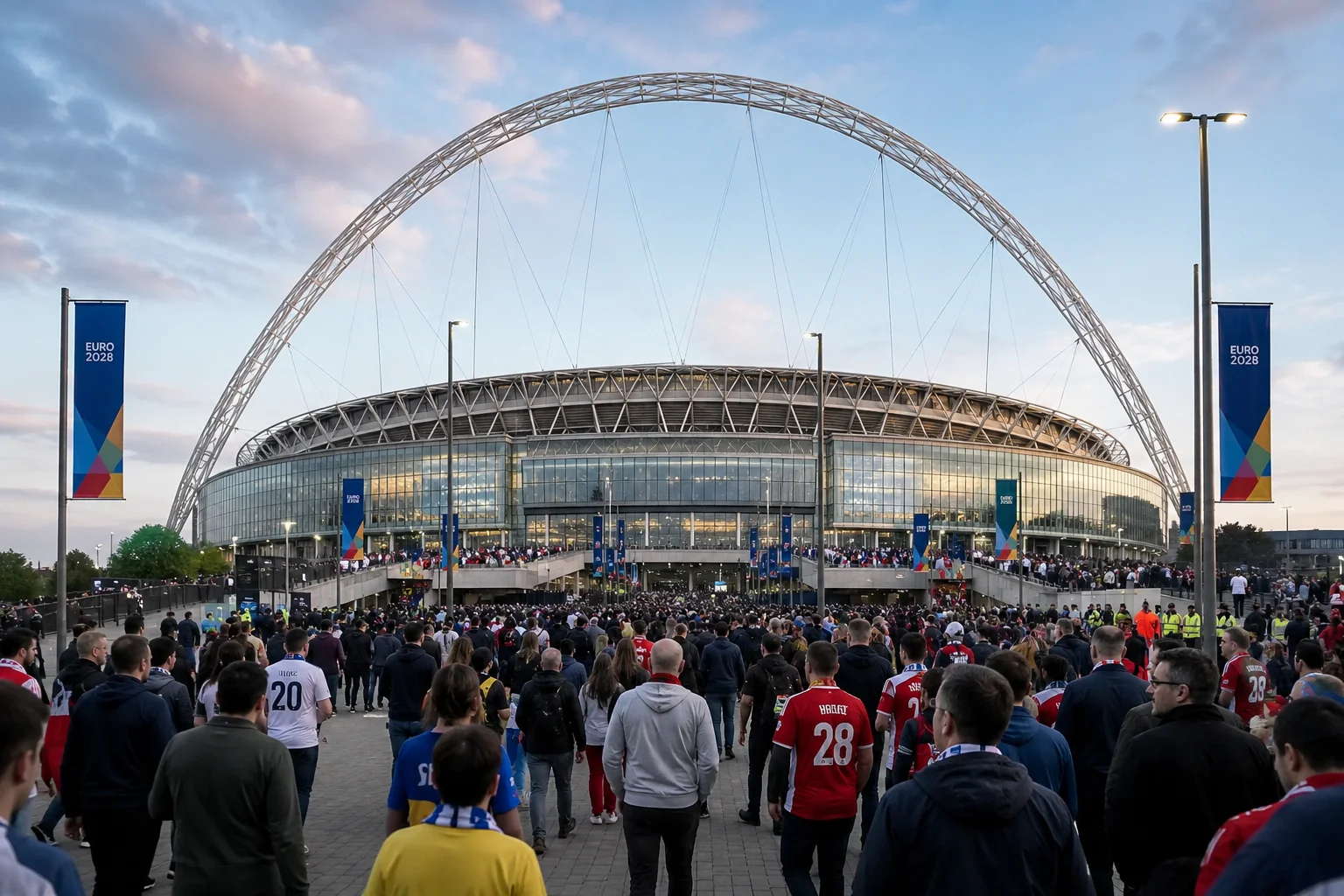
England, Scotland, Wales and the Republic of Ireland share hosting duties. London is the only city with two venues. Every stadium stages a minimum of two different groups, a deliberate choice by UEFA so local fans see a variety of teams rather than the same four sides three times.
| Stadium | Tournament name | City | Capacity | Usual tenant | Matches |
|---|---|---|---|---|---|
| Wembley Stadium | Wembley Stadium | London | 90,000 | England | 8 |
| Principality Stadium | National Stadium of Wales | Cardiff | 73,931 | Welsh Rugby Union | 6 |
| Tottenham Hotspur Stadium | Tottenham Hotspur Stadium | London | 62,850 | Tottenham Hotspur | 5 |
| Etihad Stadium | Manchester City Stadium | Manchester | Approx 61,500 | Manchester City | 5 |
| Hampden Park | Hampden Park | Glasgow | 51,866 | Scotland | 6 |
| Aviva Stadium | Dublin Arena | Dublin | 51,711 | Republic of Ireland | 7 |
| Hill Dickinson Stadium | Everton Stadium | Liverpool | 52,769 | Everton | 5 |
| St James' Park | St James' Park | Newcastle | 52,264 | Newcastle United | 5 |
| Villa Park | Villa Park | Birmingham | Rising past 50,000 | Aston Villa | 4 |
Wembley carries the heaviest load with eight fixtures. Dublin follows with seven, then Cardiff and Glasgow with six each. Villa Park has the lightest programme at four. Total capacity across the nine grounds sits close to 550,000 seats, which is how UEFA arrives at roughly three million tickets, the largest allocation in the competition's history.
Why the Etihad Becomes Manchester City Stadium
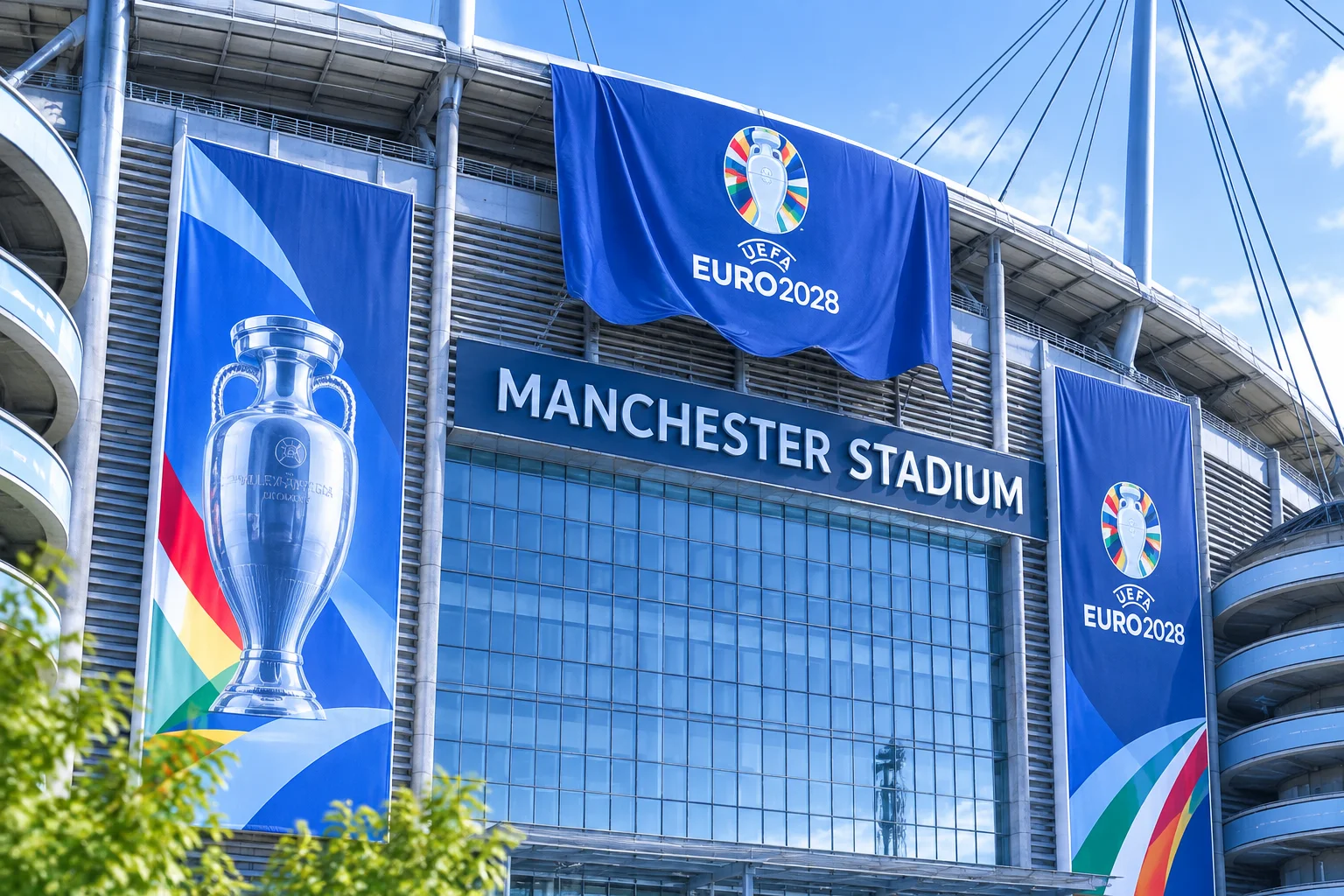
Several grounds will answer to different names for a month. UEFA does not permit commercial sponsor names at its tournaments unless the sponsor is a competition partner, so venues revert to neutral titles for the duration.
- Etihad Stadium becomes Manchester City Stadium.
- Aviva Stadium becomes Dublin Arena.
- Principality Stadium becomes the National Stadium of Wales.
- Hill Dickinson Stadium becomes Everton Stadium.
- Tottenham Hotspur Stadium keeps its name, because it has never carried a title sponsor.
This matters practically, not just cosmetically. Signage, travel apps, ticket wording and stadium directions will all use the tournament name during June and July 2028. A fan searching for the Aviva on a match morning may find nothing labelled that way at the ground itself.
WhatsApp channel
Sports news straight to your phone
Match updates, on-sale dates and ticket news from 1BoxOffice.
Cardiff Opens It, Wembley Closes It
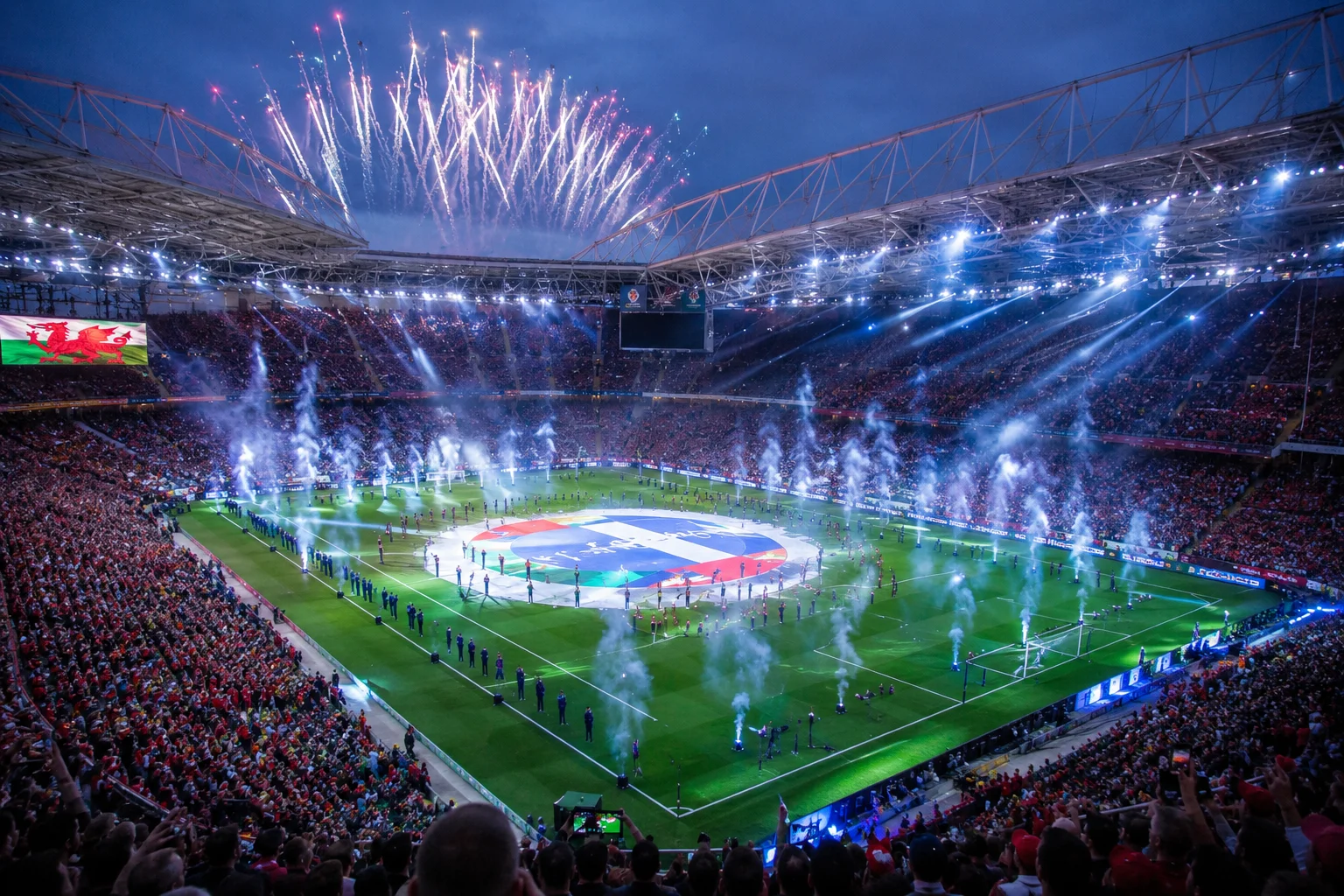
The opening Group A fixture takes place at the National Stadium of Wales on Friday 9 June 2028. Cardiff was chosen partly because the ground sits in the city centre, a two-minute walk from Cardiff Central station, which makes for a compact and well-connected start.
Wembley stages both semi-finals and the final on Sunday 9 July, its third European Championship final after 1996 and 2021. The final kicks off at 18:00 CEST, which is 17:00 UK time. That is three hours earlier than the Euro 2020 final, a change UEFA has framed around fan experience and broadcast reach, and one that reads clearly as a response to the ticketless crowd disorder at Wembley in July 2021.
The knockout distribution is unusual and worth understanding before you plan a trip:
- Eight of the nine grounds stage a round of 16 tie. Wembley is the exception.
- The four quarter-finals are split one per host nation: Cardiff, Dublin, Glasgow and Wembley.
- Three kick-off times apply across the tournament: 15:00, 18:00 and 21:00 CEST, or 14:00, 17:00 and 20:00 UK time.
The consequence for England supporters is that a Wembley run is not continuous. England open at Manchester City Stadium, play their next two group games at Wembley, then leave London again for the last 16, heading to St James' Park if they win Group B or to Everton Stadium if they finish second. Wales, by contrast, get the cleanest run of any host: all three group games in Cardiff, and a last-16 tie there too if they win Group A.
The Old Trafford and Anfield Question
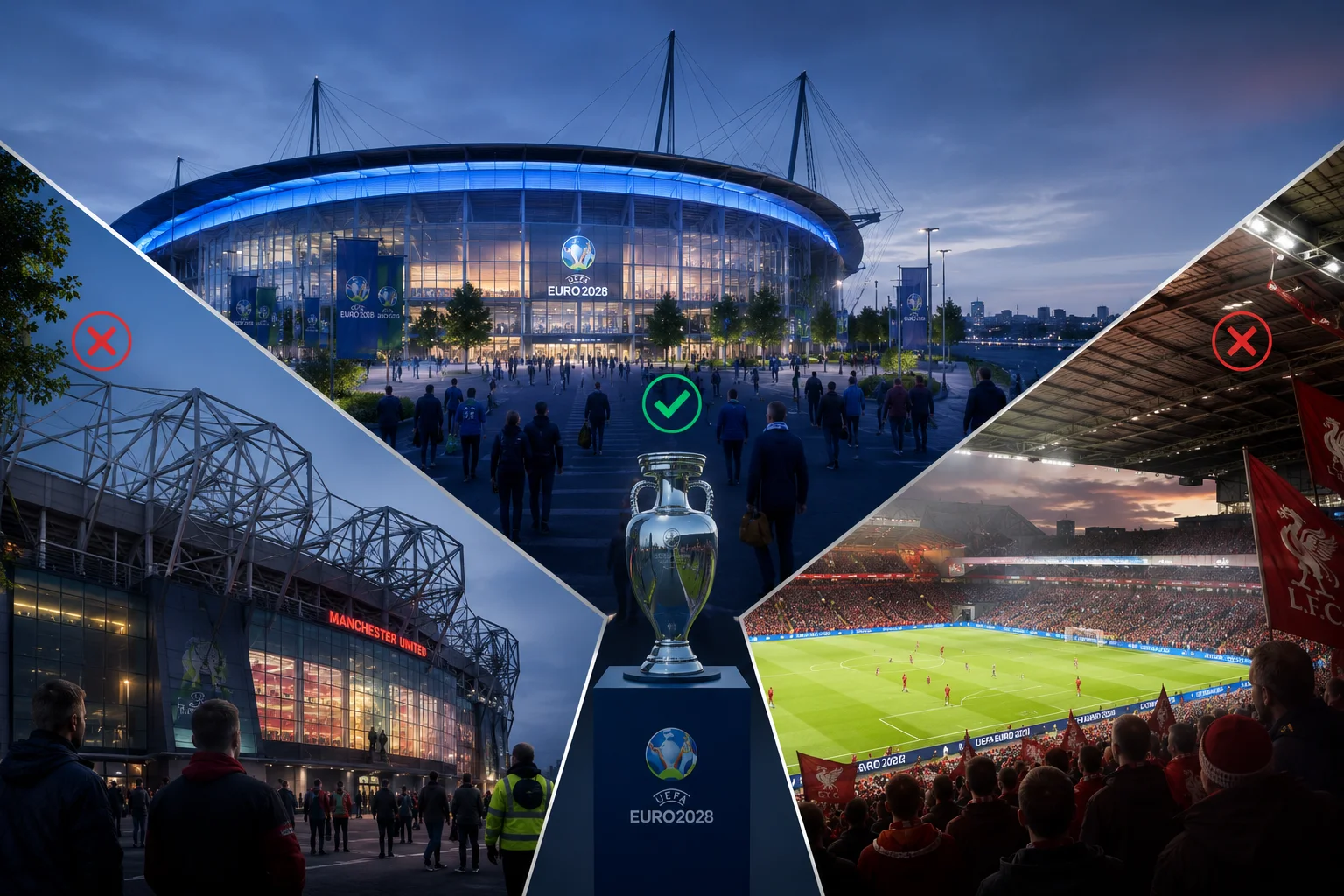
This is the argument that will not go away, and the answers are more mundane than the conspiracy theories suggest.
Old Trafford appeared on the 14-ground preliminary shortlist and then withdrew in April 2023. Manchester United could not give the FA the availability certainty a five-year commitment demands while the future of the ground was under review. Gary Neville summed up the mood by noting it had gone from one of the best stadiums in the world to one that could not get into the top 10 in Britain and Ireland. Anyone who has sat in the Old Trafford seating plan's older sections understands why the review happened.
Anfield failed on a technical measurement. UEFA requires a playing surface of 105m by 68m for tournament matches. Anfield's pitch is 101m long, a constraint Liverpool have lived with for decades. That same four-metre shortfall is why Anfield cannot stage a Champions League final either, and no amount of goodwill changes it without moving the stands themselves, as the Anfield seating plan makes clear once you look at how tightly the Kop and the Main Stand sit to the touchlines.
Others fell away for less dramatic reasons. The London Stadium and the Emirates lost out because the capital already had Wembley and a modern 62,000-seat alternative. Sunderland's Stadium of Light was passed over in favour of Newcastle in the north east. Croke Park was surplus once Dublin committed to the Aviva. In Scotland, Murrayfield, Ibrox and Celtic Park all missed out to Hampden Park, the established national ground, and picking one Old Firm stadium over the other would have created a problem nobody at the Scottish FA wanted.
Two London Grounds and a Building Site in Birmingham
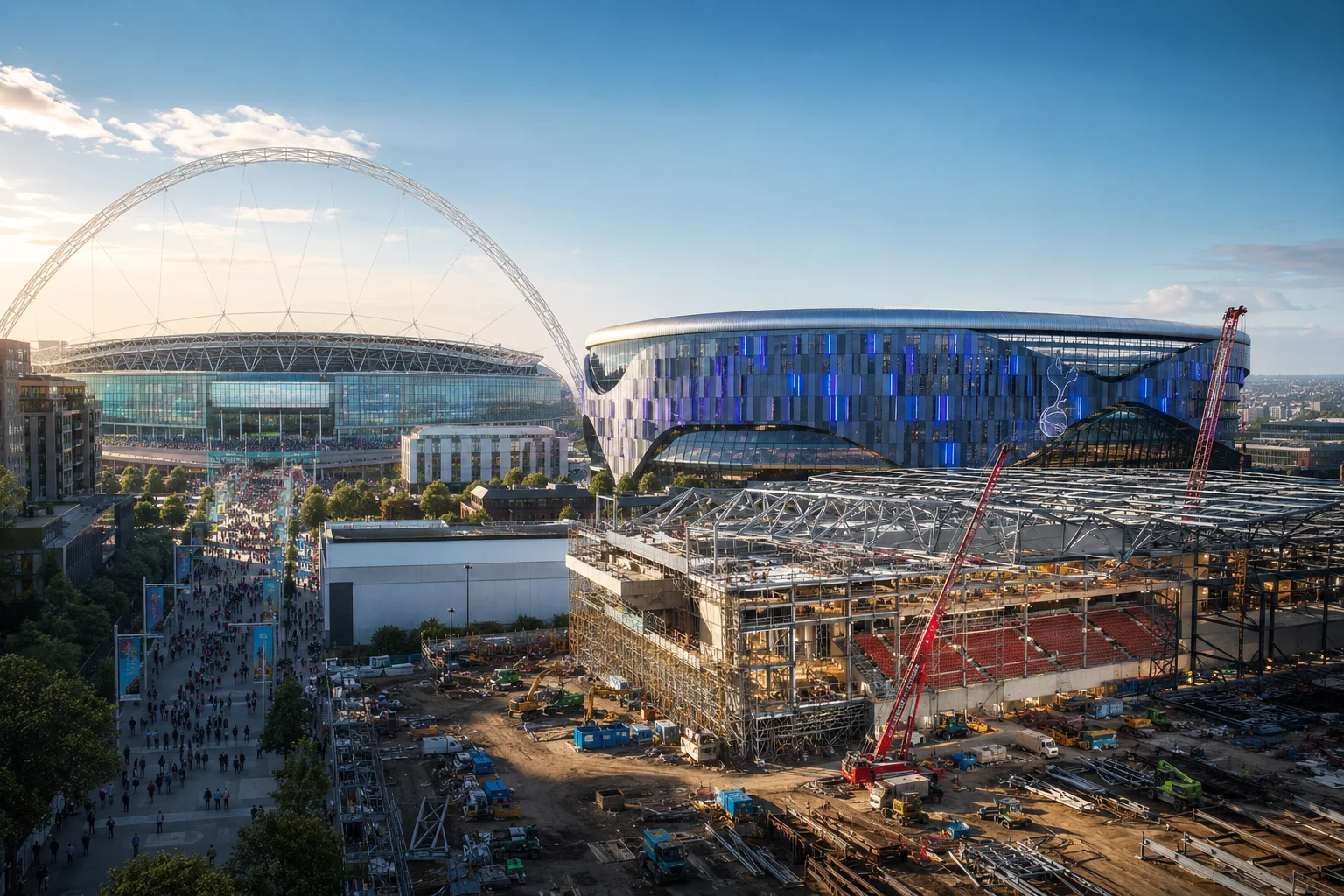
London's second venue is Tottenham Hotspur Stadium, which opened in 2019 and holds 62,850. It has the only dividing retractable natural turf pitch in world football, sliding away to reveal an artificial surface underneath, and it is the most technically capable ground in the tournament after Wembley.
Three venues are being worked on between now and 2028. Manchester City's North Stand expansion opened on 24 May 2026, lifting the Etihad Stadium from 53,400 to roughly 61,500, with the wider Medlock Square development finishing later in 2026. Villa Park is midway through a North Stand rebuild costing around £100m, due to complete in the second half of 2027 and take the ground past 50,000. During the 2026/27 season Villa Park's usable capacity drops to about 37,000 while that work continues.
Everton Stadium is the newcomer. It opened in 2025 on the Bramley-Moore Dock waterfront with 52,769 seats and will stage four group games plus a round of 16 tie on 24 June 2028. Reports of a further expansion to around 57,000 before the tournament have not been confirmed and look unlikely on the timescale.
Where to Sit at the English Venues
Tournament seating is categorised differently from domestic football, with UEFA using price categories rather than club stand names. The underlying geometry does not change though, so the club seating plans remain the best guide to sightlines, legroom and which end you actually want.
| Venue | Tiers | What to know | Seating plan |
|---|---|---|---|
| Wembley Stadium | Three | Halfway line in the lower tier sits further from the pitch than most grounds because of the athletics-capable bowl footprint | Wembley seating plan |
| Tottenham Hotspur Stadium | Four | The single-tier south stand is the steepest and loudest block in the ground | Tottenham seating plan |
| Manchester City Stadium | Three | The new North Stand adds a third tier and changes the upper-bowl sightlines from 2026 | Etihad seating plan |
| St James' Park | Two, with a very high upper | The Level 7 upper tier is among the steepest in Europe and not for anyone uneasy with heights | St James' Park seating plan |
| Villa Park | Two to three by stand | Configuration changes once the North Stand rebuild completes in 2027, so check before booking | Villa Park seating plan |
What Happened to Belfast
Casement Park was one of 10 grounds in the winning bid ratified by UEFA in October 2023. It was removed in September 2024, and Northern Ireland will stage no matches.
The reason was money and time. In a joint letter dated 13 September 2024, Northern Ireland Secretary Hilary Benn and Culture Secretary Lisa Nandy told Stormont that estimated build costs had risen from £180m when the bid was awarded to potentially over £400m, and that there was significant risk the ground would not be finished in time. The site had been derelict since 2013.
The rebuild is now proceeding anyway, just not for this tournament. GAA president Jarlath Burns put the figure at around £260m in February 2025. Committed funding covers Stormont at £62.5m, the Irish government at roughly £43m, the GAA at £15m and up to £50m from the UK government confirmed in the June 2025 Spending Review, leaving a shortfall that has driven the argument ever since. Demolition and site preparation restarted in late January 2026, and First Minister Michelle O'Neill said in July 2026 that the project remains a priority.
Belfast does keep one tournament date: it hosts the qualifying draw on 6 December 2026. Northern Ireland also compete in qualifying, and UEFA has already allocated their group venues in England if they get through, with one match each at Tottenham Hotspur Stadium, Villa Park and Wembley. Their qualifying fixtures are listed as they are confirmed.
No Free Pass for the Hosts
This trips up more people than any other part of the tournament. None of the four host nations qualifies automatically. All of them enter the standard qualifying competition of 12 groups.
- The 12 group winners and the eight best runners-up qualify directly, giving 20 teams.
- Two places are then reserved for the two best-ranked host nations that did not qualify directly.
- Play-offs fill whatever remains, and UEFA Nations League performance feeds the play-off seedings, so results in 2026 and 2027 carry more weight than they look like they should.
Qualify directly and you play your group games at home. England open at Manchester City Stadium then move to Wembley for two. Scotland play all three at Hampden Park. Wales take all three at the National Stadium of Wales, opening the tournament. The Republic of Ireland play all three at Dublin Arena.
Win your group as Scotland, Wales or the Republic of Ireland and the last 16 stays at home too. Take that a step further and a Wembley quarter-final between England and Wales becomes possible if both top their groups. The qualifying draw is on 6 December 2026, group matches run through 2027, play-offs follow in March 2028 and the final draw is expected in December 2027.
Getting Between the Grounds
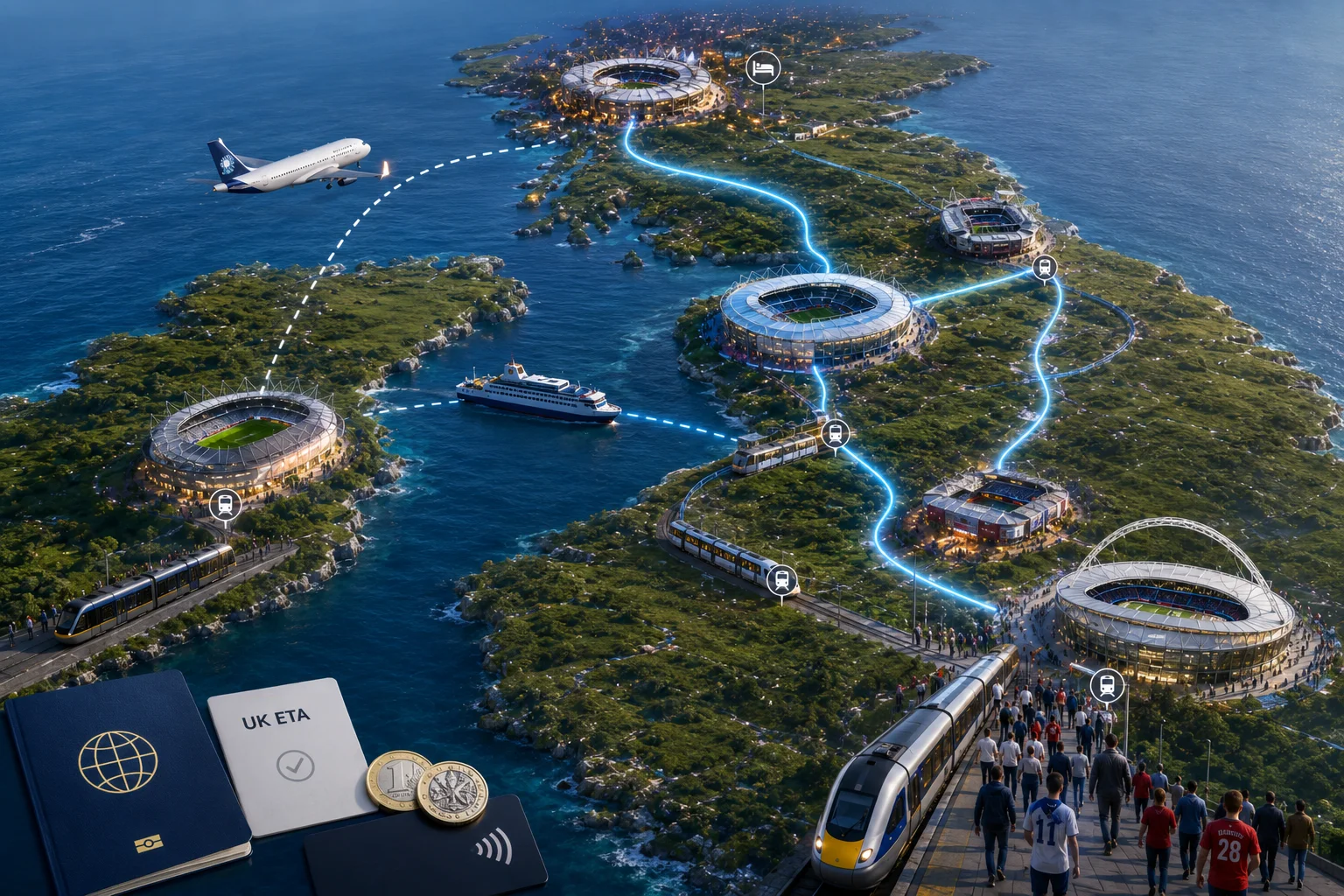
This is a compact tournament by multi-nation standards. Around 500 miles separates the two furthest venues, and organisers are planning for more than 80% of ticket holders to reach matches by public transport.
Rail handles most of the English and Welsh routes comfortably. Glasgow is reachable by direct train from England but an evening kick-off there realistically needs an overnight stay. Dublin is the one genuine break in the chain, requiring a flight of under 90 minutes from London or a rail and ferry combination through Holyhead or Liverpool.
Stadium access is straightforward at almost every venue, which is unusual for a tournament of this spread. Most grounds sit within a short walk of a rail or metro stop:
- Wembley is served by Wembley Park on the Jubilee and Metropolitan lines plus Wembley Stadium rail, both roughly 10 minutes on foot.
- St James' Park sits beside St James Metro station in Newcastle city centre.
- Dublin Arena is next to Lansdowne Road on the DART line.
- Manchester City Stadium has its own Metrolink stop at Etihad Campus.
- Hampden Park is a short walk from Mount Florida and King's Park stations on Glasgow's southside.
- Villa Park adjoins Witton station, with upgrades planned alongside Network Rail before the tournament.
- Everton Stadium is the one requiring more thought, sitting on the north docks with Sandhills the designated station and a walk or shuttle from there.
Three practical points catch out travelling fans, and the Dublin ones catch out almost everybody:
- Under the Common Travel Area, British and Irish citizens move between the UK and Ireland with recognised photo identification, though airlines and ferry operators usually insist on a passport regardless.
- Visitors from outside the UK and Ireland, including fans travelling from the Gulf and wider MENA region, need a UK Electronic Travel Authorisation alongside their passport. The fee rose from £16 to £20 on 8 April 2026 and covers multiple visits over two years.
- Ireland is a separate jurisdiction with its own entry rules and its own currency. A trip taking in Dublin and any UK city needs both euros and sterling.
Accommodation is the pressure point nobody can plan around properly, because teams are not known until the December 2027 draw. Host cities will be at capacity on match dates. Booking refundable rooms early and confirming once the draw lands is the only sensible approach.
When Tickets Actually Go on Sale
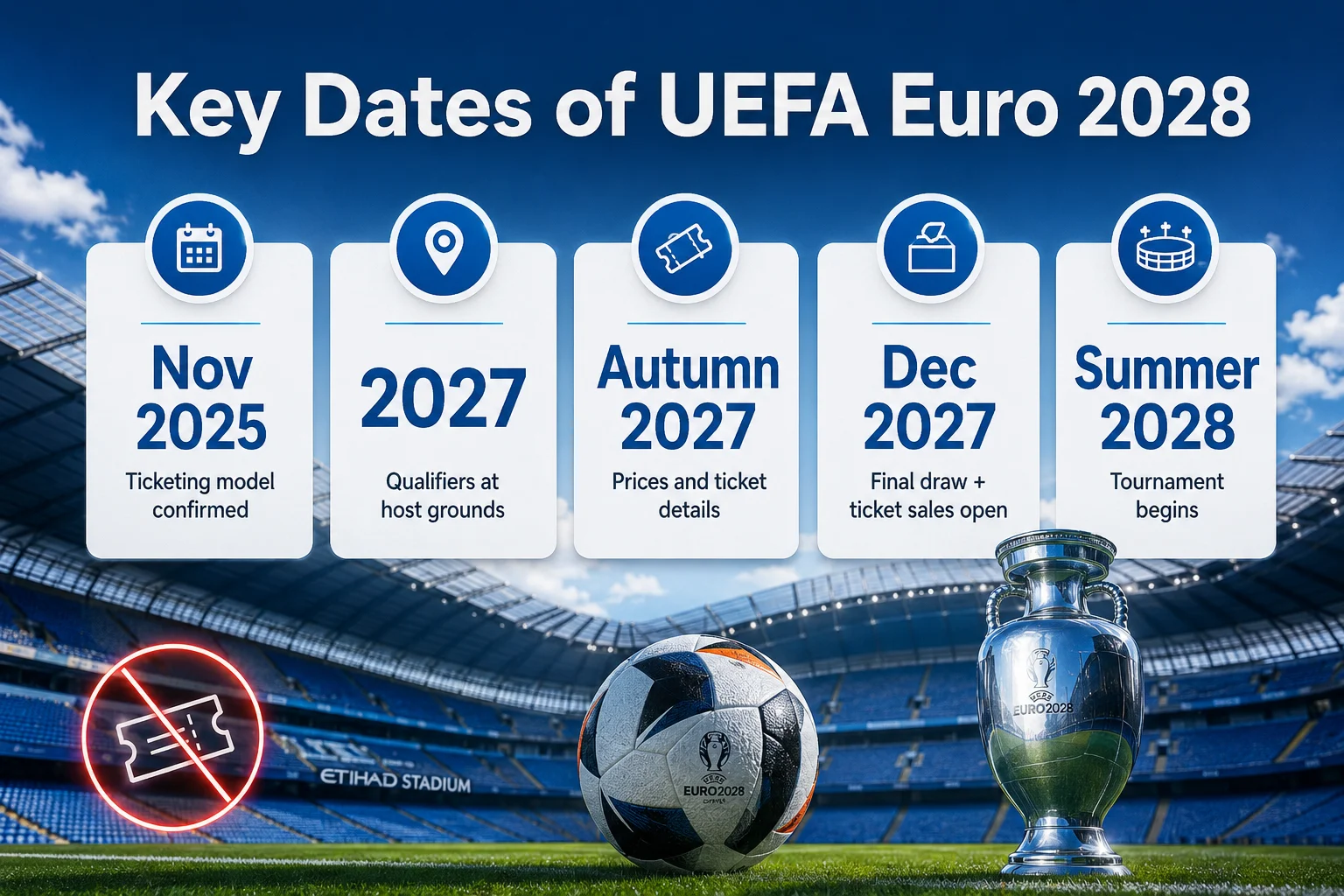
Nothing is on sale yet, and there is no register of interest to join. UEFA has said ticketing details and prices arrive in autumn 2027, with sales opening only after the final draw in December 2027. There is no pre-draw phase.
What has been confirmed about the process:
- Roughly three million tickets across 51 matches, the largest allocation the tournament has had.
- Allocation by ballot rather than first click, with an application window followed by a random draw.
- No dynamic pricing. FA chief executive Mark Bullingham stated this plainly at the November 2025 launch.
- More than 40% of tickets in the lowest price categories, with lower-tier pricing held at Euro 2024 levels of about €30 and €60.
- 10,000 tickets per group match reserved for each competing nation's supporters.
- Disabled supporters pay the lowest category price and can request a free companion ticket.
Treat any site selling specific numbered seats for a named Euro 2028 fixture before autumn 2027 with real suspicion. The draw has not happened, so nobody knows which teams play where. That is the clearest scam signal available between now and late 2027.
In the meantime, the realistic route to a summer of tournament football is through the qualifiers, which run across 2027 at these same grounds. You can create an account to set alerts for qualifying fixtures as they are listed, and follow any purchase through track order until delivery is confirmed. Every order on 1BoxOffice carries a 150% money-back guarantee, which matters most on tournament football where fixtures move and venues change.
FAQs
1. Is Edinburgh a host city for the tournament?
-
No, Glasgow is Scotland's only host city and Murrayfield was not selected despite being larger than Hampden Park.
2. How many matches will each city stage?
-
London stages 13 across its two grounds, Dublin seven, Cardiff and Glasgow six each, Manchester, Liverpool and Newcastle five each and Birmingham four.
3. Will the tournament expand to 32 teams?
-
No, the expansion floated in 2021 and 2022 was dropped after broadcasters warned that qualifying would lose competitive value, so the format stays at 24 teams.
4. Can I watch a match in two countries on the same weekend?
-
Yes, with three kick-off times per matchday and short flights between Dublin and the British cities, back-to-back fixtures in different countries are workable if you build in a night's stay.
5. Which ground is the oldest in the tournament?
-
St James' Park dates to 1892, narrowly older than Villa Park in 1897 and Hampden Park in 1903, though all three have been heavily rebuilt since.
Between now and the December 2027 draw, the qualifying campaign is where these grounds come to life, and 1BoxOffice lists fixtures across all four host nations with a 150% money-back guarantee on every order.
Sources: UEFA, The Football Association, Scottish Football Association, Football Association of Wales, Football Association of Ireland, Irish Football Association.