
In this guide
What a 2026 final seat actually costsWhy 2026 went verticalTo see how strange that is, look at the 30 years before itWhy did each final cost what it did?How we did the mathsWhat it means if you are going in 2026FAQsPicture the worst seat in the house for this summer's World Cup final. Back row, restricted view, as far from the pitch as the stadium will allow. At face value, it cost $2,030, about £1,515. That is not a resale price or a hospitality package with a buffet attached. That is the floor, the least you could pay to be in the building. And here is the part that should stop you: in today's money, that floor sits higher than the most expensive seat ever sold at a World Cup final before this one. For almost 30 years, World Cup final ticket prices barely shifted once you stripped out inflation. The 2026 tournament did not stretch that line. It tore it up. This is how a final seat went from steady to surreal, and why 2026 in particular went vertical.
What a 2026 final seat actually costs
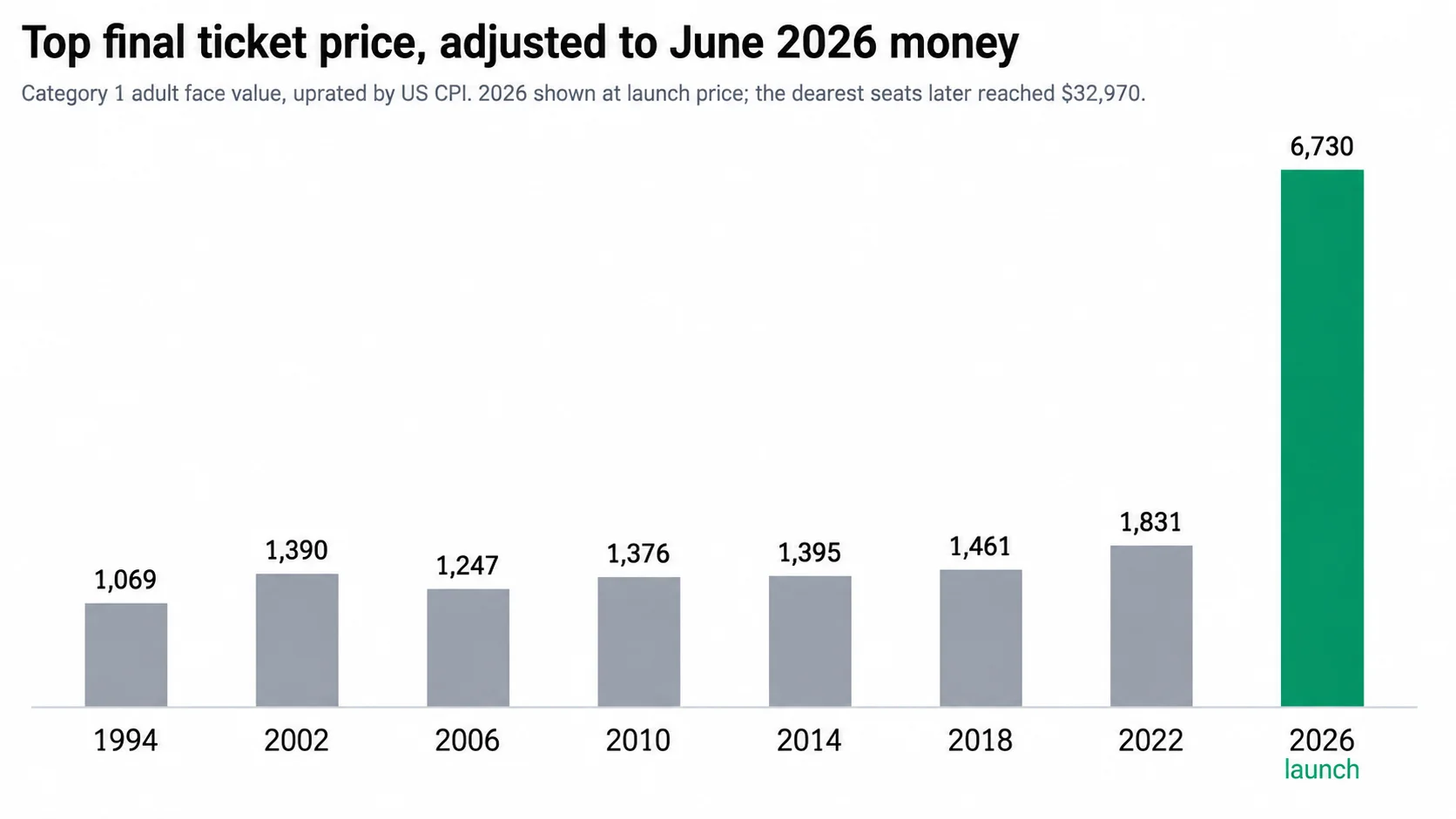
The final lands at MetLife Stadium in New Jersey on 19 July 2026. When sales opened, the top standard category ran at around $6,730, roughly £5,020. It did not stay there. By the spring, the best seats had been pushed to about $10,990. By early May, the dearest final tickets were listed at $32,970, nearly £24,600. That is before a single pound of resale markup is added. So the spread for one match runs from a $2,030 floor to a $32,970 ceiling. To understand how strange those numbers are, you have to put them next to every final that came before.
Why 2026 went vertical
Three things turned a steady price into a runaway one, and a fourth quietly widened the gap.
The biggest change is how the seat is priced at all. Every previous final used fixed tiers, set roughly a year out and printed on the ticket. The price of a Category 1 seat in Moscow in 2018 was the same, whether you bought it in October or the week of the match. The 2026 tournament is the first to price the final on demand, so the headline figure floats with how many people are chasing the same seat. When demand spikes, and for a World Cup final, it always spikes, the number climbs with it. That single mechanism is why the top price could quadruple between launch and May.
The second change is scale. This is the largest tournament ever staged, with 48 teams across 104 matches in three host countries. There is far more football to sell, but there is still only one final, and a bigger global event funnels even more demand into that one building on that one night.
The third is the market. The 2026 final sits in the most expensive live-event economy on earth. North American sport has trained its audience to pay top dollar for a seat at a one-off, the kind of money a Super Bowl or an NBA final commands on resale, and a World Cup final now competes in that bracket rather than the more modest one European and African tournaments work within.
The quiet fourth factor is resale itself. It now runs through the same system as the first sale, with a cut taken on every onward transfer, so the gap between face value and resale opens at the sales window rather than in the car park outside it. That is also why caution matters more than ever when a listing looks too good, and it is worth knowing how to spot a fraudulent ticket before you commit to anything.
To see how strange that is, look at the 30 years before it
For a generation, the top final seat was almost boringly stable in real terms. The Rose Bowl final in 1994 carried a $475 top price, about $1,069 in today's money. By the Luzhniki final in Moscow in 2018, it had reached roughly $1,461. That is a rise of well under half across 24 years, slower than wages grew over most of that period. Wherever the tournament went, a Category 1 final ticket sat in a band between about $1,100 and $1,500 in current money. Here is the verified record, final by final, from 1994.
| Tournament | Host | Final venue | Top-category face value | Value in June 2026 |
|---|---|---|---|---|
| 1994 | USA | Rose Bowl, Pasadena | $475 | $1,069 |
| 2002 | South Korea and Japan | Yokohama | $750 | $1,390 |
| 2006 | Germany | Olympiastadion, Berlin | €600 | $1,247 |
| 2010 | South Africa | FNB Stadium, Johannesburg | $900 | $1,376 |
| 2014 | Brazil | Maracanã, Rio de Janeiro | $990 | $1,395 |
| 2018 | Russia | Luzhniki, Moscow | $1,100 | $1,461 |
| 2022 | Qatar | Lusail Stadium | $1,607 | $1,831 |
| 2026 | USA, Canada and Mexico | MetLife Stadium, New Jersey | $6,730, rising to $32,970 | $6,730, rising to $32,970 |
WhatsApp channel
Sports news straight to your phone
Match updates, on-sale dates and ticket news from 1BoxOffice.
Why did each final cost what it did?
The honest headline is that the nominal price climbed for ordinary reasons, not because anyone was pushing the seat to its limit. Money lost value, host markets differed, and the tournament grew more commercial by degrees. Strip inflation out, and the real top price hardly moved until very recently.
USA 1994 set the modern baseline: dollar pricing and vast American stadiums, the first finals on that continent. Korea and Japan in 2002 were the first shared hosting and the first in Asia, two higher-cost markets that nudged the nominal figure up. Germany 2006 was priced in euros against fierce home demand as hosts, and the side that won in 1990 and again in 2014 will pull big numbers, with interest around Germany at World Cup 2026 already strong. South Africa in 2010 ring-fenced its cheaper tiers for residents, so the floor that year was never a like-for-like global price. Brazil 2014 drew enormous worldwide demand, and yet the real top price held in the same band, and interest in Brazil at World Cup 2026 is again among the strongest of any nation. France won at home in 1998 and again in Moscow in 2018, the $1,100 Russia final working out at about $1,461 today, with France at World Cup 2026 high on the demand list since the draw. Spain's sole title came in Johannesburg in 2010, where the $900 top seat equals roughly $1,376 now, and Spain at World Cup 2026 arrive as one of the favourites.
Qatar 2022 was the first real crack in the pattern. The Lusail final's $1,607 Category 1 ticket came out at about $1,831 in today's money, the highest real face value of any final to that point. A compact, premium tournament in a small, wealthy country pushed the line above where it had sat for 25 years. Argentina lifted the trophy there, and Argentina at World Cup 2026 arrive as holders into a final that has since left Qatar's record far behind. The point worth holding onto: even 2022, the dearest final before this one, was a fraction of what 2026 now asks.
How we did the maths
A data study lives or dies on its method, so here is ours, briefly. Every price above is the top standard adult category, Category 1, for the final itself, the dearest ordinary seat sold to the public at face value. No hospitality, no suites, nothing bought on resale. The series runs in US dollars because that is how the governing body has priced international tickets since 2002, and 1994 was set in dollars, too. Germany 2006 was priced in euros and converted at 2006 exchange rates, so it sits on the same scale. Each figure is then updated to June 2026 money using the United States Consumer Price Index. As a sense check, that turns the 1994 final's $475 into about $1,069, the same figure other analysts reach independently. Sterling conversions use roughly $1.34 to the pound as of mid-June.
One caveat is worth stating plainly. The cheapest tier was sometimes reserved for host-nation residents, so the floor in a given year was not always a like-for-like global price. The series tracks the top Category 1 seat, which was sold to the general public everywhere, so the comparison across tournaments holds.
What it means if you are going in 2026
A few practical points follow from all this. Tickets for 2026 are digital and tied to an account, which changes how a resale purchase is handled and transferred, so set the account up well before kickoff rather than on match day. Once an order is placed, you can follow it through order tracking. There is no entry-document scheme of the kind used at recent tournaments, a point covered in our guide to whether a fan ID applies to World Cup 2026.
The harder truth in the figures is about access. For nearly 30 years, a final was, at its cheapest, within reach of an ordinary supporter who saved for it. In real terms, that is no longer true at face value. Whether the 2026 model is a one-off spike or the new floor for World Cup pricing is the question the next set of numbers, from 2030, will answer.
FAQs
1. Which World Cup final has been the most expensive in real terms?
-
The 2026 final, by a distance, with top seats running from $6,730 up to $32,970 against a previous real-terms high of about $1,831 in 2022.
2. Why did 2026 World Cup final prices rise so sharply?
-
Demand-based pricing was used for the first time, the tournament is the largest ever at 48 teams, and the final sits in the high-spending North American market.
3. Are these the prices fans actually paid?
-
These are face values, and resale for finals has always run higher, with the 2026 primary price itself moving as demand changes.
4. How does the 2026 final price compare with 2022?
-
The 2026 final opened near $6,730 against about $1,831 for 2022 in today's money, close to four times higher at launch and far more at its May peak of $32,970.
5. Where and when is the 2026 World Cup final?
-
At MetLife Stadium in East Rutherford, New Jersey, on 19 July 2026.
For supporters planning the trip, the value of a verified marketplace grows as the gap between face value and resale widens. 1BoxOffice lists final and knockout tickets with a 150% money-back guarantee, so a buyer knows the seat is covered if anything goes wrong.
Sources: FIFA ticketing announcements at each tournament, the BBC, Reuters, The Japan Times, Al Jazeera, CNBC, Fortune, The Conversation and Statista, plus the United States Bureau of Labor Statistics Consumer Price Index.