In this guide
From European Cup to a 36-Team LeagueThe League Phase: Pots, the Draw and the CalendarWhat the Table Decides and the Points It TakesThe Knockout Rounds: Seeding All the Way to the FinalHow the Champions League Differs from the Premier LeagueWho Gets In: The 2026/27 Access ListWhat Every Result Is WorthKey Dates for 2026/27FAQsParis Saint-Germain lifted the trophy in Budapest on 30 May 2026, beating Arsenal 4-3 on penalties to retain their title. If you have ever asked how does the UEFA Champions League work under its 36-team format, the 2026/27 season is the third campaign of the single-league system. Two completed seasons have now shown exactly how many points it takes to survive, why final position shapes the whole knockout bracket and how much every result is worth in prize money.
The short version: the Champions League is an annual competition of 36 teams, played every year from September to June with qualifying rounds starting in July. Each club plays eight league phase matches in a single combined table, the top 24 progress and a seeded knockout bracket decides the champion across 189 matches in total. The full mechanics are below; fixtures are listed on the Champions League tickets page as they are confirmed.
From European Cup to a 36-Team League
The European Cup and the Champions League are the same competition under two names. It began in 1955 as the European Cup, a straight knockout open only to domestic champions; group stages arrived in 1991, the Champions League rebrand in 1992 and multiple entrants per country from 1997/98. For over three decades the shape barely moved: 32 teams, eight groups of four, six group games each.
That ended in 2024/25. The group stage no longer exists: UEFA replaced it with one league of 36 clubs, added two matchdays per team and increased the total number of matches from 125 to 189. The stated aim was more meetings between elite clubs earlier in the season; the practical effect was more broadcast inventory and a prize pot that now sits around €2.46 billion for Champions League clubs alone.
The League Phase: Pots, the Draw and the Calendar

Every club plays eight different opponents between September and January, four at home and four away, never facing the same side twice. The fixture list comes from a software-assisted draw: the 36 teams are ranked into four seeding pots of nine by UEFA club coefficient, a rolling measure of European results over the previous five seasons. Each club is drawn against two opponents from every pot, one home and one away.
The draw carries constraints that shape the fixture list before a ball is kicked. Clubs cannot face opponents from their own country in the league phase and no side can be drawn against more than two clubs from any single other nation. Wins are worth three points and draws one, with all 36 clubs ranked in one combined table.
What the Table Decides and the Points It Takes
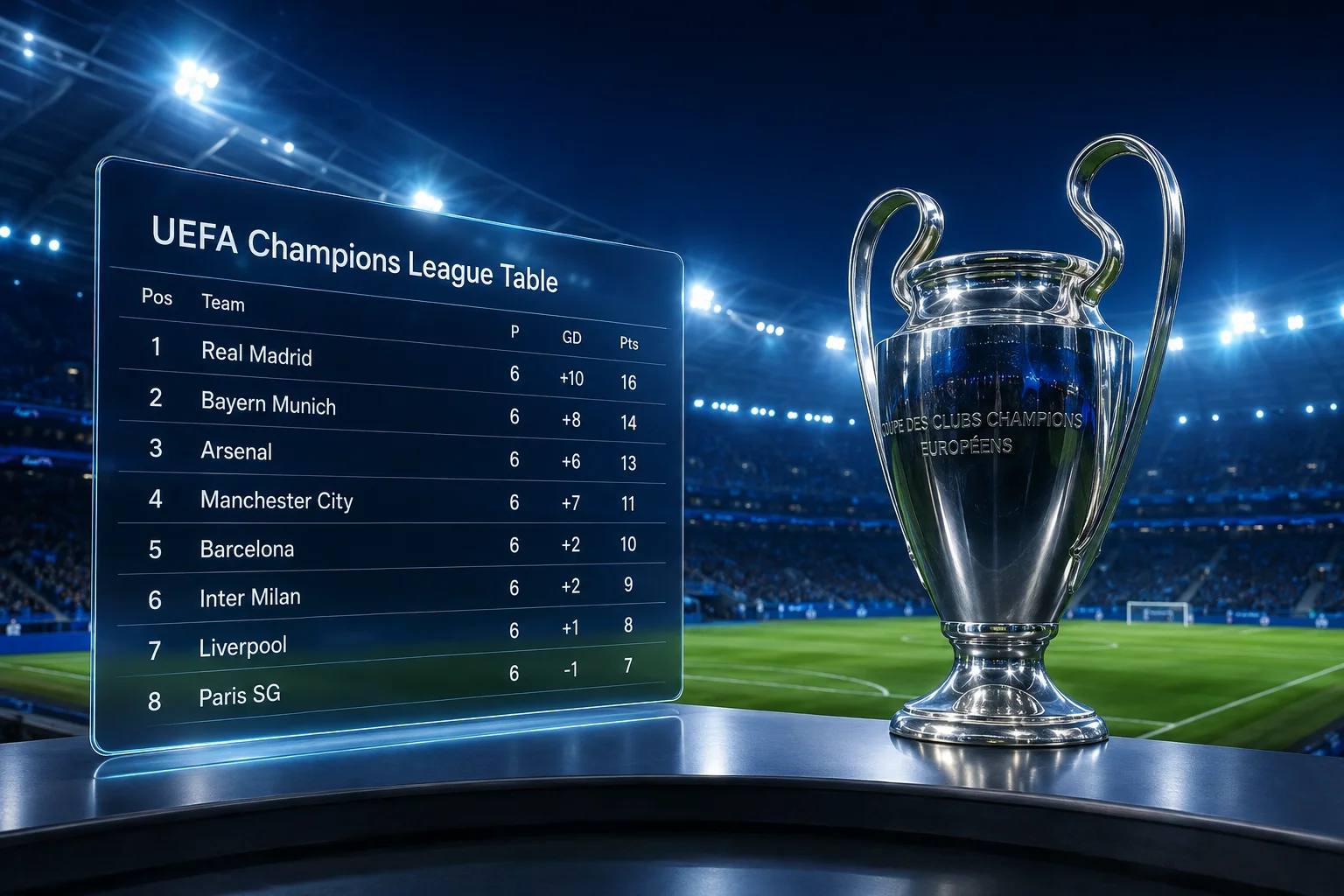
The Champions League table works on three cut-offs. The top eight go straight to the round of 16. Ninth to 24th drop into a two-legged knockout play-off in February. Anyone 25th or lower is out of Europe altogether: since 2024/25 there is no parachute into the Europa League.
Two completed seasons give real benchmarks. In both campaigns, 16 points guaranteed a top-eight finish, while sides on 11 to 15 points reached the play-off round with one painful exception: Dinamo Zagreb finished on 11 points in 2024/25 and still went out on goal difference, the first tie-breaker. Liverpool topped the inaugural league phase with 21 points; Arsenal went one better in 2025/26 with a perfect eight wins from eight.
Position matters far beyond survival. Finishing first or second guarantees the two easiest theoretical routes through the bracket, while ninth against tenth can be the difference between a seeded and unseeded play-off. The final matchday shows how fine the margins are: in January 2026, a 95th-minute Sporting CP goal knocked Real Madrid out of the top eight on the night, condemning the record 15-time champions to two extra knockout matches in February. All 18 final-round games kick off simultaneously for exactly this reason.
WhatsApp channel
Sports news straight to your phone
Match updates, on-sale dates and ticket news from 1BoxOffice.
The Knockout Rounds: Seeding All the Way to the Final
The February play-off has its own mechanics. Clubs ranked ninth to 16th are seeded, which means they play the second leg at home and are paired off against specific unseeded opponents: ninth and tenth are drawn against 23rd and 24th, 11th and 12th against 21st and 22nd and so on down the table. The eight winners join the top eight in the round of 16.
From there the bracket works like a tennis draw. Each club's league phase position fixes its path, so the sides ranked first and second cannot meet before the final and the top eight are kept apart in the early rounds. The round of 16, quarter-finals and semi-finals are two-legged ties settled by extra time and penalties if the aggregate is level; away goals were abolished in 2021, so a 2-2 aggregate is simply 2-2 regardless of where the goals came.
The final is a one-off match at a pre-selected neutral venue. The winner earns automatic entry to the next league phase, a UEFA Super Cup meeting with the Europa League winner and a place in the annual Intercontinental Cup against the champions of the other confederations.
How the Champions League Differs from the Premier League
The difference between the Champions League and the Premier League is scope. The Premier League is England's domestic league: 20 clubs, 38 rounds, everyone plays everyone home and away between August and May. The Champions League is a continental competition that sits on top of the domestic season, contested midweek by the best-placed clubs from leagues across Europe; finishing high in the Premier League is precisely how English clubs earn their place in it.
The formats differ too. A Premier League season is a complete double round-robin with no knockout element, while the Champions League combines a partial league of eight games with a knockout bracket, so a club can lose the final and still have had a statistically stronger season than the winner. A club competes in both at once, which is why squad depth and fixture congestion dominate the conversation every European week.
Who Gets In: The 2026/27 Access List
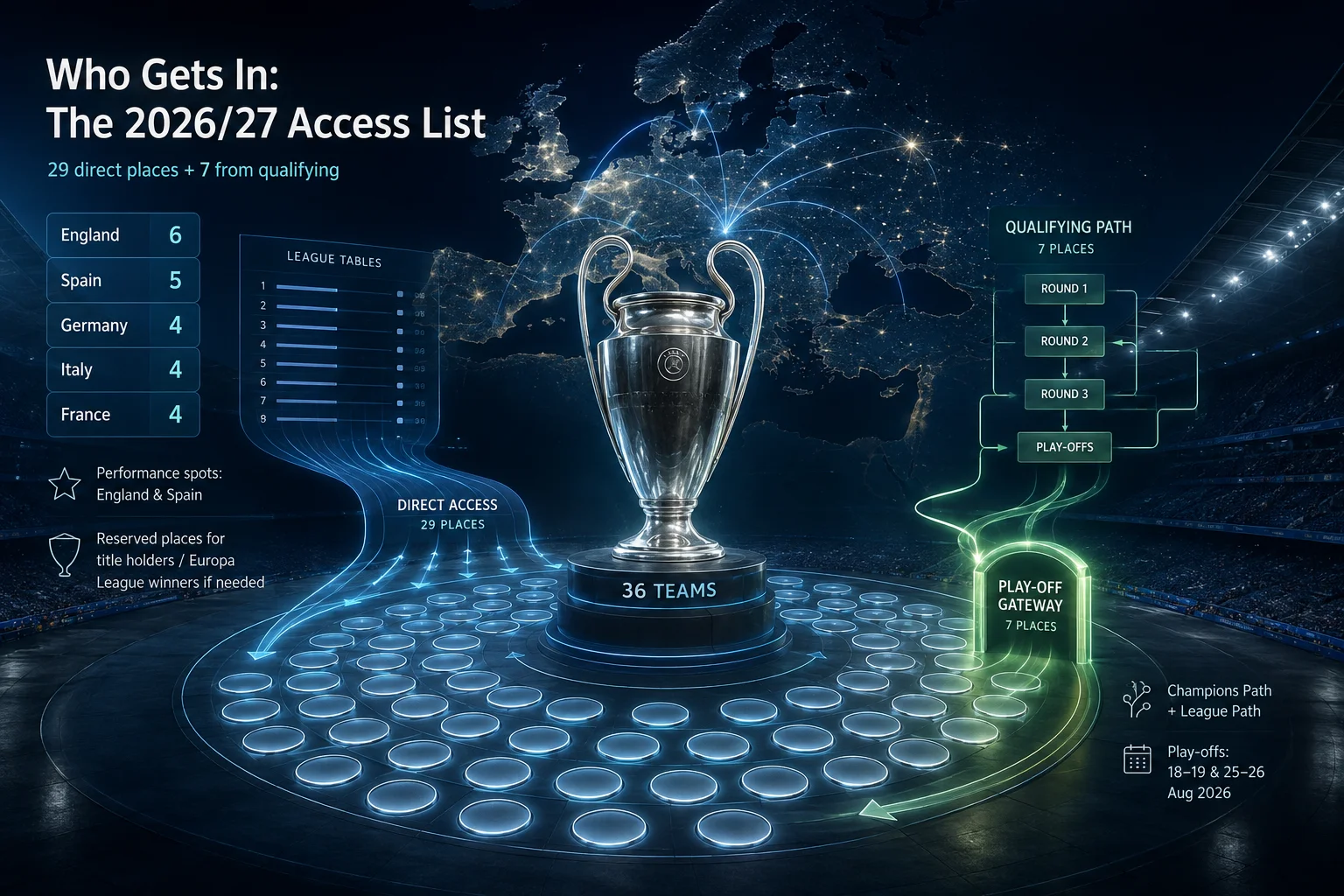
Clubs qualify for the Champions League in one of two ways: finishing high enough in their domestic league or coming through summer qualifying. The selection process fills 29 of the 36 places directly through domestic results, while the final seven come through qualifying rounds split between a Champions Path for title winners from lower-ranked nations and a League Path for the remaining hopefuls, ending with the play-off round on 18-19 and 25-26 August 2026. How many teams qualify from each country depends on the association coefficient, plus two European Performance Spots that reward the nations whose clubs did best the previous season. Both went to England and Spain for 2026/27:
- England: six clubs from the Premier League, the largest single-country contingent in the competition's history
- Spain: five clubs from La Liga
- Germany, Italy and France: four clubs each
- The title holders and the Europa League winners, if not already qualified through their league, take reserved places
What Every Result Is Worth
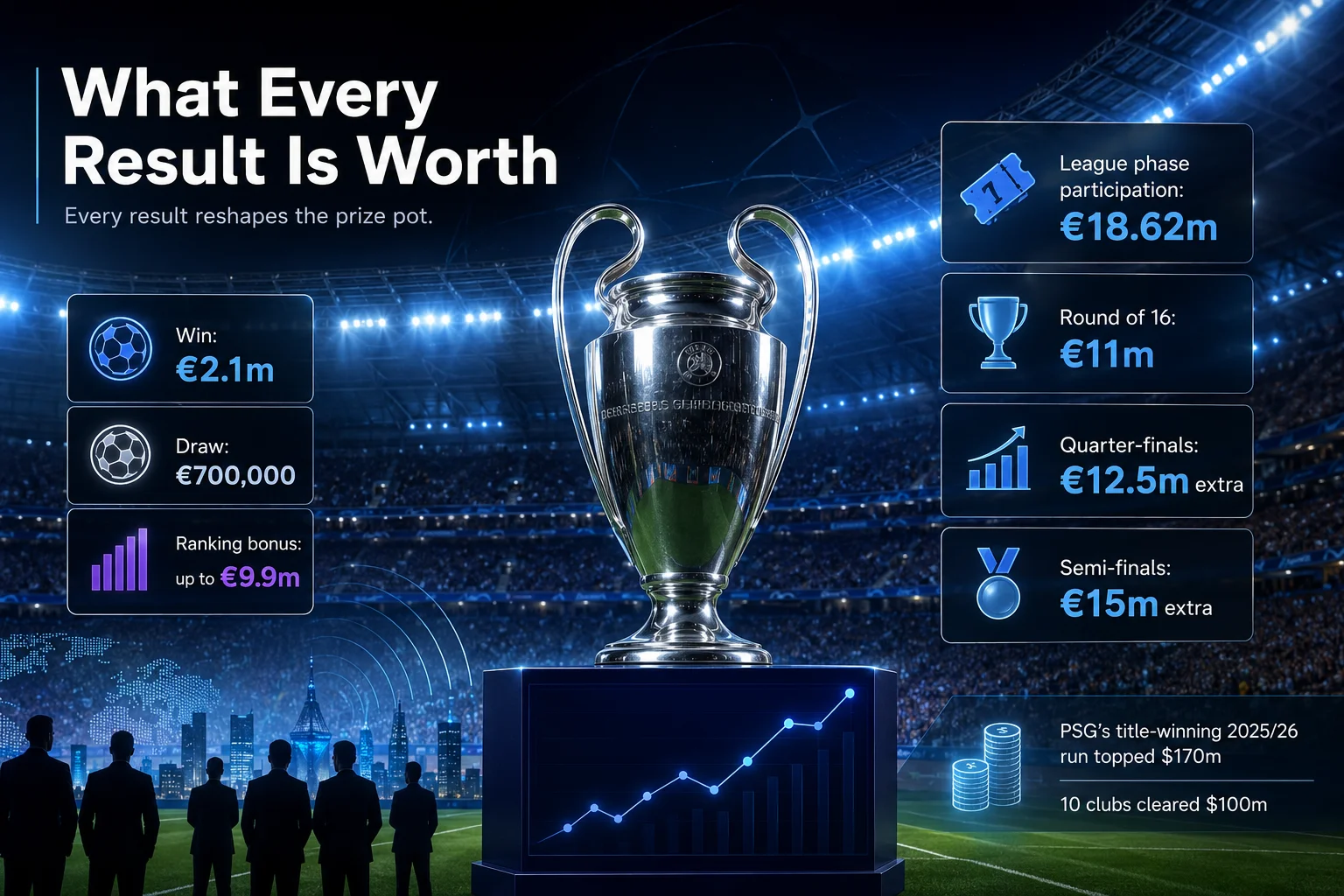
The financial structure explains why final matchday chaos matters so much to club accountants. Under UEFA's 2025/26 distribution, carried into similar figures for 2026/27, every league phase club banks a participation fee of €18.62 million (around £15.9 million) before kick-off, then earns per result and per round. All figures below are from UEFA's club distribution circular for 2025/26.
| Payment | Amount |
|---|---|
| League phase participation fee | €18.62m |
| Per league phase win | €2.1m |
| Per league phase draw | €700,000 |
| Ranking bonus, table topper | €9.9m, on a sliding scale to €275,000 for 36th |
| Reaching the round of 16 | €11m |
| Reaching the quarter-finals | €12.5m extra |
| Reaching the semi-finals | €15m extra |
A separate value pillar, weighted by broadcast market and long-term coefficient, sits on top and skews earnings towards clubs from the biggest television markets. The compounding effect is enormous: PSG's title-winning 2025/26 run generated more than $170 million in UEFA payments alone, while ten clubs cleared $100 million that season.
Key Dates for 2026/27
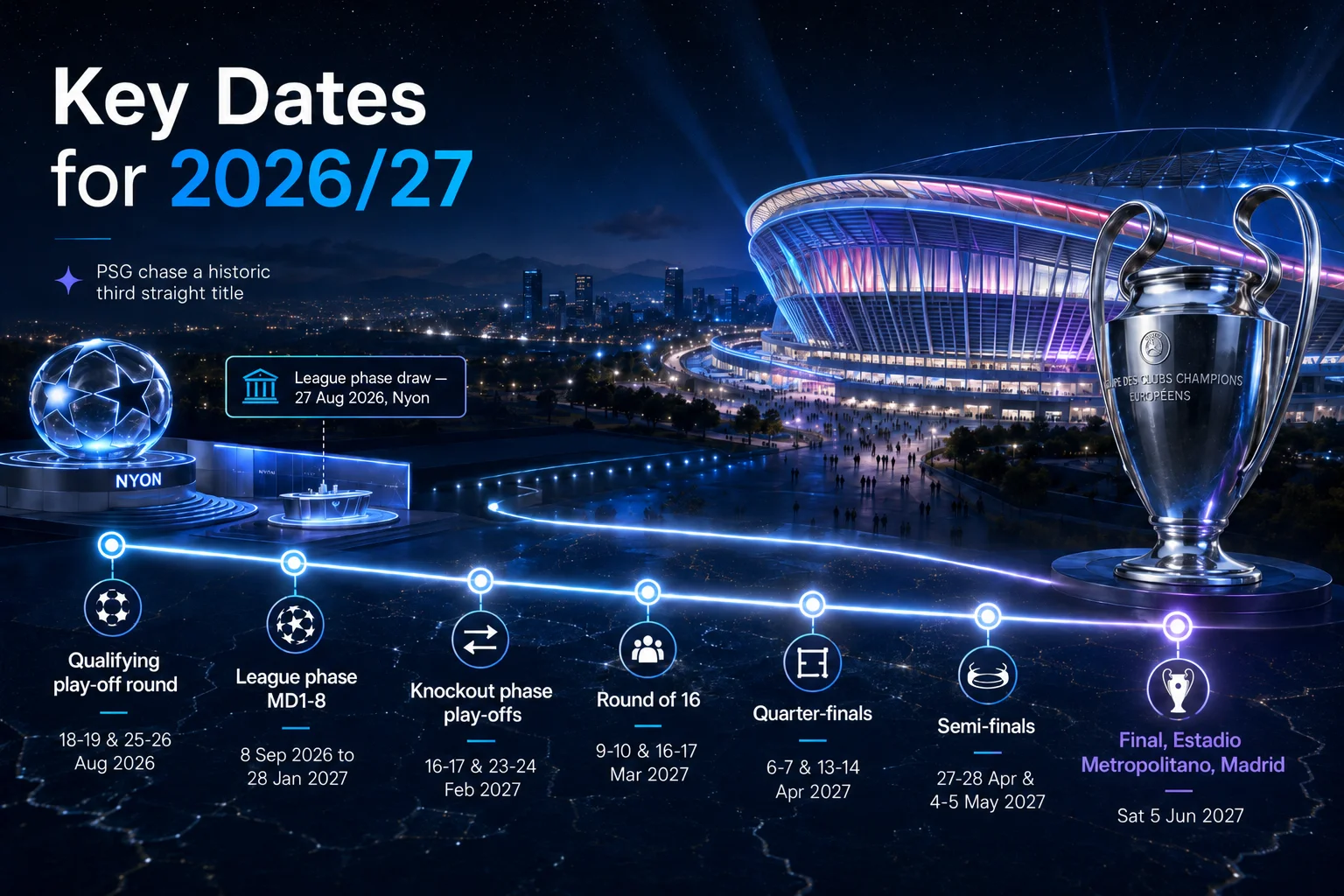
The league phase draw is on 27 August 2026 in Nyon and the season runs to the latest final date of the modern era, at a familiar venue: the Estadio Metropolitano, home of Atlético Madrid, staged the 2019 final and holds 70,692.
| Stage | Dates |
|---|---|
| Qualifying play-off round | 18-19 and 25-26 August 2026 |
| League phase, matchdays 1-8 | 8 September 2026 to 28 January 2027 |
| Knockout phase play-offs | 16-17 and 23-24 February 2027 |
| Round of 16 | 9-10 and 16-17 March 2027 |
| Quarter-finals | 6-7 and 13-14 April 2027 |
| Semi-finals | 27-28 April and 4-5 May 2027 |
| Final, Estadio Metropolitano, Madrid | Saturday 5 June 2027 |
PSG arrive as double defending champions after edging Arsenal in Budapest, where Kai Havertz's opener was cancelled out by an Ousmane Dembélé penalty before the shootout. Only Ajax, Bayern Munich and Real Madrid have ever won three in a row: that chase is the season's headline storyline before a ball is kicked.
FAQs
1. What is a UEFA coefficient?
-
It is UEFA's ranking system based on European results over the previous five seasons, used to set seeding pots for clubs and the number of places each country receives.
2. When is the 2026/27 league phase draw?
-
The draw is on Thursday 27 August 2026 at UEFA headquarters in Nyon, Switzerland.
3. How many matches does it take to win the trophy?
-
A top-eight league phase finisher plays 15 matches to the final, rising to 17 via the February play-off.
4. Who has scored the most Champions League goals?
-
Cristiano Ronaldo holds the record with 140 goals in the competition.
5. Can two clubs from the same country meet in the league phase?
-
No, the draw prevents same-nation pairings in the league phase, so domestic rivals can only meet from the knockout rounds onwards.
From matchday one in September to Madrid in June, 1BoxOffice has listed European football tickets since 2006 and backs every booking with a 150% money-back guarantee.
Sources: UEFA, BBC Sport, Sports Mole, Sports Illustrated.