In this guide
How We Ranked ThemMessi or Maradona: The Only Real ArgumentThe Countdown: 20 to 1The Hardest OmissionsFrequently Asked QuestionsOn Friday night in Miami, a 39-year-old flicked a long diagonal over an onrushing goalkeeper for his 20th World Cup goal, his eighth consecutive World Cup match with a goal and his 30th appearance at the tournament, all three of them records nobody else is close to. Ranking the greatest Argentine footballers of all time in July 2026 means ranking a list whose No. 1 is still adding to his case in real time.
It also means wrestling with a century of genius: two men with a serious claim to be the best player who ever lived, a golden 1940s generation that global lists routinely forget, and a production line that has never stopped. With the champions still alive in the World Cup 2026 knockout rounds, there has never been a better week to argue about it. We count down from 20 to the inevitable, and defensible, No. 1.
How We Ranked Them
This list puts the Argentina national team first. World Cups, Copas América and what a player meant in the blue and white stripes count for more than club silverware, which is why some all-time club greats sit lower than their talent alone would justify. Peak level, longevity and individual honours settle the rest.
One consequence is worth stating upfront: the 1940s generation of River Plate's La Máquina gets the respect Argentine historians always gave it. Argentina withdrew from the 1938, 1950 and 1954 World Cups, so José Manuel Moreno, Adolfo Pedernera and Ángel Labruna never had a global stage. Judging them by World Cup highlight reels they were never allowed to make would be lazy. We trust the contemporaneous Argentine judgement instead, anchored by the IFFHS Argentine Player of the Century poll.
One giant is deliberately absent. Alfredo Di Stéfano, five consecutive European Cups with Real Madrid and arguably a top-five player in the game's history, won just six caps for Argentina before switching allegiance to Spain, scoring 23 goals in 31 matches for La Roja. We cover him in full in our ranking of the greatest Spanish footballers, where his international career actually happened, rather than ranking the same man twice.
Messi or Maradona: The Only Real Argument
Every serious list starts here and most now end the same way. The case for Messi is career totality: eight Ballon d'Or awards when nobody else has more than five, more than 200 caps and over 120 goals for Argentina (both national records), the 2021 and 2024 Copas América, the 2022 Finalissima and the 2022 World Cup, where he scored in every knockout round. The 2026 tournament has only hardened it. His hat-trick against Algeria on 16 June, at 38 years and 357 days on his 200th cap, made him the oldest man to score a World Cup treble, and his brace against Austria six days later carried him past Miroslav Klose as the outright record World Cup goalscorer.
The case for Maradona is peak singular impact. His 1986 World Cup remains the most dominant individual tournament ever played: five goals, five assists, direct involvement in 10 of Argentina's 14 goals, fouled 53 times and both the Goal of the Century and the Hand of God in the same quarter-final against England. He then dragged unfashionable Napoli to their only two Serie A titles, a feat of individual carrying with no parallel in Messi's trophy-laden Barcelona years.
Our verdict, saved in full for the top of the countdown, treats it as a 51-49 call, not a rout. Messi's combination of a World Cup, sustained excellence across two decades and unmatched individual honours edges it, which reflects where the global consensus has settled since Qatar. Plenty of Argentines will never move Diego from top spot, and that position is entirely defensible.
The Countdown: 20 to 1
20. Emiliano Martínez
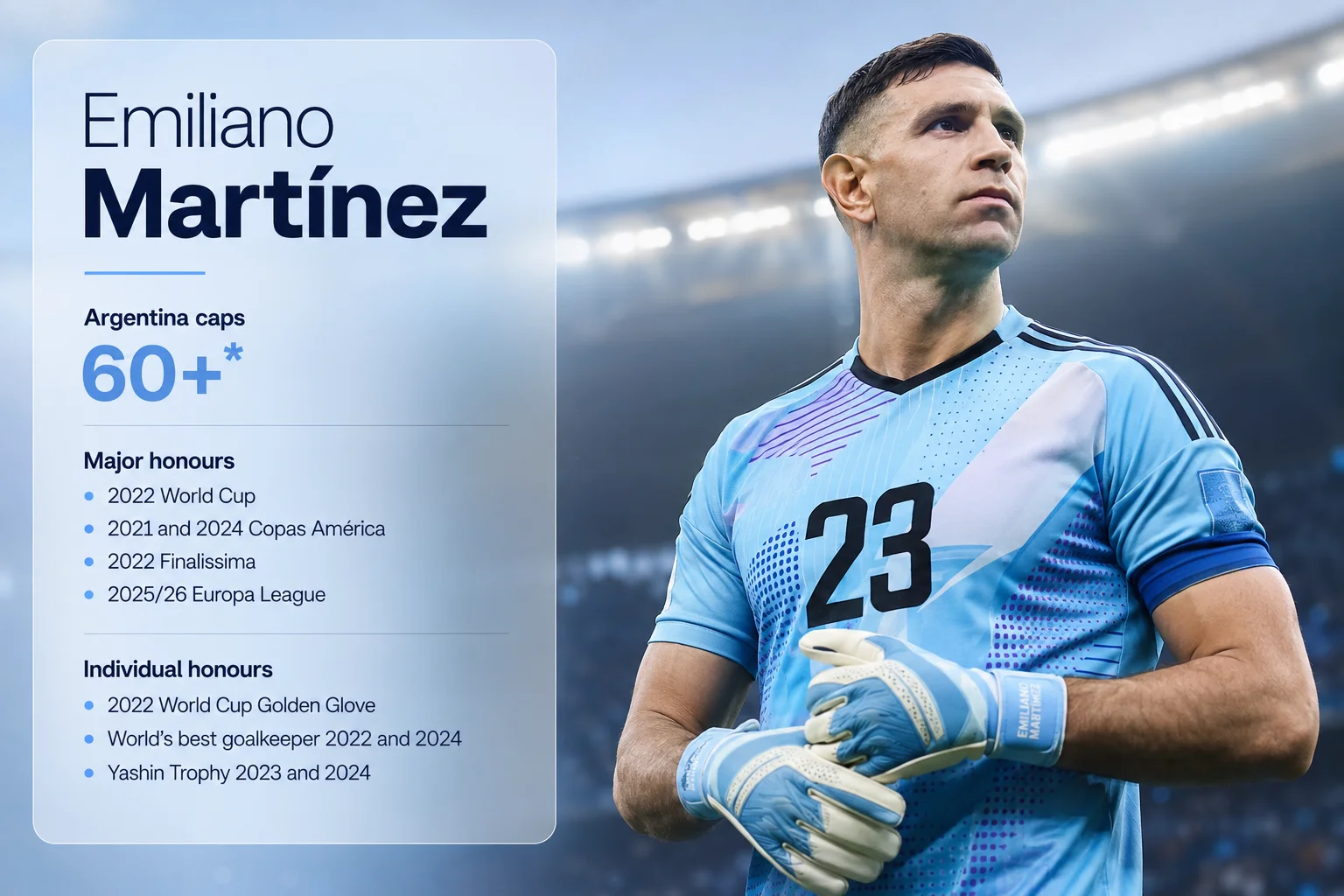
| Category | Record |
|---|---|
| Argentina caps | 60+* |
| Major honours | 2022 World Cup, 2021 and 2024 Copas América, 2022 Finalissima, 2025/26 Europa League |
| Individual honours | 2022 World Cup Golden Glove, world's best goalkeeper 2022 and 2024, Yashin Trophy 2023 and 2024 |
| Signature achievement | The extra-time save from Kolo Muani in the 2022 final |
*Active player; figures correct as of 6 July 2026 and rising while Argentina remain in the tournament.
The newest entrant, and Argentina's goalkeeper in the tournament happening right now. Dibu's 2022 World Cup was decisive in a way few goalkeepers have ever managed: the outrageous extra-time save from Randal Kolo Muani seconds from defeat in the final, shootout saves against the Netherlands and France, and the Golden Glove to certify it. He has since been named the world's best goalkeeper twice, in 2022 and 2024, and won consecutive Yashin Trophies, and no keeper alive is more feared in a shootout.
In May he added the 2025/26 Europa League with Aston Villa, beating Freiburg 3-0 in the final for the club's first European trophy since 1982, having kept a club-record 15 clean sheets in his first Premier League season after a £20 million move from Arsenal. FourFourTwo's 2026 all-time Argentine list already ranks him 19th; the only argument against him is career length next to the outfield giants, and every save he makes in this World Cup weakens it.
19. Guillermo Stábile
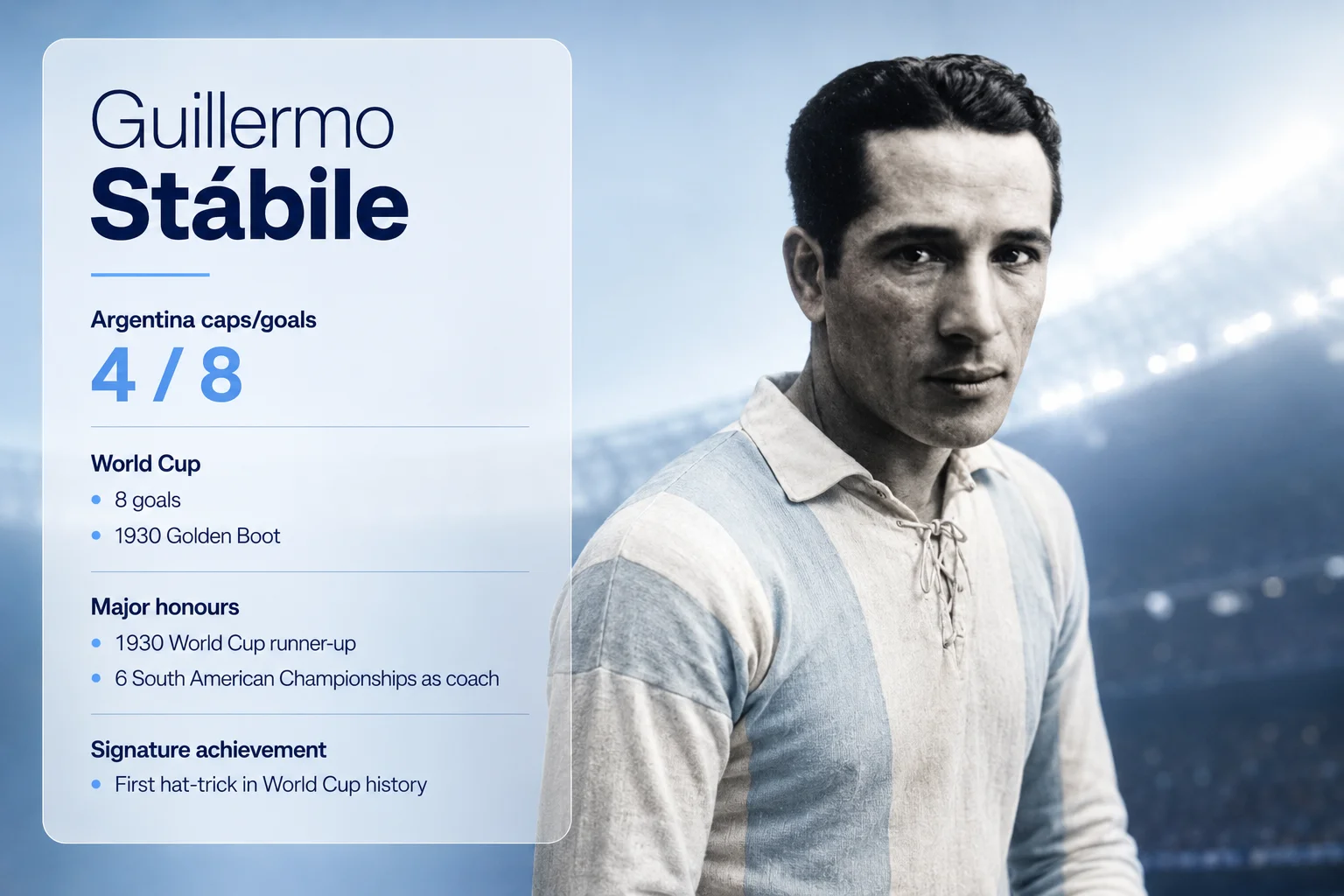
| Category | Record |
|---|---|
| Argentina caps / goals | 4 / 8 |
| World Cup goals | 8 (1930 Golden Boot) |
| Major honours as player | 1930 World Cup runner-up |
| Major honours as coach | 6 South American Championships (record) |
| Signature achievement | First hat-trick in World Cup history |
The founding father. Stábile played only four times for Argentina, every one of them at the inaugural 1930 World Cup in Uruguay, and scored eight goals: enough for the tournament's Golden Boot as a 25-year-old who only got his debut when captain Manuel Ferreira returned to Buenos Aires to sit a law exam. Against Mexico he scored the first hat-trick in World Cup history, and he found the net in every match he played on the way to the final, which Argentina lost 4-2 to the hosts in Montevideo.
He never wore the shirt again, moving straight to Italy with Genoa after the tournament, where he became one of the early foreign stars of the Italian game before finishing in France. Then came a second act almost as remarkable: as national coach he led Argentina to six South American Championships between 1941 and 1957, a record no manager has touched. Everything Messi is breaking in 2026 traces back, in a straight line, to what Stábile started 96 years ago.
18. Juan Sebastián Verón
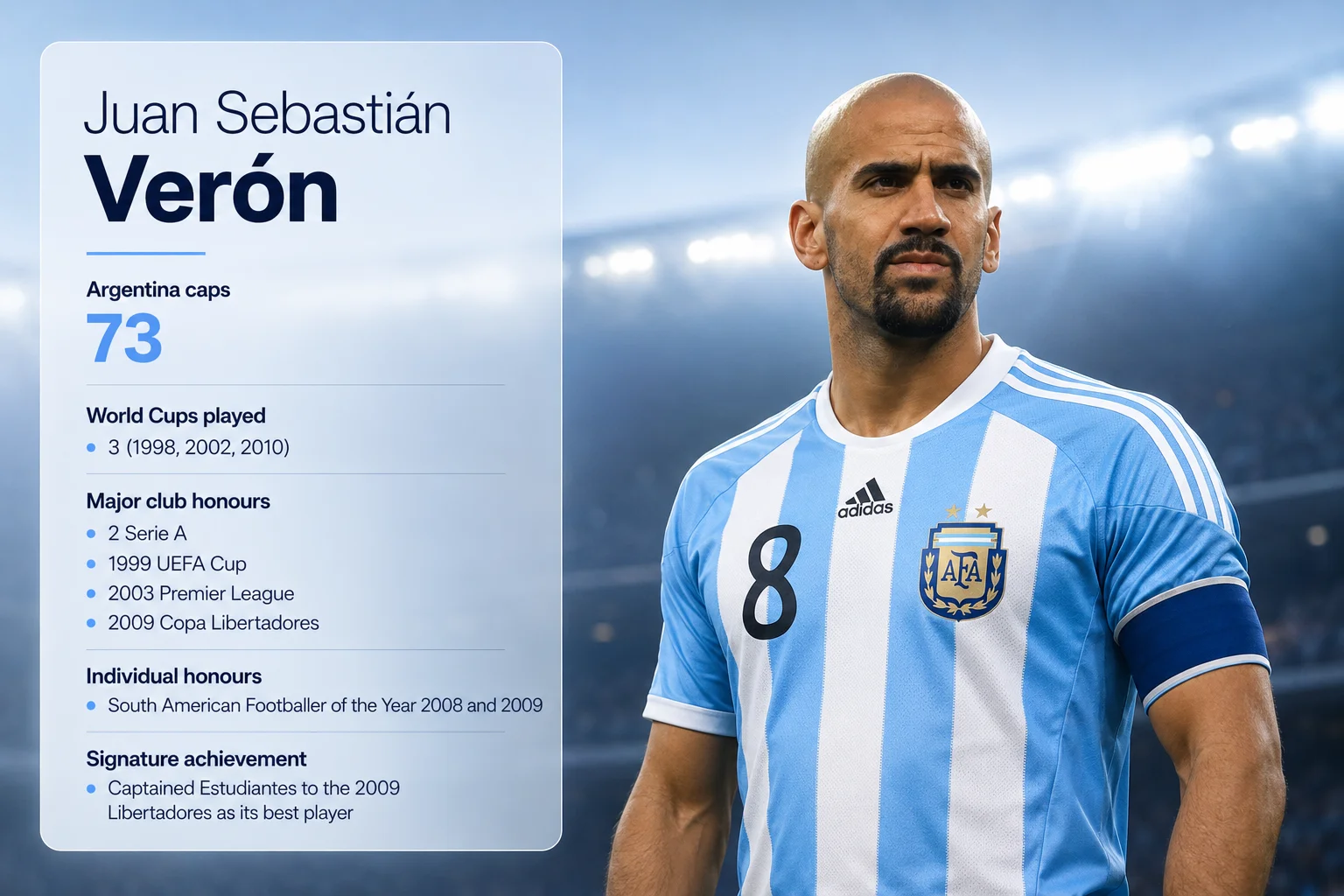
| Category | Record |
|---|---|
| Argentina caps | 73 |
| World Cups played | 3 (1998, 2002, 2010) |
| Major club honours | 2 Serie A, 1999 UEFA Cup, 2003 Premier League, 2009 Copa Libertadores |
| Individual honours | South American Footballer of the Year 2008 and 2009 |
| Signature achievement | Captained Estudiantes to the 2009 Libertadores as its best player |
La Brujita's European CV alone justifies his place: Serie A titles with Lazio in 2000 and later Inter, the 1999 UEFA Cup with Parma, then a British-record £28.1 million move to Manchester United, where he added the 2003 Premier League title. He played at three World Cups across 12 years and was, at his peak, the most complete deep playmaker in Europe, capable of 60-yard diagonals and late runs in the same move.
The chapter that defines him came in his mid-thirties. He returned to boyhood club Estudiantes on a fraction of his European wages and captained them to the 2009 Copa Libertadores, named the tournament's best player, and was voted South American Footballer of the Year in both 2008 and 2009. Few careers anywhere have ended with a better answer to the question of what a player owes the club that made him.
17. Hernán Crespo
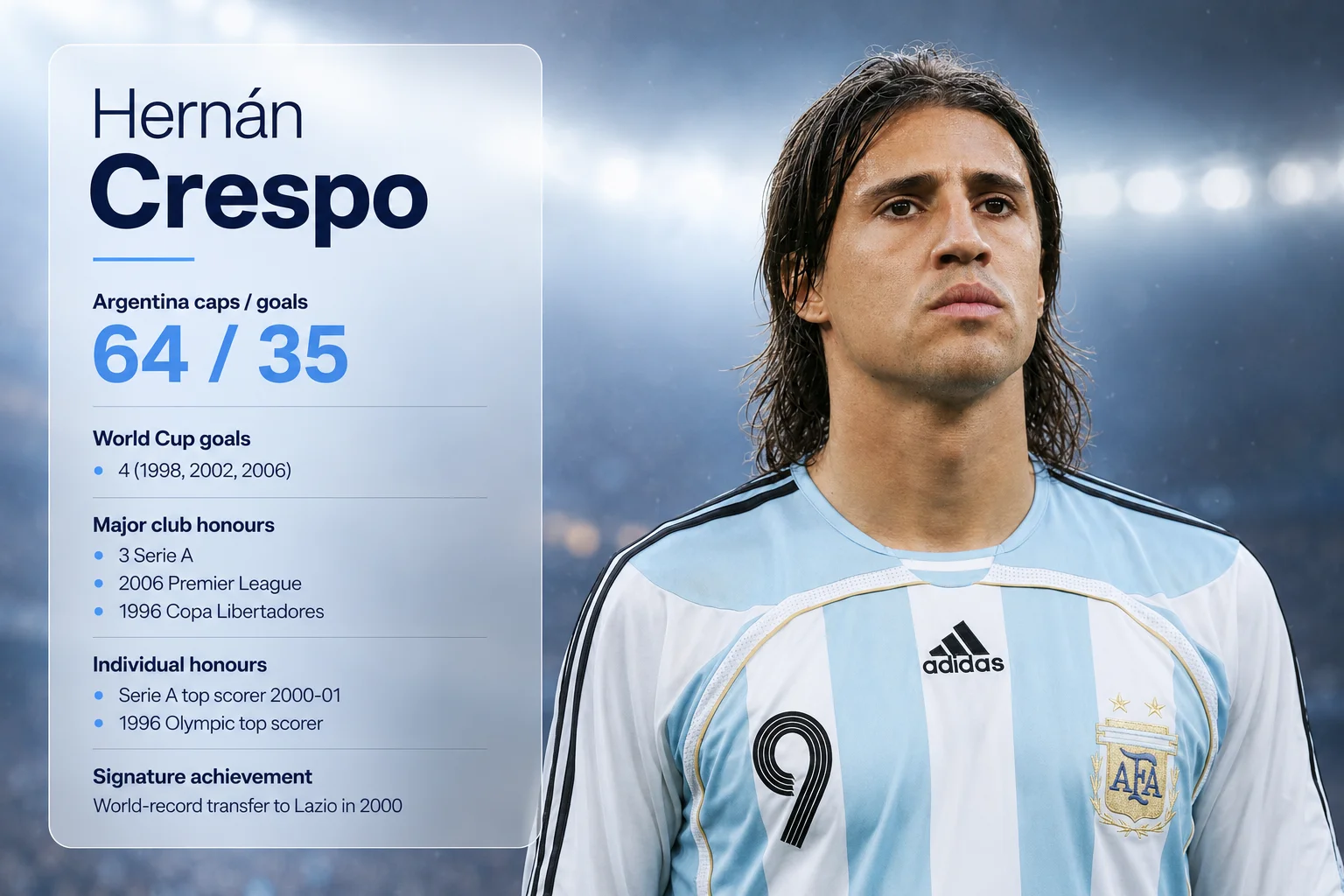
| Category | Record |
|---|---|
| Argentina caps / goals | 64 / 35 |
| World Cup goals | 4 (1998, 2002, 2006) |
| Major club honours | 3 Serie A, 2006 Premier League, 1996 Copa Libertadores |
| Individual honours | Serie A top scorer 2000-01, 1996 Olympic top scorer |
| Signature achievement | World-record transfer to Lazio in 2000 |
An aristocrat of the penalty area with 35 goals in 64 caps, still among Argentina's top five scorers, plus four World Cup goals spread across 1998, 2002 and 2006 and an Olympic silver in 1996 as the tournament's top scorer. He announced himself by winning the 1996 Copa Libertadores with River Plate, scoring twice in the final, before Parma turned him into one of Europe's most complete strikers.
In 2000 Lazio paid a world-record fee of around €56 million for him, and he repaid it with the Serie A top-scorer crown in 2000-01. Three Serie A titles with Inter followed, along with the 2006 Premier League at Chelsea and two Champions League final appearances, scoring twice in the 2005 final for AC Milan in Istanbul before Liverpool's comeback. His movement in the box was studied by a generation of Argentine No. 9s, Julián Álvarez included.
16. Fernando Redondo
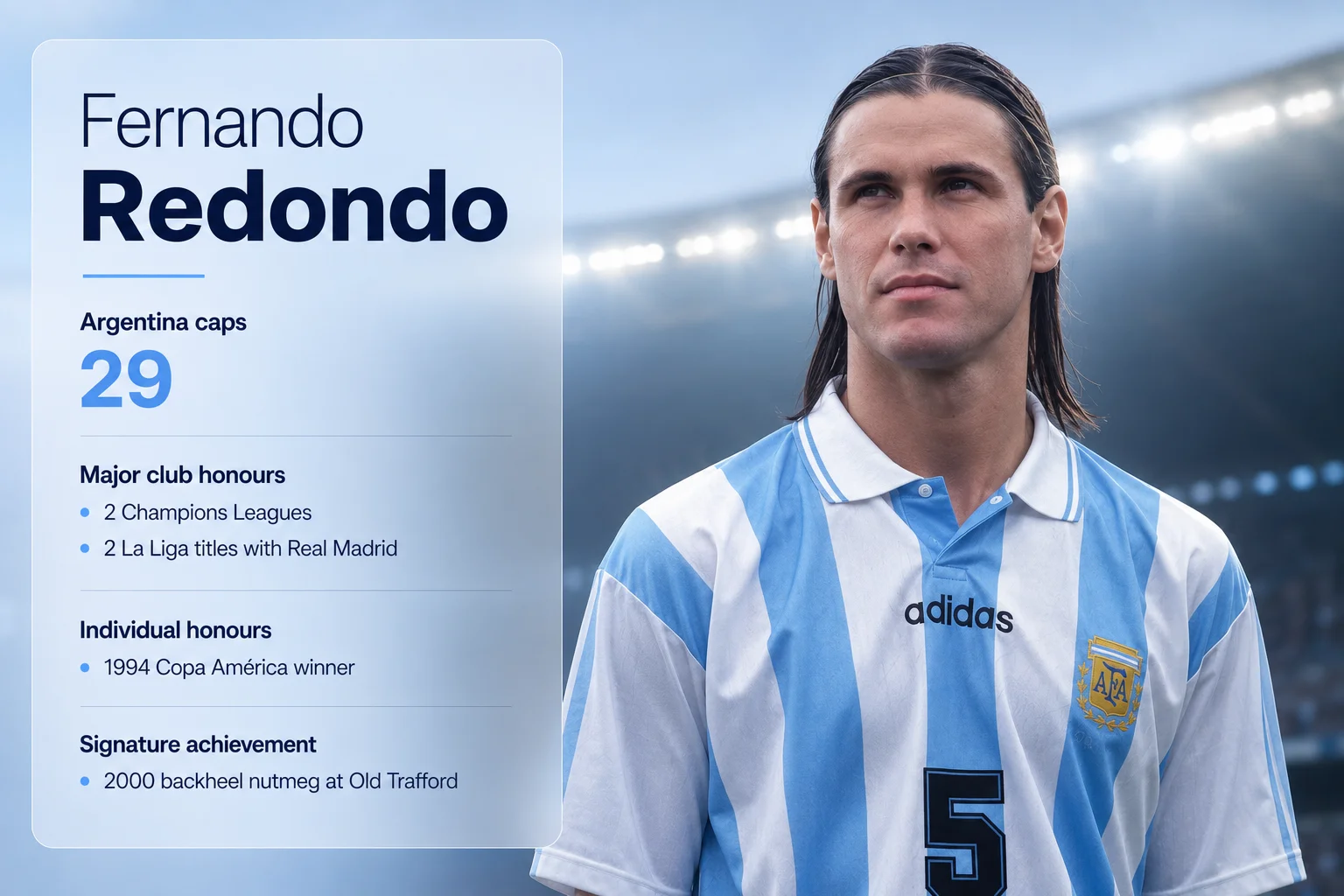
| Category | Record |
|---|---|
| Argentina caps | 29 |
| Major club honours | 2 Champions Leagues, 2 La Liga titles with Real Madrid |
| Individual honours | 1994 Copa América winner |
| Signature achievement | The 2000 backheel nutmeg at Old Trafford |
The most elegant defensive midfielder of his era and proof that principle carries a price. Redondo won just 29 caps because he refused to accept coach Daniel Passarella's squad rules before the 1998 World Cup, a stand that effectively ended his international career at 28. Talent alone would place him five spots higher; this is a national-team-first list and the gap in the record is real.
What remains is a club career of rare beauty. Two Champions Leagues with Real Madrid, in 1998 and 2000, the second featuring his backheel nutmeg on Henning Berg at Old Trafford that remains one of the competition's untouchable moments. He controlled the biggest matches at his own tempo, a No. 5 with the touch of a No. 10, before finishing at AC Milan, where a career-ending knee injury led him to voluntarily suspend his own wages for the two years he could not play. They do not make many like him.
15. Carlos Tevez
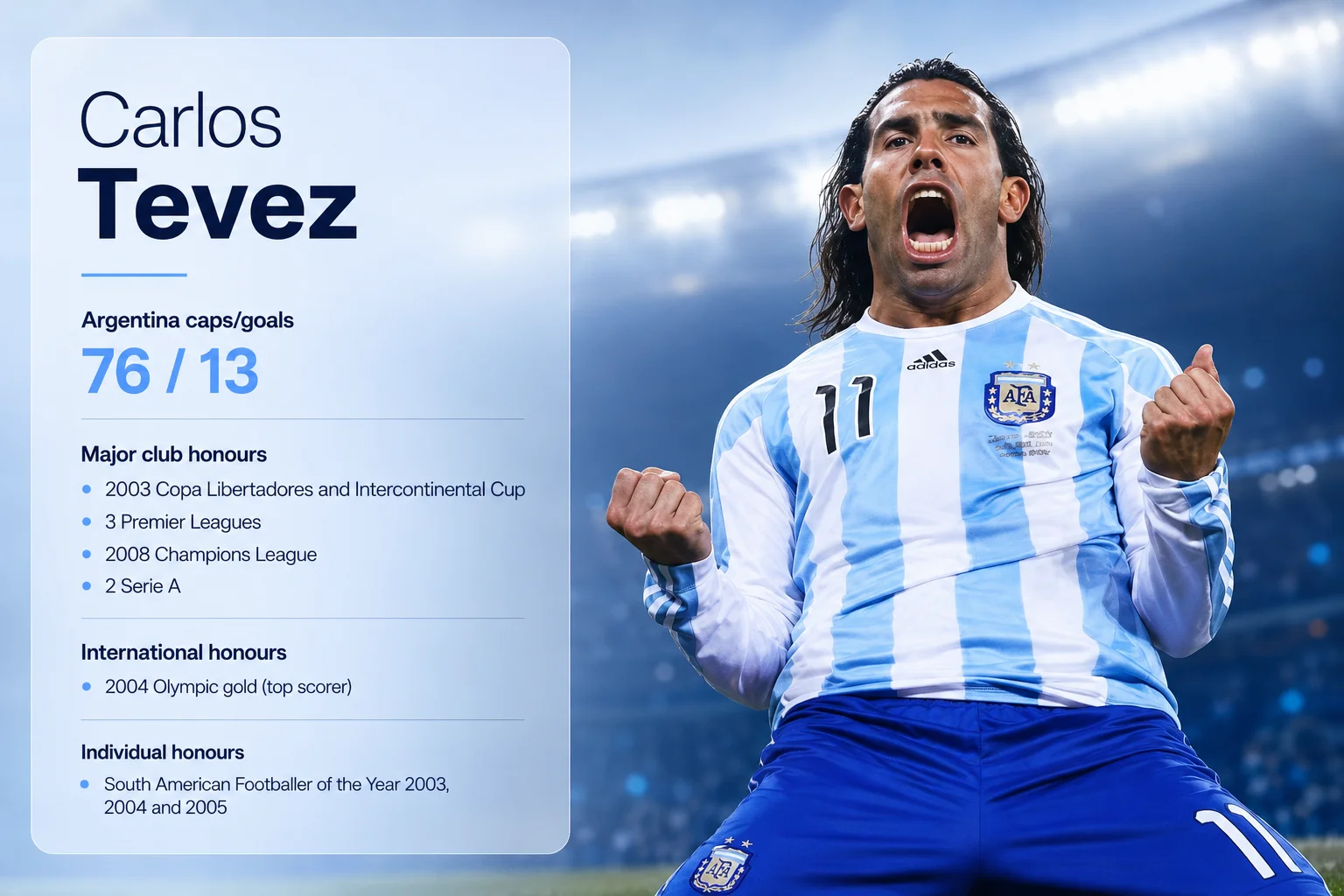
| Category | Record |
|---|---|
| Argentina caps / goals | 76 / 13 |
| Major club honours | 2003 Copa Libertadores and Intercontinental Cup, 3 Premier Leagues, 2008 Champions League, 2 Serie A |
| International honours | 2004 Olympic gold (top scorer) |
| Individual honours | South American Footballer of the Year 2003, 2004 and 2005 |
El Apache won everywhere he went, in four countries, usually as the emotional centre of the team. At Boca he delivered the 2003 Copa Libertadores and the Intercontinental Cup, tormenting Real Madrid in the final, and was named South American Footballer of the Year three seasons running from 2003 to 2005, a feat previously achieved only by legends of earlier eras. Olympic gold followed in 2004 as the tournament's top scorer with eight goals.
In Europe he won two Premier League titles and the 2008 Champions League with Manchester United, then crossed Manchester to captain City to the 2011 FA Cup, their first trophy in 35 years, and add the 2012 title. Two Serie A crowns with Juventus completed the set before a farewell at Boca. For Argentina he won 76 caps; the silverware never came at senior level, which is the only thing keeping him this low.
14. Javier Zanetti
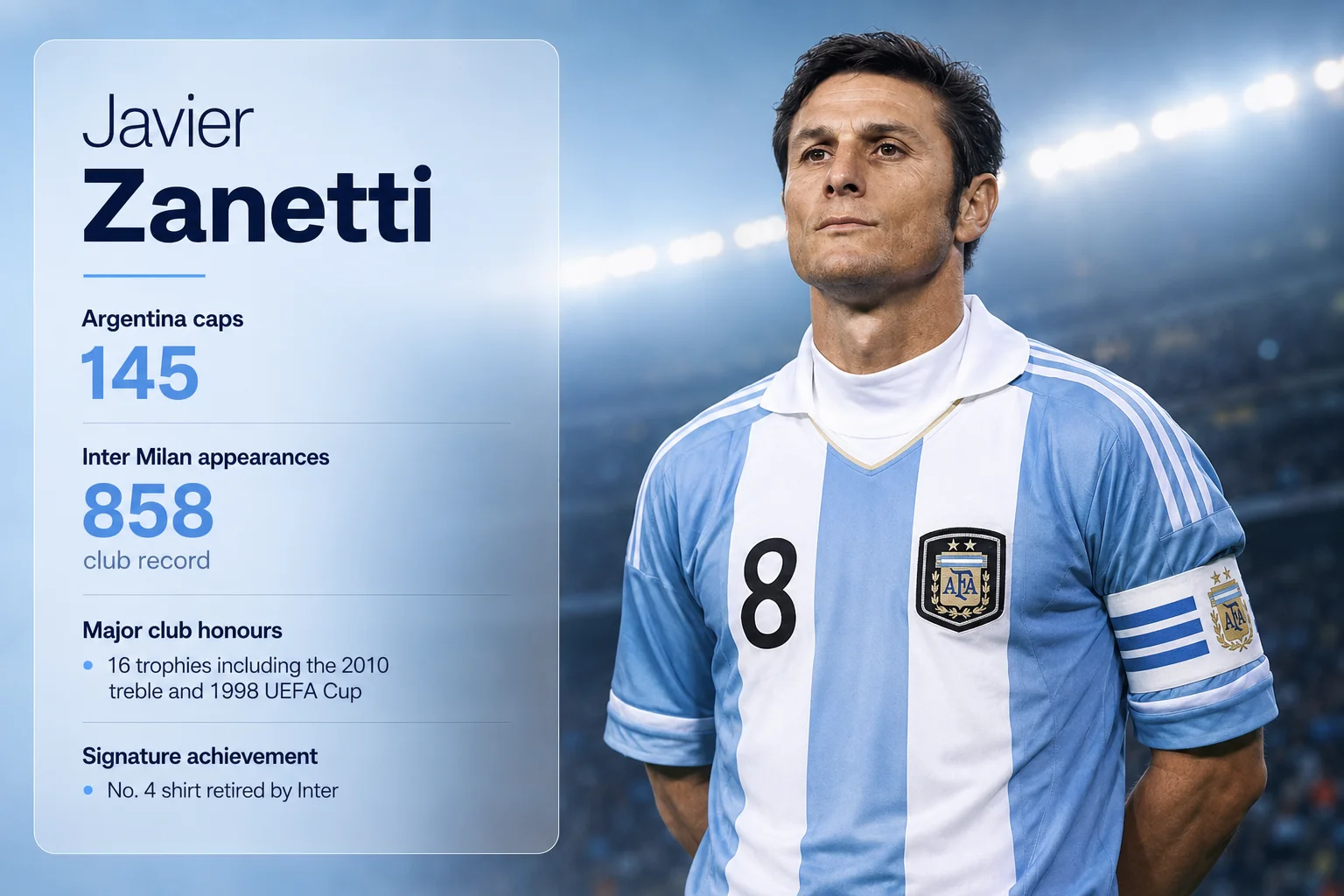
| Category | Record |
|---|---|
| Argentina caps | 145 |
| Inter Milan appearances | 858 (club record) |
| Major club honours | 16 trophies including the 2010 treble and 1998 UEFA Cup |
| Signature achievement | No. 4 shirt retired by Inter |
Il Capitano. Zanetti made a club-record 858 appearances for Inter Milan across 19 seasons, won 16 trophies and captained the 2010 side that became the first and only Italian club to win the treble of Serie A, Coppa Italia and Champions League in one season. He scored a famous goal in the 1998 UEFA Cup final win over Lazio, and when he retired the club withdrew the No. 4 shirt permanently.
His 145 caps stood as Argentina's record for years, and his fitness was so freakish that he was still playing top-level football at 40, returning from a ruptured Achilles in his final season. The caveat is unavoidable in this framework: no senior trophy with Argentina and controversial omissions from the 2006 and 2010 World Cup squads, decisions that still divide Argentine opinion. Pure professionalism and longevity carry him this high regardless, and no Argentine has been more universally respected by opponents.
13. Sergio Agüero
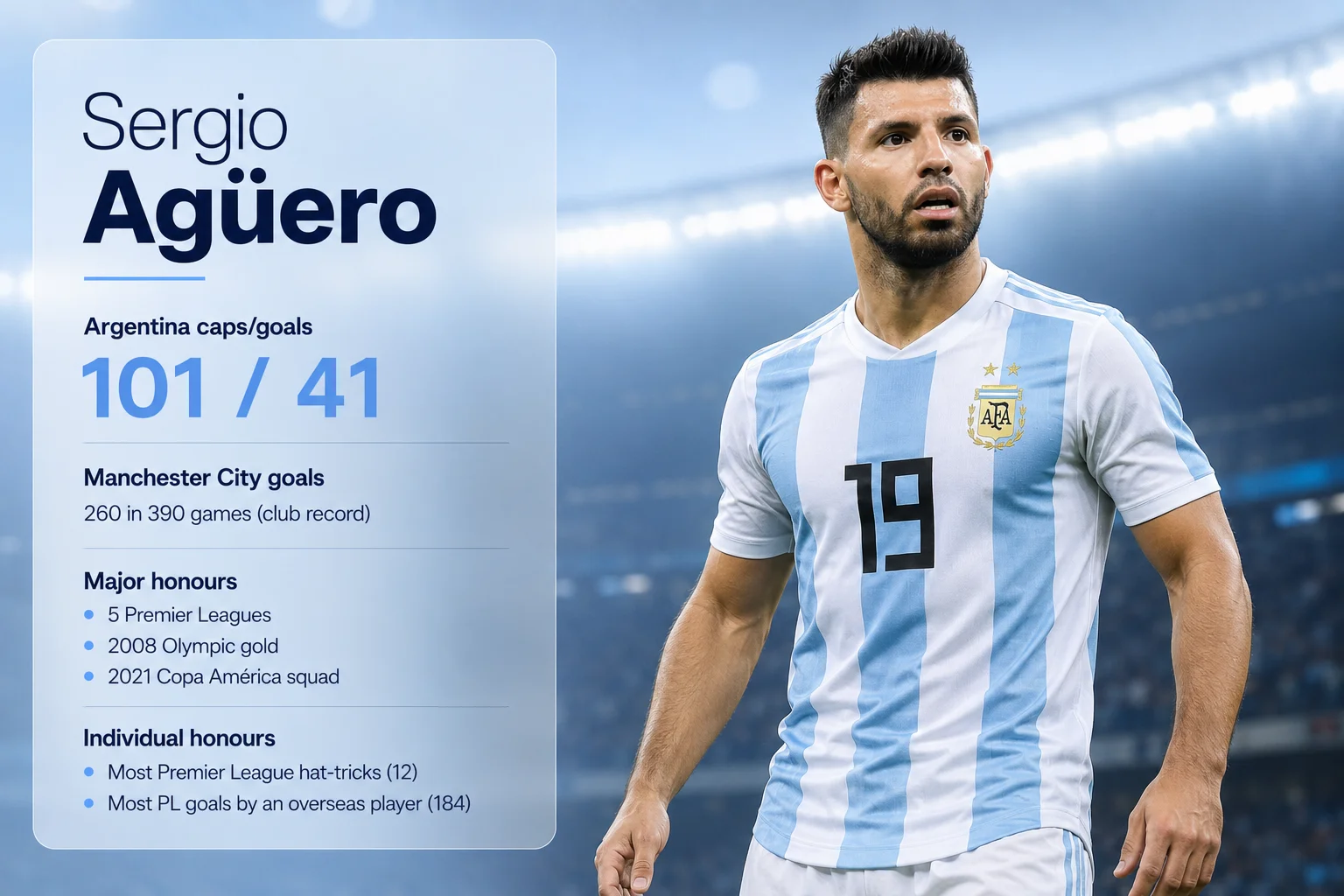
| Category | Record |
|---|---|
| Argentina caps / goals | 101 / 41 |
| Manchester City goals | 260 in 390 games (club record) |
| Major honours | 5 Premier Leagues, 2008 Olympic gold, 2021 Copa América squad |
| Individual honours | Most Premier League hat-tricks (12), most PL goals by an overseas player (184) |
The author of the most famous single moment in Premier League history. Agüero's 94th-minute winner against QPR in May 2012 sealed Manchester City's first title in 44 years, and the "Agüerooooo" commentary has been replayed more than any goal the league has produced. He retired as City's all-time top scorer with 260 goals in 390 games, won five Premier League titles and holds the competition records for most hat-tricks (12) and most goals by an overseas player (184).
For Argentina he won 101 caps and scored 41 goals, took Olympic gold in 2008 alongside Messi and Di María and was part of the drought-breaking 2021 Copa América squad. A heart condition discovered at Barcelona forced his retirement at 33, months before the World Cup he had spent a career building towards. Few strikers have combined his burst, low centre of gravity and finishing economy.
12. Ángel Labruna
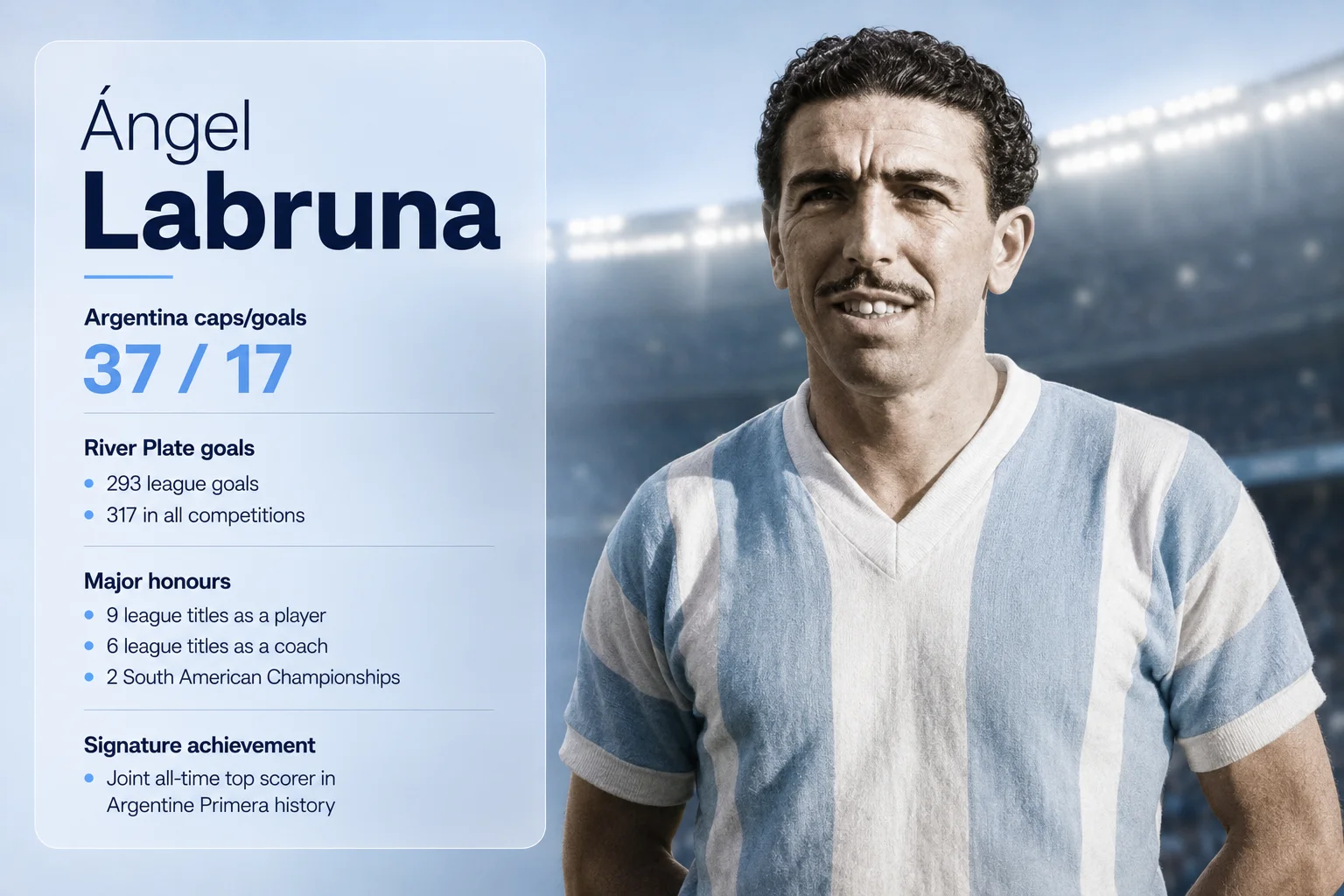
| Category | Record |
|---|---|
| Argentina caps / goals | 37 / 17 |
| River Plate league goals | 293 (up to 317 in all competitions) |
| Major honours | 9 league titles as player, 6 as coach, 2 South American Championships |
| Signature achievement | Joint all-time top scorer in Argentine Primera history |
River Plate made flesh. Labruna scored 293 league goals for River, up to 317 across all competitions depending on the count, and remains joint all-time top scorer in the history of the Argentine Primera alongside Paraguayan great Arsenio Erico. He won nine league titles as a player across three decades, formed the left side of the fabled La Máquina forward line, then returned as coach to win six more titles, including the 1975 championship that ended an 18-year drought.
For Argentina he won the South American Championship in 1946 and 1955 and played at the 1958 World Cup a month short of his 40th birthday. There is a 6.7-metre bronze statue of him outside the Monumental and a bridge beside the stadium carrying his name. Few players anywhere, in any era, have ever meant more to one club.
11. Ubaldo Fillol
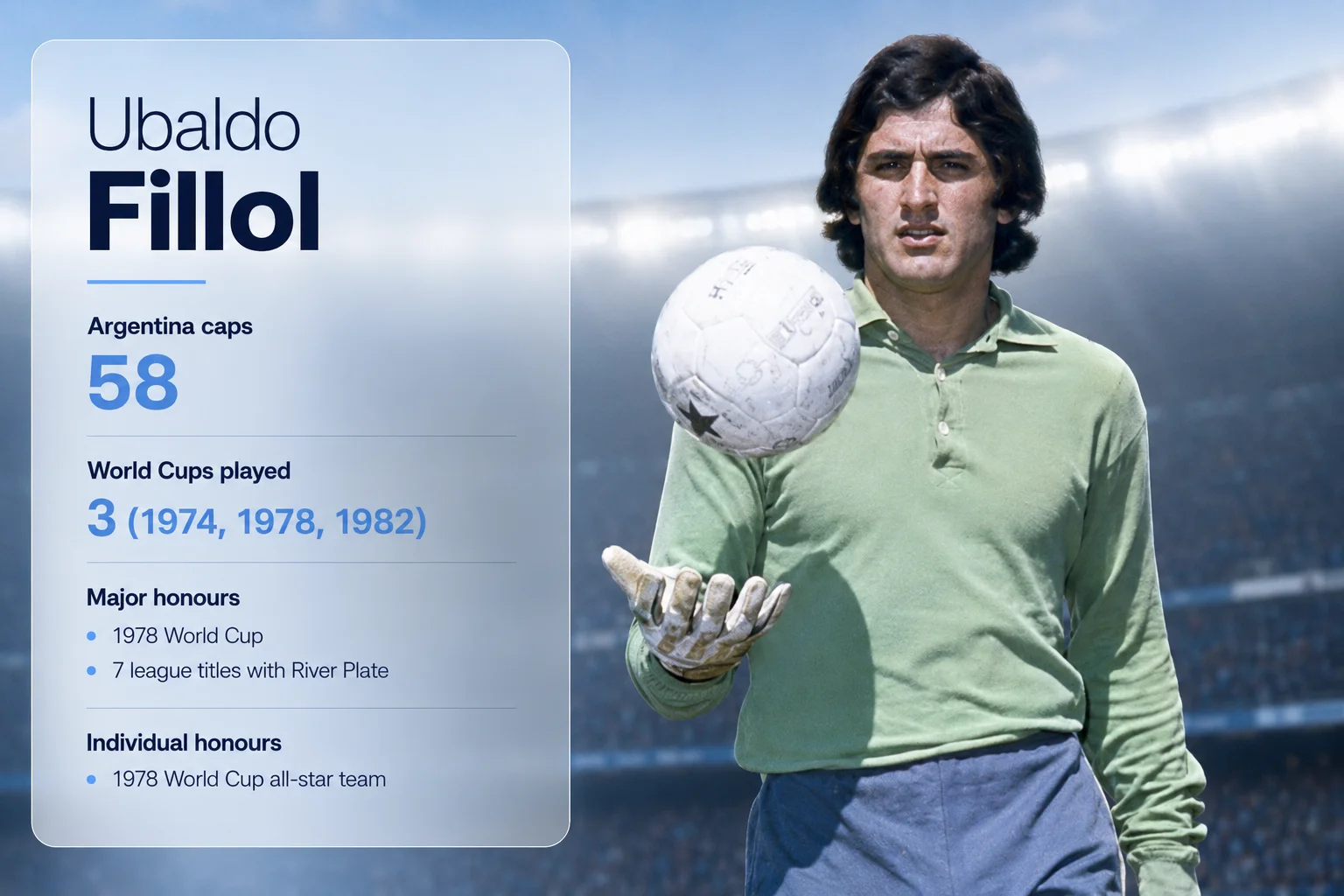
| Category | Record |
|---|---|
| Argentina caps | 58 |
| World Cups played | 3 (1974, 1978, 1982) |
| Major honours | 1978 World Cup, 7 league titles with River Plate |
| Individual honours | 1978 World Cup all-star team |
El Pato, for many the finest goalkeeper Argentina has produced, though the IFFHS century poll gave the nod to River predecessor Amadeo Carrizo. What is beyond argument is 1978: Fillol was first choice throughout the World Cup win on home soil, named in the tournament's all-star team, and his saves in the group meeting with Italy and the final against the Netherlands were as decisive as anything Kempes did at the other end. He appeared at three World Cups across 1974, 1978 and 1982 and won 58 caps.
His penalty-saving record was extraordinary for the era; Argentine crowds chanted his name after saves the way they usually reserve for goals. He won seven league titles with River Plate and later played for Flamengo and Atlético Madrid. In an age when goalkeepers were an afterthought in South American football culture, Fillol made the position box office.
10. Adolfo Pedernera
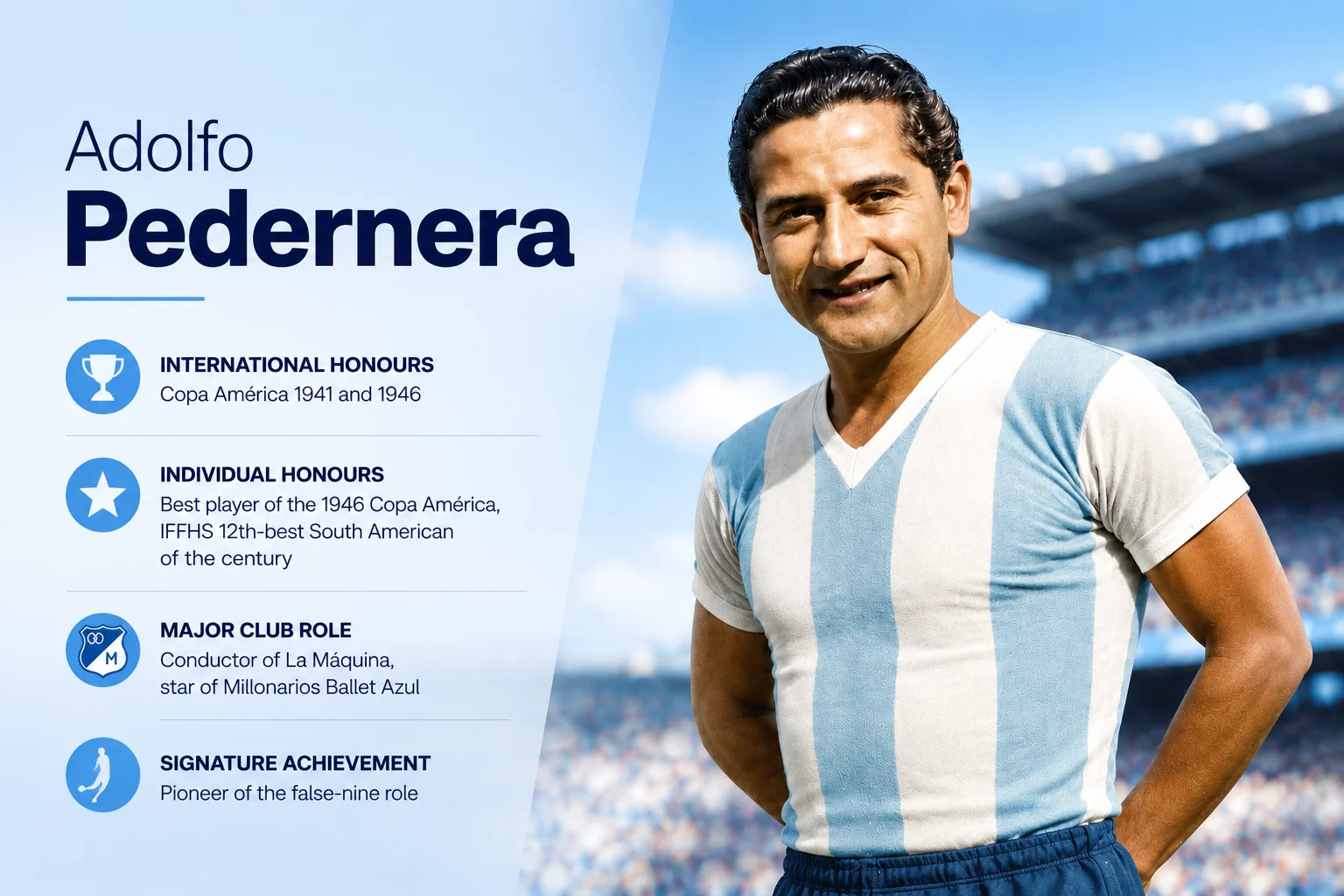
| Category | Record |
|---|---|
| International honours | Copa América 1941 and 1946 |
| Individual honours | Best player of the 1946 Copa América, IFFHS 12th-best South American of the century |
| Major club role | Conductor of La Máquina, star of Millonarios Ballet Azul |
| Signature achievement | Pioneer of the false-nine role |
El Maestro, the conductor of La Máquina and one of the earliest and most influential false nines in the game's history, dropping deep to dictate play decades before the role had a name. Tactical historians place him alongside Nándor Hidegkuti as a foundational influence on how the centre-forward position evolved. He won the Copa América with Argentina in 1941 and 1946, named the tournament's best player in the latter, and the IFFHS ranked him the 12th-best South American player of the century.
His second act changed a whole league. In 1949 he became the star signing of Colombia's breakaway El Dorado era, and the Millonarios "Ballet Azul" side he led, later joined by a young Di Stéfano, is still cited as one of the most storied club teams South America has produced. FourFourTwo included him in their 100 greatest footballers of all time in 2017, one of very few pre-television players to make such lists.
9. Ángel Di María
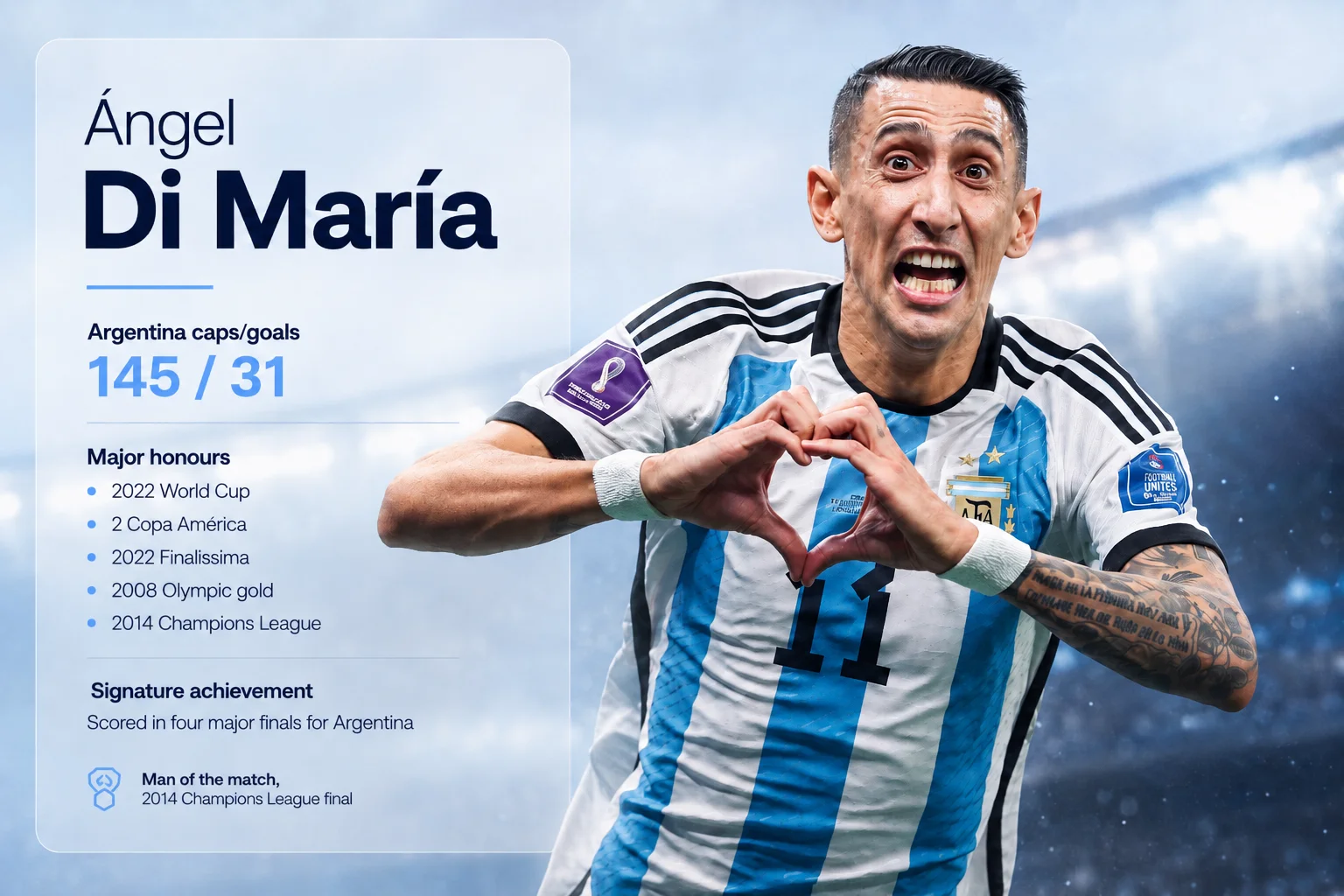
| Category | Record |
|---|---|
| Argentina caps / goals | 145 / 31 |
| Major honours | 2022 World Cup, 2 Copas América, 2022 Finalissima, 2008 Olympic gold, 2014 Champions League |
| Individual honours | Man of the match, 2014 Champions League final |
| Signature achievement | Scored in four major finals for Argentina |
The ultimate big-final specialist. Di María scored in the finals of the 2021 Copa América against Brazil at the Maracaná, the 2022 Finalissima at Wembley and the 2022 World Cup against France, and struck the winner in the 2008 Olympic final in Beijing. No Argentine, not even Messi, has a comparable record of scoring in deciding matches, and he retired from international football as a champion after the 2024 Copa América with 145 caps and 31 goals.
At club level he was man of the match in the 2014 Champions League final for Real Madrid, then took in PSG, Manchester United, Juventus and two spells at Benfica before a farewell return to boyhood club Rosario Central. For a decade his running power on the left balanced everything Argentina did on the right. The 2022 final performance, winning the penalty and scoring the second, was the finest of his life on the biggest night of it.
8. Omar Sívori
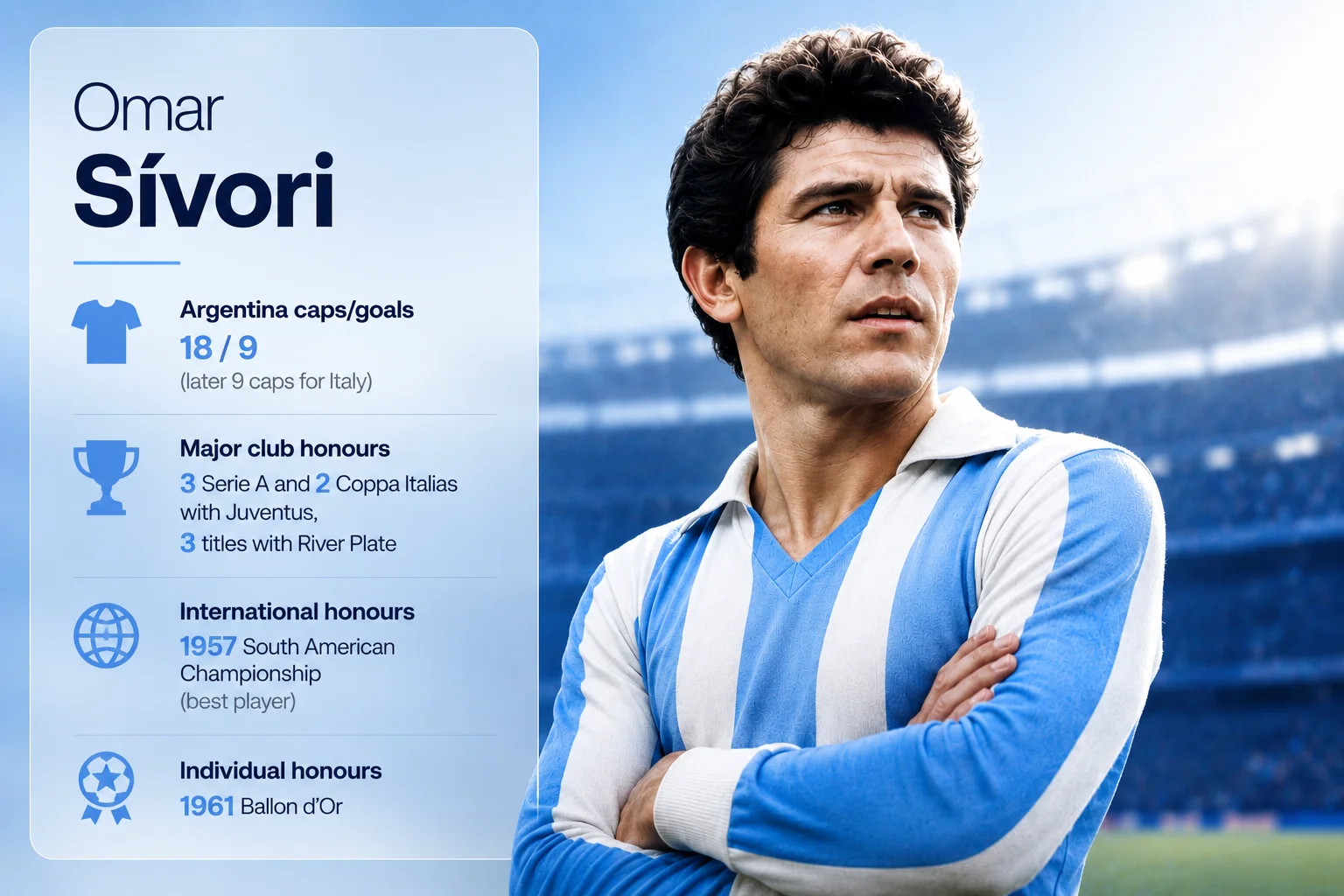
| Category | Record |
|---|---|
| Argentina caps / goals | 18 / 9 (later 9 caps for Italy) |
| Major club honours | 3 Serie A and 2 Coppa Italias with Juventus, 3 titles with River Plate |
| International honours | 1957 South American Championship (best player) |
| Individual honours | 1961 Ballon d'Or |
One of only three Argentine men ever to win the Ballon d'Or, in 1961, and the last before Messi began his run 48 years later. Sívori won the 1957 South American Championship as its best player in a legendary front line with Humberto Maschio and Antonio Angelillo, nicknamed the Angels with Dirty Faces, then moved to Juventus for what was at the time a world-record fee.
In Turin he formed the Magical Trio alongside John Charles and Giampiero Boniperti, winning three Serie A titles and two Coppa Italias, tormenting defenders with his socks rolled down and a repertoire of nutmegs he treated as a personal duel. He later switched allegiance, playing nine times for Italy including the 1962 World Cup, which is precisely what caps his placement in an Argentina-first ranking. On pure impudent talent, contemporaries put him in the same sentence as anyone.
7. Juan Román Riquelme
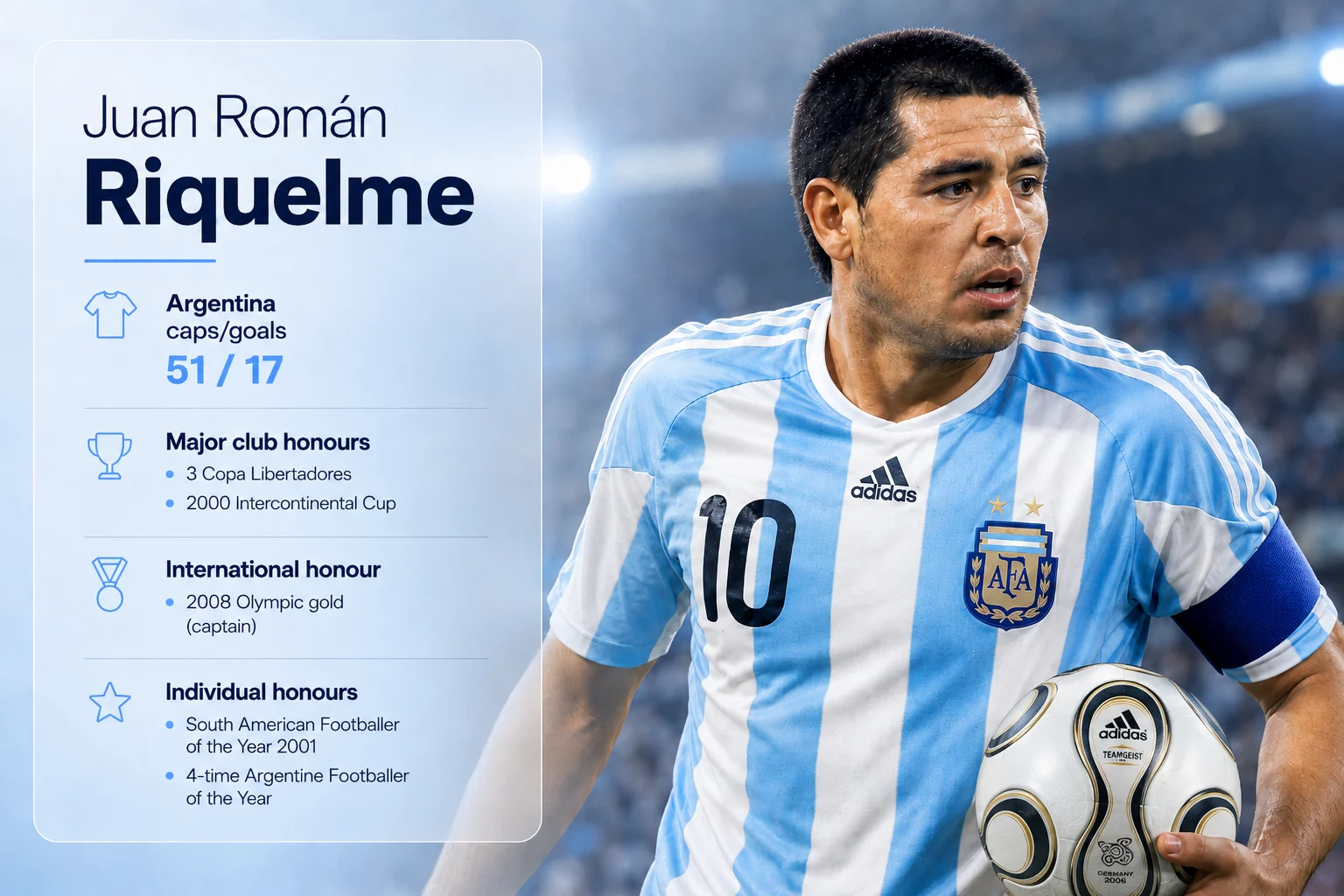
| Category | Record |
|---|---|
| Argentina caps / goals | 51 / 17 |
| Major club honours | 3 Copa Libertadores, 2000 Intercontinental Cup |
| International honours | 2008 Olympic gold (captain) |
| Individual honours | South American Footballer of the Year 2001, 4-time Argentine Footballer of the Year |
El Último 10, the greatest of Argentina's post-Maradona pure playmakers and now Boca Juniors president. His legend was built in the No. 10 shirt at La Bombonera: three Copa Libertadores titles in 2000, 2001 and 2007, the last as top scorer and best player, and the 2000 Intercontinental Cup, where Boca beat the Galácticos of Real Madrid with Riquelme conducting everything at walking pace.
At Villarreal he dragged a provincial club to within one kick of the 2006 Champions League final, his semi-final penalty saved by Jens Lehmann in a moment that still defines the fine margins of his career. He captained Argentina to Olympic gold in 2008 and reached the 2007 Copa América final, was South American Footballer of the Year in 2001 and a four-time Argentine Footballer of the Year. The thin senior international silverware is acknowledged honestly; the genius is not negotiable.
6. Gabriel Batistuta
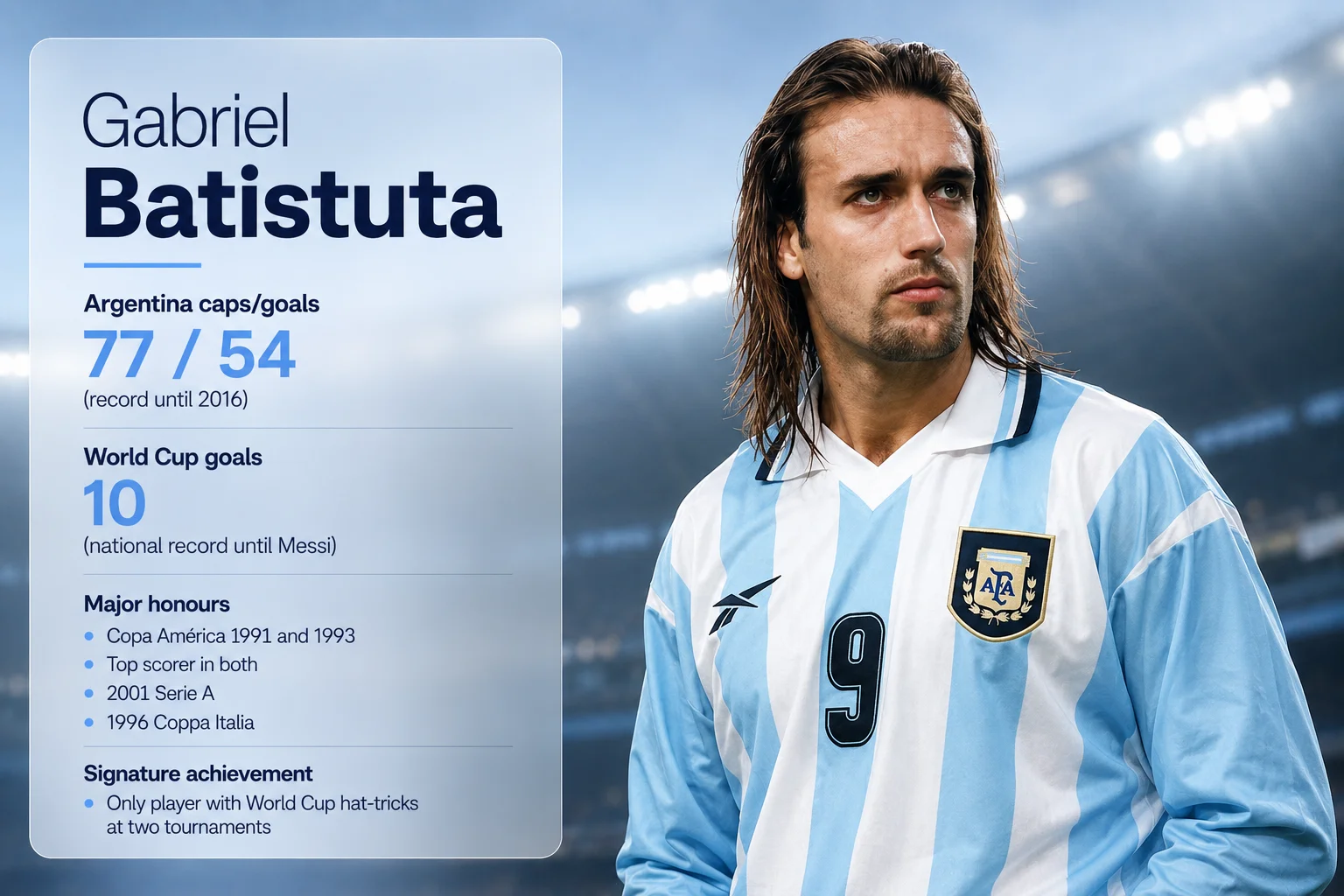
| Category | Record |
|---|---|
| Argentina caps / goals | 77 / 54 (record until 2016) |
| World Cup goals | 10 (national record until Messi) |
| Major honours | Copa América 1991 and 1993 (top scorer in both), 2001 Serie A, 1996 Coppa Italia |
| Signature achievement | Only player with World Cup hat-tricks at two tournaments |
Batigol was Argentina's all-time top scorer, with 54 goals in most counts, until Messi passed him in 2016, and his 10 World Cup goals stood as the national record until the same man took that too. He won the Copa América in 1991 and 1993, finishing top scorer in both, and he is still the only player in history to score World Cup hat-tricks at two different tournaments, against Greece in 1994 and Jamaica in 1998.
Florence worshipped him. When Fiorentina were relegated in 1993 he stayed and fired them straight back up, a loyalty the club answered with a bronze statue in 1996, and he added the Coppa Italia that same year. The move to Roma in 2000 was made explicitly to win the Serie A title that Florence could not give him, and he delivered it in 2001, scoring against Fiorentina and refusing to celebrate. The most complete No. 9 Argentina has produced, and it is not especially close.
5. José Manuel Moreno
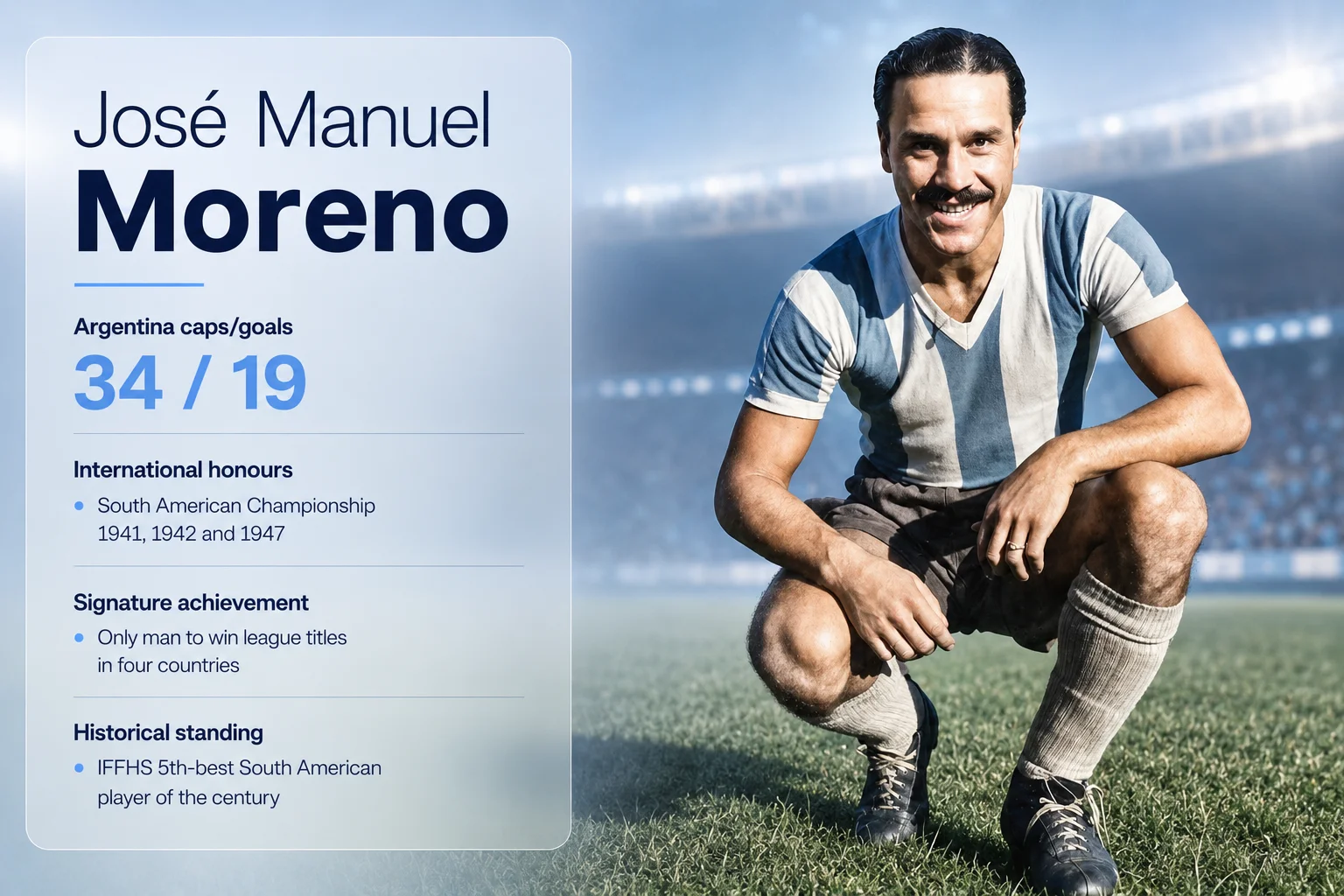
| Category | Record |
|---|---|
| Argentina caps / goals | 34 / 19 |
| International honours | South American Championship 1941, 1942 and 1947 |
| Signature achievement | Only man to win league titles in four countries |
| Historical standing | IFFHS 5th-best South American player of the century |
The great forgotten genius, and the boldest call on this list. Moreno was the creative heart of River Plate's La Máquina, the 1940s forward line of Muñoz, Moreno, Pedernera, Labruna and Loustau that is still cited as the most beautiful attacking unit South America ever produced. He won the South American Championship with Argentina in 1941, 1942 and 1947 and remains the only man to win league titles in four countries: Argentina, Mexico, Chile and Colombia.
The IFFHS ranked him the fifth-best South American player of the century, and Argentine critics who saw both consistently rated Moreno the greatest they had witnessed until Maradona arrived. A bohemian who famously insisted tango was the finest training a footballer could do, he played top-flight football into his forties. World War II and Argentina's withdrawals from the 1938, 1950 and 1954 World Cups denied his generation any global stage; judging him by the highlight reels he was never allowed to make would be lazy. This placement trusts the people who actually watched him.
4. Daniel Passarella
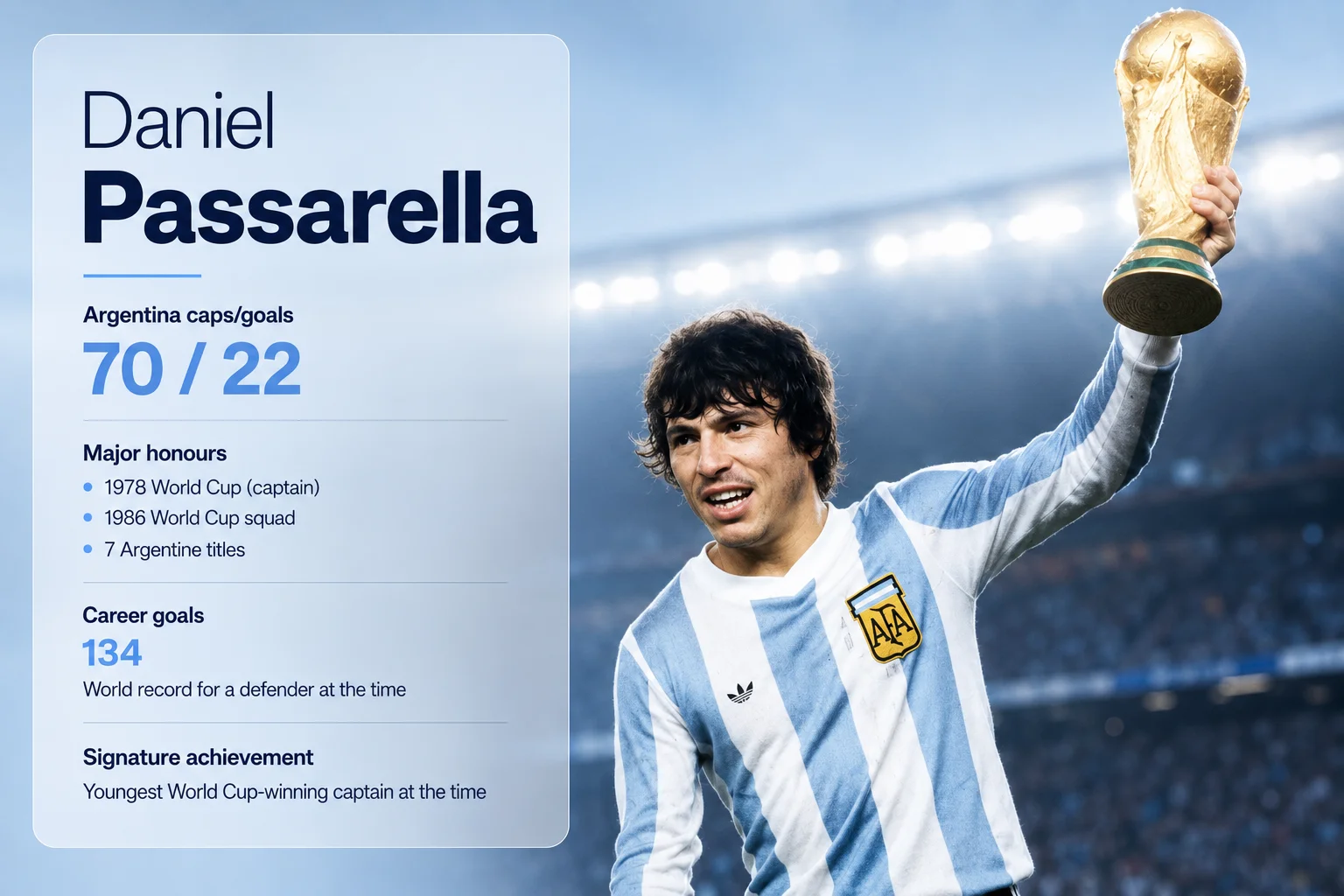
| Category | Record |
|---|---|
| Argentina caps / goals | 70 / 22 |
| Major honours | 1978 World Cup (captain), 1986 World Cup squad, 7 Argentine titles |
| Career goals | 134, then a world record for a defender |
| Signature achievement | Youngest World Cup-winning captain at the time |
El Gran Capitán. Passarella lifted the 1978 trophy as, at the time, the youngest captain to win a World Cup, and he remains the only Argentine named in both the 1978 and 1986 winning squads, though illness and injury kept him off the pitch throughout Mexico 86. A ferocious, elegant leader who attacked set pieces like a striker, he scored 22 goals in 70 caps and finished his career with 134 goals, then the most by any defender in football history.
He won seven Argentine titles with River Plate and spent six seasons in Serie A with Fiorentina and Inter, where his goal output from centre-back baffled Italian defences. As national coach his rigid squad rules cost Argentina Redondo in 1998, a collision of two strong characters that shaped this very list. The image of him hoisting the World Cup amid the Monumental confetti is one of Argentine football's founding photographs.
3. Mario Kempes
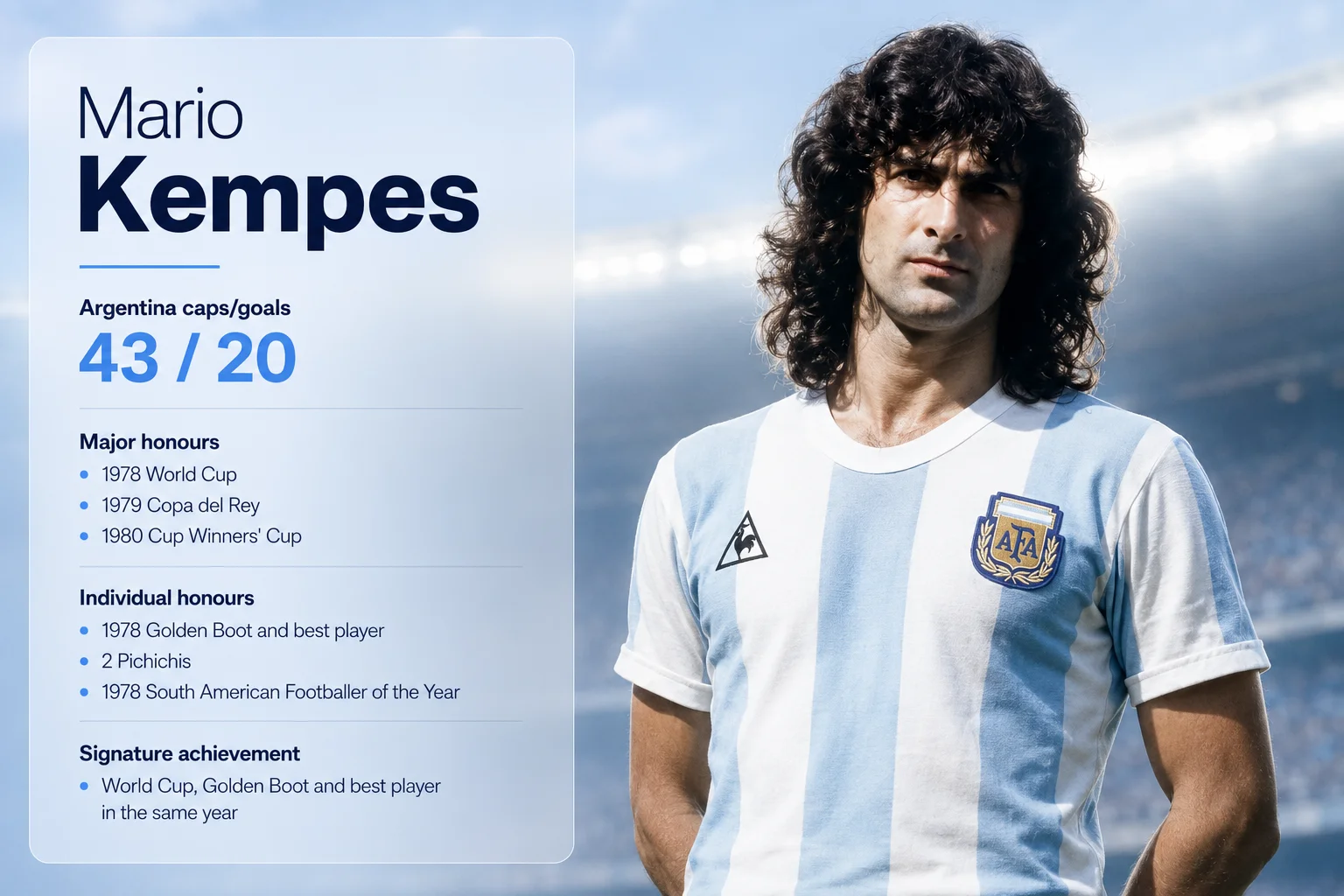
| Category | Record |
|---|---|
| Argentina caps / goals | 43 / 20 |
| Major honours | 1978 World Cup, 1979 Copa del Rey, 1980 Cup Winners' Cup |
| Individual honours | 1978 Golden Boot and best player, 2 Pichichis, 1978 South American Footballer of the Year |
| Signature achievement | World Cup, Golden Boot and best player in the same year |
The face of Argentina's first World Cup win, and the story of 1978 is better than the summary. Kempes went goalless through the entire first group stage, and coach César Luis Menotti, rather than dropping him, told him to shave off his moustache to change his luck. Six goals in the final four matches followed, including two in the final against the Netherlands, giving El Matador the Golden Boot and recognition as the tournament's best player. He remains one of only three men to win the World Cup, finish as its top scorer and be named its best player in the same year.
He was also the only foreign-based player Menotti selected in that squad, such was his standing at Valencia, where he won back-to-back Pichichi awards as Spain's top scorer, the 1979 Copa del Rey with both goals in the final, and the 1980 Cup Winners' Cup. South American Footballer of the Year in 1978, inevitably.
2. Diego Maradona
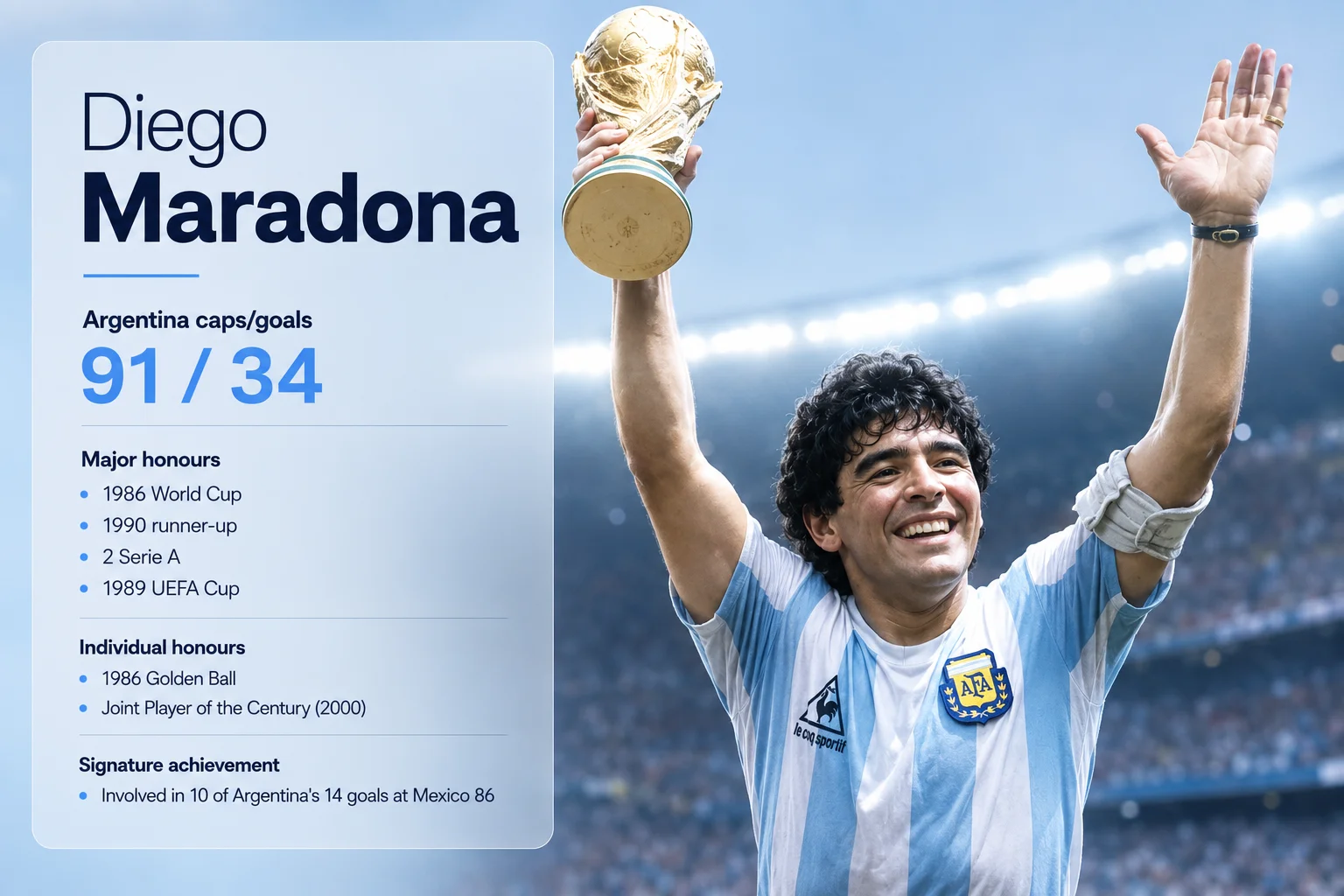
| Category | Record |
|---|---|
| Argentina caps / goals | 91 / 34 |
| Major honours | 1986 World Cup, 1990 runner-up, 2 Serie A, 1989 UEFA Cup |
| Individual honours | 1986 Golden Ball (unanimous), joint Player of the Century (2000) |
| Signature achievement | Involved in 10 of Argentina's 14 goals at Mexico 86 |
El Diez. In 91 caps he scored 34 goals and produced the single most influential tournament performance in history at Mexico 86: five goals, five assists, direct involvement in 10 of Argentina's 14 goals, fouled 53 times, the Golden Ball by unanimous vote, and both the Goal of the Century and the Hand of God in the same quarter-final against England. He is the only player since detailed records began to both score and assist five or more times at a single World Cup. Four years later, on one ankle, he dragged a far weaker side to another final in Rome.
His club peak has no parallel. Napoli had never won the title in 60 years of trying when he arrived from Barcelona in 1984; he delivered the 1987 and 1990 Serie A crowns plus the 1989 UEFA Cup to a city that responded by painting him onto its walls, where he remains. Voted joint Player of the Century in 2000, he shares with Messi alone the distinction of winning the Golden Ball at both a U-20 World Cup and the senior tournament. For millions of Argentines, no evidence will ever move him off top spot, and that position is entirely defensible.
1. Lionel Messi
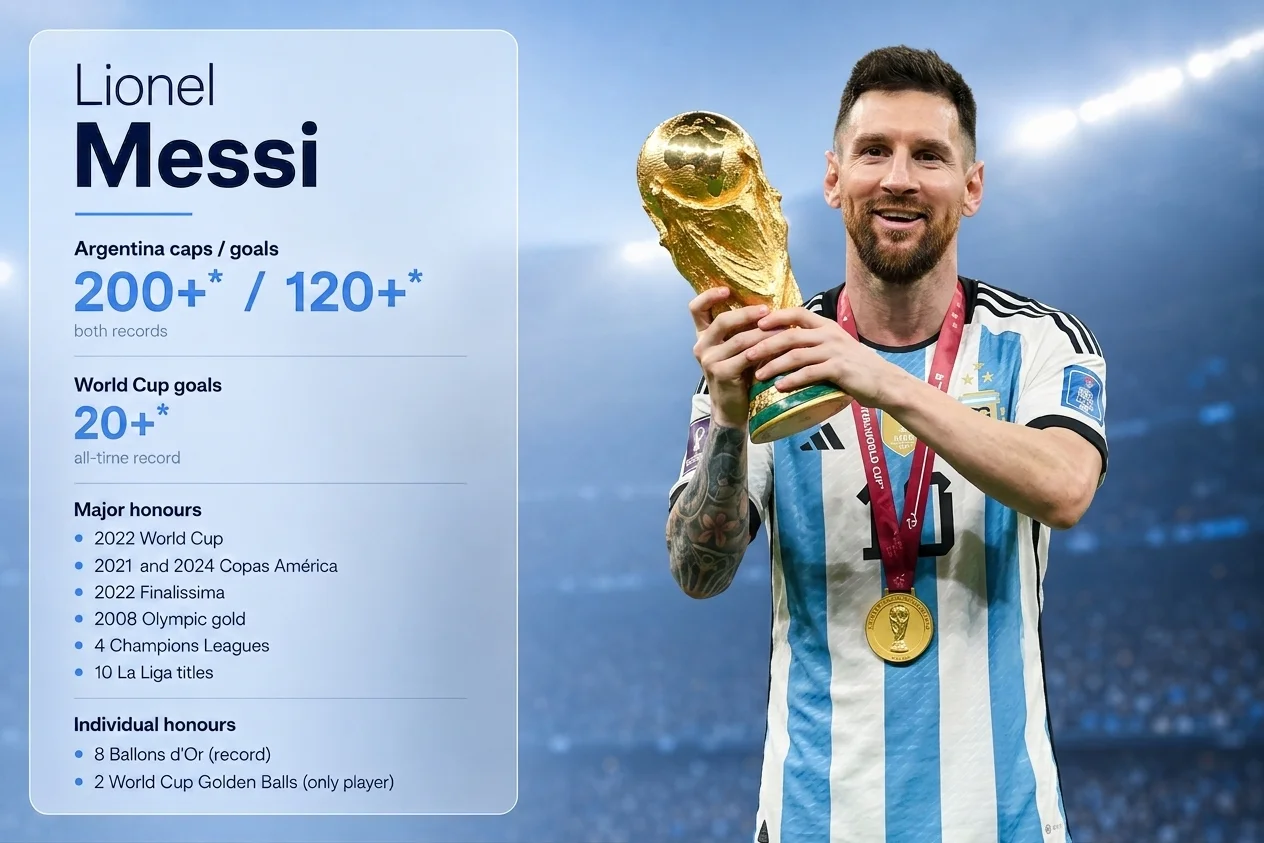
| Category | Record |
|---|---|
| Argentina caps / goals | 200+* / 120+* (both records) |
| World Cup goals | 20+* (all-time record) |
| Major honours | 2022 World Cup, 2021 and 2024 Copas América, 2022 Finalissima, 2008 Olympic gold, 4 Champions Leagues, 10 La Liga titles |
| Individual honours | 8 Ballons d'Or (record), 2 World Cup Golden Balls (only player) |
*Active player; figures correct as of 6 July 2026 and rising while Argentina remain in the tournament.
The greatest, by the accumulated weight of two decades. Eight Ballon d'Or awards when nobody else in history has more than five. Argentina's records for caps and goals, both by a distance. The 2021 Copa América that ended a 28-year senior drought, the 2022 Finalissima, the 2024 Copa América and the 2022 World Cup, where he scored in every knockout round and won the Golden Ball, the only man to win it twice. At Barcelona he won four Champions Leagues and 10 league titles while redefining what a forward's numbers could look like; 91 goals in the 2012 calendar year remains barely believable.
And at 39 he is still adding clauses to the argument. His hat-trick against Algeria on 16 June, on his 200th cap at 38 years and 357 days, made him the oldest man to score a World Cup treble. His brace against Austria carried him past Miroslav Klose as the outright record World Cup goalscorer. Friday's opener against Cape Verde was his 20th World Cup goal in a record 30th appearance, his eighth consecutive World Cup match with a goal, another record. Argentina meet Egypt in Atlanta on Tuesday with the title defence intact, largely because their captain refuses to age. Whatever happens next, the verdict here is Messi by 51-49 over Diego, and the margin is only that close out of respect.
WhatsApp channel
Sports news straight to your phone
Match updates, on-sale dates and ticket news from 1BoxOffice.
The Hardest Omissions
Oscar Ruggeri is the closest call, the defensive rock of the 1986 win whom FourFourTwo rank as high as sixth all-time; a back line without a single 1986 defender is this list's most attackable position. Ricardo Bochini, Independiente's eternal idol and Maradona's boyhood hero, is the clearest victim of the national-team-first rule, having played only minutes for Argentina.
Also unlucky:
- Osvaldo Ardiles, 1978 world champion and a Tottenham great
- Javier Mascherano, midfield anchor of the 2014 finalists
- Jorge Valdano and Claudio Caniggia, heroes of 1986 and 1990
- Amadeo Carrizo, the IFFHS's Argentine goalkeeper of the century
Frequently Asked Questions
1. When do Argentina play next at the 2026 World Cup?
-
Argentina face Egypt in the round of 16 at Mercedes-Benz Stadium in Atlanta on Tuesday 7 July 2026, kicking off at 12:00 local time.
2. How many World Cups have Argentina won?
-
Three, in 1978, 1986 and 2022, and they are defending the title at the 2026 tournament.
3. Has Argentina ever hosted the World Cup?
-
Yes, Argentina hosted the 1978 tournament and won it on home soil, beating the Netherlands in the final in Buenos Aires.
4. Are any active players in this top 20?
-
No, Emiliano Martínez also features at 20, and both are in Argentina's 2026 squad, while Julián Álvarez and Enzo Fernández are building cases for future editions.
5. Where does Messi play his club football now?
-
He plays for Inter Miami in Major League Soccer, having joined the American club in 2023 after two seasons at Paris Saint-Germain.
However Argentina's title defence ends, this ranking will need revisiting soon: that is what happens when your greatest ever player is still rewriting the record books at 39. If you want to see the next chapter written live, 1BoxOffice lists verified knockout-round tickets from trusted sellers, every order covered by a 150% money-back guarantee.
Sources: IFFHS, ESPN, Sky Sports, CNN.