In this guide
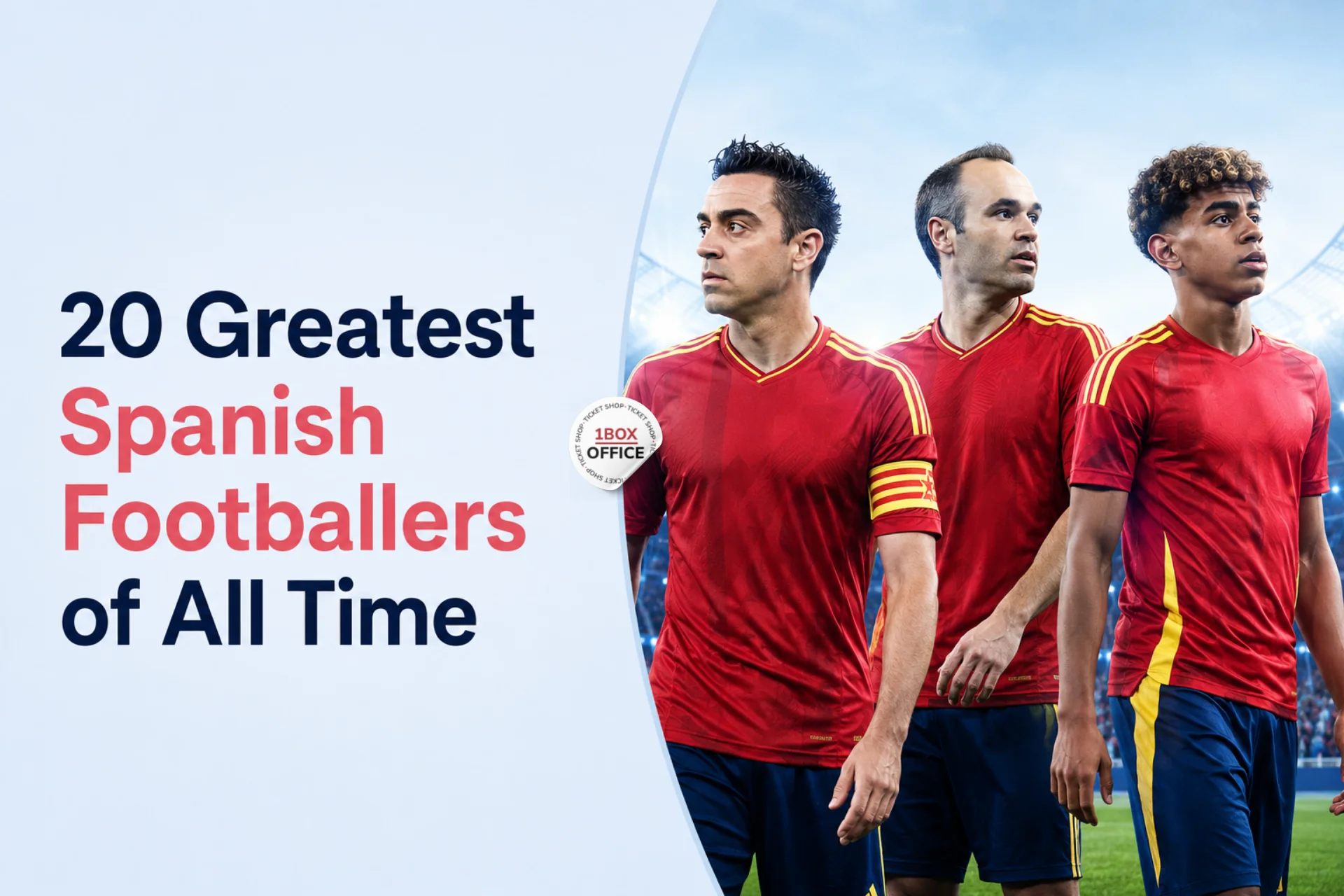
How this ranking works20. Lamine Yamal, the teenager rewriting the timeline19. Cesc Fabregas, the man who made the biggest moments18. Emilio Butragueno, the Vulture of the Quinta17. Telmo Zarra, the record that stood for 60 years16. Gerard Pique, the ball-playing blueprint15. David Silva, the quiet genius of Manchester14. Xabi Alonso, the range-finder13. Fernando Torres, El Nino of the finals12. Carles Puyol, the captain who ran through walls11. Sergio Busquets, the player you watch to see the whole game10. David Villa, the sharpest edge Spain ever had9. Francisco Gento, the man with six European Cups8. Raul Gonzalez, the eternal captain7. Luis Suarez Miramontes, the original Golden Galician6. Alfredo Di Stefano, the man who built the empire5. Rodri, the Ballon d'Or that ended the wait4. Sergio Ramos, the record cap holder who lived for the last minute3. Iker Casillas, the saint of the golden era2. Andres Iniesta, the man who scored the goal1. Xavi Hernandez, the metronome the whole era ran throughFAQsTen minutes into his first World Cup start in Atlanta on 21 June 2026, Lamine Yamal tapped in at the back post against Saudi Arabia and joined Pele as the only players aged 18 or under to open the scoring in a World Cup match. A country that waited 80 years for its first World Cup now produces teenagers who treat the tournament like a playground, which makes ranking the greatest Spanish footballers of all time harder than it has ever been: the golden generation of 2008 to 2012 has to share space with the men who built Real Madrid's European empire in the 1950s and the new wave winning right now.
This is our ranked guide to the 20 finest players Spain has produced, weighing individual honours, decisive contribution to club and country and iconic weight. With La Roja through to the knockout rounds in North America, you can check availability for Spain tickets for the remainder of the tournament, with the 150% money-back guarantee behind every order should a listed match be cancelled.
How this ranking works
Trophy counts alone would produce a list of 2008 to 2012 squad members and little else, so the order blends three things: personal awards such as the Ballon d'Or and tournament player awards, what each man actually decided for his teams rather than merely witnessed and the cultural mark he left on Spanish football. One eligibility call needs stating up front. Alfredo Di Stefano was born in Buenos Aires, but he took Spanish citizenship in 1956 and won 31 caps for Spain, so he is eligible here, and we have flagged the tension in his entry rather than hiding it. Every statistic below was checked against tournament records and match reports current to the 2026 World Cup. Figures marked with an asterisk belong to active players and are correct to the end of the group stage.
The full ranking at a glance
| Rank | Player | Main position | Peak era | Signature honour |
|---|---|---|---|---|
| 1 | Xavi Hernandez | Midfielder | 2008 to 2012 | World Cup, two Euros, three Ballon d'Or podiums |
| 2 | Andres Iniesta | Midfielder | 2008 to 2015 | 2010 World Cup final winning goal |
| 3 | Iker Casillas | Goalkeeper | 2000s to 2012 | Captain for the World Cup and both Euros |
| 4 | Sergio Ramos | Centre-back | 2005 to 2021 | Record 180 caps, four Champions Leagues |
| 5 | Rodri | Defensive midfielder | 2019 to present | 2024 Ballon d'Or |
| 6 | Alfredo Di Stefano | Forward | 1950s | Five straight European Cups, two Ballon d'Ors |
| 7 | Luis Suarez Miramontes | Midfielder | 1960s | 1960 Ballon d'Or, Euro 1964 |
| 8 | Raul Gonzalez | Forward | Late 1990s to 2000s | Three Champions Leagues, Madrid icon |
| 9 | Francisco Gento | Winger | 1950s to 1960s | Six European Cups, an all-time record |
| 10 | David Villa | Striker | 2005 to 2014 | Spain's record scorer with 59 goals |
| 11 | Sergio Busquets | Defensive midfielder | 2009 to 2015 | World Cup, Euro 2012, nine league titles |
| 12 | Carles Puyol | Centre-back | 2000s to 2010 | 2010 semi-final winner against Germany |
| 13 | Fernando Torres | Striker | 2007 to 2012 | Euro 2008 final winner, Euro 2012 Golden Boot |
| 14 | Xabi Alonso | Midfielder | 2005 to 2014 | Champions League with Liverpool and Madrid |
| 15 | David Silva | Attacking midfielder | 2010 to 2019 | Four Premier League titles, three international trophies |
| 16 | Gerard Pique | Centre-back | 2008 to 2015 | Four Champions Leagues with two clubs |
| 17 | Telmo Zarra | Striker | 1940s to 1950s | Six Pichichis, 251 La Liga goals |
| 18 | Emilio Butragueno | Forward | 1980s | Four goals against Denmark at the 1986 World Cup |
| 19 | Cesc Fabregas | Midfielder | 2008 to 2012 | Assists in the 2010 and 2012 final wins |
| 20 | Lamine Yamal | Winger | 2023 to present | Euro 2024 at 17, Ballon d'Or runner-up at 18 |
20. Lamine Yamal, the teenager rewriting the timeline
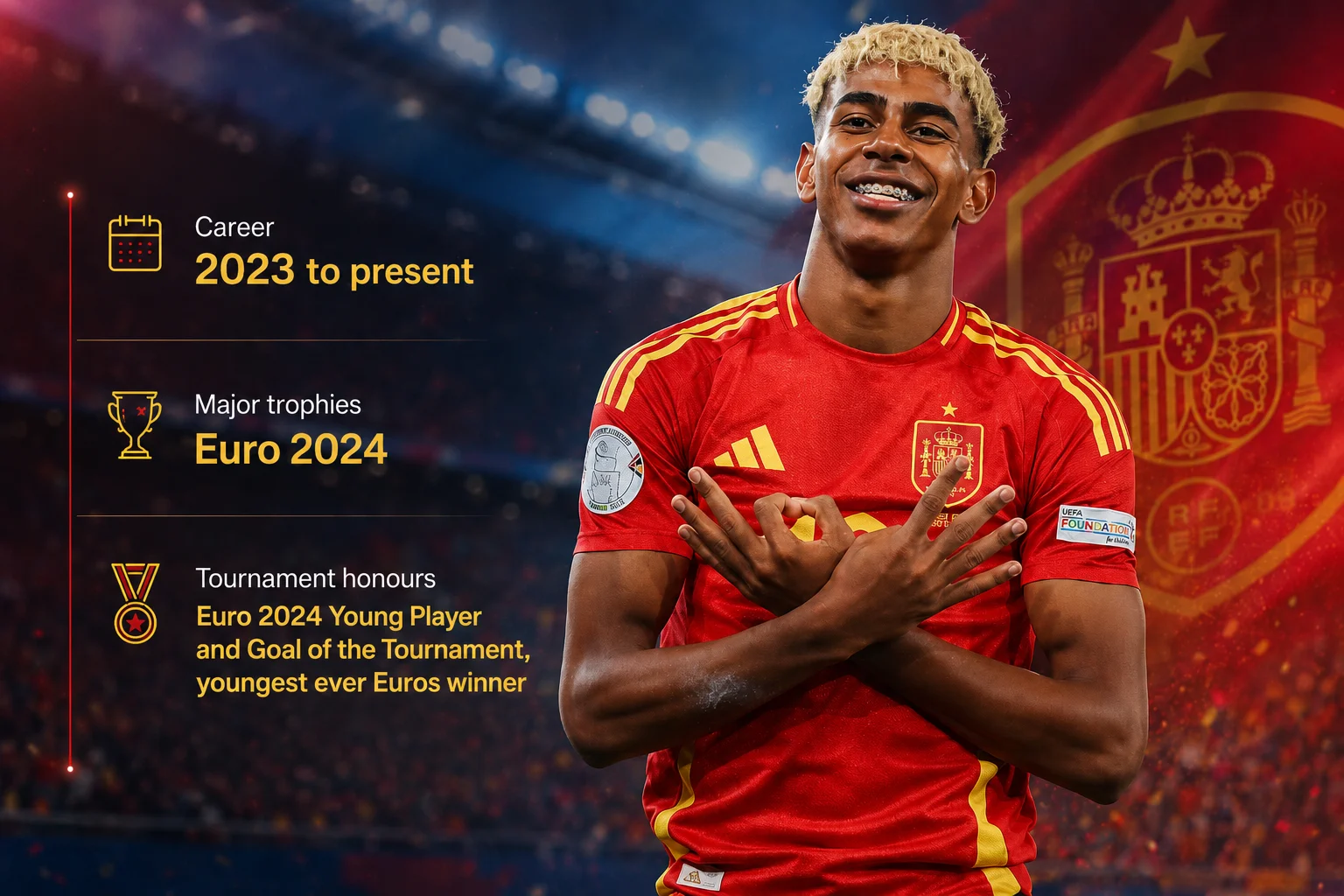
Placing an 18-year-old on an all-time list is a risk, but the case is already concrete. Yamal became the youngest player and youngest scorer in European Championship history while winning Euro 2024 with Spain at 17, his semi-final strike against France instantly entering tournament folklore. He has since collected back-to-back Kopa Trophies, finished runner-up in the 2025 Ballon d'Or, won La Liga with Barcelona and, after recovering from a hamstring problem, scored on his first World Cup start this June. If his career stopped tomorrow it would still outweigh several fine players who missed this list; it will not stop tomorrow, and his position can only climb.
| Spain record | Detail |
|---|---|
| Career | 2023 to present |
| Caps | 28* |
| Goals | 7* |
| Major trophies | Euro 2024 |
| Tournament honours | Euro 2024 Young Player and Goal of the Tournament, youngest ever Euros winner |
19. Cesc Fabregas, the man who made the biggest moments
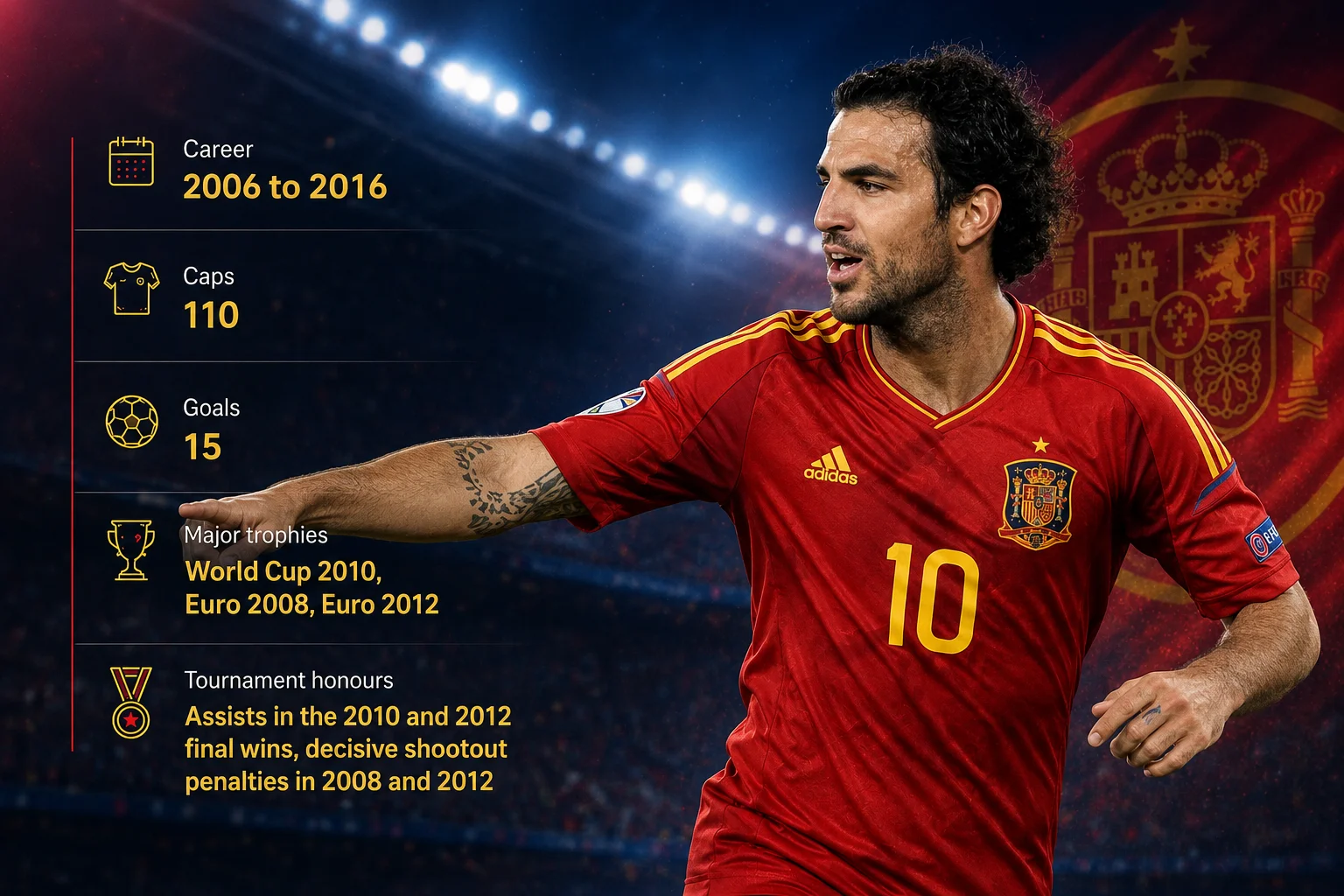
Fabregas rarely started Spain's biggest matches, and his fingerprints are on the trophies anyway. He converted the decisive penalty in the Euro 2008 quarter-final shootout against Italy, delivered the pass for Andres Iniesta's World Cup winner in 2010, scored the clinching penalty in the Euro 2012 semi-final shootout against Portugal, then set up David Silva's opener in the final against Italy. Add the youngest captaincy in Arsenal's modern history, two Premier League titles with Chelsea and a place among the Premier League's leading all-time assist providers, and his 110 caps carry unusual weight per minute played.
| Spain record | Detail |
|---|---|
| Career | 2006 to 2016 |
| Caps | 110 |
| Goals | 15 |
| Major trophies | World Cup 2010, Euro 2008, Euro 2012 |
| Tournament honours | Assists in the 2010 and 2012 final wins, decisive shootout penalties in 2008 and 2012 |
WhatsApp channel
Sports news straight to your phone
Match updates, on-sale dates and ticket news from 1BoxOffice.
18. Emilio Butragueno, the Vulture of the Quinta
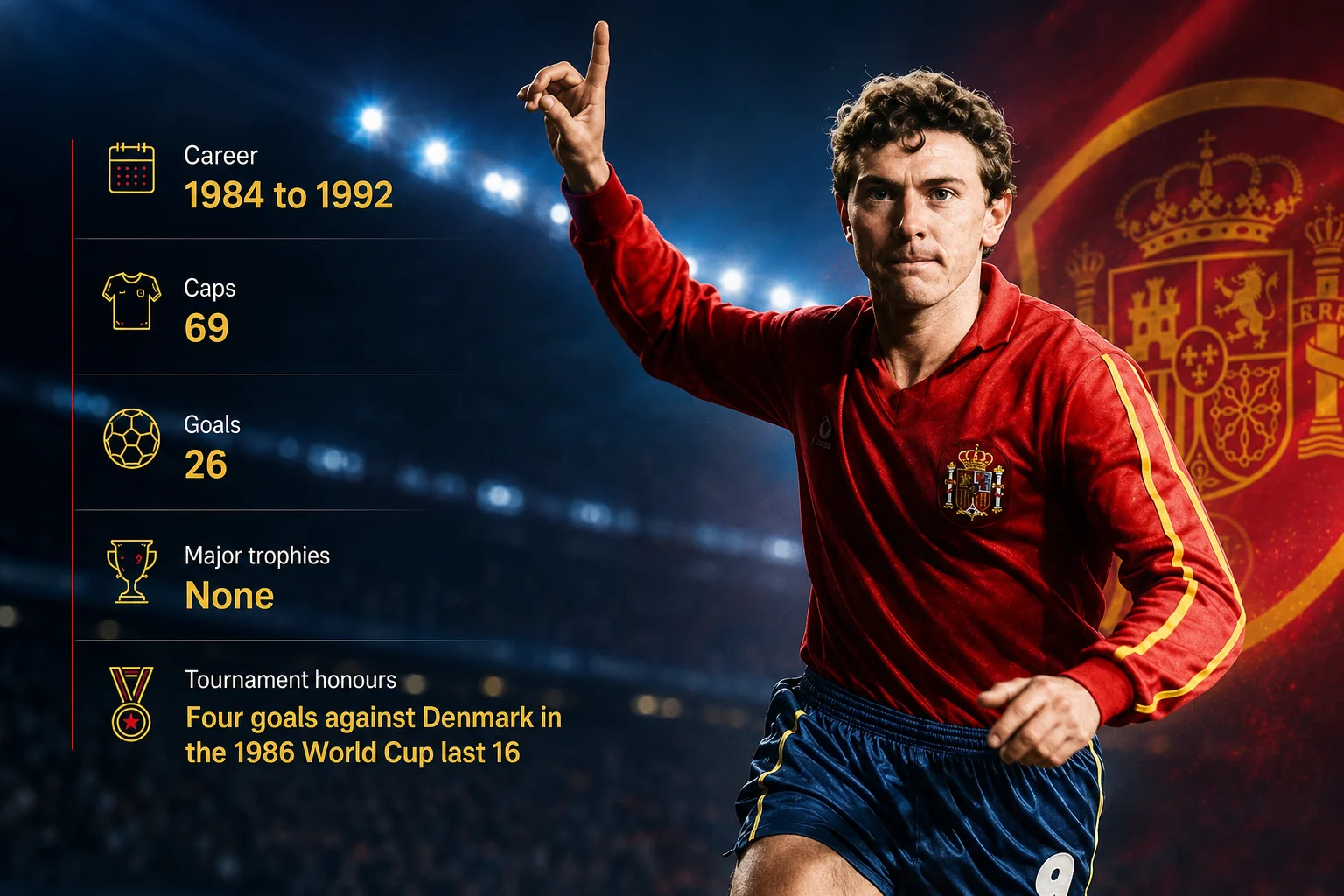
The figurehead of the Quinta del Buitre, the homegrown core that carried Real Madrid to five consecutive league titles between 1986 and 1990 and back-to-back UEFA Cups in 1985 and 1986. Butragueno's international peak arrived in one afternoon in Queretaro at the 1986 World Cup, when he scored four times as Spain dismantled Denmark 5-1 in the last 16, still the last man to score four in a World Cup knockout tie of any kind for Spain. Elegant, unhurried and lethal in the box, he finished with 26 goals in 69 caps in an era when Spain won nothing, which is precisely why his individual brilliance stands out.
| Spain record | Detail |
|---|---|
| Career | 1984 to 1992 |
| Caps | 69 |
| Goals | 26 |
| Major trophies | None |
| Tournament honours | Four goals against Denmark in the 1986 World Cup last 16 |
17. Telmo Zarra, the record that stood for 60 years
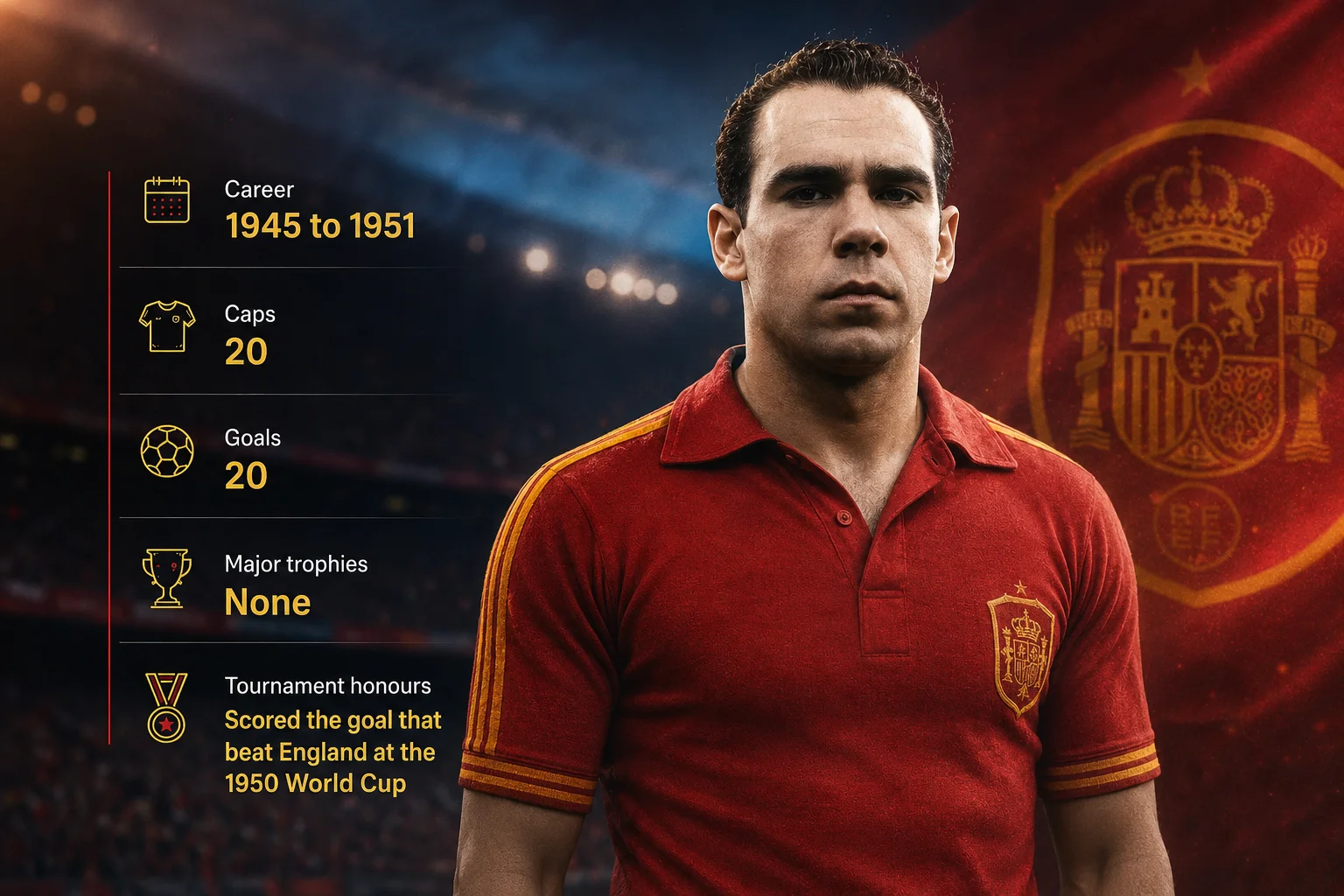
Zarra's 251 La Liga goals for Athletic Club remained the competition's all-time record from the 1950s until Lionel Messi finally passed it in 2014, and his six Pichichi trophies remain the most any player has won. Spain's award for the league's top domestic scorer now carries his name. His international legend rests on a single strike: the goal that beat England 1-0 at the Maracana at the 1950 World Cup, the country's most celebrated result for half a century. Twenty goals in 20 caps is a ratio no Spanish forward since has approached.
| Spain record | Detail |
|---|---|
| Career | 1945 to 1951 |
| Caps | 20 |
| Goals | 20 |
| Major trophies | None |
| Tournament honours | Scored the goal that beat England at the 1950 World Cup |
16. Gerard Pique, the ball-playing blueprint
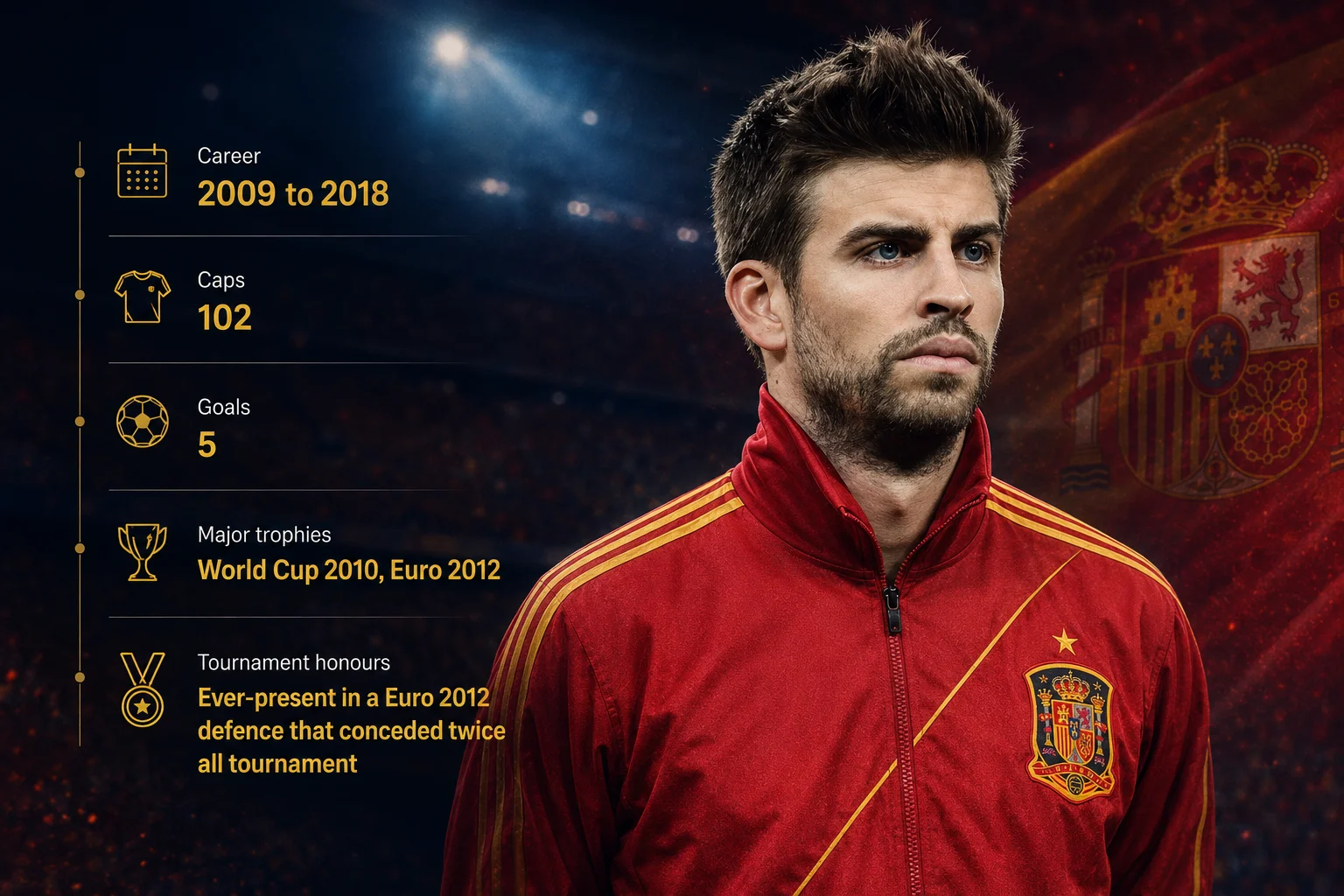
Pique won the Champions League with Manchester United in 2008 and then again with Barcelona in 2009, one of a tiny group to win it in consecutive seasons with different clubs, and he added two more in 2011 and 2015. Alongside eight league titles, a World Cup and Euro 2012, he redefined what a Spanish centre-back was for: the first pass of the attack rather than the last line of defence. His partnership with the man at number four on this list, forged despite the fiercest club rivalry in the sport, conceded just two goals across Spain's entire victorious Euro 2012 campaign.
| Spain record | Detail |
|---|---|
| Career | 2009 to 2018 |
| Caps | 102 |
| Goals | 5 |
| Major trophies | World Cup 2010, Euro 2012 |
| Tournament honours | Ever-present in a Euro 2012 defence that conceded twice all tournament |
15. David Silva, the quiet genius of Manchester
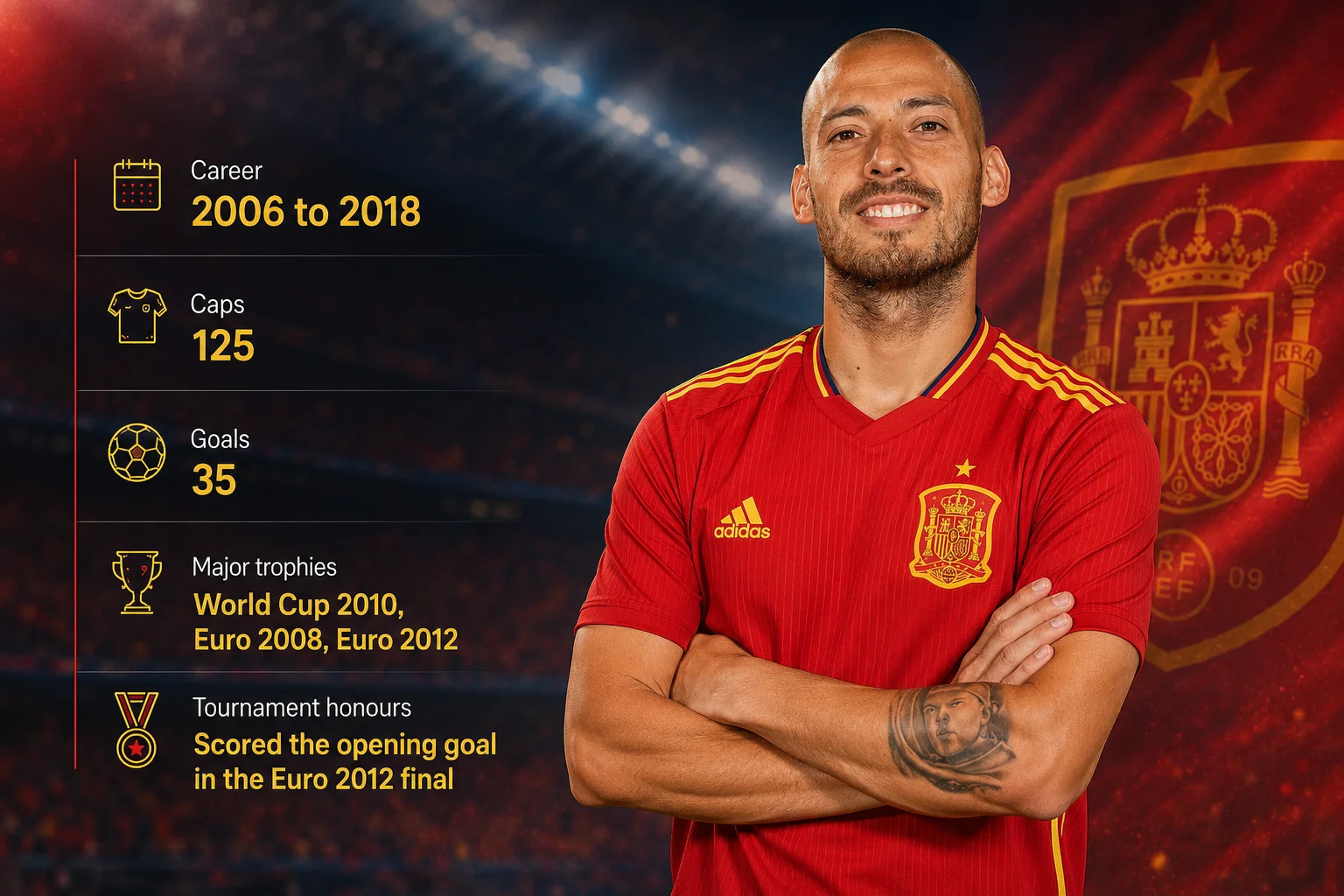
Silva won the World Cup and both Euros, scoring the opening goal in the Euro 2012 final rout of Italy, and 125 caps put him among Spain's five most-capped players. It was in England that his stature grew into something singular: 436 appearances for Manchester City, four Premier League titles and a decade as the club's creative reference point, honoured with a statue outside the Etihad before he closed his career at Real Sociedad. In a golden generation stacked with midfielders, Silva's trick was making the hardest position on the pitch, the pockets between the lines, look like the easiest.
| Spain record | Detail |
|---|---|
| Career | 2006 to 2018 |
| Caps | 125 |
| Goals | 35 |
| Major trophies | World Cup 2010, Euro 2008, Euro 2012 |
| Tournament honours | Scored the opening goal in the Euro 2012 final |
14. Xabi Alonso, the range-finder
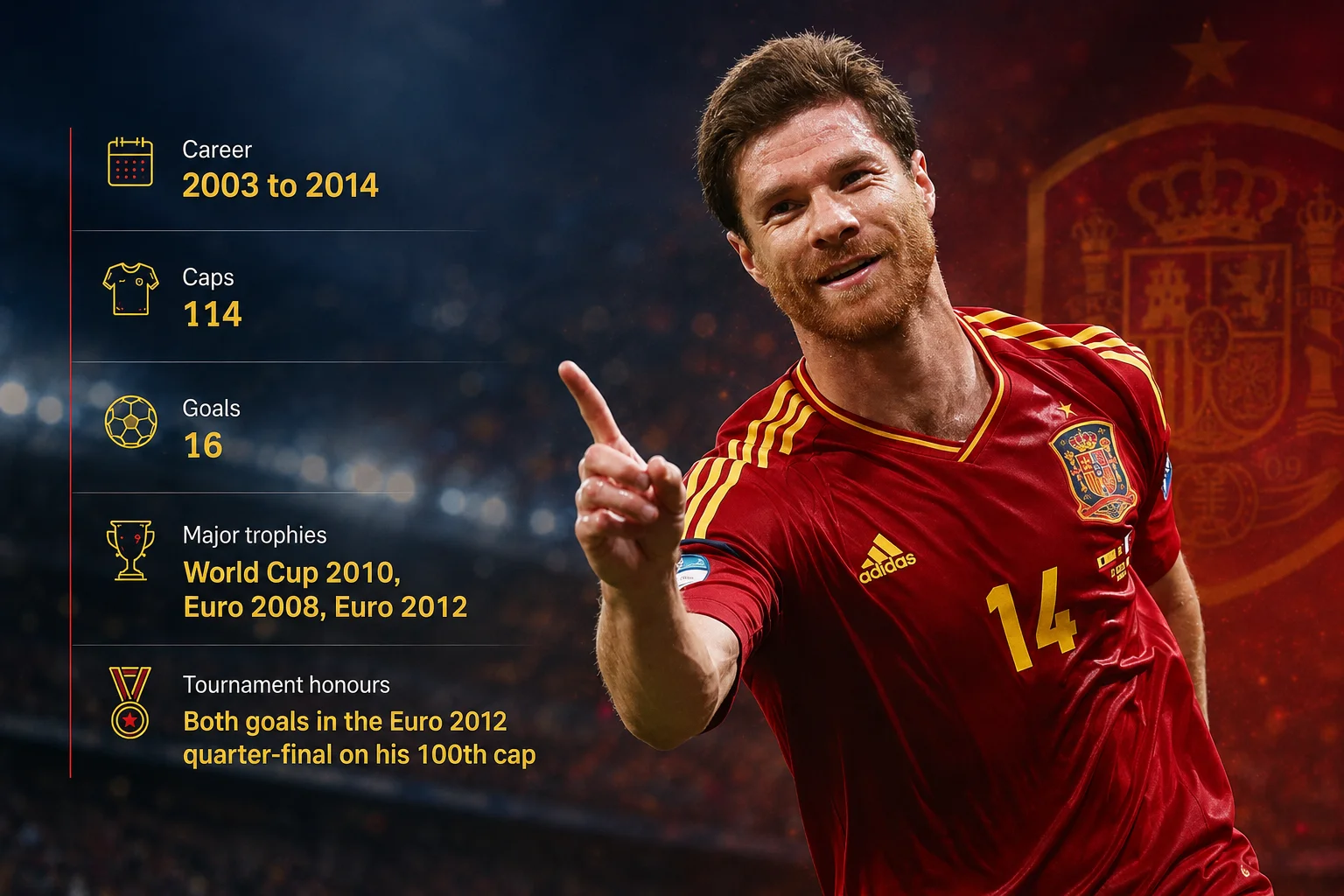
Alonso won the Champions League in Istanbul with Liverpool in 2005, scoring the rebound that completed the comeback, and won it again with Real Madrid in 2014, alongside the full international set of a World Cup and two Euros. He marked his 100th cap by scoring both goals in the Euro 2012 quarter-final win over France, then added three Bundesliga titles at Bayern Munich in his mid-thirties. No Spanish midfielder has ever passed longer or better, and his second act as a coach only deepens the aura.
| Spain record | Detail |
|---|---|
| Career | 2003 to 2014 |
| Caps | 114 |
| Goals | 16 |
| Major trophies | World Cup 2010, Euro 2008, Euro 2012 |
| Tournament honours | Both goals in the Euro 2012 quarter-final on his 100th cap |
13. Fernando Torres, El Nino of the finals
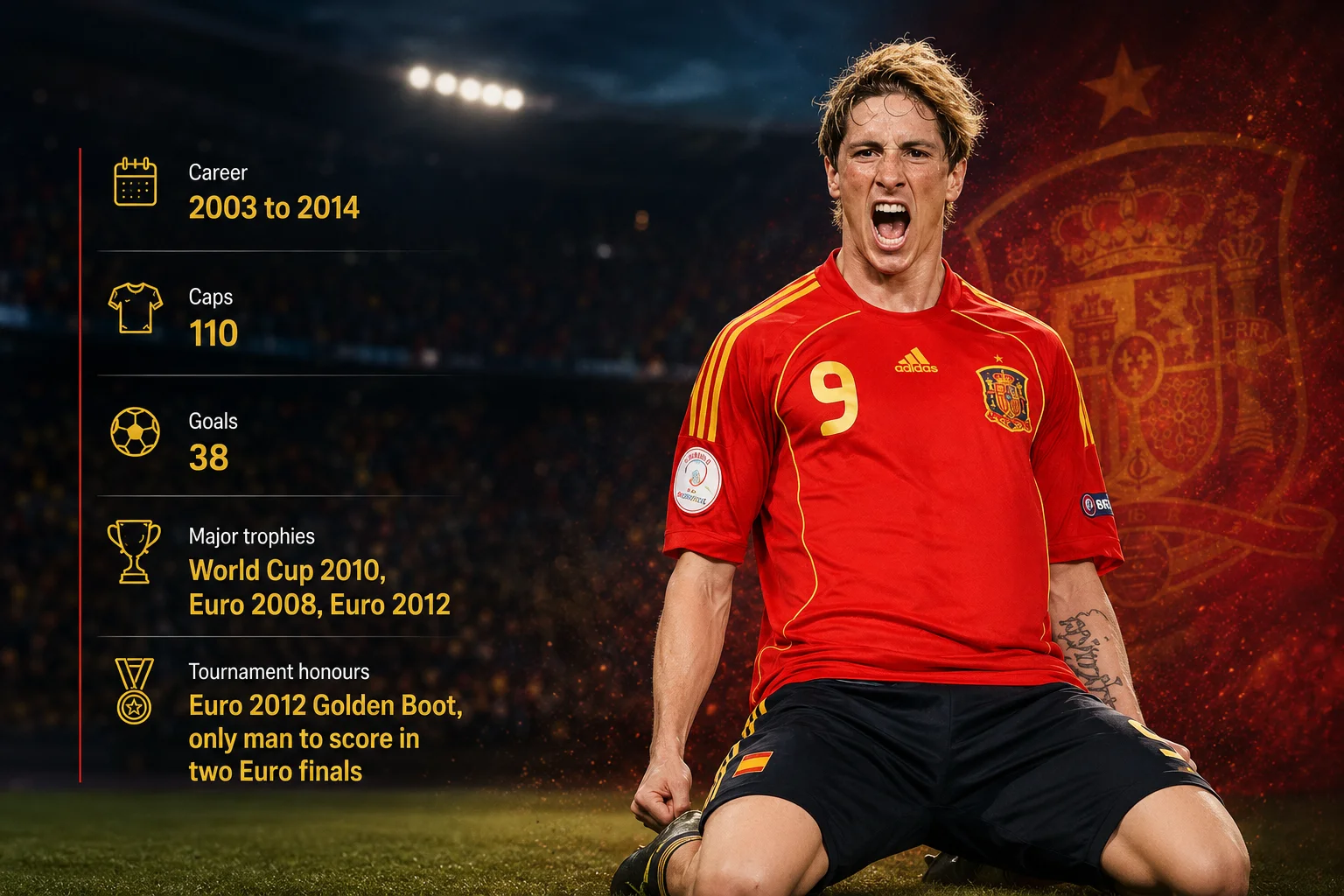
Torres remains the only man to score in two European Championship finals. Atletico Madrid's teenage captain grew into the striker whose clipped finish past Jens Lehmann won Euro 2008 and ended Spain's 44-year trophy drought, and his late goal in the 2012 final helped him claim that tournament's Golden Boot. At his Anfield peak he was arguably the most feared striker in Europe, and he later added the 2012 Champions League with Chelsea, semi-final goal at Camp Nou included. Injuries stole his top gear early, which is the only reason a player of this iconic weight sits outside the top ten.
| Spain record | Detail |
|---|---|
| Career | 2003 to 2014 |
| Caps | 110 |
| Goals | 38 |
| Major trophies | World Cup 2010, Euro 2008, Euro 2012 |
| Tournament honours | Euro 2012 Golden Boot, only man to score in two Euro finals |
12. Carles Puyol, the captain who ran through walls
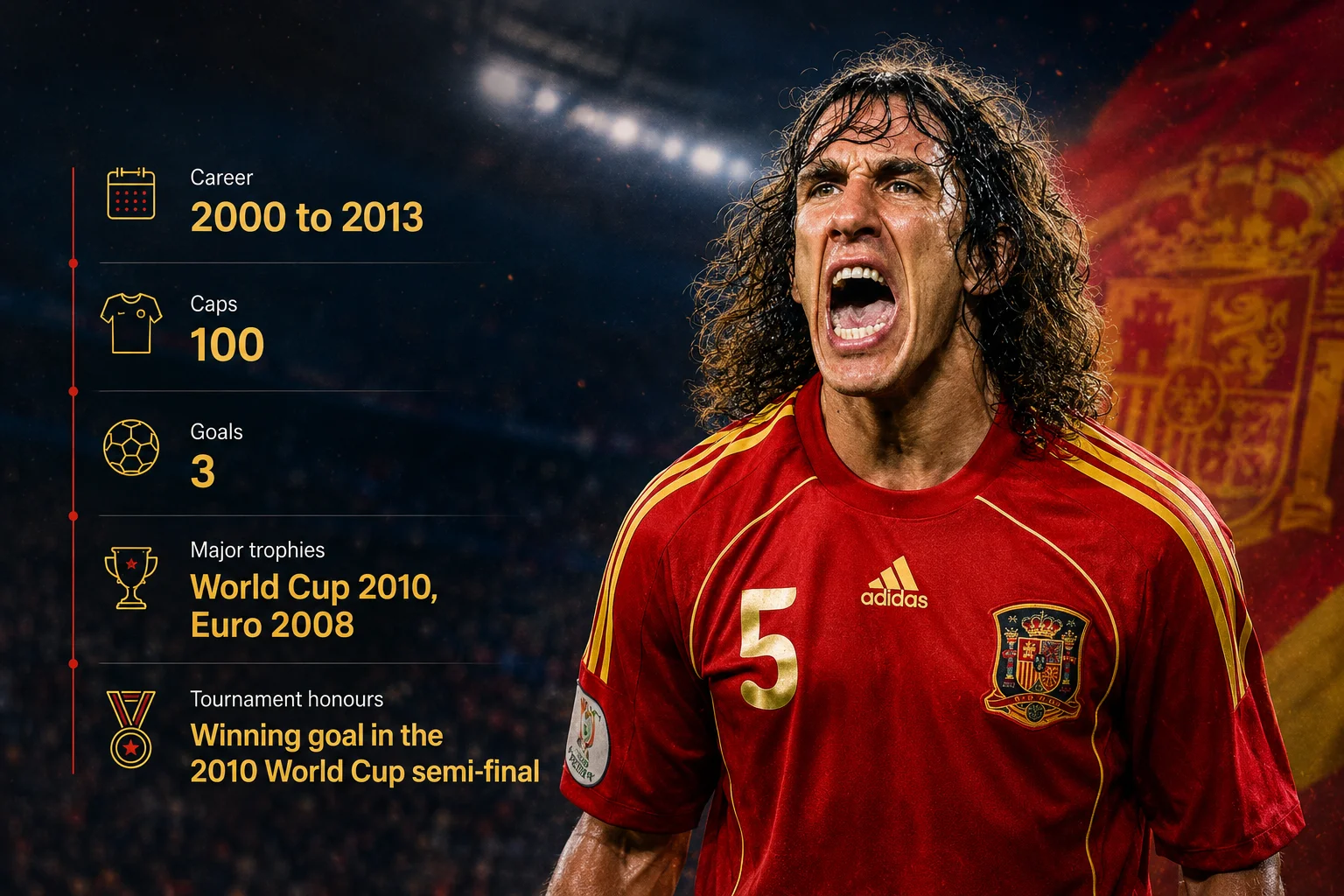
Every great passing team needs one player who treats every ball as a matter of honour, and for Barcelona and Spain that was Puyol. He won six league titles and three Champions Leagues as Barcelona captain, plus Euro 2008 and the World Cup with the national team, reaching exactly 100 caps. His defining act came in the 2010 semi-final against Germany, a thundering header from Xavi's corner that sent Spain to their first World Cup final. Defenders with more talent have played for Spain; none has been trusted more.
| Spain record | Detail |
|---|---|
| Career | 2000 to 2013 |
| Caps | 100 |
| Goals | 3 |
| Major trophies | World Cup 2010, Euro 2008 |
| Tournament honours | Winning goal in the 2010 World Cup semi-final |
11. Sergio Busquets, the player you watch to see the whole game
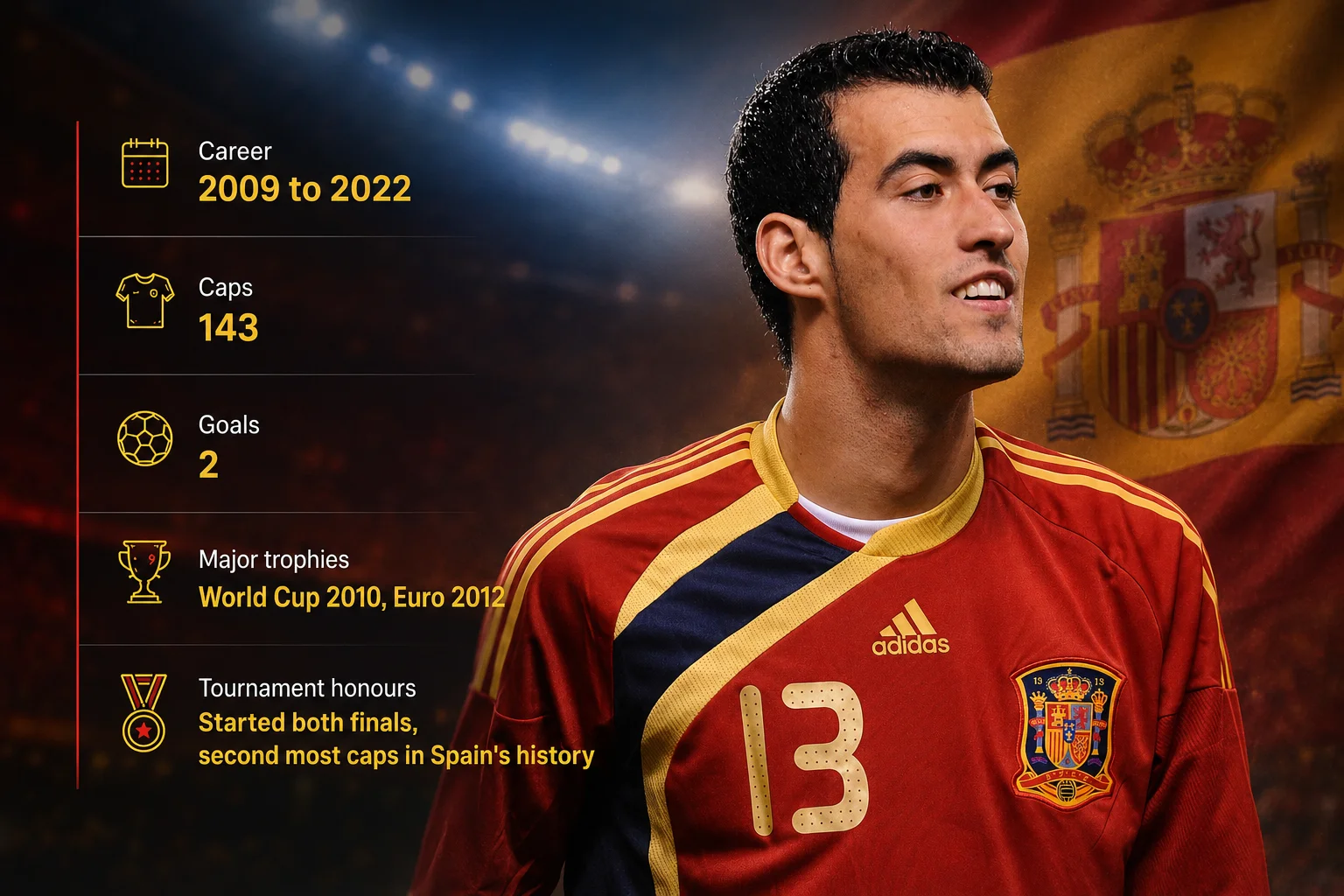
Vicente del Bosque's famous line captured it: watch the match and you might miss Busquets, watch Busquets and you see the whole match. He anchored the World Cup win in 2010 within two years of his debut, started the Euro 2012 final and won nine league titles and three Champions Leagues among more than 30 trophies at Barcelona. With 143 caps, only one Spaniard has played more times for the national team. Nobody has made the pivot position look so effortless, and a generation of coaches now builds teams around players asked to imitate him, right up to his farewell seasons alongside Messi at Inter Miami.
| Spain record | Detail |
|---|---|
| Career | 2009 to 2022 |
| Caps | 143 |
| Goals | 2 |
| Major trophies | World Cup 2010, Euro 2012 |
| Tournament honours | Started both finals, second most caps in Spain's history |
10. David Villa, the sharpest edge Spain ever had
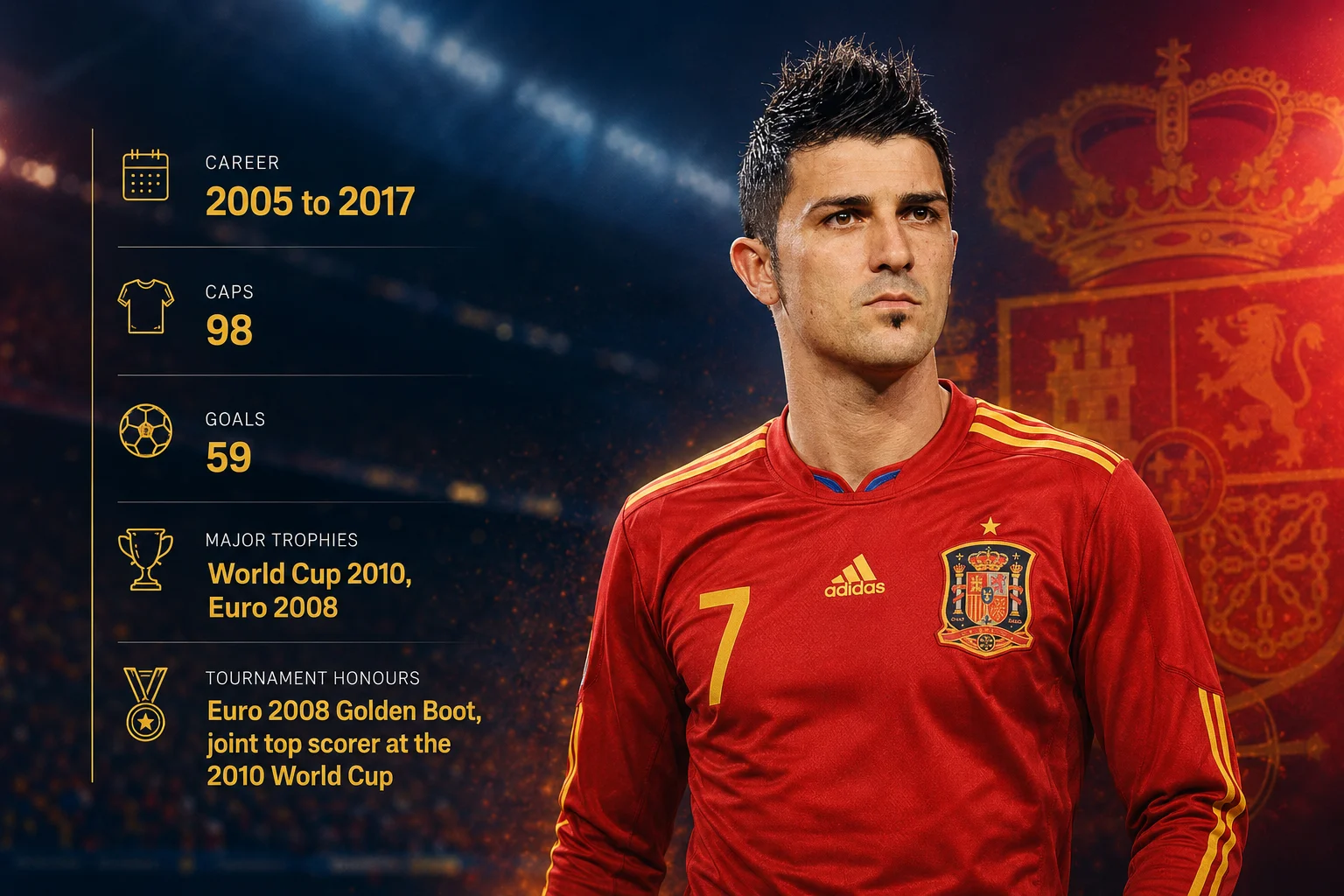
Spain's tiki-taka era is remembered for midfielders, but somebody had to finish the moves, and Villa's 59 goals in 98 caps remain the national record by a distance. He won the Golden Boot at Euro 2008 with four goals, then scored five of Spain's eight at the 2010 World Cup, joint-top in the tournament, carrying the attack almost alone after Torres lost fitness. At club level he starred for Valencia before scoring in the 2011 Champions League final for Barcelona against Manchester United. Ruthless, two-footed and brave, he is the finisher every Spanish striker since has been measured against.
| Spain record | Detail |
|---|---|
| Career | 2005 to 2017 |
| Caps | 98 |
| Goals | 59 |
| Major trophies | World Cup 2010, Euro 2008 |
| Tournament honours | Euro 2008 Golden Boot, joint top scorer at the 2010 World Cup |
9. Francisco Gento, the man with six European Cups
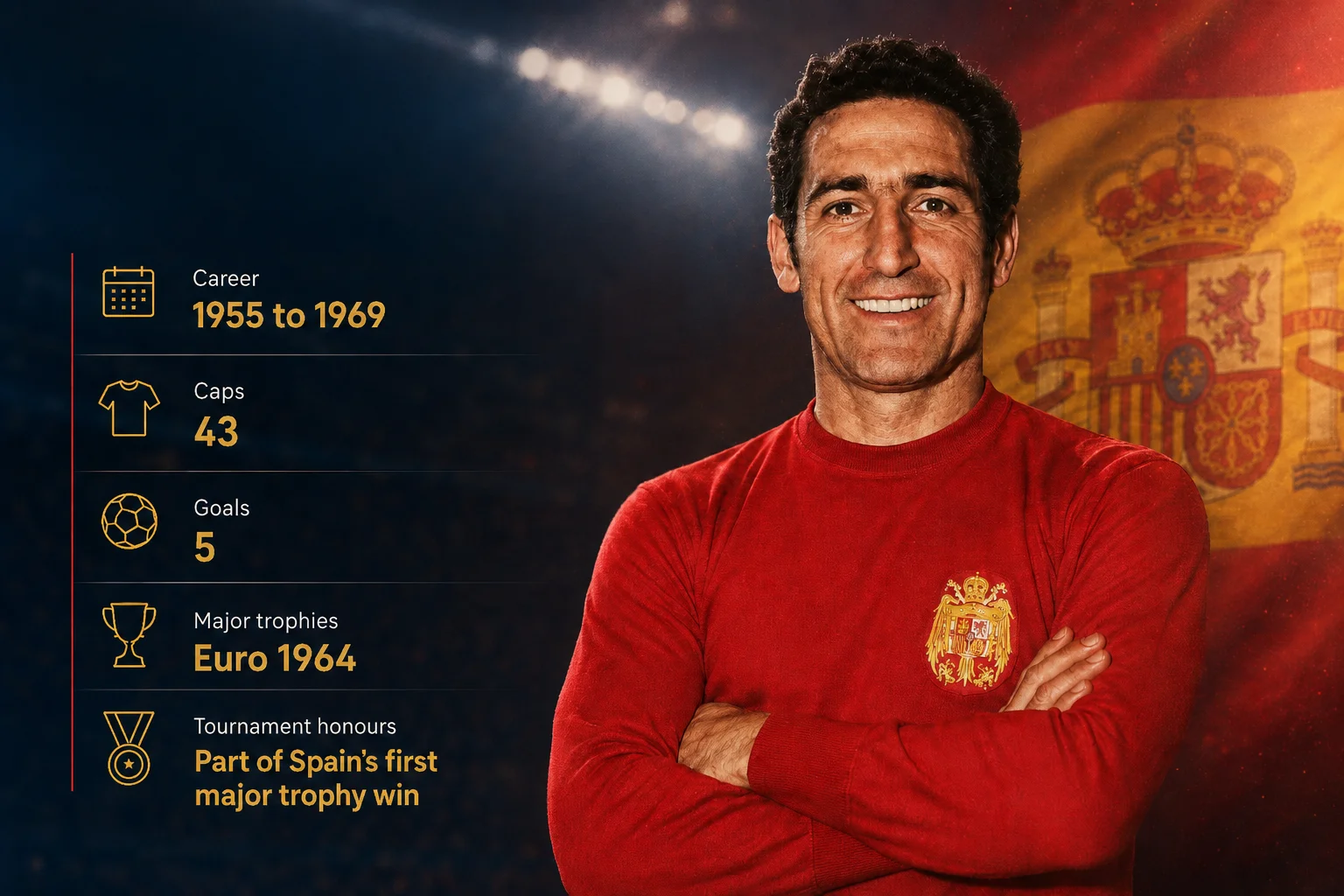
No player in history has won the European Cup six times except Gento, who played in eight finals across 18 seasons at Real Madrid and lifted the trophy as captain in 1966. Add 12 league titles, still a Spanish record, and a left wing partnership with Di Stefano and Puskas that defined the competition's first decade. La Galerna del Cantabrico, the gale from the Cantabrian coast, was reputedly the fastest player of his era, and Madrid made him honorary president before his death in 2022. His medal collection alone would justify a higher place; his relatively supporting role in that side is what holds him at nine.
| Spain record | Detail |
|---|---|
| Career | 1955 to 1969 |
| Caps | 43 |
| Goals | 5 |
| Major trophies | Euro 1964 |
| Tournament honours | Part of Spain's first major trophy win |
8. Raul Gonzalez, the eternal captain
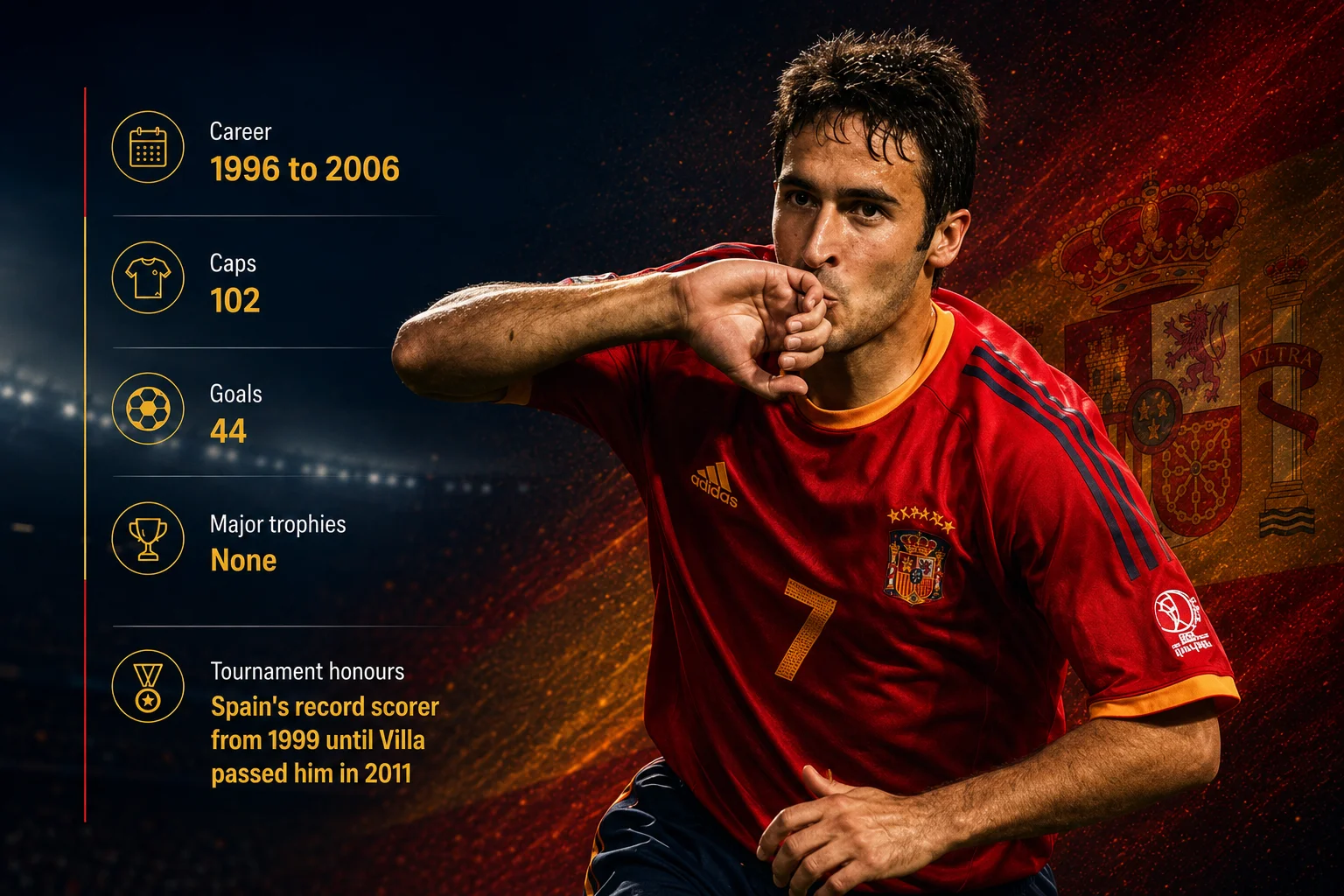
For a decade Raul was Spanish football, full stop. He scored 323 goals in 741 appearances for Real Madrid, both club records when he left in 2010, won three Champions Leagues including goals in the 2000 and 2002 finals and took six league titles. His 44 international goals stood as Spain's record until Villa passed it. The asterisk is unavoidable: his international career ended in 2006, just before the golden era began, so he never won a major tournament. On individual stature and club contribution, though, only a handful of Spaniards in history can look him in the eye.
| Spain record | Detail |
|---|---|
| Career | 1996 to 2006 |
| Caps | 102 |
| Goals | 44 |
| Major trophies | None |
| Tournament honours | Spain's record scorer from 1999 until Villa passed him in 2011 |
7. Luis Suarez Miramontes, the original Golden Galician
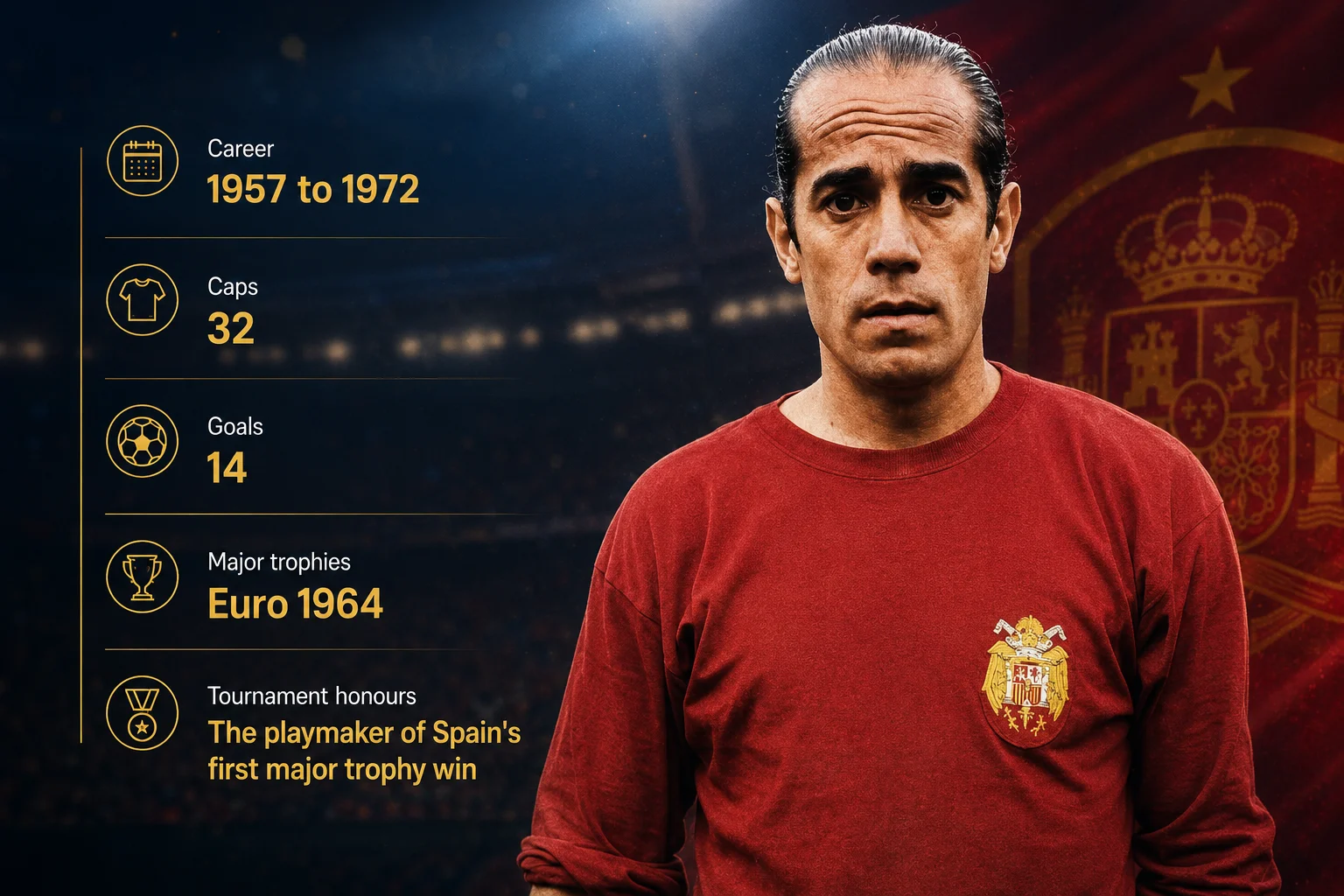
For 64 years Luis Suarez held a distinction no compatriot could touch: the only Spanish-born man to win the Ballon d'Or, claimed in 1960 while at Barcelona, with runner-up finishes in 1961 and 1964. He then became the brain of Helenio Herrera's Grande Inter, winning back-to-back European Cups in 1964 and 1965 as the deep-lying playmaker the whole system ran through. In 1964 he was also the best player on the pitch as Spain beat the Soviet Union to win their first major trophy, the European Championship, in Madrid. Half a century before Xavi, Suarez had already written the template.
| Spain record | Detail |
|---|---|
| Career | 1957 to 1972 |
| Caps | 32 |
| Goals | 14 |
| Major trophies | Euro 1964 |
| Tournament honours | The playmaker of Spain's first major trophy win |
6. Alfredo Di Stefano, the man who built the empire
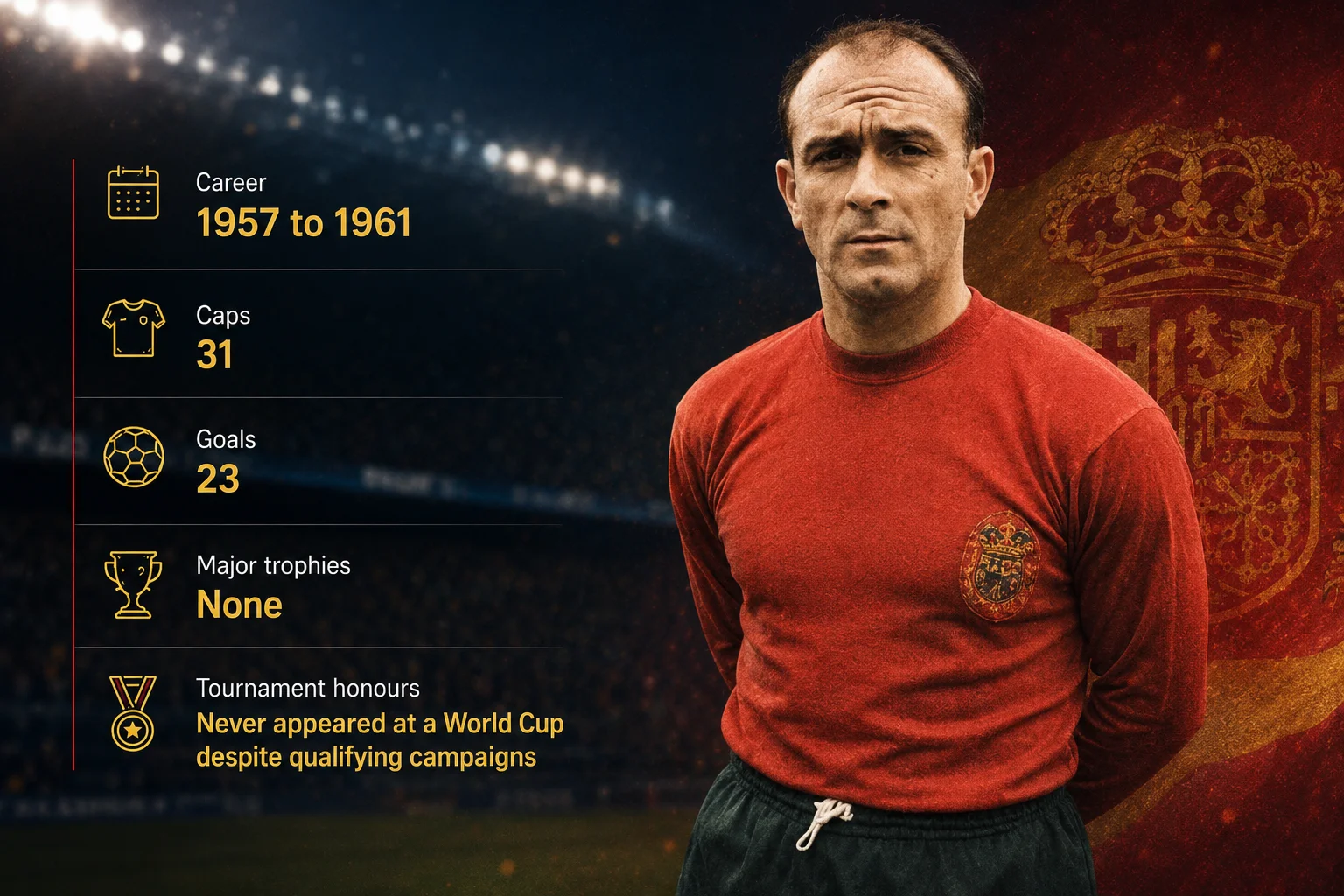
Here is the eligibility question this list cannot dodge. Di Stefano was born in Buenos Aires and played for Argentina before taking Spanish citizenship in 1956 and winning 31 caps for Spain, scoring 23 goals, though he never appeared at a World Cup. What he did at club level has no parallel: five consecutive European Cups from 1956 to 1960, scoring in all five finals including a hat-trick in the 7-3 destruction of Eintracht Frankfurt at Hampden Park, plus eight La Liga titles and two Ballon d'Ors in 1957 and 1959. He saw out his playing days at Espanyol, and the verdict splits cleanly: rank him purely as a Spain international and he falls; rank him as the greatest player Spanish football ever hosted and shaped, and sixth is arguably harsh.
| Spain record | Detail |
|---|---|
| Career | 1957 to 1961 |
| Caps | 31 |
| Goals | 23 |
| Major trophies | None |
| Tournament honours | Never appeared at a World Cup despite qualifying campaigns |
5. Rodri, the Ballon d'Or that ended the wait
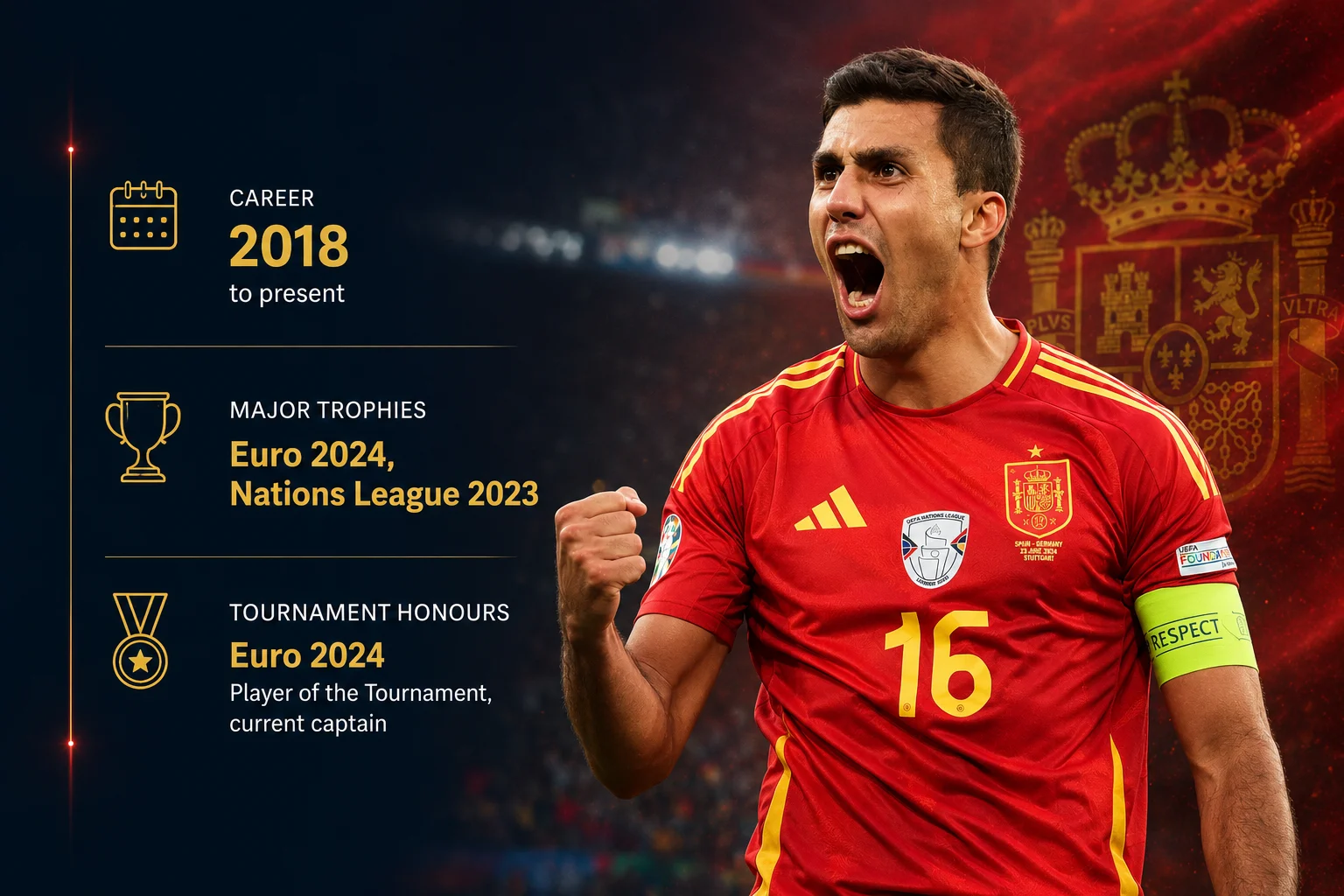
When Rodri won the 2024 Ballon d'Or he became the first Spanish-born winner since Suarez in 1960, the payoff for two seasons in which he was plainly the best midfielder in the world. He scored the only goal of the 2023 Champions League final to complete Manchester City's treble, won four Premier League titles and was named player of the tournament as Spain won Euro 2024, a side that lost him to injury for the second half of the final and visibly wobbled without him. Now back from the knee injury that cost him most of the following season, he is running Spain's midfield at this World Cup. Fifth place after seven elite seasons is aggressive, and it is the correct reading of how completely one player can control football matches.
| Spain record | Detail |
|---|---|
| Career | 2018 to present |
| Caps | 62* |
| Goals | 4* |
| Major trophies | Euro 2024, Nations League 2023 |
| Tournament honours | Euro 2024 Player of the Tournament, current captain |
4. Sergio Ramos, the record cap holder who lived for the last minute
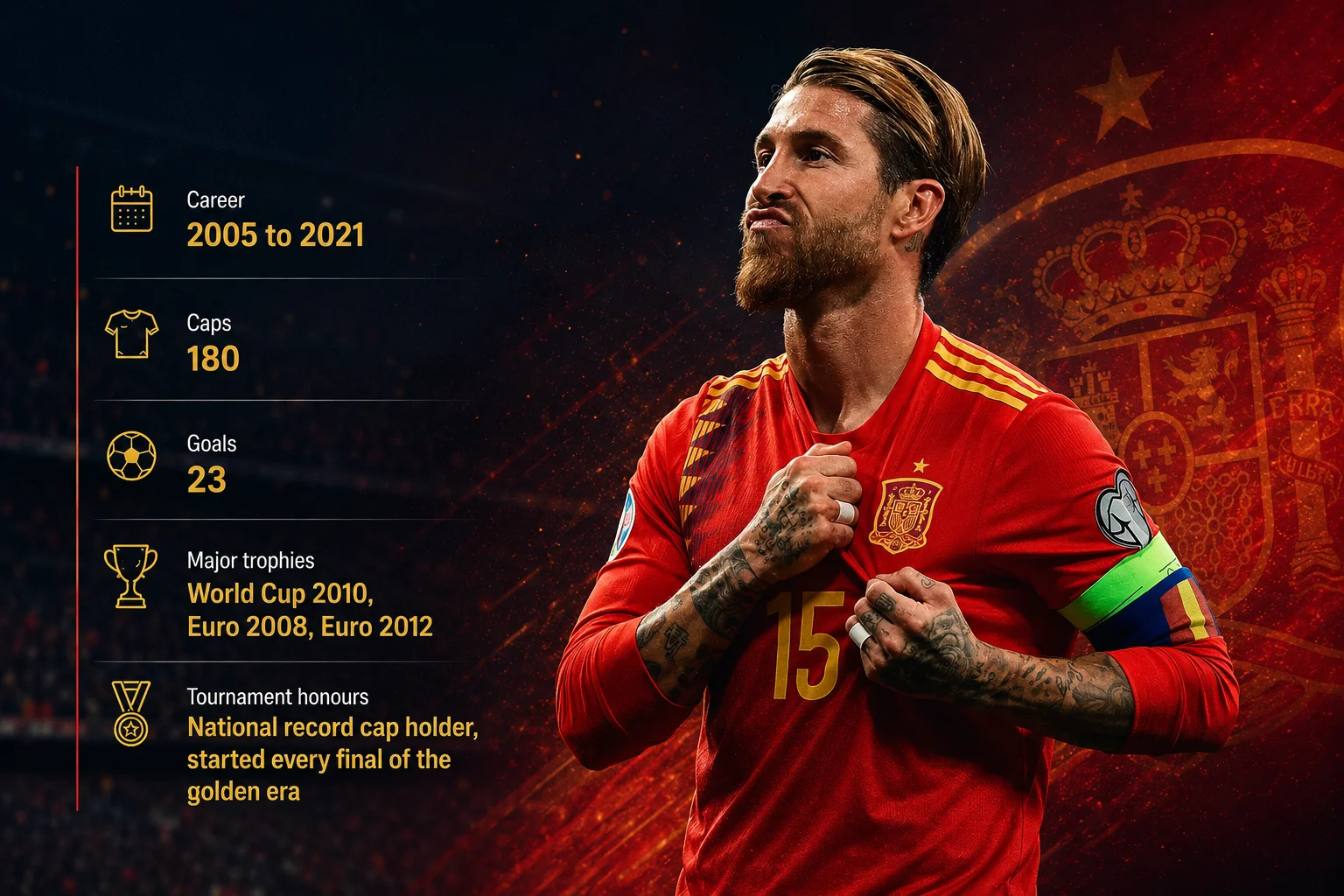
No man has played for Spain more often than Ramos, whose 180 caps span the entire golden era: the World Cup in 2010 and both Euros either side of it, most of it at right-back before he became the world's dominant centre-back. At Real Madrid he won five league titles and four Champions Leagues, and his 93rd-minute header in the 2014 Lisbon final against Atletico Madrid remains the single most consequential goal any defender has scored in the competition's modern history. Combustible, decorated and impossibly clutch, he scored 23 international goals, an outrageous return for a defender, and captained club and country through their most demanding years.
| Spain record | Detail |
|---|---|
| Career | 2005 to 2021 |
| Caps | 180 |
| Goals | 23 |
| Major trophies | World Cup 2010, Euro 2008, Euro 2012 |
| Tournament honours | National record cap holder, started every final of the golden era |
3. Iker Casillas, the saint of the golden era
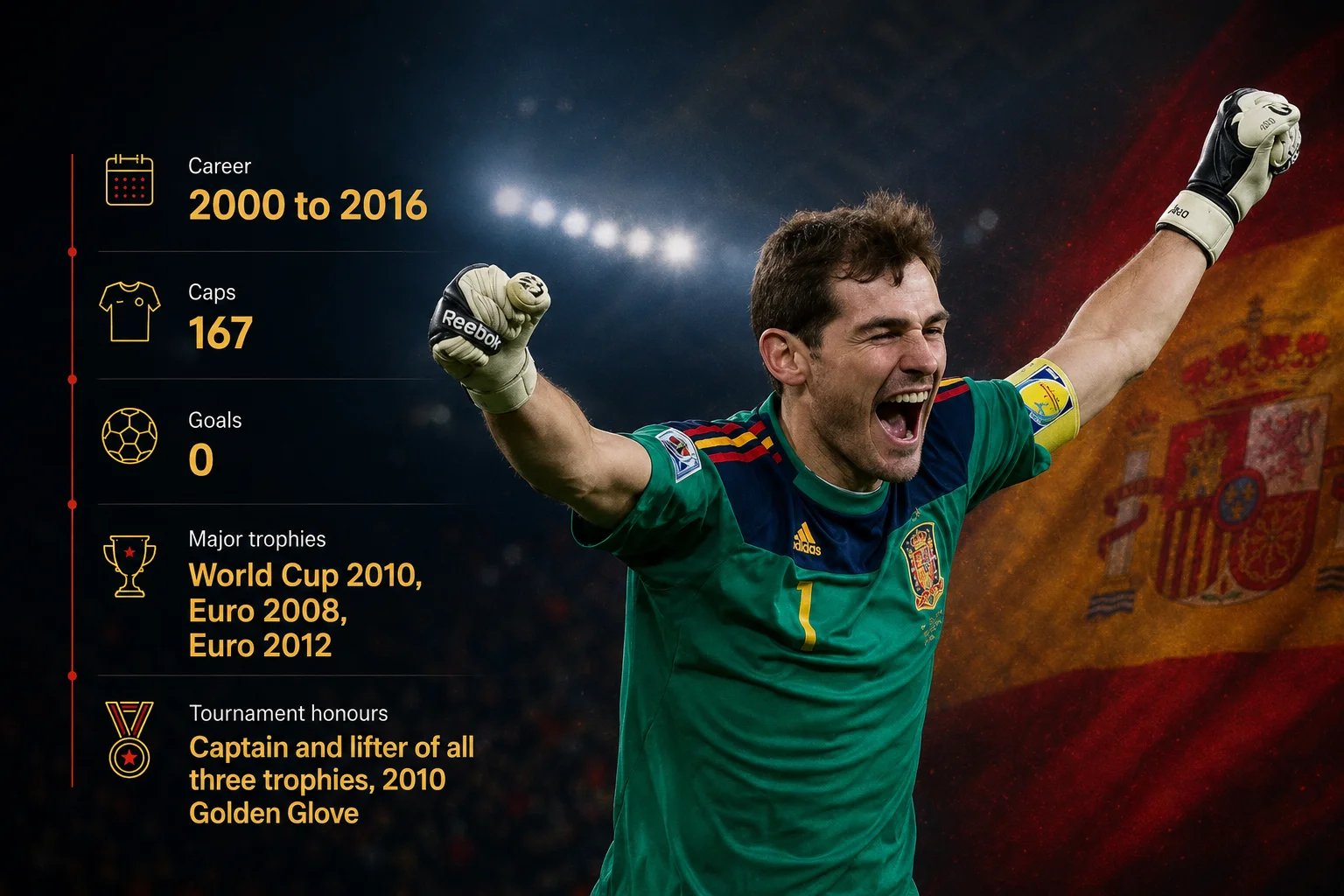
Casillas captained Spain to all three of the golden era's trophies and lifted each one himself, the only goalkeeper ever to skipper a side through a World Cup and two European Championships in succession. His outstretched boot to deny Arjen Robben one on one, twice, in the 2010 final is the save the trophy was won with, and it earned him that tournament's Golden Glove. Voted the world's best goalkeeper five years running from 2008 to 2012, he also won three Champions Leagues and five league titles at Real Madrid after breaking through as a teenager, before a five-season final act at Porto. For a decade the last line of Spanish football was simply not a worry.
| Spain record | Detail |
|---|---|
| Career | 2000 to 2016 |
| Caps | 167 |
| Goals | 0 (goalkeeper) |
| Major trophies | World Cup 2010, Euro 2008, Euro 2012 |
| Tournament honours | Captain and lifter of all three trophies, 2010 Golden Glove |
2. Andres Iniesta, the man who scored the goal
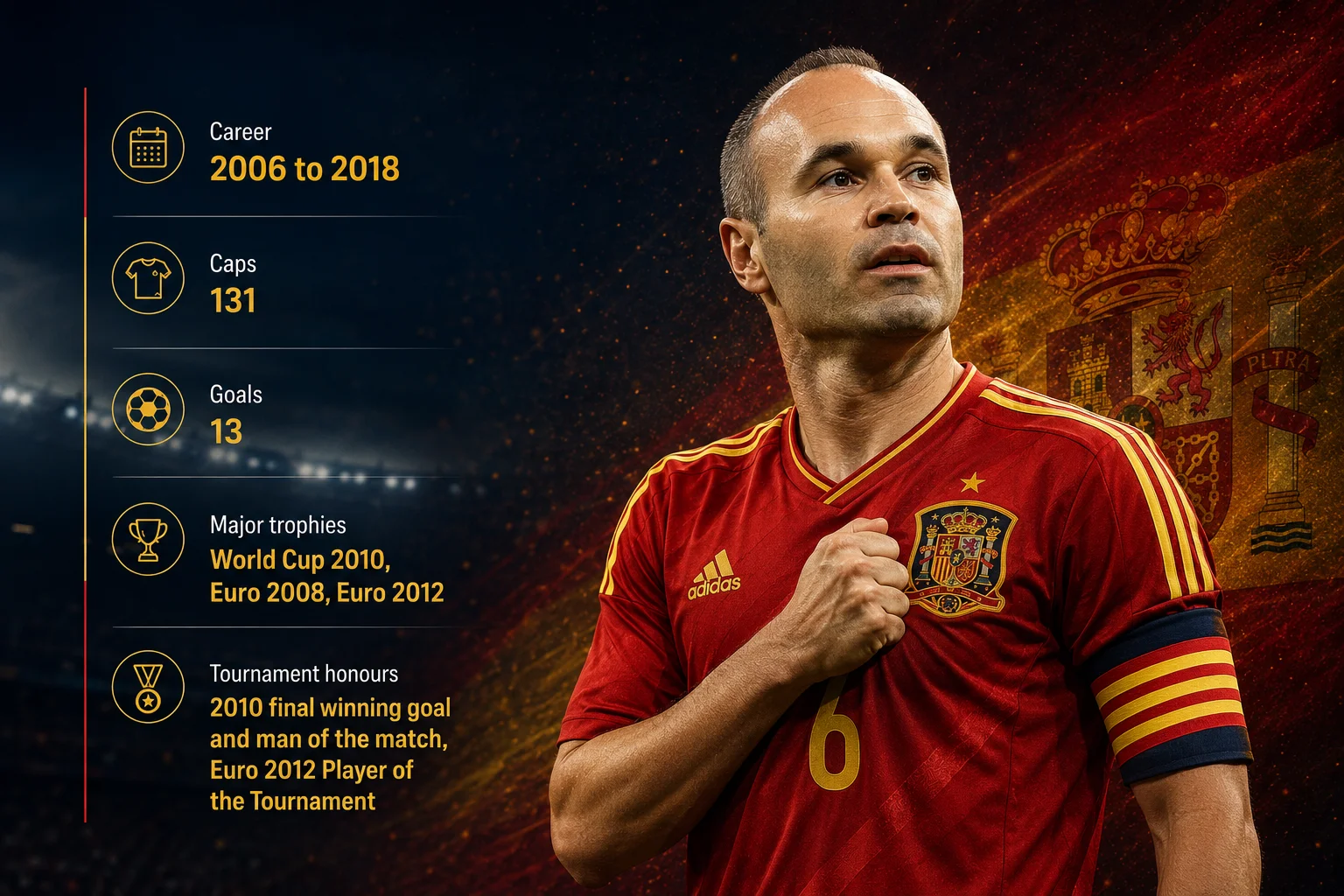
In the 116th minute in Johannesburg, Iniesta met Fabregas's pass on the half-volley and won Spain the World Cup, the most important goal in the country's history and the reason opposition fans at every Spanish ground applauded him for the rest of his career. He was man of the match in that final, player of the tournament at Euro 2012 and runner-up to Messi in the 2010 Ballon d'Or. At Barcelona he won nine league titles, four Champions Leagues and six Copas del Rey, tormenting Chelsea at Stamford Bridge in 2009 and dismantling united defences with a dribble that seemed to happen in slow motion. If this ranking measured pure aesthetics and single-moment weight, he would be first.
| Spain record | Detail |
|---|---|
| Career | 2006 to 2018 |
| Caps | 131 |
| Goals | 13 |
| Major trophies | World Cup 2010, Euro 2008, Euro 2012 |
| Tournament honours | 2010 final winning goal and man of the match, Euro 2012 Player of the Tournament |
1. Xavi Hernandez, the metronome the whole era ran through
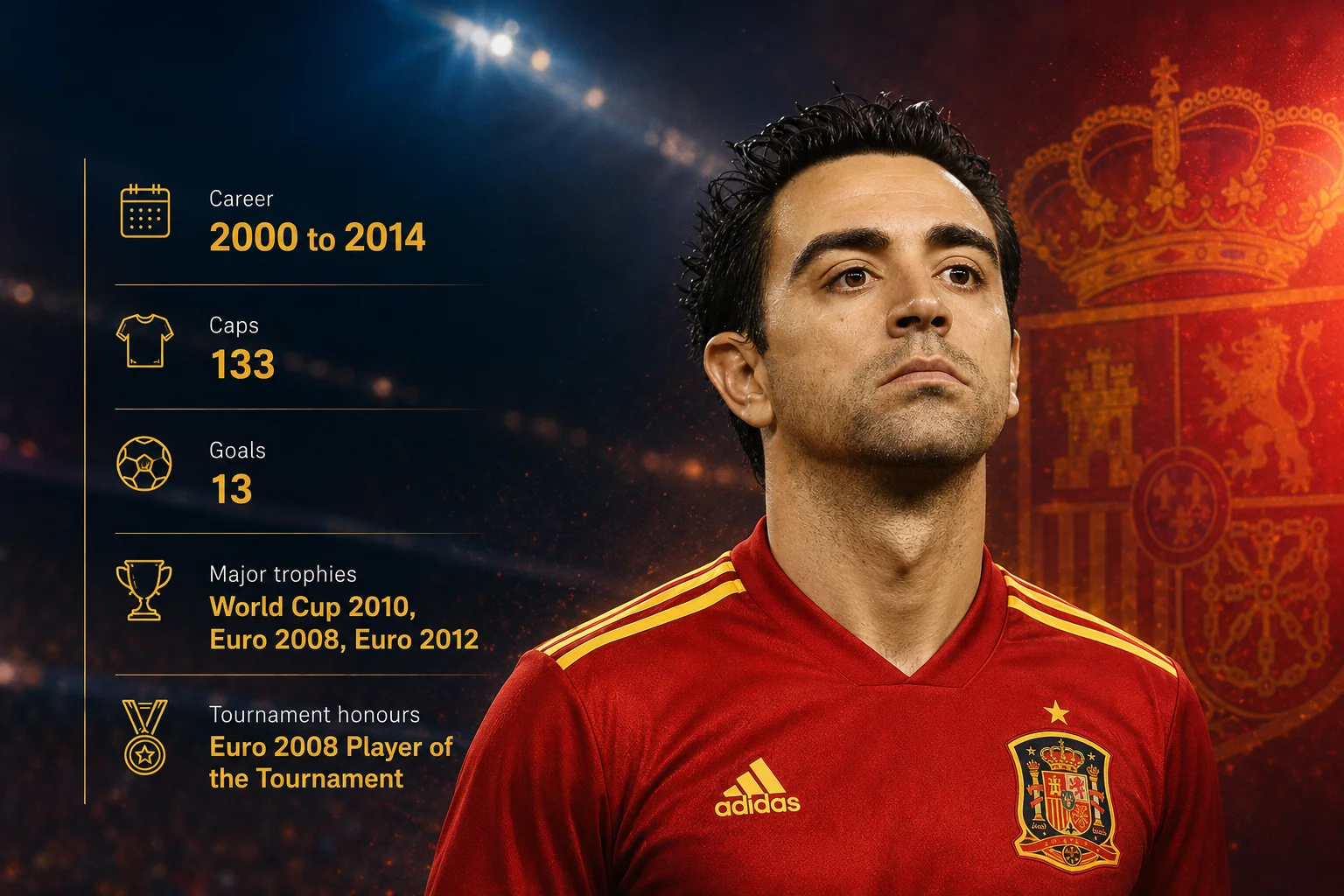
Every pass map of Spain's greatest years leads back to Xavi. He was player of the tournament at Euro 2008, delivered the corner for Puyol's semi-final winner and controlled the final at the 2010 World Cup, then set the record for pass completion as Spain retained the Euros in 2012. He finished third in the Ballon d'Or three years running from 2009 to 2011, kept off the top step only by Messi and Cristiano Ronaldo at their absolute peaks. With eight league titles, four Champions Leagues and 133 caps, he did not just win everything; he authored the style, tiki-taka's tempo and geometry, that made a whole footballing nation the world's reference point. Iniesta scored the goal, Casillas lifted the cups, but Xavi is why the ball got there.
| Spain record | Detail |
|---|---|
| Career | 2000 to 2014 |
| Caps | 133 |
| Goals | 13 |
| Major trophies | World Cup 2010, Euro 2008, Euro 2012 |
| Tournament honours | Euro 2008 Player of the Tournament |
FAQs
1. How many Spain internationals have won the Ballon d'Or?
-
Three: Di Stefano in 1957 and 1959, Luis Suarez in 1960 and Rodri in 2024.
2. Why did none of the 2010 winners take the Ballon d'Or?
-
The 2010 award went to Messi ahead of Iniesta and Xavi, a result still widely debated given Spain had just won the World Cup.
3. Which women would make an equivalent Spanish list?
-
Aitana Bonmati and Alexia Putellas, with five Ballon d'Or Feminin wins between them plus the 2023 World Cup, would head any all-time Spanish women's ranking.
4. Who narrowly missed this top 20?
-
Fernando Hierro, Ricardo Zamora, Amancio Amaro and Andoni Zubizarreta were the hardest omissions.
5. When do Spain play next at the 2026 World Cup?
-
They face Austria in the Round of 32 at SoFi Stadium in Los Angeles on 2 July 2026, having won Group H without conceding a goal.
Rankings like this are built to be argued with, and the next few weeks may force an edit or two of their own. If you enjoy the format, our ranking of the greatest Portuguese footballers makes a natural companion piece. Whichever names you would move, 1BoxOffice lists tickets for the World Cup knockout rounds and club fixtures across Europe, with the 150% money-back guarantee applied if a listed event is cancelled.
Sources: UEFA, World Cup match records, ESPN, BBC Sport, The Guardian, Al Jazeera and published match reports. Player statistics are current to the 2026 World Cup.