In this guide
The Master List at a GlanceOne Rulebook, Rewritten Four TimesThe Oriundi: Italy's Borrowed World Cup WinnersDi Stéfano, Puskás and the ExilesSantamaría and Altafini: The Last Men Through the DoorWhen the Map Changed Underneath ThemThe Quiet Loophole: Senior Caps That Never CountedDiego Costa: The Most Hated Switch of the Modern EraThe Heritage Generation: Youth Caps, Second ThoughtsBrothers Divided: When the Rules Split FamiliesMunir El Haddadi: The 13 Minutes That Rewrote the LawWorld Cup 2026: The Switch Goes MainstreamWhat the Switches Cost, and What They WonFAQsSol Campbell could walk from Tottenham to Arsenal, Luís Figo could cross from Barcelona to Real Madrid, and however much the fans raged, nothing in the laws of the game stood in their way. A player can sign for his club's fiercest rival tomorrow. He cannot do the same with his country: international football ties a footballer to one flag, and the rare men who wore two are the reason the rules governing players who played for two countries have been rewritten four times.
No one embodies how much is at stake like Luis Monti, who received death threats before the 1930 World Cup final and again before the 1934 final, from opposite directions. In 1930, according to his granddaughter Lorena, Uruguayans wanted to hurt him if Argentina won; in 1934, with Mussolini's regime demanding the trophy, Italians wanted to hurt him if Italy lost. He lost the first final in Argentina's shirt and won the second in Italy's, the only man ever to play in two World Cup finals for two different nations. This is the full record: who did it, why they did it and what it cost them.
The subject has never been more current. At the tournament now deep into its knockout rounds across the USA, Mexico and Canada, roughly one in four squad members represents a country other than the one they were born in, and several previously wore another nation's shirt at senior level. Fans following the remaining rounds can find World Cup 2026 tickets for every fixture still to be played as those stories unfold on the pitch.
The Master List at a Glance
Before the stories, the record. The table below covers every major case in this article, grouped by what made the move possible. It is not exhaustive, because hundreds of players have switched at youth level, but it captures the senior-level cases that mattered most.
| Player | First nation | Second nation | Era | What enabled it |
|---|---|---|---|---|
| Luis Monti | Argentina | Italy | 1930s | Pre-rule naturalisation |
| Raimundo Orsi | Argentina | Italy | 1930s | Pre-rule naturalisation |
| Attilio Demaría | Argentina | Italy | 1930s | Pre-rule naturalisation |
| Josef Bican | Austria | Czechoslovakia | 1930s-40s | Pre-rule naturalisation |
| László Kubala | Czechoslovakia, Hungary | Spain | 1940s-50s | Defection and naturalisation |
| Alfredo Di Stéfano | Argentina (Colombia unrecognised) | Spain | 1940s-60s | Naturalisation |
| Ferenc Puskás | Hungary | Spain | 1940s-60s | Defection and naturalisation |
| José Santamaría | Uruguay | Spain | 1950s-60s | Naturalisation |
| José Altafini | Brazil | Italy | 1958-62 | Naturalisation, last before the 1962 lock |
| Robert Prosinečki | Yugoslavia | Croatia | 1990s | State dissolution |
| Robert Jarni | Yugoslavia | Croatia | 1990s | State dissolution |
| Davor Šuker | Yugoslavia (squad) | Croatia | 1990s | State dissolution |
| Andrei Kanchelskis | USSR, CIS | Russia | 1990s | State dissolution |
| Matthias Sammer | East Germany | Germany | 1990 | Reunification |
| Thiago Motta | Brazil | Italy | 2003-16 | Dual-nationality switch provision |
| Jermaine Jones | Germany | USA | 2008-17 | Friendlies only for first nation |
| Alex Bruce | Rep. of Ireland | Northern Ireland | 2007-13 | Friendlies only for first nation |
| Denzel Dumfries | Aruba | Netherlands | 2014-present | Friendlies only for first nation |
| Vurnon Anita | Netherlands | Curaçao | 2010-present | Friendlies only for first nation |
| Nacer Chadli | Morocco | Belgium | 2010-21 | Friendly only for first nation |
| Diego Costa | Brazil | Spain | 2013-18 | Friendlies only for first nation |
| Wilfried Zaha | England | Ivory Coast | 2012-23 | Friendlies only for first nation |
| Declan Rice | Rep. of Ireland | England | 2018-present | Friendlies only for first nation |
| Geoffrey Kondogbia | France | Central African Rep. | 2013-present | Friendlies only for first nation |
| Kevin-Prince Boateng | Germany (youth) | Ghana | 2010-14 | 2009 removal of age limit |
| Munir El Haddadi | Spain | Morocco | 2014-present | 2020 Article 9 reform |
| Steven Caulker | England | Sierra Leone | 2012-present | Friendly only for first nation |
| Aymeric Laporte | France (youth) | Spain | 2021-present | 2020 legal-certainty clause |
| Iñaki Williams | Spain | Ghana | 2016-present | Friendly only for first nation |
| Yunus Musah | England (youth) | USA | 2020-present | Youth caps do not tie |
| Brahim Díaz | Spain | Morocco | 2021-present | Friendly only for first nation |
| Aaron Wan-Bissaka | England (youth) | DR Congo | 2025-present | Youth caps do not tie |
| Ayyoub Bouaddi | France (youth) | Morocco | 2026 | Youth caps do not tie |
One Rulebook, Rewritten Four Times
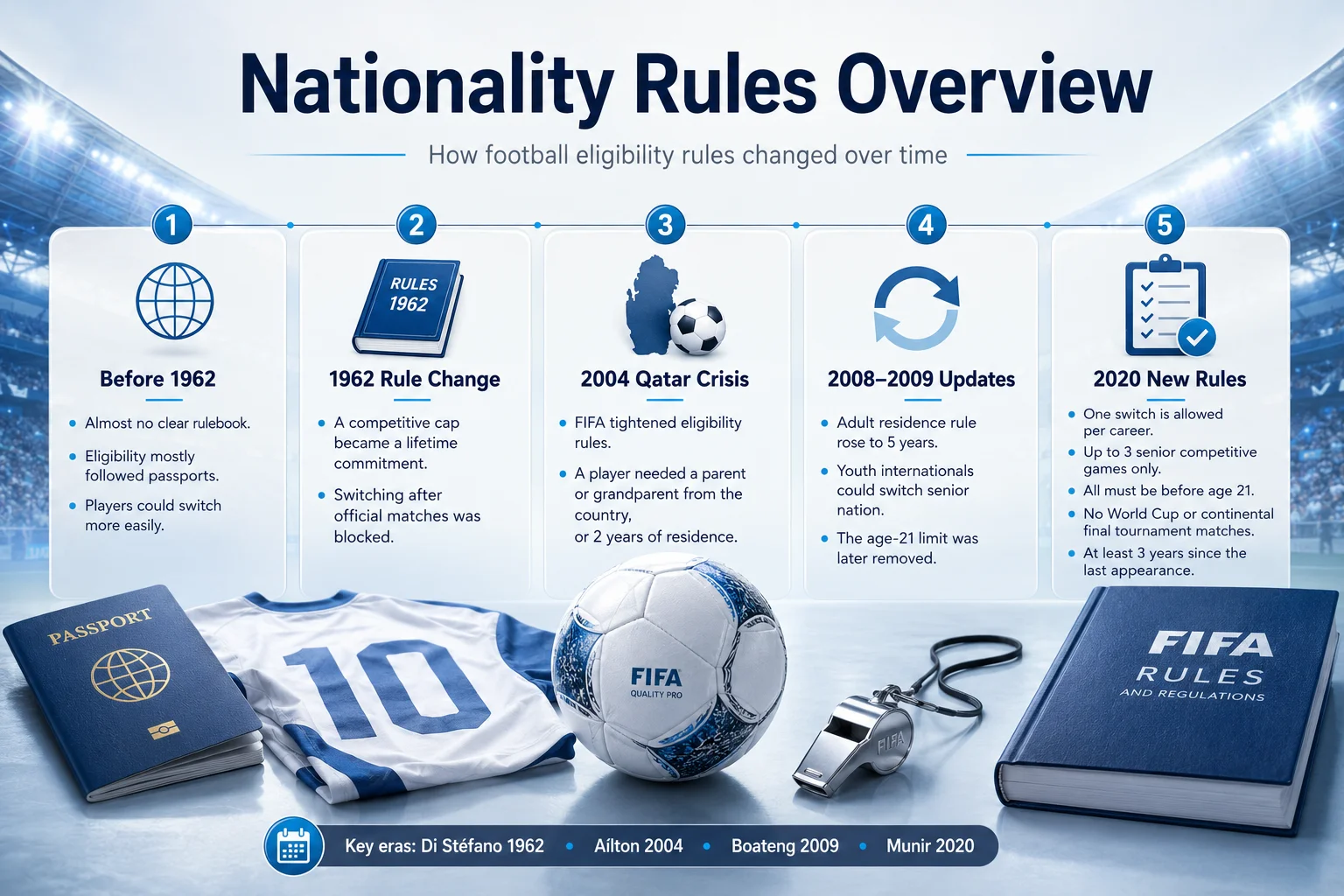
None of these careers makes sense without the rulebook that framed them, because every generation of switchers produced the next generation's rules. For the first half of the twentieth century there was effectively no rulebook at all. Eligibility followed passports, passports could be acquired, and clubs in Italy and Spain used exactly that mechanism to import ready-made internationals. The first correction came after the abuses of the 1950s: once Ferenc Puskás, José Santamaría and José Altafini had all appeared at World Cups for second nations, FIFA introduced stipulations around the 1962 tournament establishing that a player capped in a competitive fixture could not switch. The change is universally read as a reaction to the Di Stéfano and Puskás era, though the attribution is a consensus reading of the period rather than a single documented FIFA statement. Either way, the competitive cap became a lifetime commitment for four decades.
The 2004 crisis then reshaped the law again, and it deserves telling in full because it nearly broke international football's basic premise. In early 2004 Qatar attempted to naturalise three Brazilian players with no connection whatsoever to the country: the Werder Bremen striker Aílton, then the Bundesliga's top scorer, who was reportedly offered around $1 million, along with Dedé and Leandro. None had a Qatari parent, grandparent or day of residence. FIFA's emergency committee moved within weeks, ruling in March 2004 that a player must have at least one parent or grandparent born in the country he wishes to represent, or have lived there for at least two years. Sepp Blatter treated the episode as a personal priority and spent years warning, in characteristically blunt terms, that without the rule half the teams at a future World Cup would be stocked with naturalised Brazilians. In 2008 the residence requirement for players aged 18 and over was raised to five years.
The same year as the Qatar ruling, FIFA formalised the youth-to-senior switch, letting a player capped at junior level commit to a different senior nation before turning 21; Antar Yahia, a France youth international who chose Algeria, was the first through the door. In 2009 the age-21 deadline was removed, unlocking Kevin-Prince Boateng's move to Ghana months later. Then on 18 September 2020, at its 70th Congress, FIFA approved the biggest overhaul yet to Article 9 of its eligibility regulations: a player may now change association even after senior competitive appearances, provided he made no more than three, all before turning 21, none at the final tournament of a World Cup or continental championship, with at least three years passed since the last one. Only one switch is permitted per career, with a narrow reversal provision. Each of the four rewrites has a name attached: Di Stéfano in 1962, Aílton in 2004, Boateng in 2009 and, as this article will come to, Munir El Haddadi in 2020.
The Oriundi: Italy's Borrowed World Cup Winners
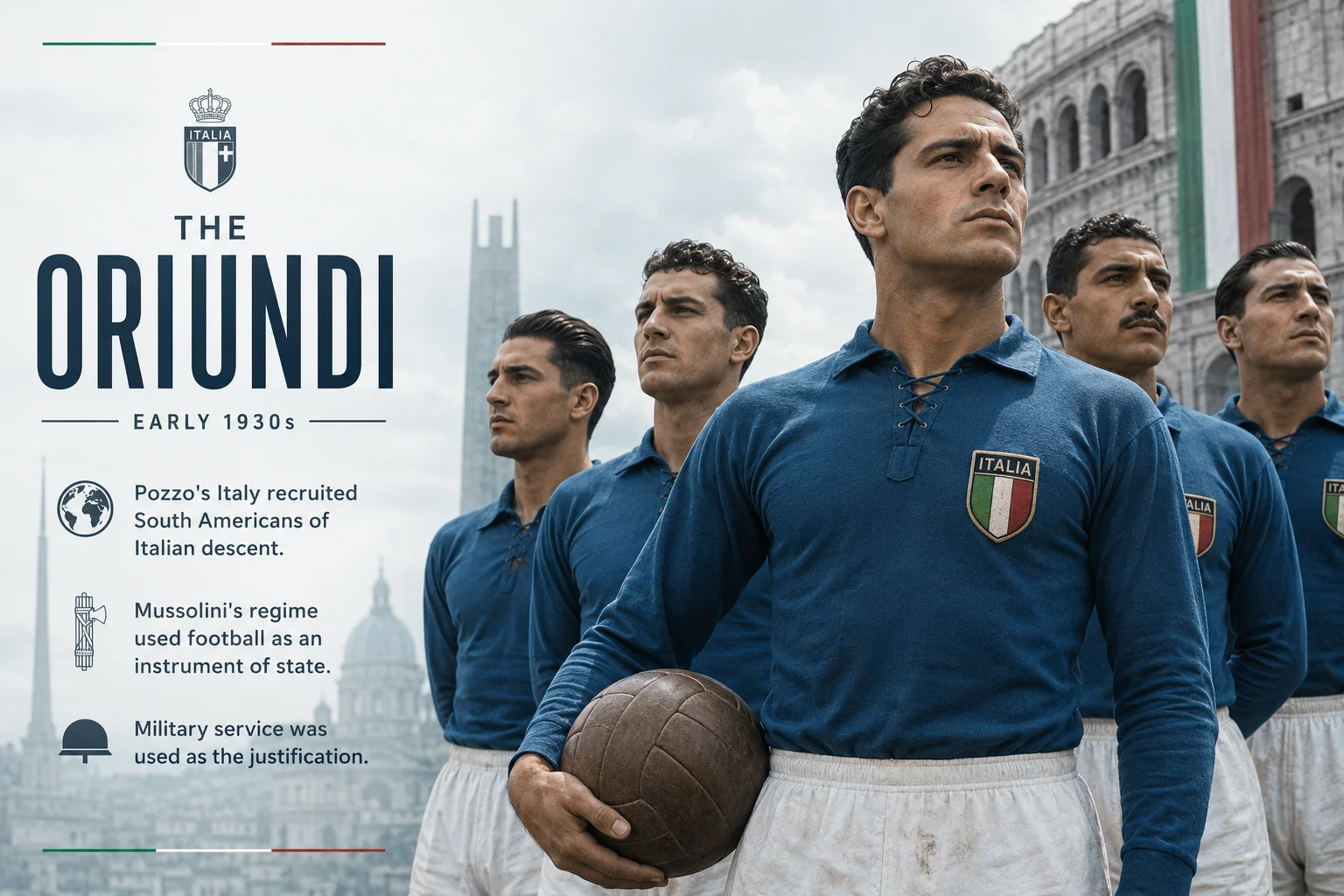
The first great wave was political. In the early 1930s Vittorio Pozzo's Italy recruited the oriundi, South Americans of Italian descent, with the encouragement of Mussolini's regime, which treated the national team as an instrument of state. The justification of the era was blunt: the oriundi had performed Italian military service, and Pozzo reasoned that men who could die for Italy could certainly play football for it.
Luis Monti was the headline act. A ferocious defensive midfielder, he anchored Argentina at the 1930 World Cup, played the final under those death threats and lost it 4-2 to Uruguay in Montevideo. Juventus signed him in 1931, citizenship followed through his Romagnol ancestry, and by 1934 he was the pivot of the Italy side that beat Czechoslovakia 2-1 in Rome to win the World Cup on home soil, this time threatened with violence should he fail. He won four consecutive Serie A titles at Juventus along the way. Two tournaments, two nations, one runners-up medal and one winners' medal: a double the rulebook has made unrepeatable.
He was not alone. Raimundo Orsi, an Olympic silver medallist with Argentina in 1928, joined Juventus that year as the trailblazing oriundo and scored Italy's famous equaliser in the 1934 final, finishing with 13 caps for Argentina against 35 for Italy. Attilio Demaría, another member of Argentina's 1930 squad, also appeared for Italy in 1934. Argentina, stripped of stars it could not pay European wages, sent a deliberately weakened squad to that tournament and nursed the grievance for decades; Italy won consecutive World Cups in 1934 and 1938 with a model other federations quietly noted. One more name belongs to this lawless era: Josef Bican, among the most prolific goalscorers the game has produced, played for both Austria and Czechoslovakia as club moves and shifting borders redrew his citizenship, and in the eyes of the Czech federation his scoring record still stands above Cristiano Ronaldo's.
WhatsApp channel
Sports news straight to your phone
Match updates, on-sale dates and ticket news from 1BoxOffice.
Di Stéfano, Puskás and the Exiles
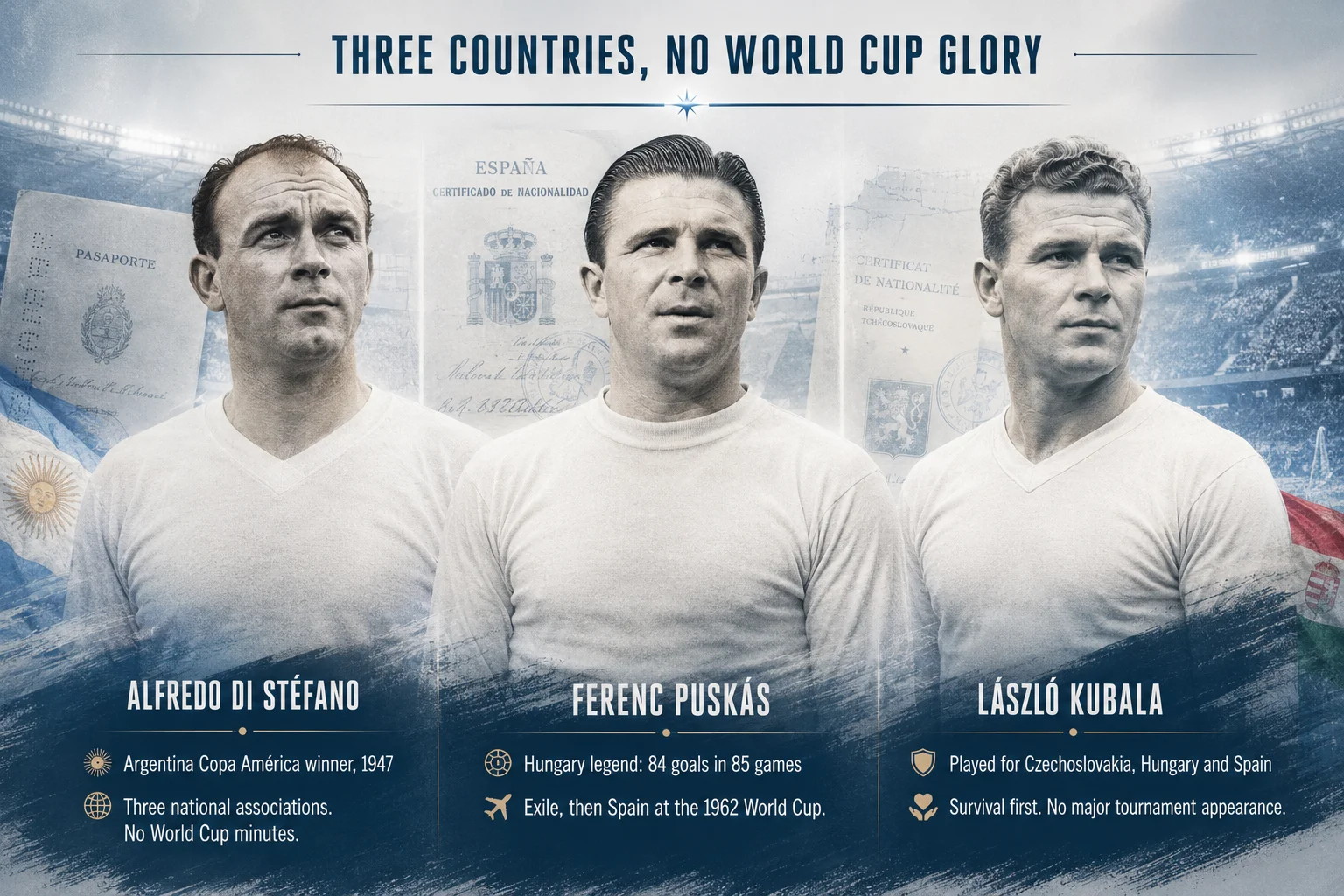
Alfredo Di Stéfano is the most decorated player never to appear at a World Cup, and his three-country career is the reason. He won the 1947 Copa América with Argentina, scoring six goals in his six caps. The 1949 Argentine players' strike drove him to the breakaway El Dorado league in Colombia, where Millonarios paid wages South American football could not match by operating outside FIFA's transfer system; while there he turned out four times for a Colombia side whose matches FIFA never recognised. His transfer to Real Madrid in 1953 brought Spanish naturalisation in 1956 and 23 goals in 31 appearances for Spain, alongside five consecutive European Cups. The repercussions were cruel in their precision. FIFA barred him from further Argentina appearances over the unsanctioned Colombia games, Spain failed to qualify for the 1958 World Cup at his peak, and when they reached the 1962 finals injury kept the 35-year-old off the pitch for all three matches. Three national associations, not a single World Cup minute.
If Di Stéfano's switches were commercial, Ferenc Puskás's was a matter of survival. The captain of the Mighty Magyars scored 84 goals in 85 matches for Hungary, won the 1952 Olympic title and lost the 1954 World Cup final 3-2 to West Germany. When Soviet forces crushed the Hungarian Revolution in November 1956, Puskás was abroad with Honvéd for a European Cup tie and refused to return. The price was steep: the communist regime opened a treason file on him codenamed Wanderer, kept it active for 14 years and suppressed news of his career; he did not set foot in Hungary again until 1981 and received a full pardon only in 1993. FIFA banned him for roughly two years, Italian clubs judged him too old and too heavy, and Real Madrid gambled on a 31-year-old in 1958. The gamble returned five straight league titles and seven goals across two European Cup finals; naturalised, he added four caps for Spain and a goalless 1962 World Cup.
László Kubala's road was harder still. He fled Soviet-occupied Hungary in 1949 hidden in the back of a truck among refugees. The Hungarian federation pursued him, FIFA imposed a one-year ban for breach of contract, desertion and evading military service, and Franco's Spain then fast-tracked his citizenship and turned his story into Cold War propaganda, complete with a feature film. Already capped by Czechoslovakia and Hungary, Spain became his third national team while he defined Barcelona in the 1950s; named in Spain's 1962 World Cup squad, he was injured and never played a major tournament. Sándor Kocsis and Zoltán Czibor, his compatriots from the 1954 final, also rebuilt at Barcelona. For all of these men the decision was survival first and football second, and the cost was permanent exile from the crowds that had made them.
Santamaría and Altafini: The Last Men Through the Door
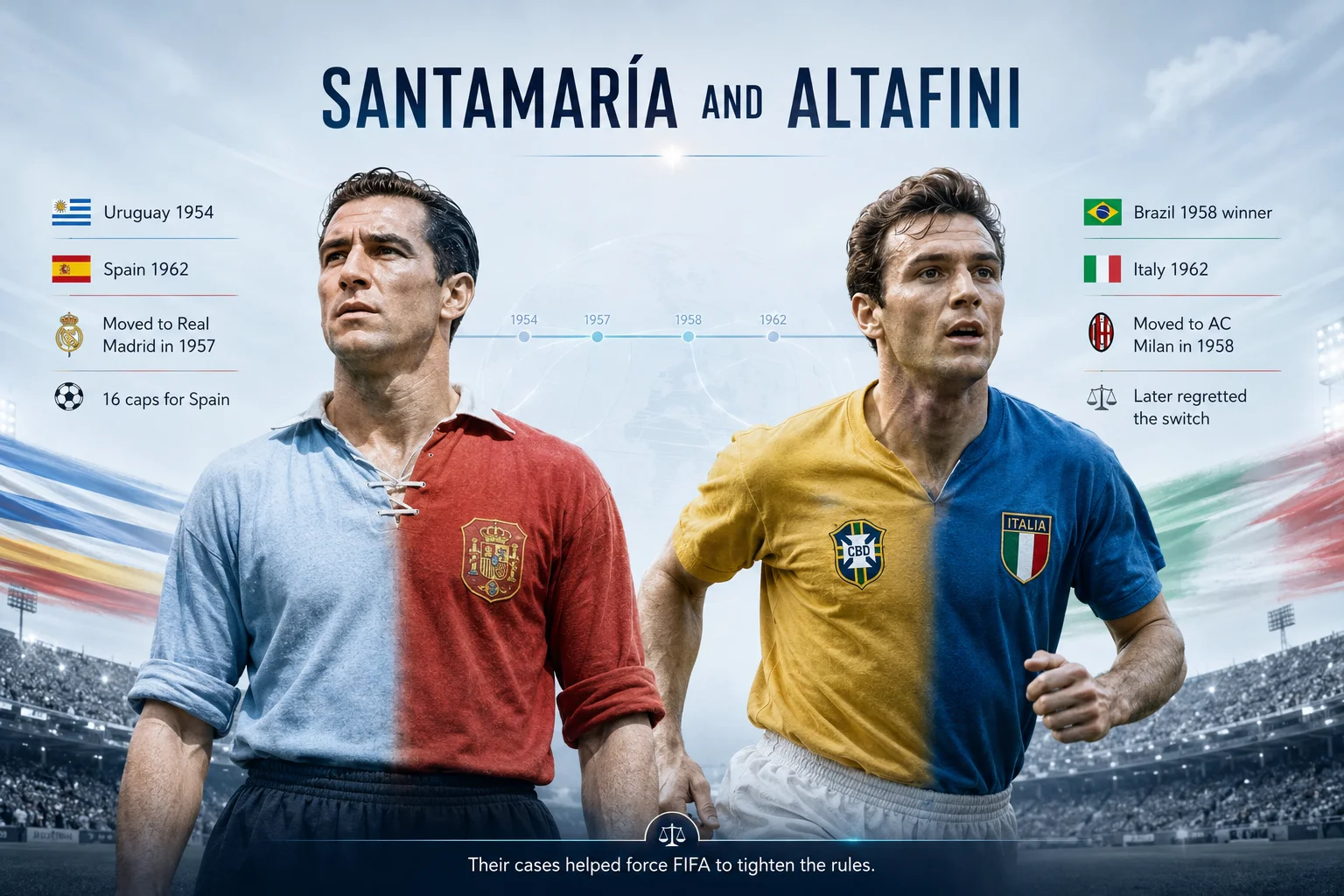
Two more cases completed the pattern that forced FIFA's hand. José Santamaría, the granite Uruguayan centre-half, played at the 1954 World Cup for Uruguay, who finished fourth, joined Real Madrid in 1957 and reappeared at the 1962 World Cup as a Spain international. Even his statistics carry the untidiness of the era: his 16 Spain caps are consistent across sources, but his Uruguay total is recorded as 20 in some references and 25 in Real Madrid's and UEFA's obituaries, a discrepancy never resolved before his death in Madrid in April 2026 at the age of 96.
José Altafini went one better on speed. He won the 1958 World Cup with Brazil as a 20-year-old, nicknamed Mazzola for his resemblance to the Italian great Valentino Mazzola, transferred to AC Milan that summer and by 1962 was playing in the World Cup for Italy through his Trentino heritage. Brazil at the time effectively overlooked players based in Europe, which made the choice feel forced; decades later Altafini admitted he regretted playing the 1962 tournament for Italy rather than the country of his birth. The sporting returns were thin, with Spain and Italy both out at the group stage in 1962, and the governing body had seen enough. For nearly six decades afterwards, no established senior international legally pulled on a second country's shirt by choice.
When the Map Changed Underneath Them
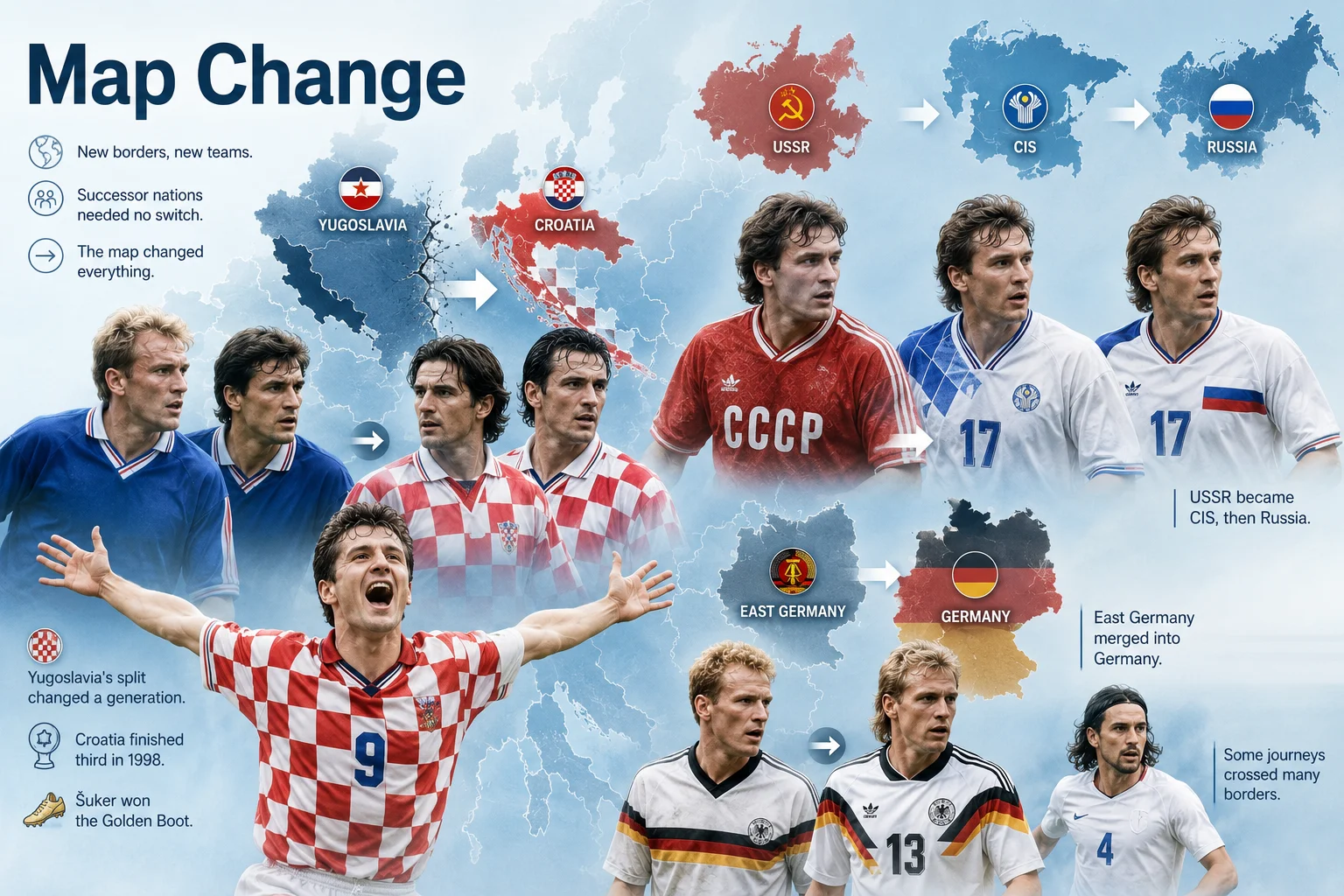
The second category of two-nation players chose nothing at all. When states dissolve, FIFA treats successor nations as new associations, so players capped by the old country may represent the new one without any switch procedure. The collapse of Yugoslavia produced the most consequential examples. The country's 1987 World Youth Championship-winning generation, including Robert Prosinečki, Zvonimir Boban, Davor Šuker, Predrag Mijatović and Alen Bokšić, was split by the wars of 1991 to 1995. Prosinečki and Robert Jarni played for Yugoslavia at the 1990 World Cup and for Croatia at the 1998 tournament, where Croatia finished third on debut and Šuker, an unused squad member in 1990, won the Golden Boot with six goals. The counterfactual of a unified Yugoslav side at France 98 remains one of the game's great what-ifs.
The Soviet collapse produced its own multi-shirt careers, Andrei Kanchelskis representing the USSR, the short-lived CIS at Euro 92 and then Russia without ever making a choice a modern fan would recognise. German reunification folded East Germany's internationals into a single team after the DFV merged into the DFB in November 1990, with eight players capped by both: Matthias Sammer won 23 East Germany caps, then Euro 96 with Germany and that season's European Footballer of the Year award, while Ulf Kirsten split his century of caps almost exactly in half. The repercussions were mostly administrative, but not always. Selections in the former Yugoslavia carried the weight of a recent war, and Neven Subotić shows how tangled the map could get: born in Yugoslavia, raised partly in Germany and the USA, capped by American youth teams, he committed to Serbia after a falling-out with a US youth coach and starred in Serbia's 1-0 win over Germany at the 2010 World Cup.
The Quiet Loophole: Senior Caps That Never Counted
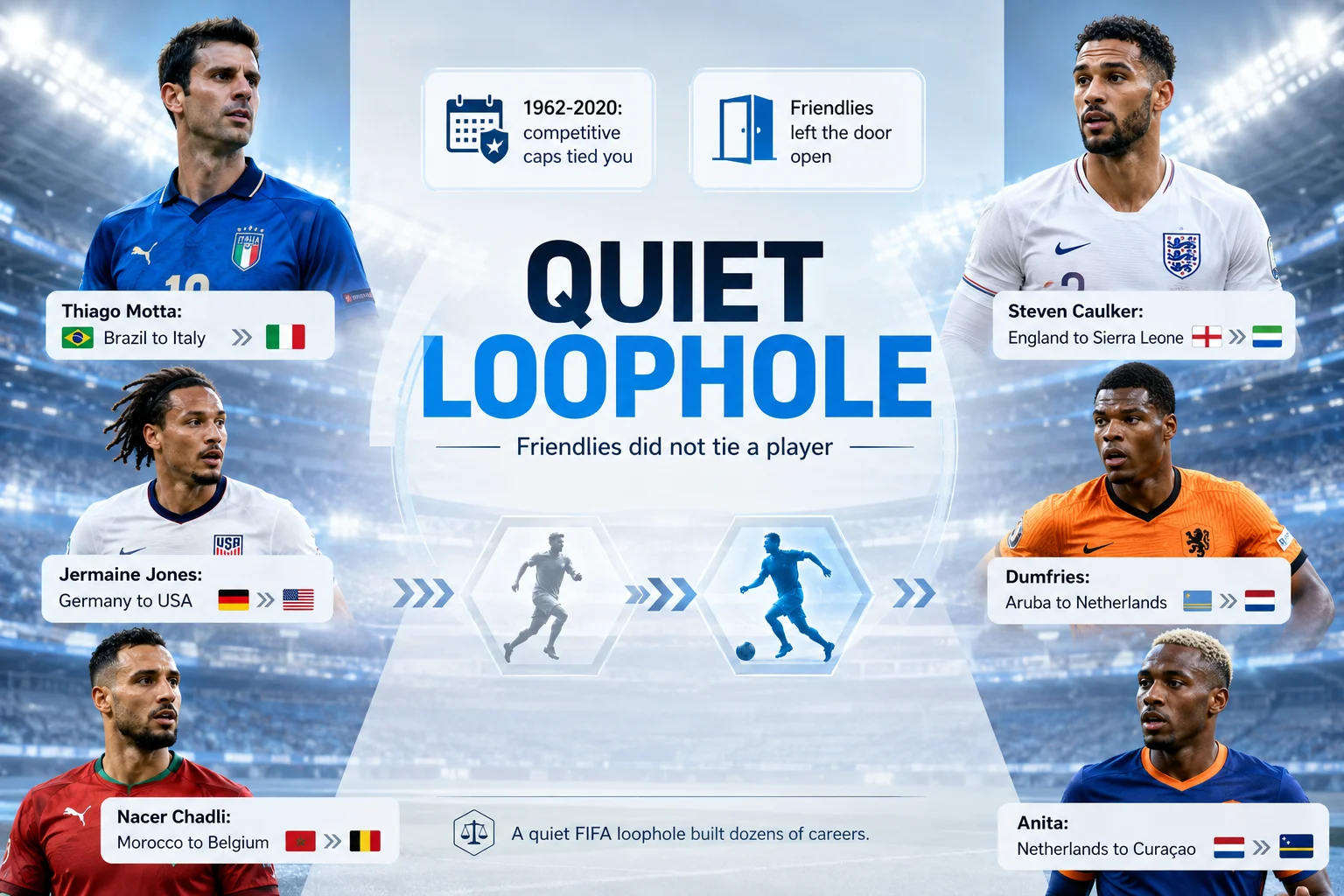
Between 1962 and 2020 the law looked absolute, but it contained one large exception that built dozens of careers: friendly matches never tied a player. A footballer could make senior appearances for one country and still switch, provided none came in a competitive fixture. Thiago Motta is the most instructive case because his caps were not friendlies. Brazil fielded him twice at the 2003 Gold Cup, competitive matches by any definition, yet a FIFA provision for players holding dual nationality at the time of their first cap allowed him to change association, and from 2011 he built a 30-cap Italy career spanning Euro 2012, the 2014 World Cup and Euro 2016. Jermaine Jones travelled the same road in reverse gear: three friendlies for Germany, then 69 caps for the USA and a thunderous goal against Portugal at the 2014 World Cup. Alex Bruce, son of Steve Bruce, holds the oddest distinction here, having played friendlies for both the Republic of Ireland and Northern Ireland.
The Caribbean-Dutch corridor produced two mirror-image careers, Vurnon Anita leaving three Netherlands caps behind for Curaçao while Denzel Dumfries left two Aruba caps behind for the Netherlands. Nacer Chadli ran the loophole in the least expected direction: called up by Morocco and named man of the match on his friendly debut, he declared for Belgium anyway and scored the stoppage-time winner against Japan at the 2018 World Cup as Belgium finished third. Geoffrey Kondogbia left France after friendly appearances to captain the Central African Republic, a switch with no sporting upside whatsoever, which is precisely what made it admirable. Steven Caulker, capped once by England in a 2012 friendly, resurfaced as a Sierra Leone international in 2021.
Diego Costa: The Most Hated Switch of the Modern Era
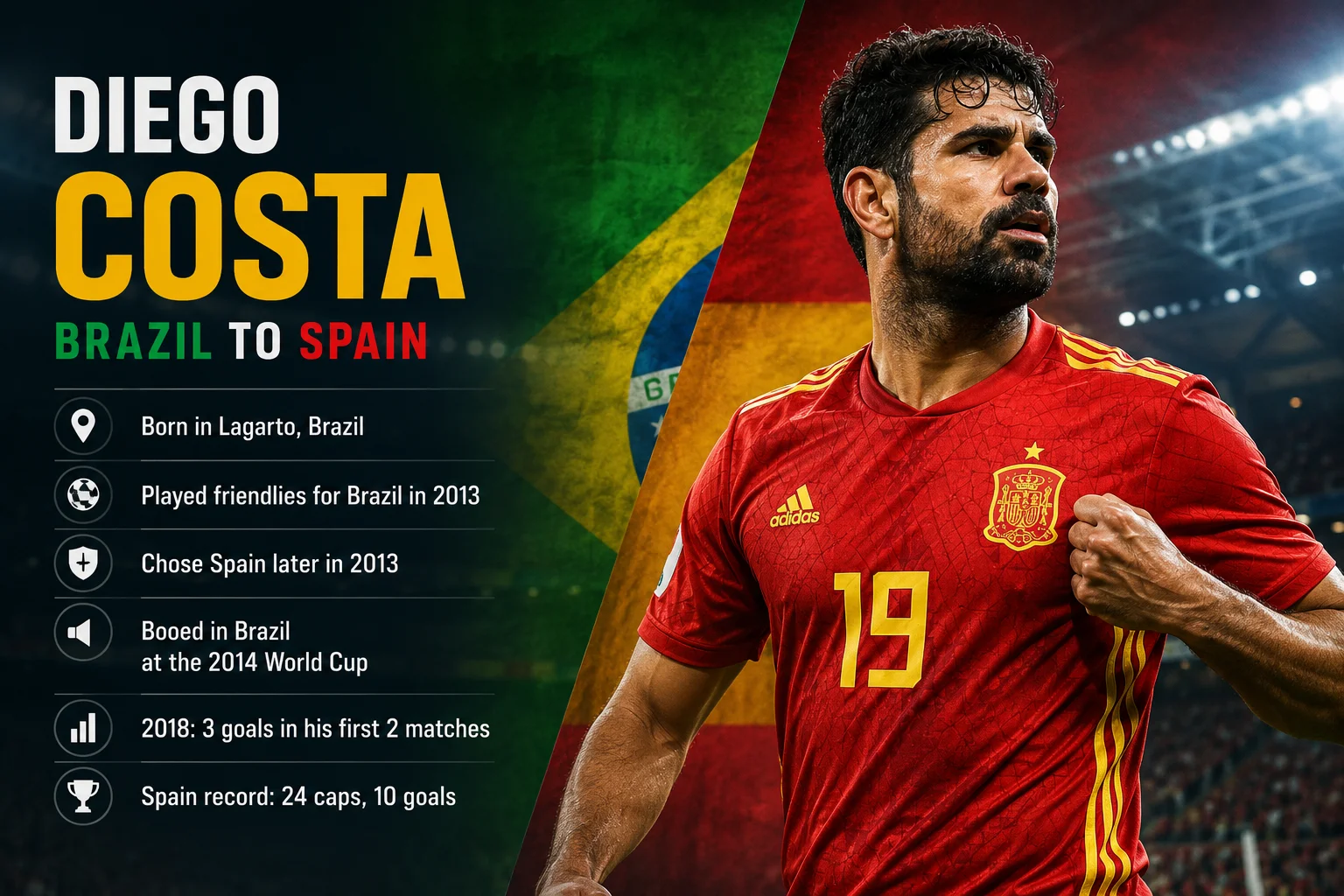
No case tested public opinion like Diego Costa's, because no case was so nakedly sporting. Born in Lagarto in Brazil's north-east, with no family connection to Spain, Costa became one of Europe's most feared strikers at Atlético Madrid and earned a Brazil call-up in March 2013, playing friendlies against Italy and Russia. Later that year, having gained Spanish citizenship through residency, he informed the Brazilian federation he would play for Spain, describing it publicly as the country that had given him everything he had in life.
The reaction in Brazil was ferocious. Luiz Felipe Scolari, the manager who had capped him, accused him of turning his back on the dream of millions of Brazilians, and the federation explored whether his citizenship could be stripped. The timing sharpened everything: the 2014 World Cup was in Brazil, Spain played group matches there as holders, and Brazilian crowds booed Costa's every touch. The sporting gods offered no shelter. He arrived half-fit, Spain exited at the group stage and his revenge tour produced nothing. Three goals in his first two matches at the 2018 World Cup offered partial redemption before Spain again went out early, and he finished with 24 caps and 10 goals attached to a reputation he never repaired in the country of his birth.
The Heritage Generation: Youth Caps, Second Thoughts
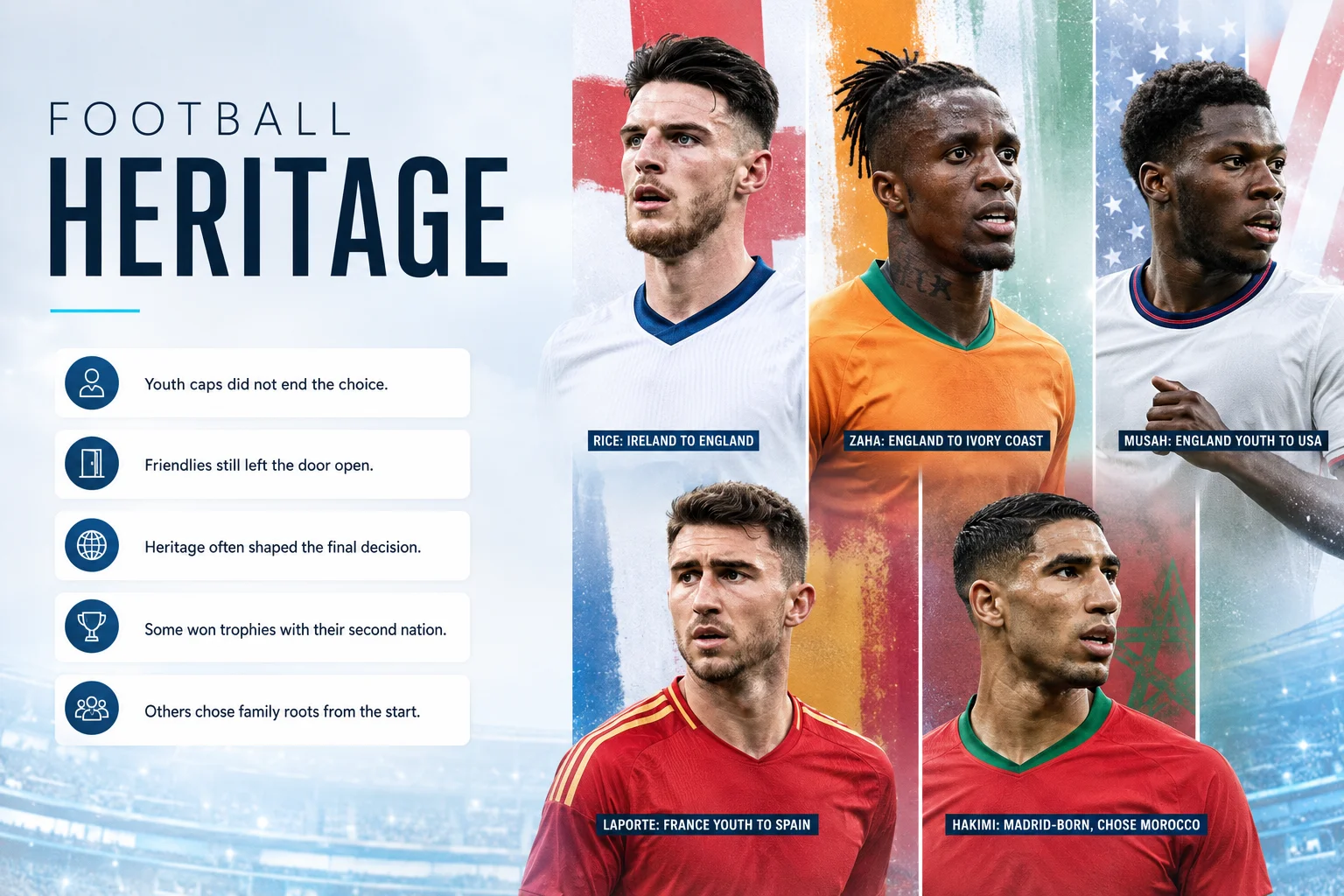
From 2004 onwards the typical two-nation footballer looked different again: developed by one country's system, capped at youth level or in senior friendlies, then committed competitively to another. The England-Ireland corridor generated the most heat. Declan Rice, London-born and Ireland-eligible through his Cork grandparents, won three senior friendly caps for Ireland in 2018, celebrating each with visible emotion. When he declared for England in February 2019, weighing England's run to the 2018 World Cup semi-finals against Ireland's decline, the reaction went far beyond punditry: he was branded a traitor and received death threats, abuse that has never entirely stopped. The rawness resurfaced in September 2024 when Rice scored against Ireland in Dublin and pointedly declined to celebrate. Jack Grealish's parallel move from Irish youth ranks, made before any senior cap and after being named Ireland's U21 Player of the Year, drew the same anger with less legal drama.
Wilfried Zaha travelled the corridor in the opposite direction. Born in Abidjan and raised in London from the age of four, he won two England friendly caps under Roy Hodgson and then watched the call-ups stop. Gareth Southgate tried personally to keep him; Zaha chose Ivory Coast in late 2016, saying he had never felt he belonged in the England setup, and won roughly 33 caps without ever quite getting the ending, missing both the squad that won the trophy on home soil and the 2026 World Cup. The France-to-Algeria pipeline has run hotter than any other, from Antar Yahia's rule-making switch in 2004 to its two most recent recruits: Houssem Aouar, capped once by France in a 2020 friendly, switched in March 2023 and said openly that he regretted having played for France at all, while Amine Gouiri, a France U21 international, committed six months later. Both made Algeria's 2026 World Cup squad, whose run ended against Switzerland in the round of 32.
Two switches in this generation ended in silverware for the second nation. Yunus Musah won more than 30 England youth caps before committing to the USA, the country of his birth, in March 2021, and started every match of their 2022 World Cup campaign at 19. Aymeric Laporte, a France youth international never capped at senior level, switched to Spain in 2021 via a legal-certainty clause in the 2020 rules and was a European champion three years later. Naturalisation kept producing pillars too: Deco arrived in the Portugal squad in 2003 over the public objection of Luís Figo, Pepe gave Portugal 141 caps and Euro 2016 without ever playing for Brazil, and Marcos Senna anchored Spain's Euro 2008 winning midfield. One non-switch completes the picture: Achraf Hakimi, born in Madrid and produced by Real Madrid's academy, committed to Morocco from the start in 2016 and now captains them.
Brothers Divided: When the Rules Split Families
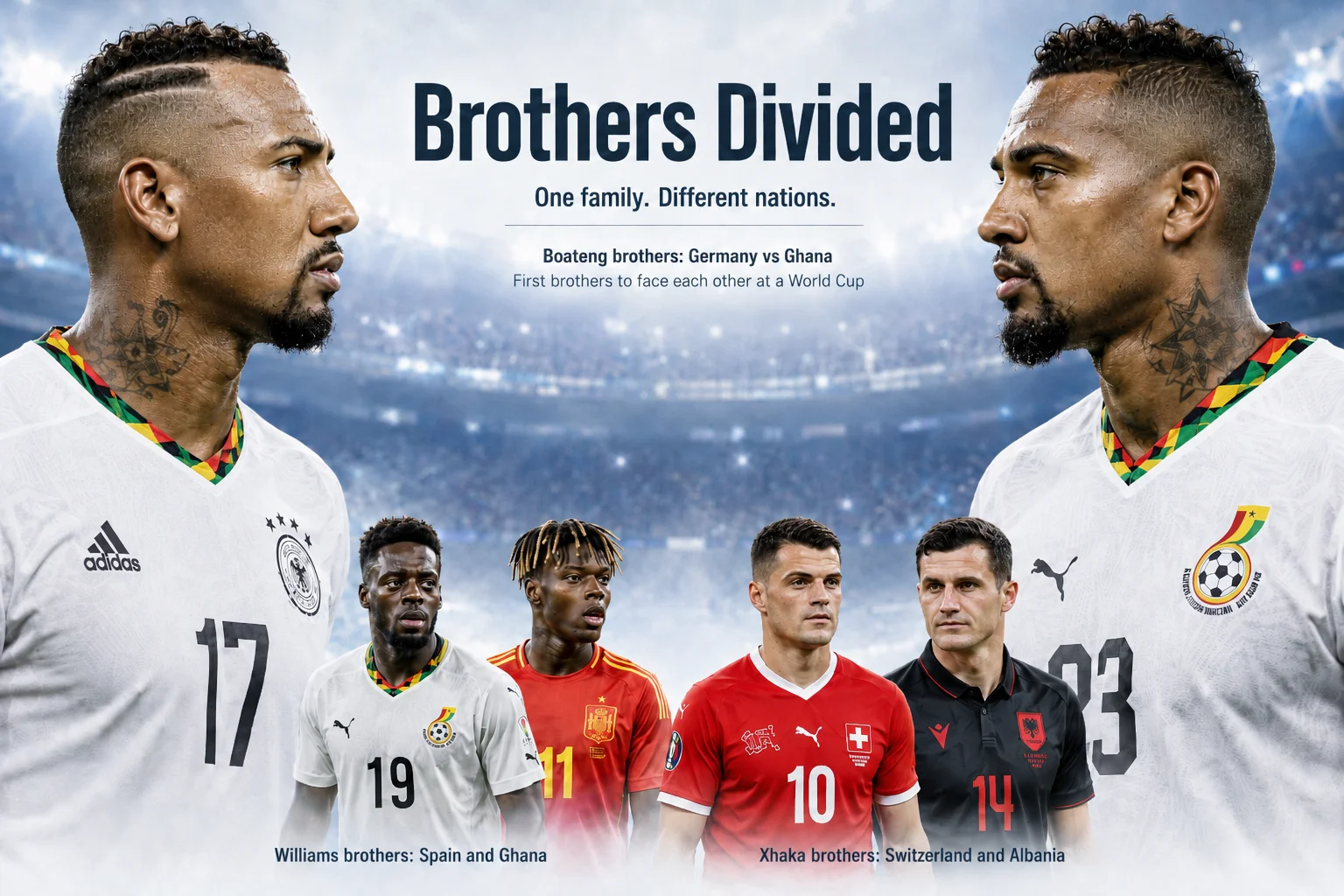
The starkest human consequences of the eligibility system show up inside single families. The Boateng brothers of Berlin are the defining case. Kevin-Prince and Jérôme, paternal half-brothers born to a Ghanaian father, both came through Hertha BSC and Germany's youth system. Jérôme rose into the senior Germany squad; Kevin-Prince, blocked and disillusioned, used FIFA's 2009 rule change to declare for Ghana in May 2010, weeks before the World Cup. Then came the tackle. In that month's FA Cup final, Kevin-Prince's challenge on Michael Ballack tore ankle ligaments, ruled the Germany captain out of the World Cup and effectively ended his international career. Germany erupted, Kevin-Prince called the reaction hypocritical, and Jérôme stopped speaking to his brother. On 23 June 2010 in Johannesburg the two became the first brothers in World Cup history to play on opposite sides, and they did it again in 2014. Kevin-Prince scored against the USA as Ghana reached the 2010 quarter-finals, then was sent home from the 2014 tournament over alleged abusive conduct and never played for Ghana again. Jérôme won the World Cup that same summer.
The Williams brothers of Bilbao split more gently but no less completely, and their story starts a generation earlier: their parents crossed the Sahara on foot and climbed the border fence at Melilla to reach Spain from Ghana. Iñaki played 11 minutes of one friendly for Spain in 2016, waited out the eligibility clock and debuted for Ghana in 2022, calling the choice the fulfilment of a family dream; Nico stayed with Spain and won Euro 2024. This summer both are at the same World Cup for different nations for the second tournament running, Iñaki's Ghana grinding out a goalless draw with England in Group L while Nico's Spain reached the last 16. The Xhakas of Basel had already normalised the divided household, Granit anchoring Switzerland while his older brother Taulant chose Albania and faced him at Euro 2016. The pattern keeps renewing itself at this World Cup: Désiré Doué plays for France while his brother Guéla chose Ivory Coast, and John Souttar's Scotland has a mirror in Harry Souttar's Australia.
Munir El Haddadi: The 13 Minutes That Rewrote the Law
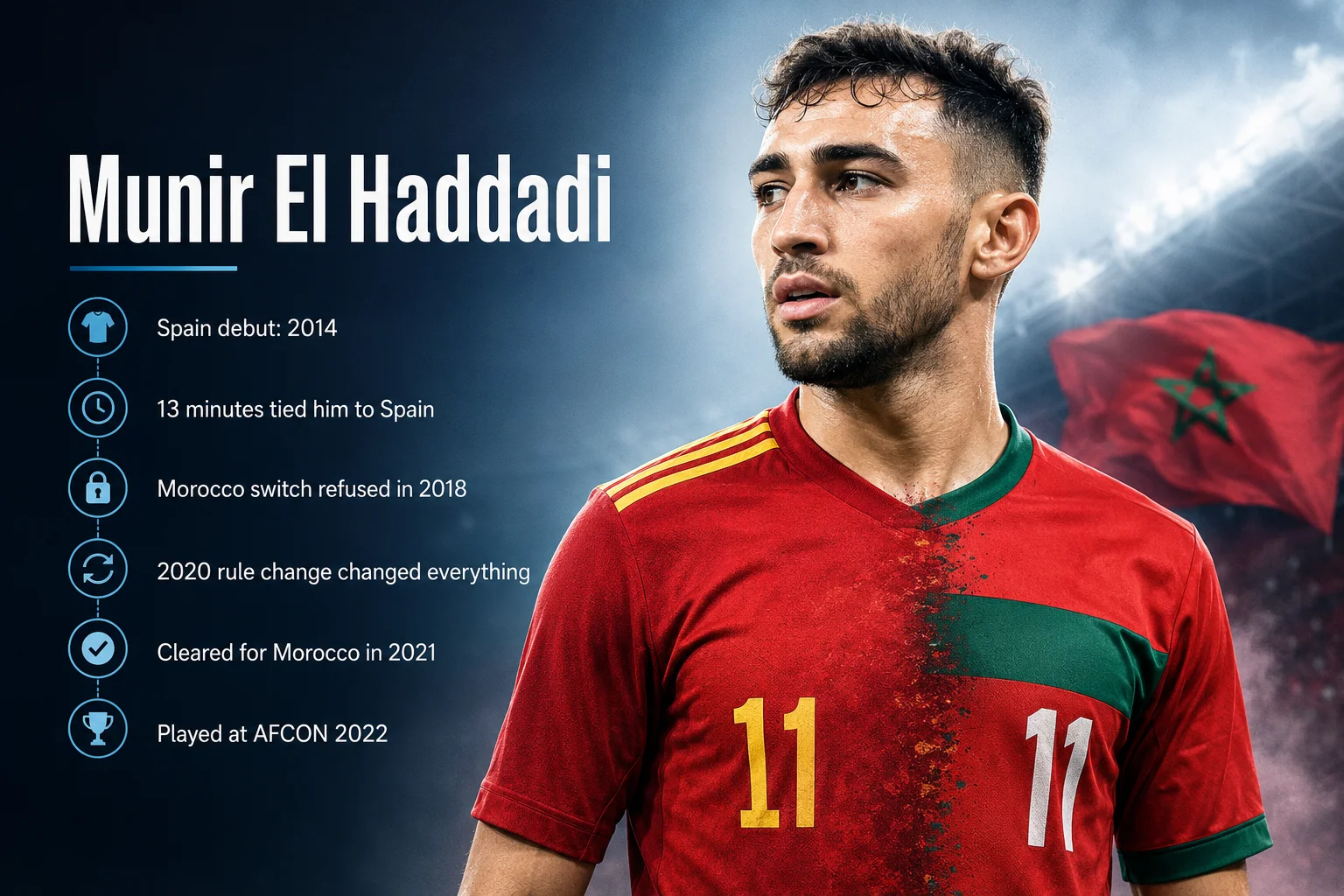
If one player embodies why FIFA changed the rules in 2020, it is Munir El Haddadi. In September 2014, aged 19, he came on as a 77th-minute substitute for Spain in a European Championship qualifier against Macedonia. Those 13 minutes, in a competitive fixture, tied him to Spain for life. Spain never picked him again. When Morocco, his father's country, wanted him for the 2018 World Cup, FIFA refused the switch and the Court of Arbitration for Sport upheld the refusal, first in 2018 and again in October 2020, in part because he had played Spain U21 matches after turning 21. His case became the reform movement's exhibit A, and the regret reached the top of Spanish football: Vicente del Bosque said publicly that he felt responsible for Munir's situation and believed he should be allowed to play for Morocco.
The September 2020 overhaul was drafted with exactly this hardship in view, and Morocco's federation had lobbied hard for it. Even then Munir needed the clarifying Commentary FIFA published in January 2021 before he was cleared. He debuted in a World Cup qualifier that March and played the 2022 Africa Cup of Nations: one substitute appearance for Spain, a full international career for Morocco, the first genuine, lawful return of the two-country senior footballer since 1962, this time by regulation rather than loophole.
World Cup 2026: The Switch Goes Mainstream
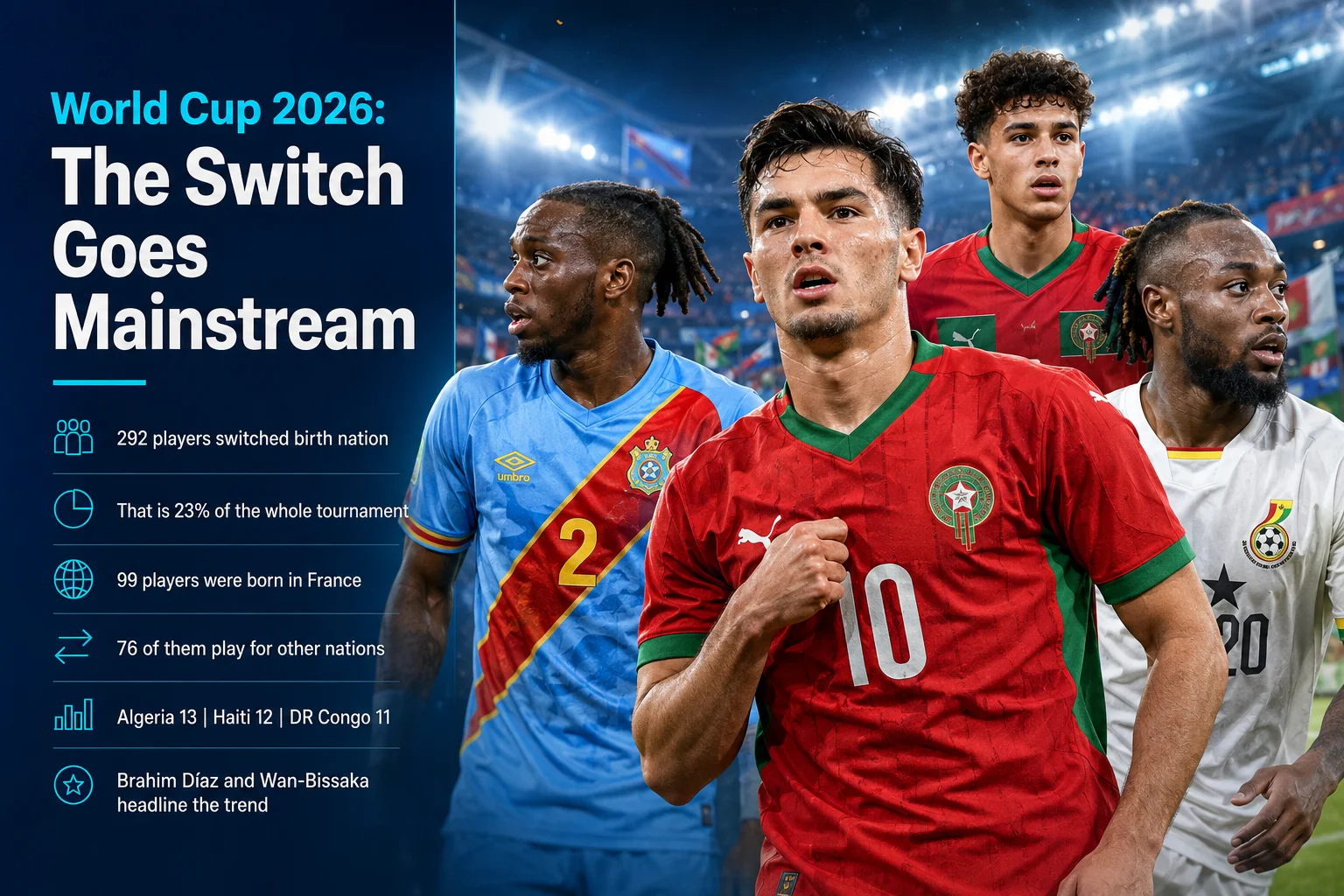
The tournament unfolding now is the fullest expression of everything above, and the numbers are startling. Of the 1,248 players selected across the 48 squads, 99 were born in France, and 76 of those 99 represent nations other than France; only 23 play for France itself. Algeria's squad contains 13 French-born players, Haiti's 12 and DR Congo's 11, and the French-born contingent has roughly doubled since Russia 2018, when it stood at about 50. In total, around 292 players, some 23 per cent of everyone at the World Cup, represent a country other than the one they were born in.
Morocco field the two marquee cases. Brahim Díaz, Malaga-born, scored on his single senior Spain appearance in June 2021 before FIFA processed his switch in March 2024 after a sustained recruitment effort in which then coach Walid Regragui was personally involved. The return has been extraordinary and agonising in equal measure: at the Africa Cup of Nations on home soil this January he became the first player to score in each of his first five AFCON appearances, won the Golden Boot with five goals, then missed a 97th-minute Panenka in the final against Senegal, who won in extra time. Six months later he supplied two assists in Morocco's unbeaten World Cup group stage and helped eliminate the Netherlands on penalties in the round of 32. Alongside him, Ayyoub Bouaddi, the 18-year-old Lille midfielder whose switch from France was approved only in May 2026, started that Netherlands tie, the fastest turnaround from approved switch to World Cup knockout football in the modern era.
DR Congo, at a World Cup for the first time since 1974, built a squad on the diaspora more completely than any nation in the field. Aaron Wan-Bissaka, a former England U21 international, debuted for the Leopards in a 4-1 qualifying win in South Sudan in September 2025, and his defending underpinned the 1-1 group-stage draw with Portugal. The knockout draw then produced the story the whole system had been building towards. In Atlanta on 1 July, in the first knockout match in DR Congo's history, Wan-Bissaka faced the England that developed him, cleared a Marcus Rashford effort off the line, and watched Brian Cipenga's seventh-minute opener stand until Harry Kane equalised on 75 and thumped an 86th-minute winner to send England through 2-1 to a last-16 tie with Mexico at the Azteca. Antoine Semenyo, London-born and Ghana's attacking spearhead, had already lived his own version of that fixture, playing the full group-stage meeting with England that finished goalless. The 2020 rule change did not just free a handful of one-cap wonders; it redrew the talent map of an entire confederation.
What the Switches Cost, and What They Won
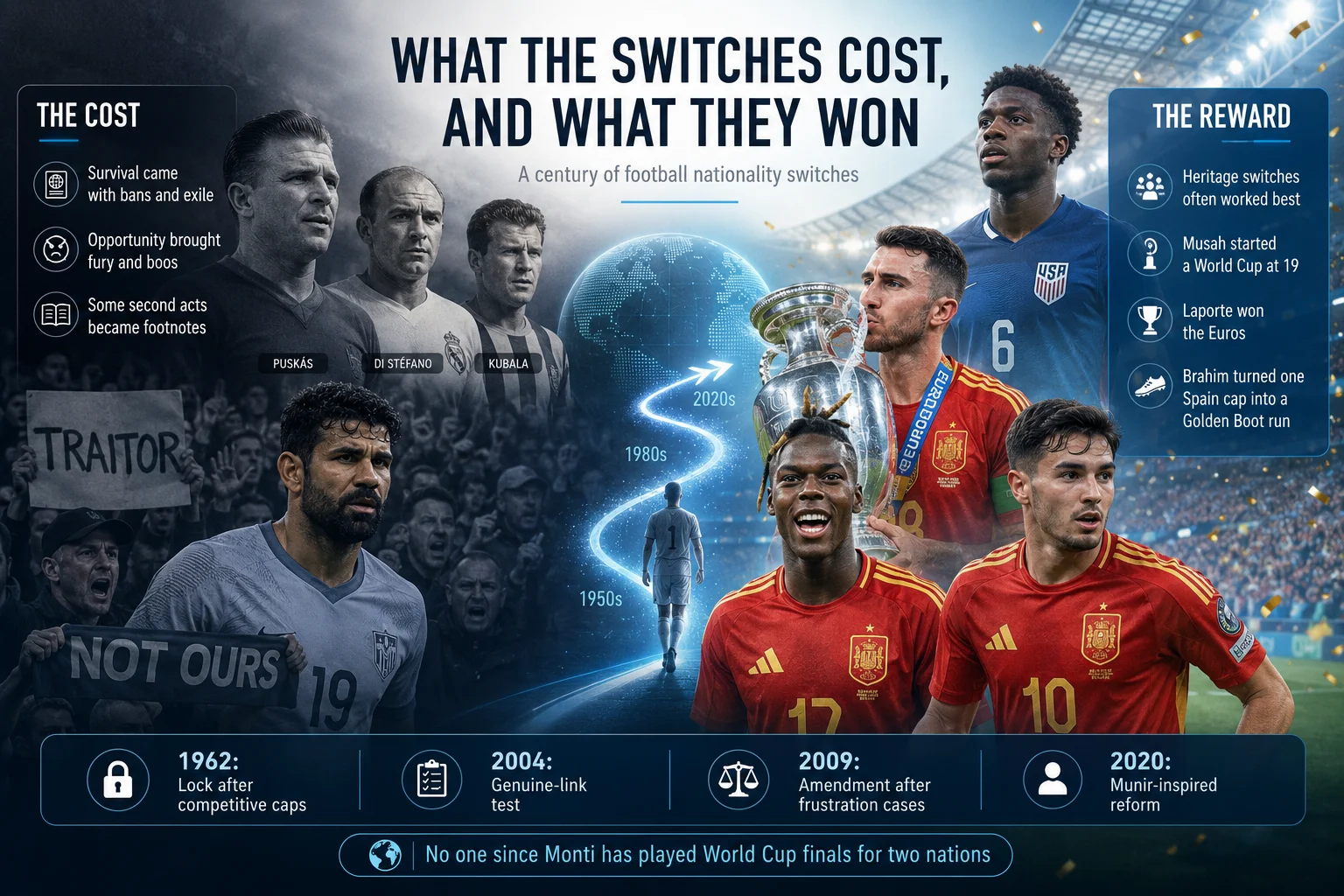
Read across a century, the ledger is remarkably consistent, and it sorts by motive. Players who switched for survival paid with bans, exile and state persecution, and their second international careers were footnotes to their first: Puskás and Di Stéfano between them managed one goalless World Cup group stage for Spain, and Kubala never played a tournament at all. Players who switched for naked opportunity absorbed the most hostility, from Argentina's fury at the oriundi to the booing of Diego Costa, and the pattern of the opportunistic switch failing at the very tournament it was made for recurs too often to be coincidence. Players who switched for heritage have fared best of all: Musah started a World Cup at 19, Laporte won a European Championship, Iñaki Williams got the tournaments Spain would never have given him and Brahim Díaz turned one Spain cap into a Golden Boot and a World Cup knockout run, even if Senegal denied him the continental title itself.
For the governing body, every era of switching produced the next era's rules: Monti's generation the 1962 lock, Qatar's chequebook the 2004 genuine-link test, Boateng's frustration the 2009 amendment's first great test case, Munir's 13 minutes the 2020 reform. Whatever controversy the current World Cup generates will, on that pattern, produce the next amendment. And one benchmark is worth watching as the knockout rounds continue: no one since Monti has appeared at World Cup final tournaments for two different nations the way he did across the finals themselves, and the modern rulebook means any player who comes close will be making history of a kind the game has not seen for 92 years.
FAQs
1. Can a player ever reverse a nationality switch?
-
Yes, the 2020 regulations allow a one-time switch to be reversed provided the player has never been fielded by the new association.
2. How long must a player wait before a switch is approved?
-
At least three years must have passed since the player's last appearance for the association he is leaving.
3. Did Michel Platini really play for a second country?
-
The France legend played 21 minutes in an unofficial 1988 friendly for Kuwait at the invitation of the Kuwaiti Emir, which never counted as a formal cap.
4. Were Di Stéfano's Colombia appearances ever recognised?
-
No, his four Colombia matches never counted as formal caps because the Colombian federation was in dispute with the governing body at the time.
5. Can players choose freely between England, Scotland, Wales and Northern Ireland?
-
No, British citizenship alone is not enough and a player needs a specific link to the relevant association, such as birth, parentage, grandparentage or five years of schooling in its territory.
Every switch in this story eventually came down to the same thing: the chance to play the biggest matches. If you want to be in the ground when the next chapter is written, 1BoxOffice has listed tickets for the fixtures that matter since 2006, with every order covered by a 150% money-back guarantee.
Sources: FIFA Commentary on the Rules Governing Eligibility to Play for Representative Teams, FIFA match reports, BBC Sport, The Guardian, Olympics.com, Sky Sports, Confederation of African Football, Court of Arbitration for Sport case records.