In this guide
Who Is Visiting Dortmund This SeasonGetting an Away Ticket Through Your ClubBuying on the Resale Market Without Getting BurnedThe North-East Corner: Where You Will Stand or SitThe Free Train Rule and Its CatchDüsseldorf, Dortmund or Cologne: Picking Your AirportFrom the Hauptbahnhof to the TurnstileGetting Out AgainBags, Beer and the RulebookWhere to Drink Before Kick-OffIs Dortmund Safe for Away FansBeds, Flights and the Düsseldorf OptionPassports in 2026: EES Yes, ETIAS Not YetA Spare Day in DortmundDortmund or Munich: Which Away Day WinsFAQsSignal Iduna Park away fans get one of the better deals in European football: a north-east corner that faces the Yellow Wall head on, a match ticket that doubles as a free rail pass across the whole of North Rhine-Westphalia and a Champions League away price capped at €50 by UEFA. The catch is that none of those three things works the way most travelling supporters assume, and the 2026/27 draw has removed the fixture most British fans were planning around.
Article Summary: Visiting supporters at Borussia Dortmund are housed in the north-east corner of the North Stand, standing in the lower blocks for Bundesliga matches and seated for UEFA fixtures. Your match ticket covers regional trains, trams and buses across North Rhine-Westphalia until 3am, but digital tickets need a separate free companion pass. No English club visits Dortmund in the 2026/27 Champions League league phase.
- Signal Iduna Park holds 81,365 for Bundesliga matches and 66,099 all-seated for UEFA fixtures, according to the stadium operator.
- UEFA regulations cap Champions League away tickets at €50 and require home clubs to release at least 5% of UEFA capacity to visiting fans, roughly 3,300 seats in Dortmund.
- Bags larger than DIN A4 are refused at the turnstile; a storage point by the away entrance takes them for €0.50 in cash, as of September 2026.
- Borussia Dortmund host Real Betis on 4 November 2026, Inter Milan on 9 December 2026 and AEK Athens on 27 January 2027 in the Champions League league phase.
- ETIAS is not in operation as of September 2026; UK passport holders enter Germany on a passport alone, with EES biometric checks at the border.
The three remaining home nights in the league phase bring supporters from Seville, Milan and Athens rather than from England. That changes the character of this guide. Rather than a countdown to one fixture, it is built for anyone travelling to Dortmund as a visiting supporter or a neutral in 2026/27, starting with the next arrival: Dortmund vs Real Betis on Wednesday 4 November 2026.
Who Is Visiting Dortmund This Season
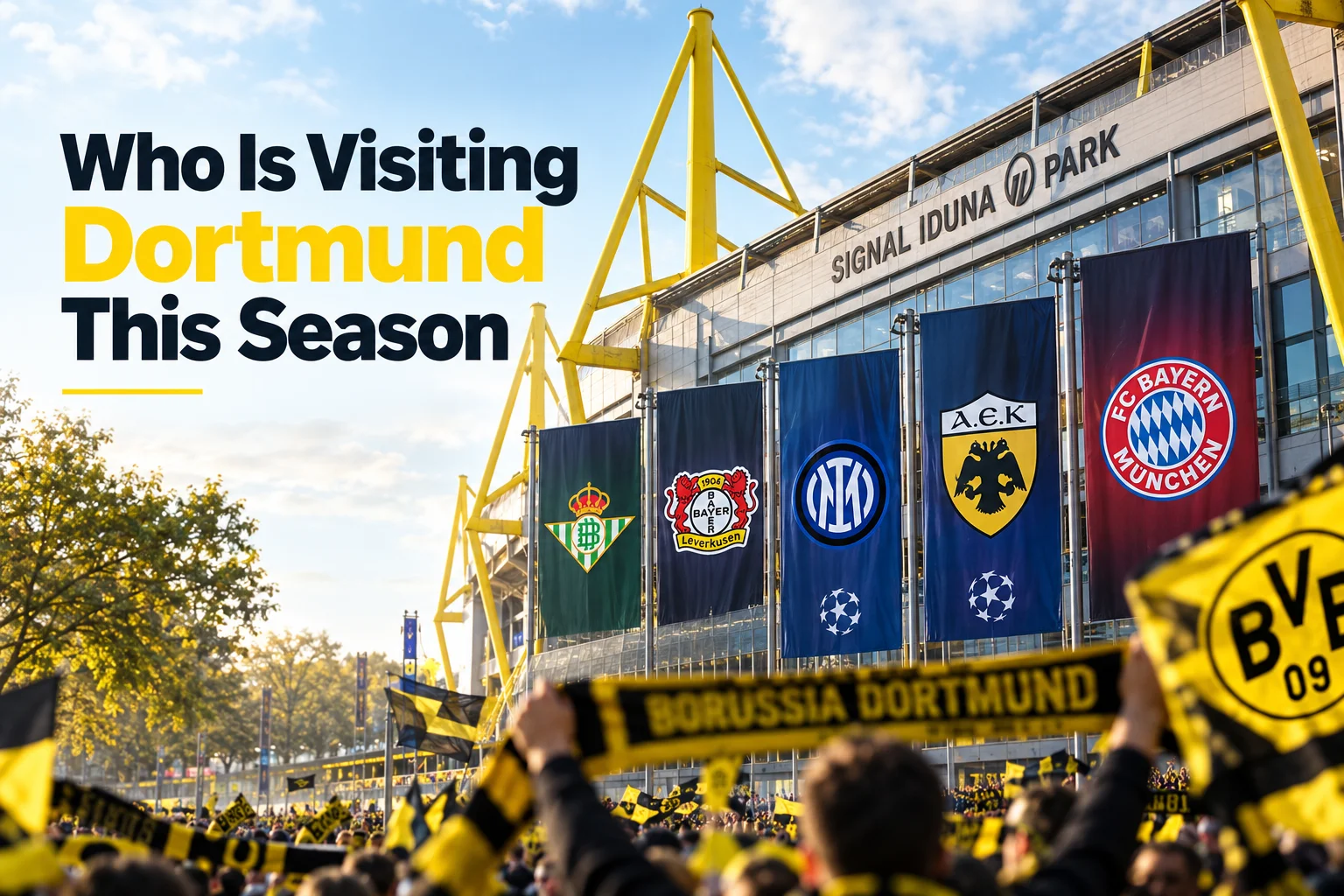
The 2026/27 Champions League draw gave Dortmund four home ties and four away. Both English opponents, Arsenal and Aston Villa, host Dortmund rather than the other way round. Arsenal vs Dortmund is at the Emirates Stadium on 24 November 2026 and Aston Villa vs Dortmund is at Villa Park on 19 January 2027, according to UEFA's published league phase schedule. A Premier League club can still be drawn to Dortmund in the knockout play-offs in February or the round of 16 in March, which is exactly when this guide will matter most to English readers.
Dortmund opened the campaign by beating Villarreal 3-2 at home on 8 September 2026, with Serhou Guirassy scoring twice, per the Bundesliga's match report. The table below lists every 2026/27 fixture at Signal Iduna Park with a meaningful visiting contingent, as of 10 September 2026. Bundesliga dates are provisional until the DFL confirms exact kick-off slots roughly six weeks ahead.
| Fixture at Signal Iduna Park | Competition | Date | Away allocation basis |
|---|---|---|---|
| Dortmund vs Real Betis | Champions League league phase | Wed 4 Nov 2026, 21:00 CET | Minimum 5% of 66,099 |
| Dortmund vs Bayer Leverkusen | Bundesliga | Sat 28 Nov 2026 (provisional) | Up to 10% of 81,365 |
| Dortmund vs Inter Milan | Champions League league phase | Wed 9 Dec 2026, 21:00 CET | Minimum 5% of 66,099 |
| Dortmund vs AEK Athens | Champions League league phase | Wed 27 Jan 2027, 21:00 CET | Minimum 5% of 66,099 |
| Dortmund vs Bayern Munich (Der Klassiker) | Bundesliga | Sat 6 Mar 2027 (provisional) | Up to 10% of 81,365 |
Getting an Away Ticket Through Your Club
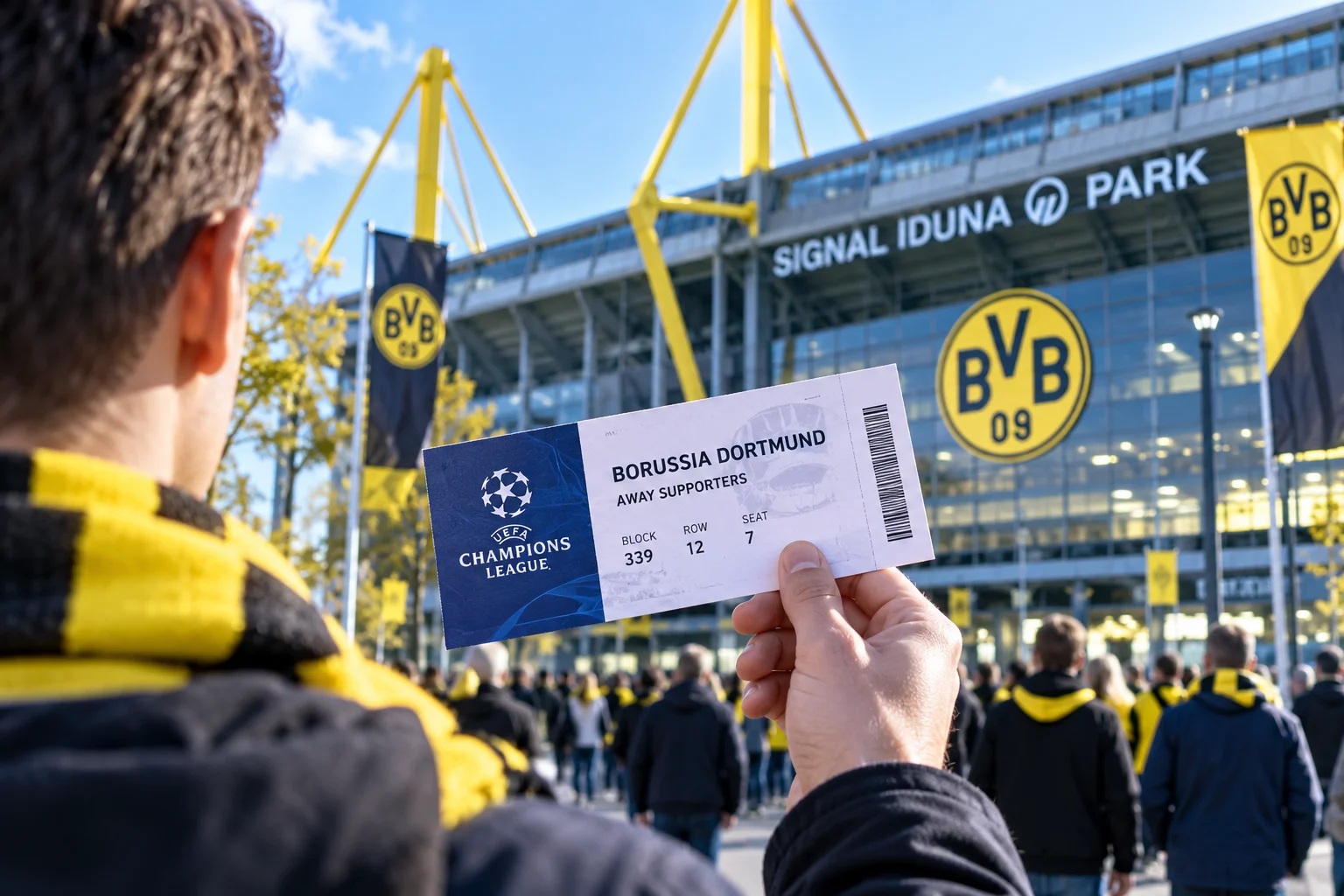
The cheapest and safest route into the away corner is your own club's allocation, and UEFA fixes the terms. Article 48 of the Champions League regulations obliges the home club to make at least 5% of the UEFA spectator capacity available to visiting supporters, priced no higher than a comparable home seat and never above €50. The Europa League cap is €35 and the Conference League cap is €20, per UEFA's September 2024 announcement that took full effect from 2025/26. At Dortmund's UEFA capacity of 66,099, the 5% floor is around 3,300 tickets.
How those tickets reach fans depends entirely on the visiting club. English clubs run loyalty-point or credit schemes, so the first release usually goes to supporters with the most recorded away attendances, and the 32-day gap between the draw and the first matchday under the league phase format compresses every sales window. If your club is in the Europa League or the Conference League the same 5% floor applies, at the lower caps.
Two practical points travelling supporters often miss. First, the visiting club can return unsold allocation to Dortmund up to seven days before the match without payment, so a fixture that looks sold out in week one can reopen in week three. Second, Dortmund's away tickets for UEFA nights are generally issued as digital or print-at-home tickets by the visiting club, which matters for the free-transport rule covered below. For a full walkthrough of ballots, memberships and the resale fallback, read our guide on how to buy Champions League tickets.
Buying on the Resale Market Without Getting Burned
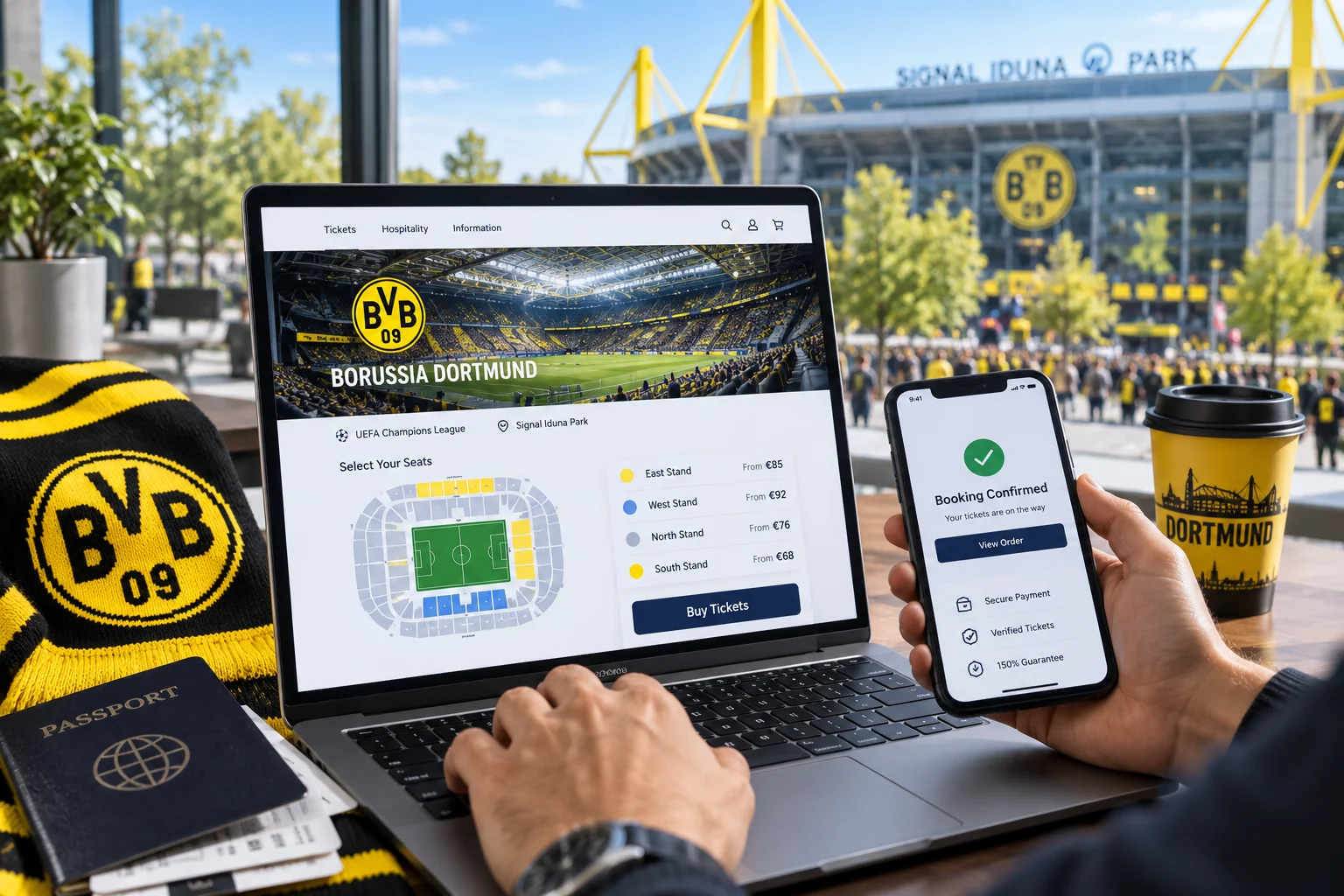
Miss the club allocation and you have two honest options: a verified marketplace or a home-end seat bought as a neutral. Neither puts you in the away corner. Guest-sector tickets at Dortmund are distributed only through the visiting club, so any listing that claims to be an away-block ticket for a UEFA night deserves suspicion. What a marketplace can offer is a seat elsewhere in the ground, and the rules on wearing colours there are covered in the safety section below.
Dortmund tickets are personalised, which is why the general mechanics of buying tickets for sold-out matches apply with one extra step: confirm how the seller transfers the ticket into your name before you pay. Street sellers outside the Westfalenhallen are a recurring source of duplicated print-at-home barcodes, and the first scan wins at the turnstile.
Step1
Find the fixture
Open the Borussia Dortmund event you want and check the competition. The same seat is standing for a Bundesliga match and a numbered seat for a Champions League match, and the transport, alcohol and allocation rules differ between the two.
Step2
Create an account or log in
Use the 1BoxOffice register page with the same name and email address that appear on your passport, since Dortmund tickets carry the holder's name.
Step3
Select your seat
Filter by stand. Neutrals wanting atmosphere without standing should look at the Ost or West stands; anyone in visiting colours should avoid the Südtribüne and the home blocks of the Nordtribüne entirely.
Step4
Review the delivery notes
Every listing states the delivery format. Print-at-home and digital tickets both work at Dortmund's turnstiles, according to the club's matchday FAQ, but only a digital ticket in your own name lets you apply for the free transport pass.
Step5
Complete payment
Check the total with fees before confirming. Every order on 1BoxOffice is covered by the 150% money-back guarantee if the ticket is invalid or fails to arrive in time for the match.
Step6
Track your order
Use the track order page to follow delivery. For Dortmund fixtures the ticket typically lands in the days before the match, so travel with the confirmation email to hand.
WhatsApp channel
Sports news straight to your phone
Match updates, on-sale dates and ticket news from 1BoxOffice.
The North-East Corner: Where You Will Stand or Sit
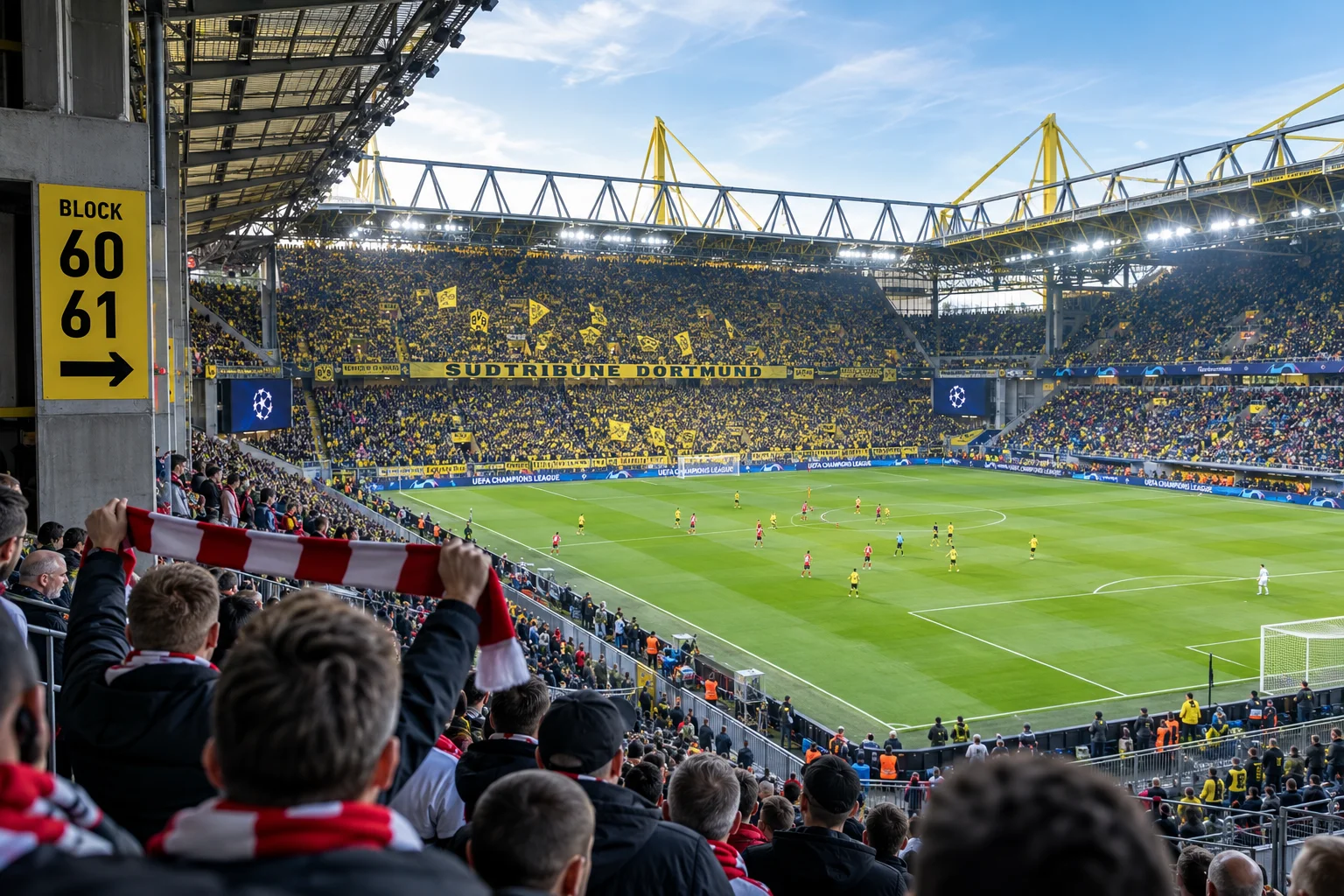
Away supporters occupy the north-east corner of the Nordtribüne, the North Stand, which puts them at the opposite end of the pitch from the Südtribüne rather than tucked behind a goal in the same half. Entry for visiting fans is through the north-east entrance area, and the club's own signage uses blocks 8, 60, 61 and 70 for domestic matches, adding 71 and 75 for European nights, according to Football Ground Guide's away-section briefing for Celtic supporters. When the allocation is large, as it was for Bayer Leverkusen's 2025/26 visit, the visiting club's fan information listed blocks 55, 56, 58, 59, 60, 61 and 70.
For Bundesliga matches the lower blocks are standing terracing and the rows above them are seated. That is where the Bundesliga's 10% guideline for visiting supporters comes from: at Signal Iduna Park it allows an allocation of up to around 8,100, which is why the corner stretches sideways into the 50s for big domestic games. For UEFA fixtures every standing area in the ground converts to seating, which drops the capacity to 66,099 and turns the away corner into numbered seats, per the stadium operator's information page.
| Competition | Away blocks | Standing or seated | Typical allocation |
|---|---|---|---|
| Bundesliga, standard allocation | 60, 61 lower; 70 upper | Standing lower, seated upper | 2,000 to 3,000 |
| Bundesliga, large allocation | 55 to 61 lower; 70 upper | Standing lower, seated upper | Up to about 8,100 (10%) |
| Champions League, Europa League | 60, 61, 70, 71, 75 | All seated | Minimum about 3,300 (5%) |
Sightlines from the corner are good. The stand is steep, the roof covers all but the front rows in driving rain and the view across to the Yellow Wall, 24,454 standing supporters on a single 40-metre-high terrace, is the reason many neutrals pick this ground over any other in Germany. Block-by-block numbering for the whole bowl, including the family corner in the north-west and the business seats in the Westtribüne, is on our Signal Iduna Park seating plan.
The Free Train Rule and Its Catch
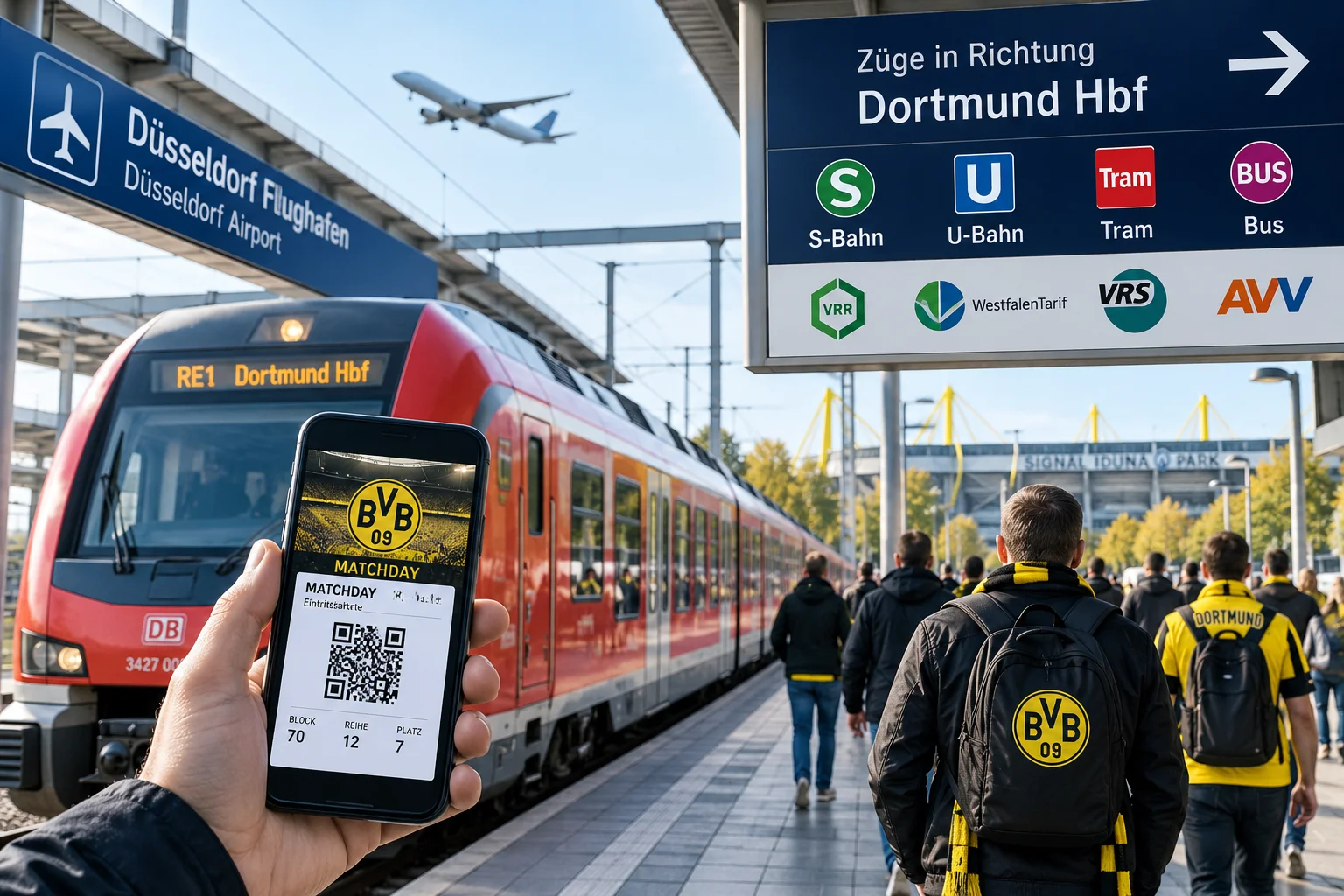
A Dortmund match ticket is valid as a public transport pass across all of North Rhine-Westphalia on match day and until 3am the following morning, on second-class regional trains, S-Bahn, U-Bahn, trams and buses run by VRR, WestfalenTarif, VRS and AVV, according to Borussia Dortmund's matchday FAQ. That covers the airport station at Düsseldorf, the whole of Cologne and every regional service between them. It does not cover ICE or IC intercity trains.
Here is the part that catches visiting fans. The travel entitlement is printed on physical and season tickets, but a digital or print-at-home ticket does not carry it automatically. The club states that holders of those formats must apply for a separate, free companion ticket through the DSW21 combi-ticket portal, using the details on their match ticket. Do this before you travel, not on the platform. Conductors on the RE trains from Düsseldorf Flughafen have no way to validate a UEFA away ticket issued by an English club without the companion pass.
Build in slack for Deutsche Bahn. A six-day national train drivers' strike ran from 24 to 29 January 2026 and a nationwide signalling fault stopped services on 23 June 2026, as widely reported at the time. Neither affected a Dortmund home match directly, but a 21:00 CET Champions League kick-off leaves no margin if the regional service from the airport is cancelled.
Düsseldorf, Dortmund or Cologne: Picking Your Airport
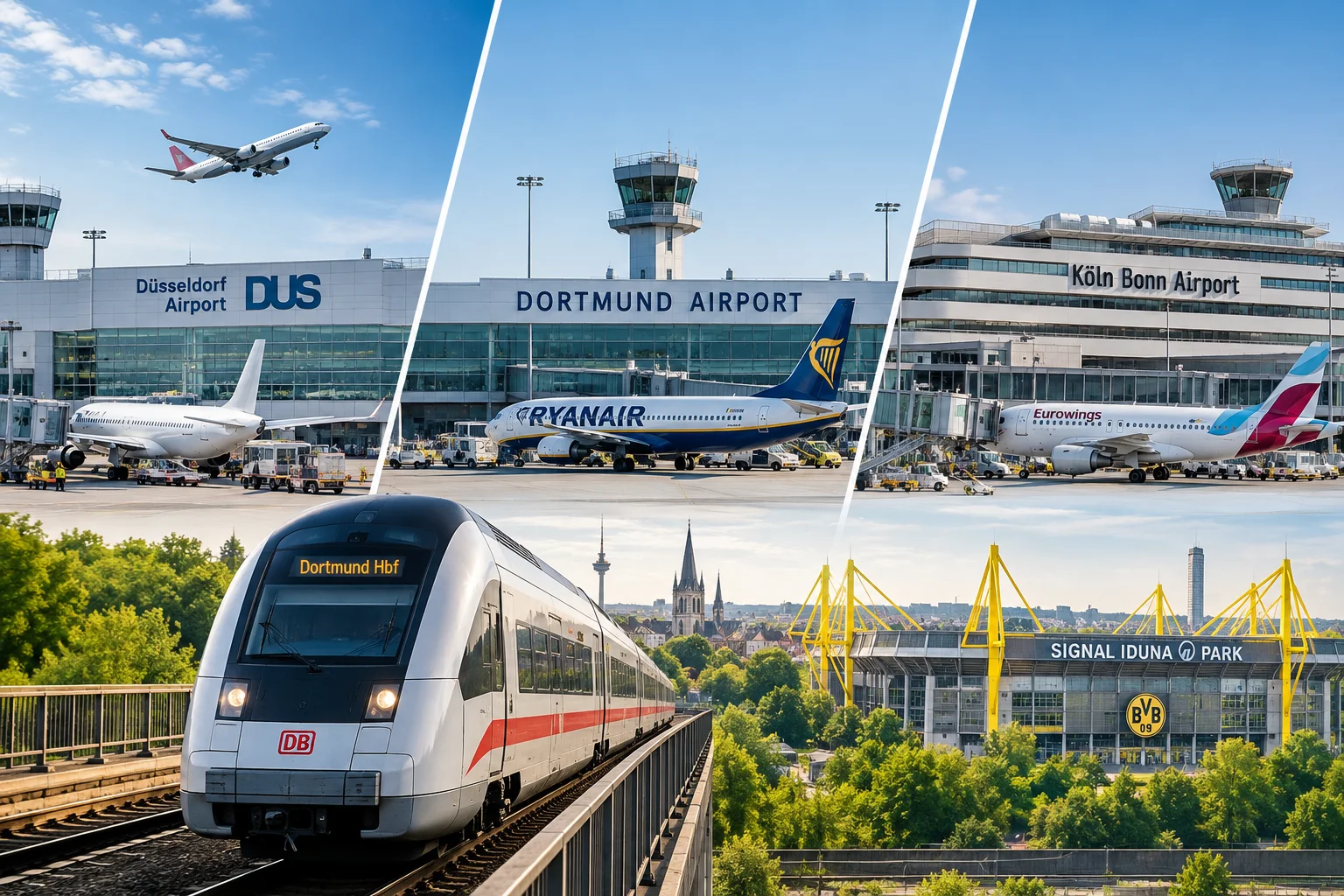
Düsseldorf is the default and for good reason: it has the widest choice of UK routes and its airport railway station sits directly on the regional line to Dortmund. Dortmund's own airport is closer but thinly served, while Cologne Bonn adds an hour of rail travel and suits fans who want to base themselves in Cologne. All three fall inside the NRW transport zone, so every rail leg below is covered by the match ticket plus companion pass on match day.
| Airport | Distance to stadium | Rail to Dortmund Hbf | Notes, as of September 2026 |
|---|---|---|---|
| Düsseldorf (DUS) | About 70km | About 1 hour, one change, no direct train to the stadium station; advance fares from about €9 per Trainline | Widest UK route choice; sky train links terminal to Düsseldorf Flughafen station |
| Dortmund (DTM) | About 10 to 12km | Airport express bus to Hbf, roughly 30 to 45 minutes door to door | Limited UK routes; check schedules before relying on it |
| Cologne Bonn (CGN) | About 95km | Roughly 2 hours by regional rail | Best if Cologne is your base; ICE services are not covered by the match ticket |
From the Hauptbahnhof to the Turnstile
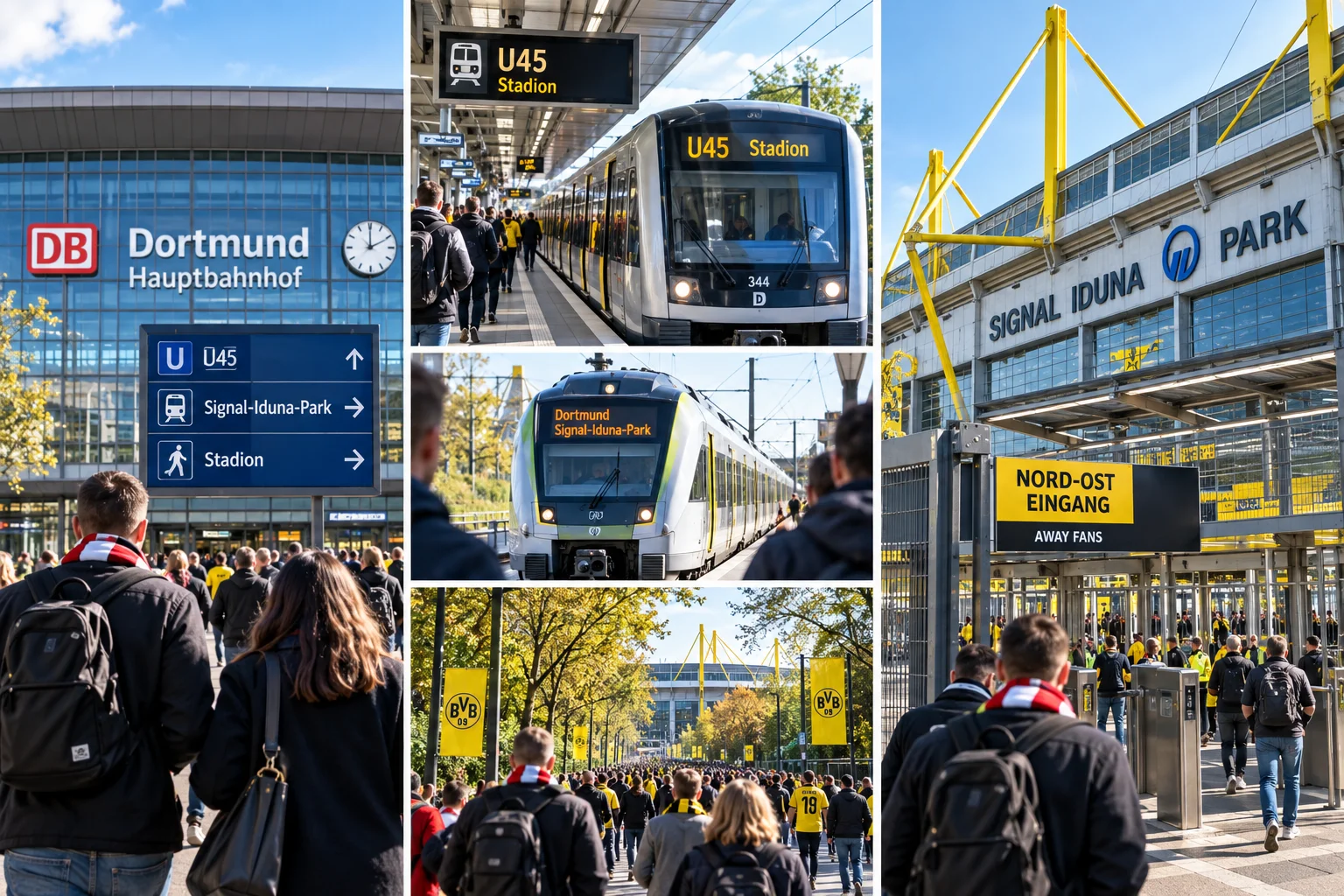
From Dortmund Hauptbahnhof there are three ways to the ground and the club recommends two of them. The U45 U-Bahn runs from the station towards Westfalenhallen and Stadion; the Stadion stop is the closer one for the away corner, so check the destination board because some U45 services terminate one stop early at Westfalenhallen, as visiting clubs including Newcastle United have warned their supporters. The ride takes around 10 minutes. On match days regional trains also run one stop from the Hauptbahnhof to Dortmund Signal-Iduna-Park station, which drops you at the north side of the ground.
The third option is the walk. Follow the signed route south from the Hauptbahnhof through the city centre and along the signed, tree-lined approach to the stadium; allow 30 minutes. On a Bundesliga Saturday it is a moving river of black and yellow and worth doing once. Gates open two and a half hours before kick-off, per the club's FAQ, and the north-east entrance handles the whole away contingent, so aim to be at the turnstiles at least an hour before the whistle for a European night.
Getting Out Again
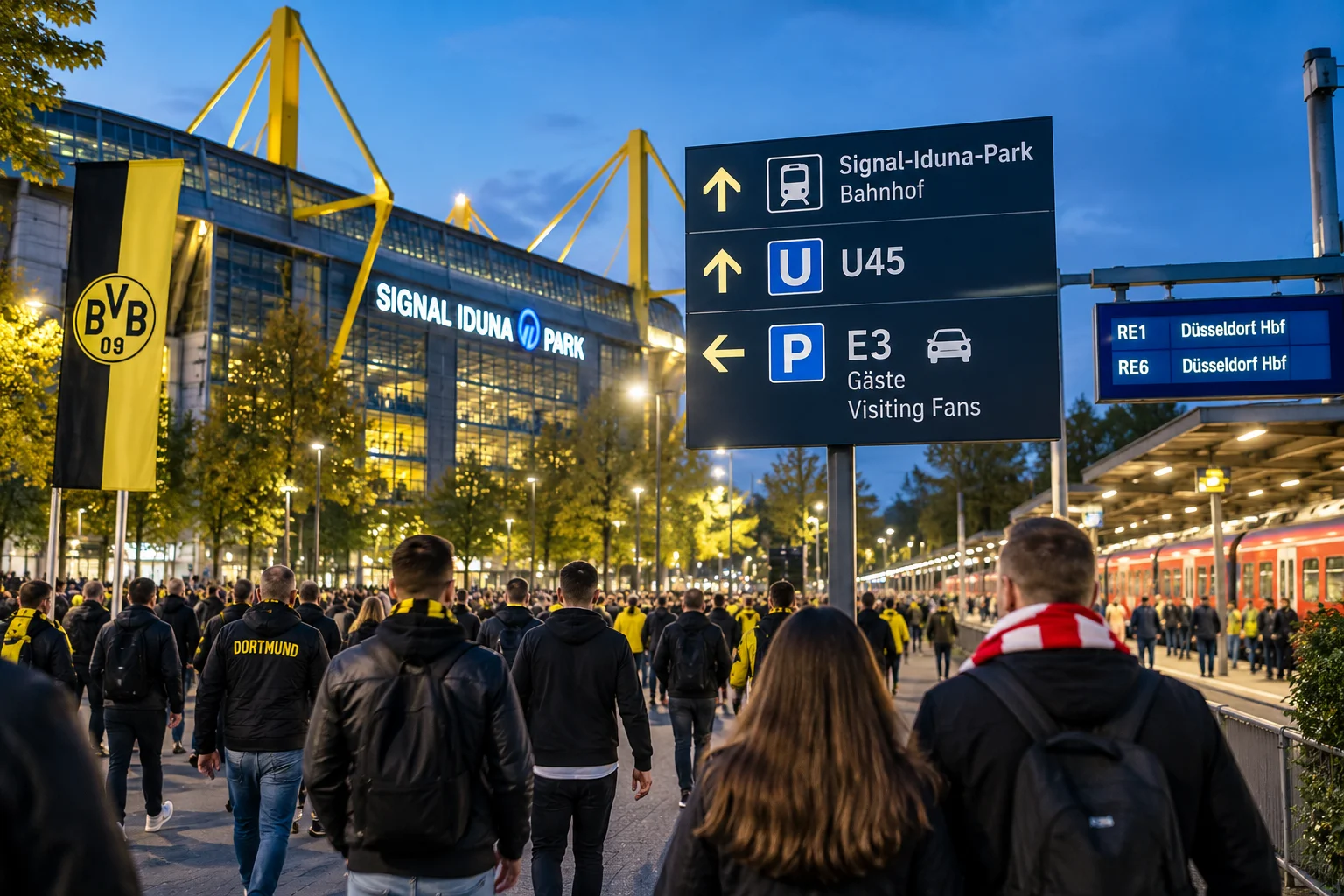
Leaving is slower than arriving. The club itself asks fans to be patient because platform capacity at Signal-Iduna-Park station is limited and the whole ground empties at once. Away supporters are usually held briefly in the corner while home blocks clear, then walked to the station or to car park E3, which is designated for visiting fans and must be pre-booked online through DOPARK21 with the sat-nav address Viktor-Toyka-Strasse, according to the club's arrival page.
If you are heading back to Düsseldorf after a 21:00 CET kick-off, the practical answer is the Hauptbahnhof rather than the stadium station. Walk the 30 minutes north or take the U45 to the main station, then board the RE1 or RE6 towards Düsseldorf. Late regional services run well past midnight and the match ticket entitlement lasts until 3am, but the last realistic connection to the airport station on a weeknight is earlier than that, so check the Deutsche Bahn timetable for the specific date before you commit to a same-night return.
Bags, Beer and the Rulebook
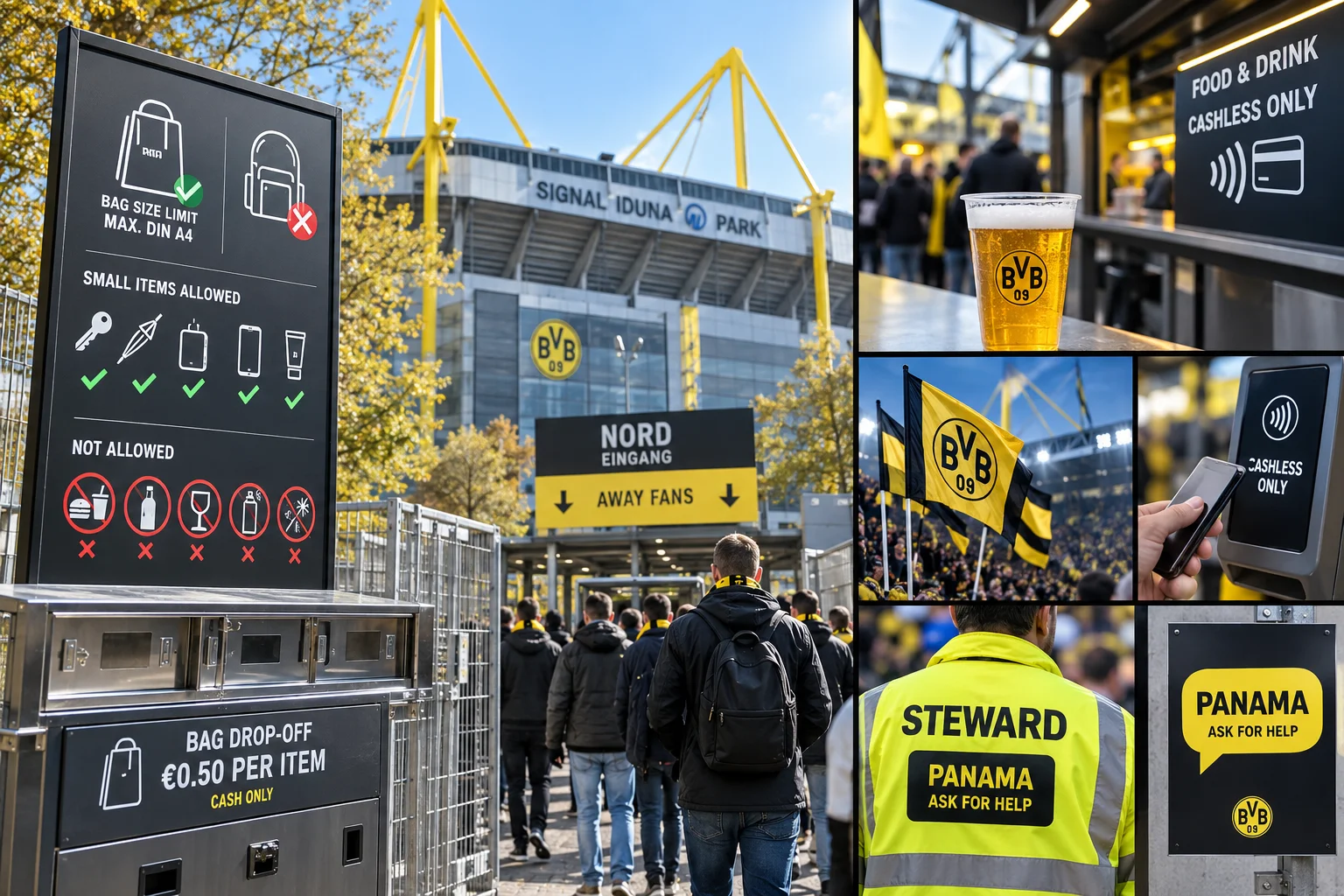
The bag rule is the one that ruins the most evenings. Anything larger than DIN A4 is refused at the turnstile, and the drop-off point opposite the away entrance on the north side charges €0.50 in cash per item and closes 30 minutes after the final whistle, as of September 2026, according to the fan information Bayer Leverkusen published for its supporters travelling to Dortmund. Space there is limited. Keys, a small folding umbrella, a phone-sized power bank and cosmetics up to 50ml in non-glass containers are allowed; food, drink of any kind, glass, aerosols and pyrotechnics are not, per the club's FAQ.
- Payment inside is cashless only: debit and credit cards and phone wallets, with no cash accepted at food or drink kiosks.
- Flags on poles up to 2 metres long with plastic tubes up to 3cm in diameter are allowed in the away corner; larger banners need advance clearance through your own club's fan liaison team.
- Beer is sold on the concourses on Bundesliga match days; on UEFA nights the club confirms the alcohol policy in its matchday information, so check before you assume.
- Professional camera equipment, telephoto lenses and tripods are refused; phone filming for private use is fine.
- The PANAMA codeword, signposted around the ground, gets you immediate help from any steward if you feel unsafe, harassed or threatened.
German terrace culture is tolerant of noise and colour and intolerant of a few specific things, and most of them are covered in our stadium etiquette guide. The two that matter most in Dortmund: do not stand in a seated block on a UEFA night, since stewards enforce it, and do not join in with pyro in the away corner, because German police treat everyone in the vicinity as part of the group.
Where to Drink Before Kick-Off
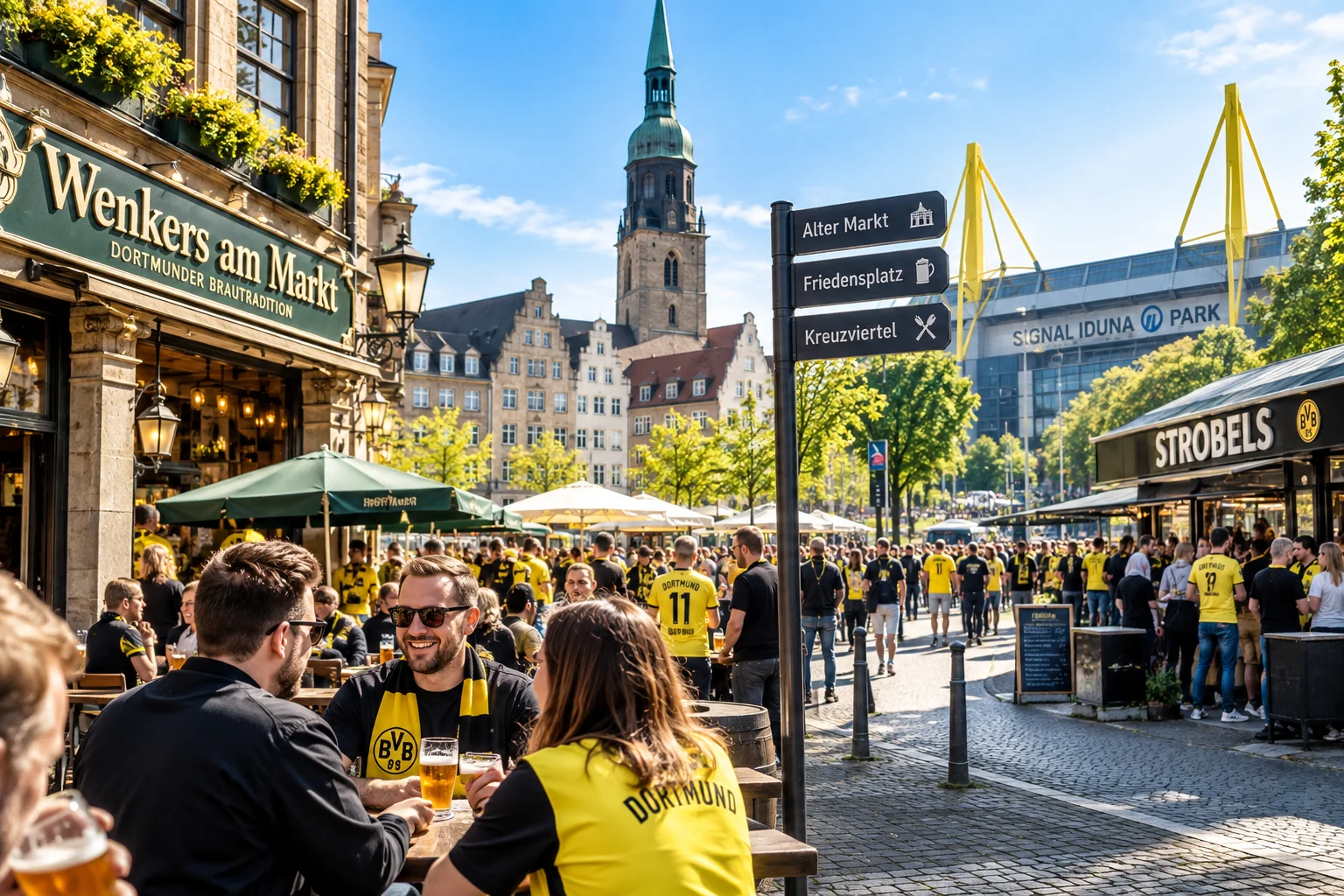
Dortmund's pre-match geography is simple. The city centre squares, Alter Markt and Friedensplatz, fill from lunchtime with fans, food stalls and open-air drinking, which is legal in Germany. Wenkers am Markt, the brewery pub on Alter Markt, is the traditional meeting point and gets rammed. Kreuzviertel, the bar quarter south-west of the centre, is where locals drink and is about 30 minutes on foot from the stadium, so it works as a first stop rather than a last one.
Closer to the ground, Strobels at the north end of the stadium is the club's own pub and effectively a home-fan venue, while the beer garden by the old Stadion Rote Erde next door is more mixed. Visiting fans are generally welcome in all of these on Bundesliga days; the friendly mixing between home and away supporters before and after matches is the thing British visitors most often remark on. Whether to drink in home pubs in your colours on a European night is a different question, covered next.
Is Dortmund Safe for Away Fans
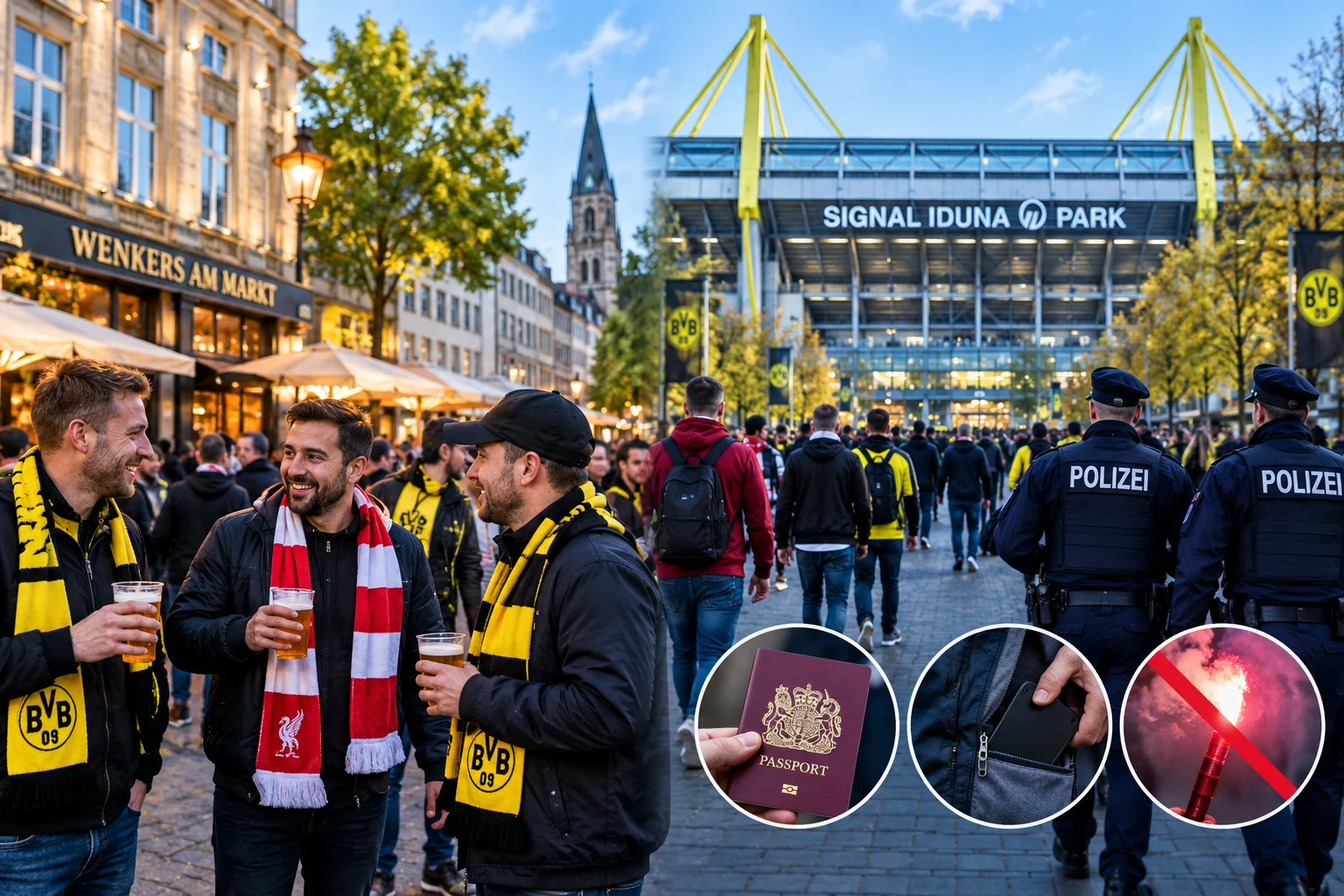
Broadly yes, with two honest caveats. Dortmund has a reputation among travelling supporters as one of the more relaxed away trips in Europe: segregation inside the ground is enforced but policing is light-touch, and home and away fans drink together in the centre without incident at most matches. That reputation is deserved for Bundesliga games and for most European nights.
The caveats are real, though. During Euro 2024 the UK Football Policing Unit reported that groups of Dutch supporters attacked England fans in bars in Dortmund and tried to steal flags before the semi-final on 10 July 2024, leaving five with minor injuries, as reported by Reuters and others at the time. Visiting club fan liaison teams routinely advise supporters to cover away colours on the way to and from the ground unless they are travelling on a supervised relief train, and to avoid the Nordstadt area north of the Hauptbahnhof late at night. Neutrals with a home-end seat should not wear visiting colours in it: stewards remove visibly visiting supporters from home blocks, and the away corner is closed to anyone without a guest-sector ticket.
Practical rules that experienced travellers repeat: carry your passport, because a lost one cannot be replaced in Dortmund and the nearest British consulate is in Düsseldorf; keep phones zipped away in the post-match crush at the stadium station; and stay well clear of any group setting off flares.
Beds, Flights and the Düsseldorf Option
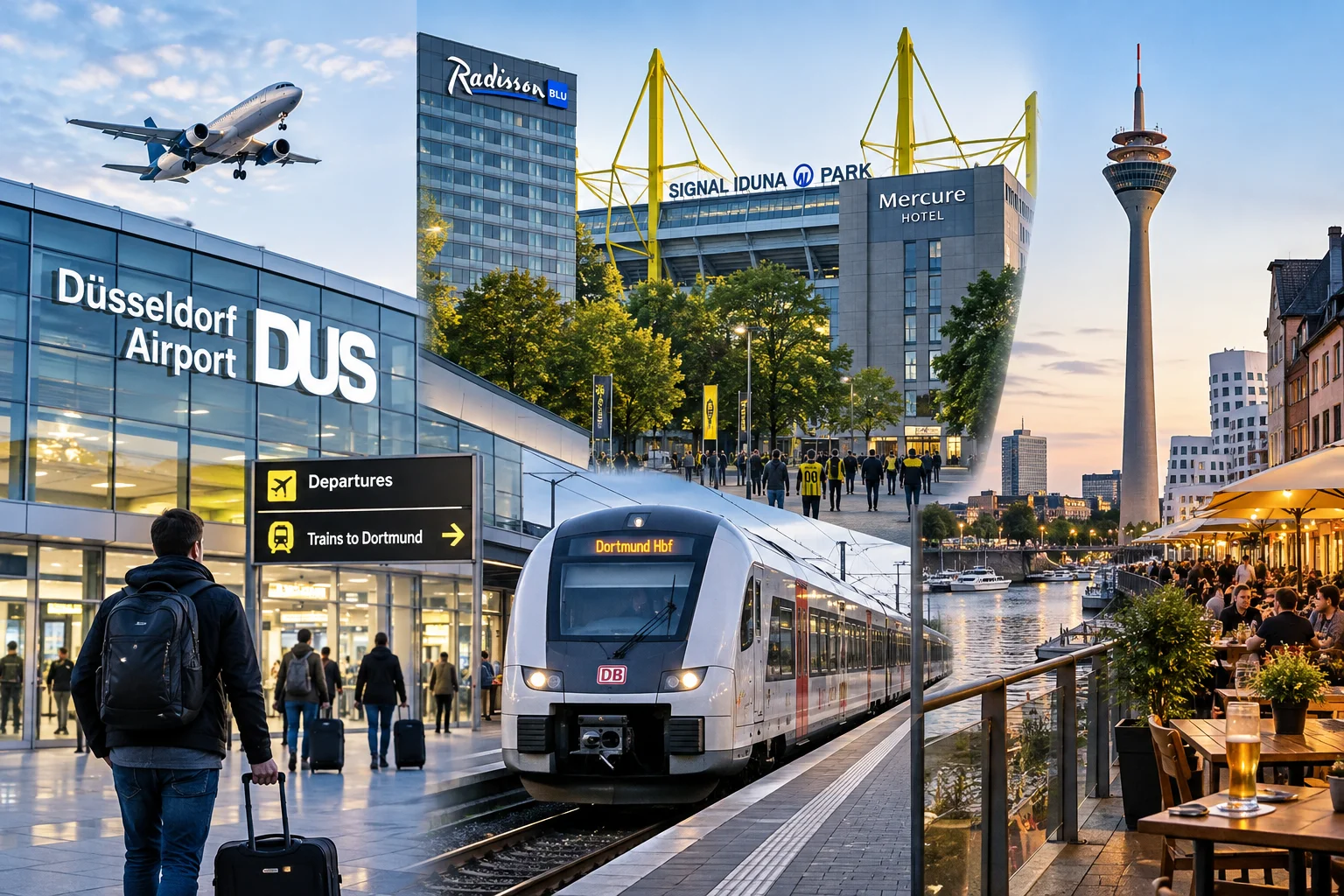
Hotel supply in Dortmund is thin for a city of 600,000 and it disappears fast around Champions League nights and Der Klassiker. The two nearest hotels to the ground are the Radisson Blu and the Mercure Messe and Kongress, both next to the Westfalenhallen and a five-minute walk from the turnstiles. Around the Hauptbahnhof the NH Dortmund and Hotel Unique are the reliable business-class options. Book the moment the draw is made.
Many travelling fans stay in Düsseldorf instead and treat the match ticket as their train pass. The regional service from Düsseldorf Hauptbahnhof to Dortmund takes about an hour, the airport is 10 minutes from the city and the Altstadt has far more late bars than Dortmund. The trade-off is the return leg after a 21:00 kick-off, which means a midnight arrival at the earliest. Cologne works the same way with a longer commute. Package operators bundle flights, hotels and match tickets for Dortmund; if you are weighing one up, our P1 Travel review explains what is and is not included in that model.
Passports in 2026: EES Yes, ETIAS Not Yet
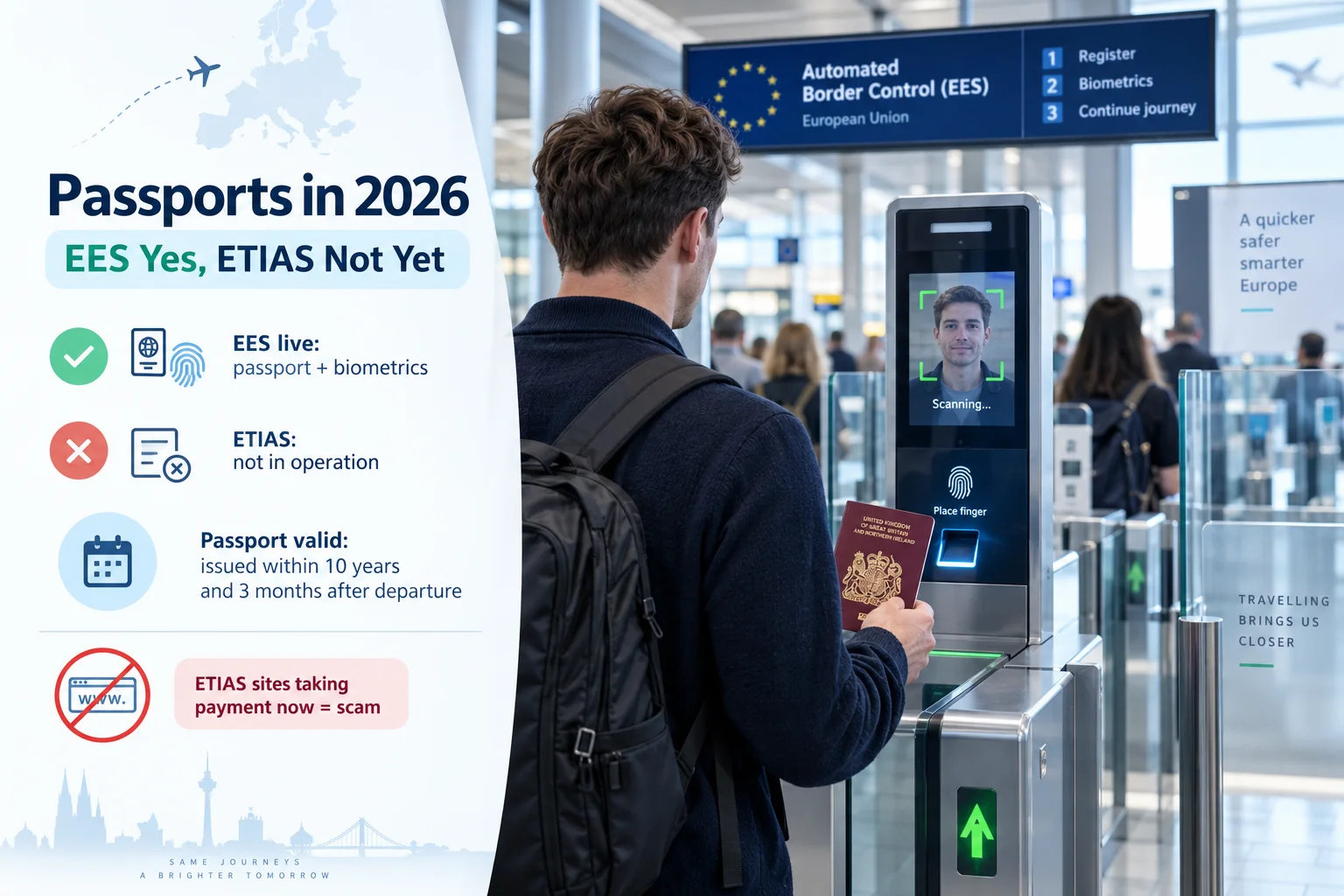
As of 10 September 2026 a UK passport holder enters Germany on a passport alone. The EU's Entry/Exit System has been live since 12 October 2025 and replaced passport stamping with fingerprint and facial biometrics at the external border, with the phased rollout completed by 10 April 2026, according to the European Commission. Expect a slower queue at Düsseldorf on your first EES registration and a faster one on every trip after.
ETIAS, the €20 pre-travel authorisation, is not in operation. The European Commission removed its "last quarter of 2026" launch target from the ETIAS website in July 2026 and now says a start date will be announced several months in advance, with 2027 widely reported as the likely outcome. Any website charging for an ETIAS application today is a scam. Your passport must have been issued within the last 10 years and be valid for at least three months beyond the day you intend to leave the Schengen area.
A Spare Day in Dortmund
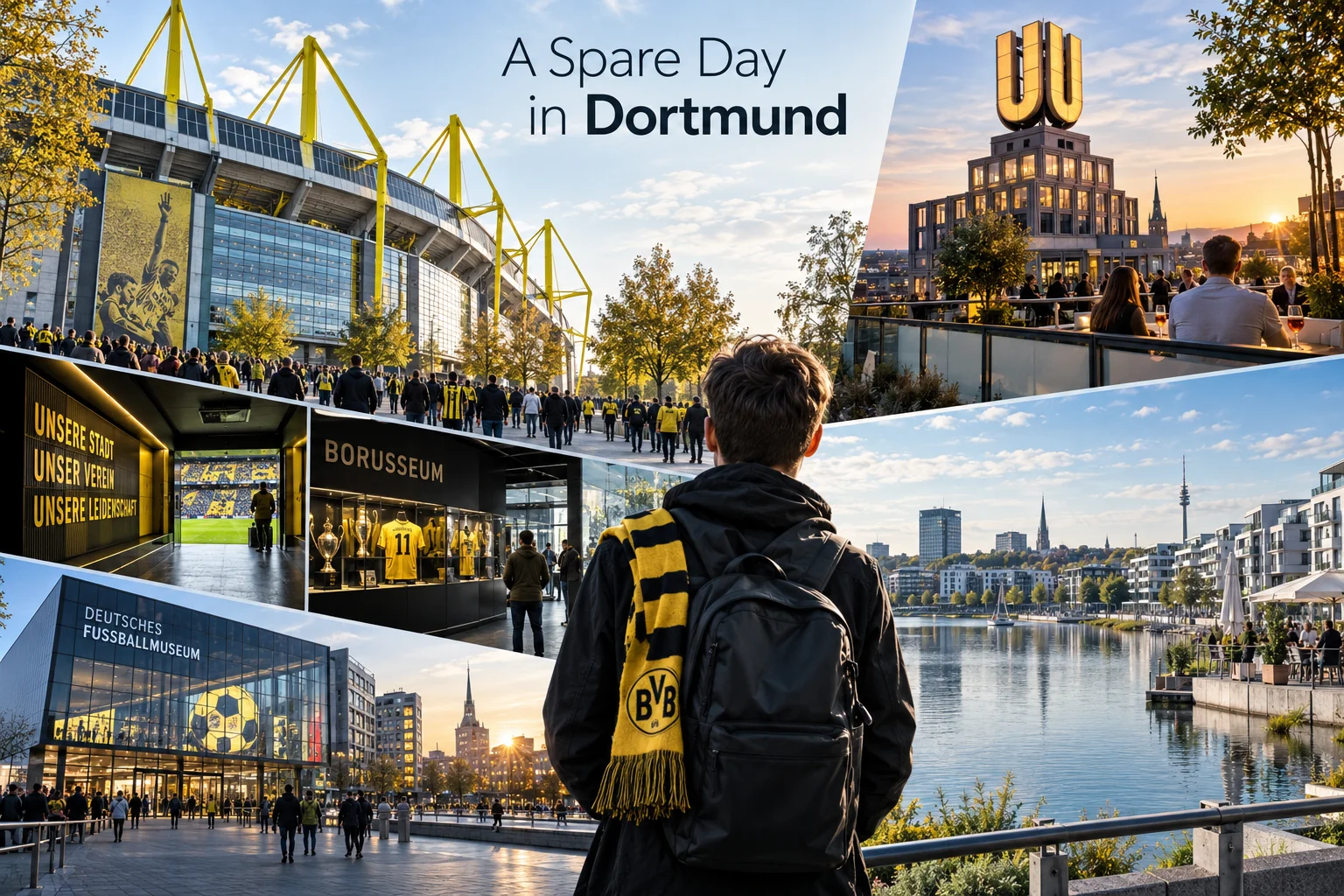
The football itinerary fills a day on its own. Signal Iduna Park runs a self-guided stadium walk from about €14 through third-party booking platforms as of September 2026, covering the players' tunnel, the dugout and the foot of the Südtribüne, with no walks on match days. The Borusseum, the club museum built into the North Stand, is priced from about €10 on the same platforms. The Deutsches Fussballmuseum, the national football museum directly opposite the Hauptbahnhof, lists adult admission from about €23 as of September 2026 and covers the full arc of the German game, from the 1954 Miracle of Bern to the women's national team, with a chapter on football under the Nazi regime that stops most visitors in their tracks. Check the museum's own ticket shop for the current tariff before you go.
Beyond football, Dortmunder U, the converted brewery tower by the station, houses contemporary art and a rooftop bar. Phoenix See, a lake built on the site of a demolished steelworks, is the walk locals recommend on a clear afternoon. The Christmas market from late November has the tallest Christmas tree in Germany, at 45 metres, which coincides neatly with the Leverkusen and Inter fixtures. If you want the wider context of the league you are visiting, our Bundesliga facts piece covers the 50+1 ownership rule and why standing terraces survived here when they vanished in England.
Dortmund or Munich: Which Away Day Wins
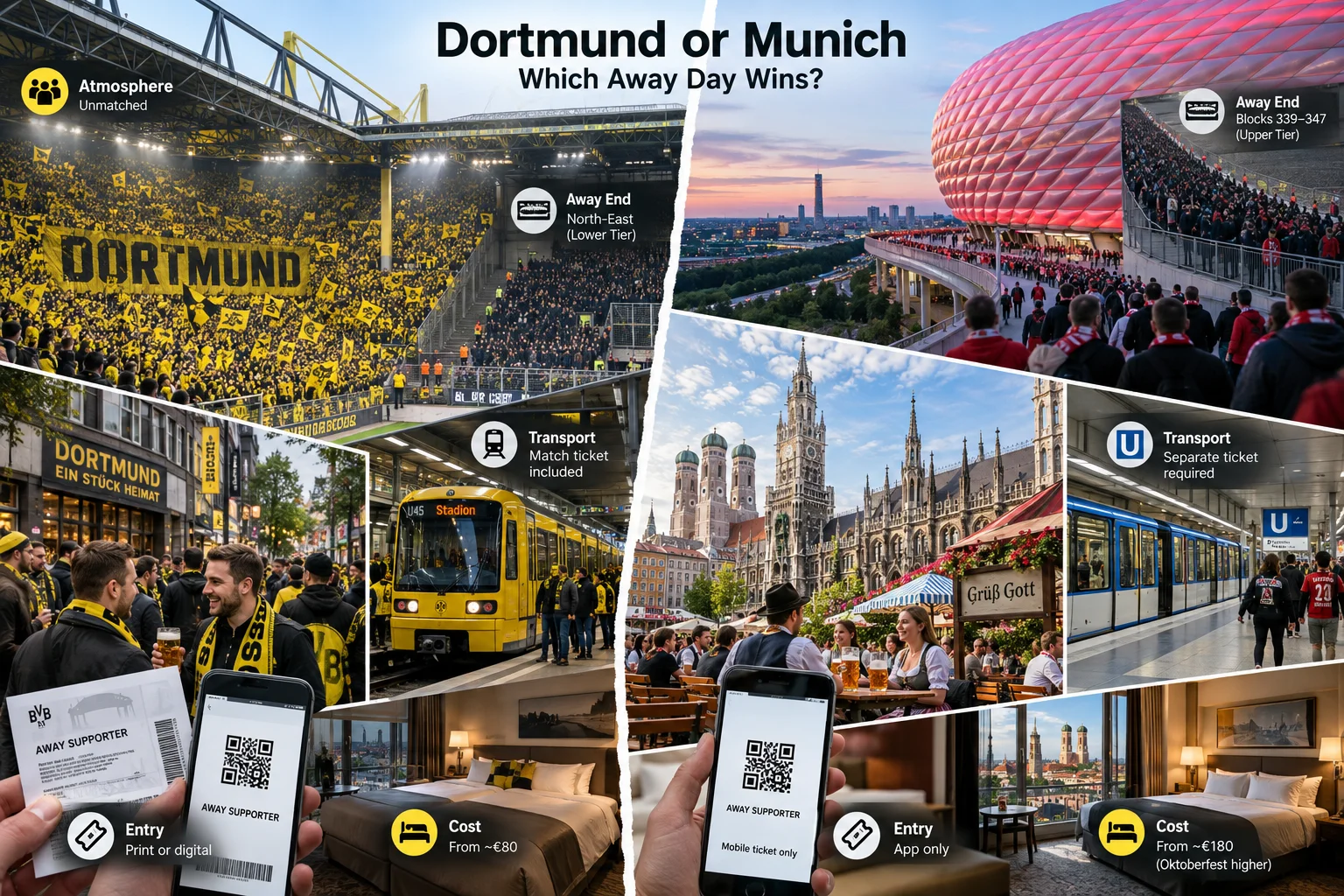
The two German heavyweights offer different trips, and if you have a choice of one European away in a season the difference is worth understanding. Our Allianz Arena trip guide covers the Munich end in the same detail as this one; the short version is below.
- Away section: Dortmund's north-east corner faces the Yellow Wall at pitch level; the Allianz Arena puts visiting fans in the upper tier, blocks 339 to 347, which is higher and further from the pitch.
- Transport: a Dortmund ticket is a free NRW-wide rail pass with the companion-ticket caveat; a Munich ticket does not include MVV travel, so budget for it.
- Ticket entry: Dortmund still accepts print-at-home and digital tickets; Bayern Munich tickets are app-only at the turnstile from 2026/27.
- Cost: Dortmund hotels are scarcer but cheaper outside big fixtures; Munich prices spike hard around Oktoberfest in late September and early October.
- Atmosphere: Dortmund for the terrace and the pre-match mixing in the centre; Munich for the city itself.
For a warm-weather comparison, our Madrid away guide covers the Bernabéu and the Metropolitano in the same format.
FAQs
1. How many away fans does Signal Iduna Park hold for a Champions League match?
-
Around 3,300 as a minimum, because UEFA requires 5% of the 66,099 all-seated capacity to be offered to the visiting club, and the two clubs may agree a larger figure.
2. Can away fans park at Signal Iduna Park?
-
Car park E3 on Viktor-Toyka-Strasse is reserved for visiting supporters and must be pre-booked online through DOPARK21, as no parking is sold on the day.
3. Are young children allowed in the away standing block at Dortmund?
-
Children aged six and under can enter on a €1 lap ticket bought at the turnstile with proof of age, but the club does not permit lap tickets in any standing area, so a seated block is required.
4. Why is Signal Iduna Park called BVB Stadion Dortmund in the Champions League?
-
UEFA does not permit stadium sponsor names in its competitions, so the ground appears as BVB Stadion Dortmund on tickets and broadcasts for European fixtures while remaining Signal Iduna Park domestically.
5. Do I need cash at Signal Iduna Park?
-
Only a few euro coins for the €0.50 bag storage point, since every food and drink kiosk inside the stadium is card and phone-wallet only.
Dortmund rewards the fan who reads the small print: the companion ticket, the A4 bag, the Stadion stop rather than Westfalenhallen. Get those right and the north-east corner of Signal Iduna Park is as good as a European away gets. When your club's allocation is gone, 1BoxOffice lists verified seats across the rest of the ground with a 150% money-back guarantee if a ticket fails to arrive or is refused at the gate.
Sources: Borussia Dortmund, UEFA, Bayer 04 Leverkusen fan information, Bundesliga, DSW21, European Commission, Football Ground Guide, Trainline, GetYourGuide, Reuters.


